November 2019

I am late with  this post as we are already in December. As I write a cold south east wind is blowing. This is normally associated with early spring, but we have had some extremely hot days and summer is definitely here. The spring bloom has faded and we are reliant on summer stalwarts for colour, however looking back November  had many stars.

Roses

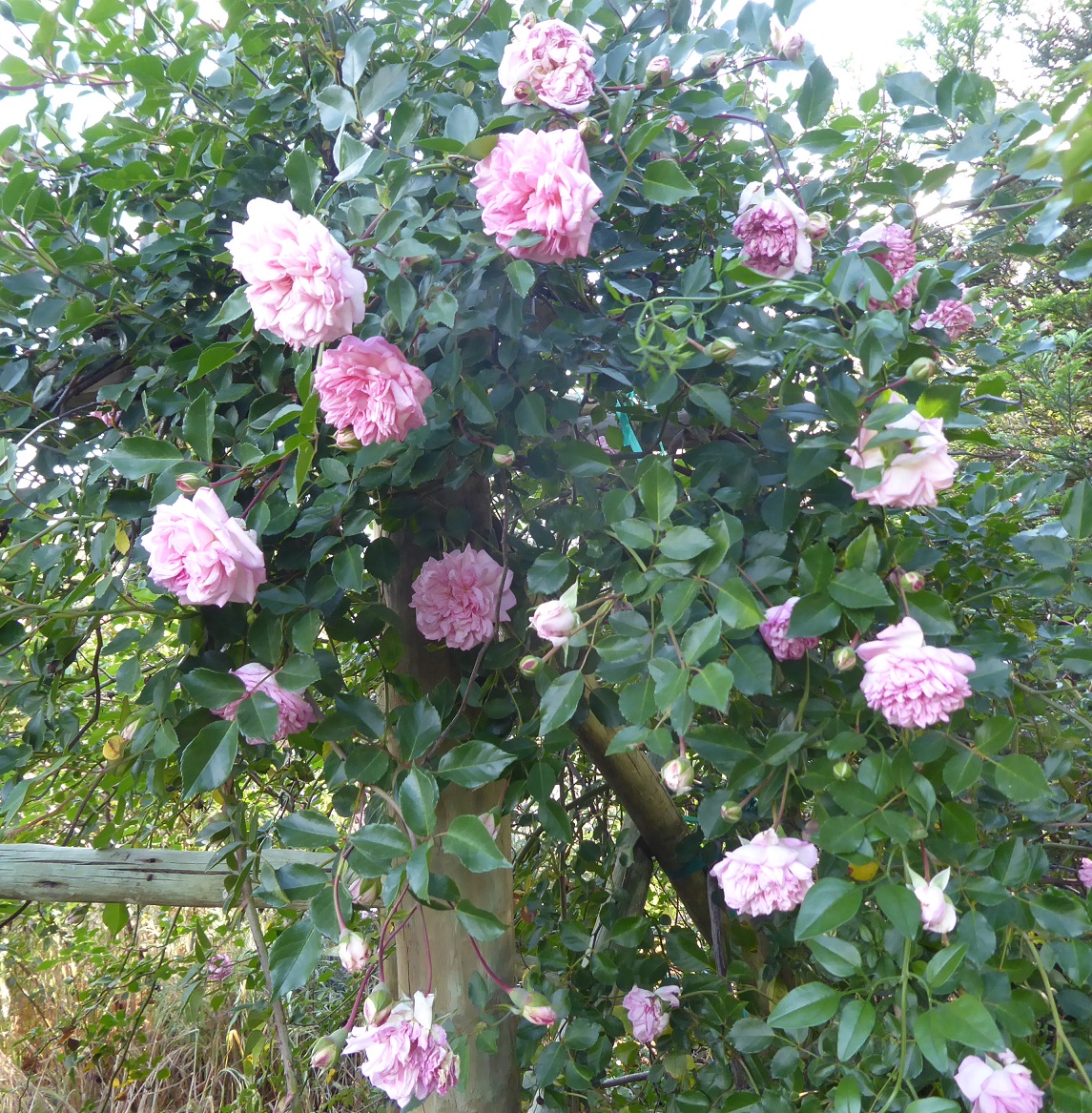
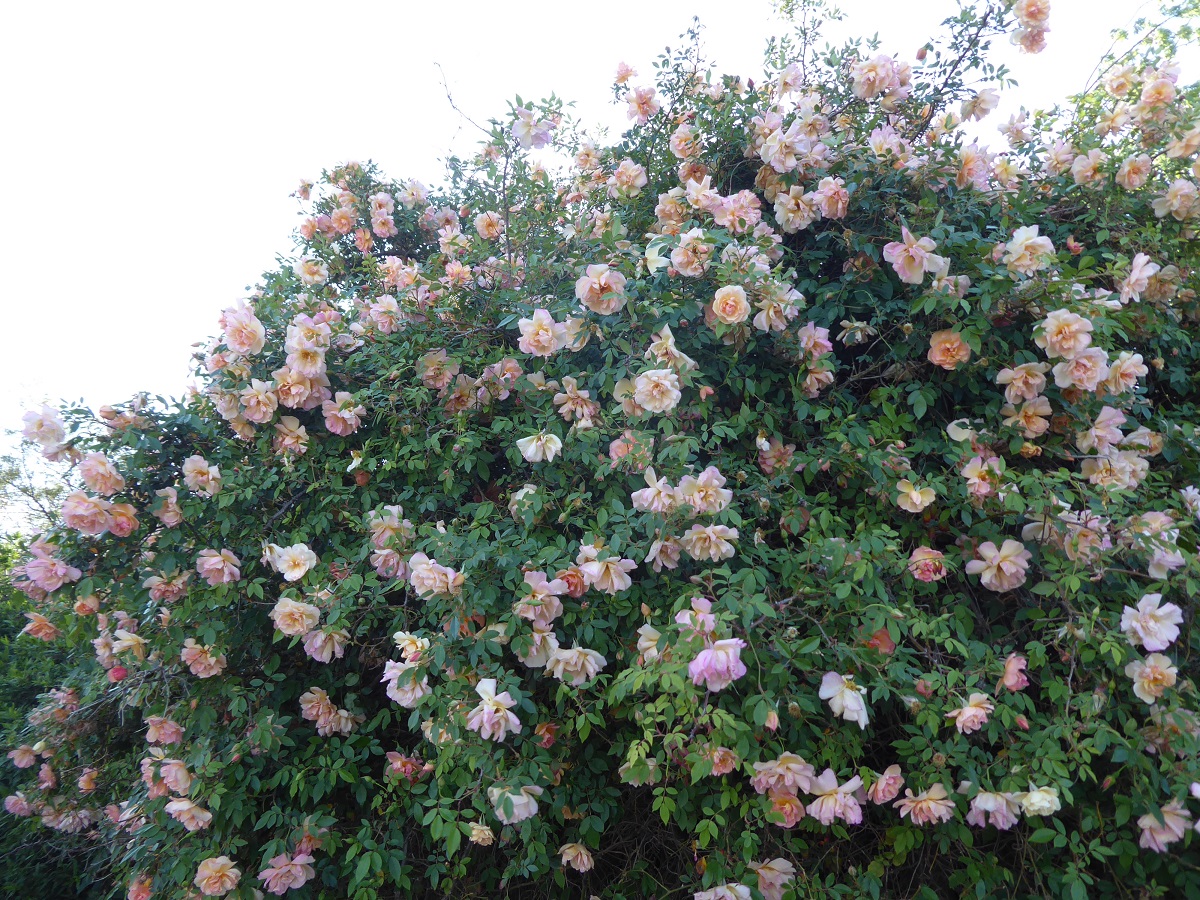
Early November was a glorious time in the garden. All the rambling roses were at their peak. One of my favourites is an old rambler with clusters of small very double soft pink heavily scented flowers. It is the rose which forms the boundary hedge at the old Boschendal rose garden. I am not sure of the name. I have two big bushes tangled up with a rampageous musk rose and a cerise purple old climbing rose called Russelliana. To be out in the garden in the early morning when the scents of all these roses are heavy in the air is to be in heaven.

There are several musk roses in the garden. Most have large clusters of single white flowers. One has delightful semi double flower. All are scented and most are vigorous growers with particularly vicious thorns making them ideal barrier plants.

November is also when the old Wichurana ramblers such as Dorothy Perkins flower. These roses have small glossy leaves and are common at the Cape surviving in old country hedges. Dolly as we fondly call her has clusters of bright pink flowers and vicious thorns, but no scent. She makes a charming picture growing in the plumbago on the boundary fence. I also have a darker pink red form for Dolly which might be the rose called Excelsa. It makes a huge bush tangled up with a rose which has clusters of single pink flowers with white centres.  I grew it from slip gathered on the side of the road near Joubertina in the Eastern Cape

The other very special Wichurana rambler to flower in November is the blue rose, Veilchenblau. I struggle to grow this rose well, but its flowers are a joy every year. I think it likes a little shade

Several years ago I bought two rose bushes from the university  Botanical garden in Stellenbosch. Their labels indicated that they had come from seed collected by the previous curator, Wim Tijmens, on a visit to China. Curator of this garden from 1966-1999, he was a great plantsman and I was delighted to give them a home. They have both done exceptionally well surviving with minimal water and make big bushes with smallish pale pink flowers. One is single, the other semi double

Towards the middle of the month the 3 huge bushes of Cécile Brunner or Bloomfield Abundance started flowering. I am not sure which it is as both have tall candlabras of pale pink exquisitely formed small flowers which tower up above the bushes. They were some of my earliest plantings and now they dwarf the plumbago hedge and everything around. They get no water in summer, but are thriving and their pale pinks blooms nodding over the blue hedge are pretty. I seem to have a soft spot for pink and blue combinations which make sophisticated gardeners shudder. What was the old rhyme – “pink and blue will never do, all the boys will wink at you” Well what is wrong with that!

Lastly it would be unfair to leave the roses without singing the praise of Mermaid. She was covered with her big yellow single flowers for about a month. Unlike the other rose mentioned, there will be more flowers as the summer progresses. Mermaid also has vicious spines and grows along the boundary fence surrounded by plumbago.

I was delighted to get her ancestor, Rosa bracteata, two years ago. This is also known as the Macartney rose and has single white flowers with bristly buds/calyxes and shiny foliage. A huge bush used to grow against the wall of the Castle in Cape Town, but last time I looked someone had set fire to it and I am not sure if it survived. This rose is sometimes confused with Rosa laevigata (the Cherokee rose) at the Cape but they are easy to tell apart. The leaves of R. laevigata usually have 3 leaflets, the flowers are bigger and occur very early in Spring, with a few in autumn. Leaves of R. bracteata have 5 or more leaflets, are glossier and it flowers later and on and off all summer. The buds are also bristly and the branches have brownish down.

Trees of November

Without a doubt, November is Jacaranda month. It is not only Pretoria that celebrates this tree, Boland towns also have magnificent specimens, often covered in  lilac purple flowers without a leaf to be seen. Our young trees have leaves while in flower and are not yet as spectacular. The sight of the flowers against the clear blue  sky is very special, as is the lilac carpet of fallen flowers. These trees are on the invasive aliens list and there are parts of the country where they should not be grown.  They are  best grown in a courtyard or paved area where you can grow other plants in pots and you can enjoy the carpet of fallen flowers. Very little will thrive in the soil under a Jacaranda.

Another tree which flowers this month is the Catalpa (Catalpa bignonioides) or Indian bean tree.  Despite the common name this tree is native to the south eastern states of the USA. These trees have large pale green hairy leaves and their tubular scented white  foxglove-like flowers with maroon speckled interiors come in drooping clusters. They like water and my tree is struggling, but farms nearby have some magnificent specimens. I first saw this tree near Zoo Lake in Johannesburg almost 50 years ago and have always wanted to grow one. It is closely related to the Paulownia with lilac flowers which I tried to grow, but lost.

The Jamboes tree also bears its clusters of creamy white fluffy flowers now.  These if we are lucky will grow into tasty rose apples to enjoy at Easter.  This tree is a member of the Eugenia family and has glossy leaves which emerge an attractive bronze red.   Jamboes used to be common in old Cape gardens, but they are seldom seen now.

Lovely white shrubs.

I have several pretty white shrubs which look great in November. First is Romneya coulteri, a poppy with spectacular big white flowers with yellow centres. Fried egg plant is one of its common names. This is a wandering perennial plant which sends up tall stems (about 2m) of greyish silver leaves. It is tricky to get established and will only grow from root cuttings taken in the middle of winter (June). It comes from California and Mexico and does well in the sandy soils of the Cape, but you need a big space to do it justice as once it gets going it will spread over several metres. From my front veranda I can see it displayed against the purple dodonea, but the real joy is to stand under the plants and look at the sky through their crepe paper like flowers. It is very drought tolerant and gets no summer water.

The carissas are also in flower this month and Carissa edulis in particular has been fabulous. The whole bush was covered in clusters of white flowers emerging from pink buds. The sweet scent is glorious, and I picked a big branch for the vase and enjoyed the fragrance indoors for a week.

Escallonia is also a valuable shrub in the garden. Its evergreen foliage always looks healthy and is a good foil to the plant’s  clusters of small waxy pristine white flowers. You do get pink and red colour forms, but I prefer the white.   I should prune and shape the plant more to enhance its value.

Lastly is  sweetly scented Bauhinia bowkeri. This scrambling shrub comes from the Eastern Cape, but has done exceptionally well here. The white flowers emerge from  unusually coloured mink brown buds and cover the big bush for at least a month at this time of the year. It has typical twinned bauhinia leaves which are a fresh green.

Cacti

Early in November we were treated to a spectacular flowering of the red cacti on the succulent beds. These cacti usually sense approaching rain and time their flowering to coincide with the rain. I should try to find out what they are called, but meanwhile we just enjoy them.

One grows as a cluster of tallish columns (about .5m) and has small red flowers that stick all the way up the stems. It flowers off and on all summer as fronts pass.

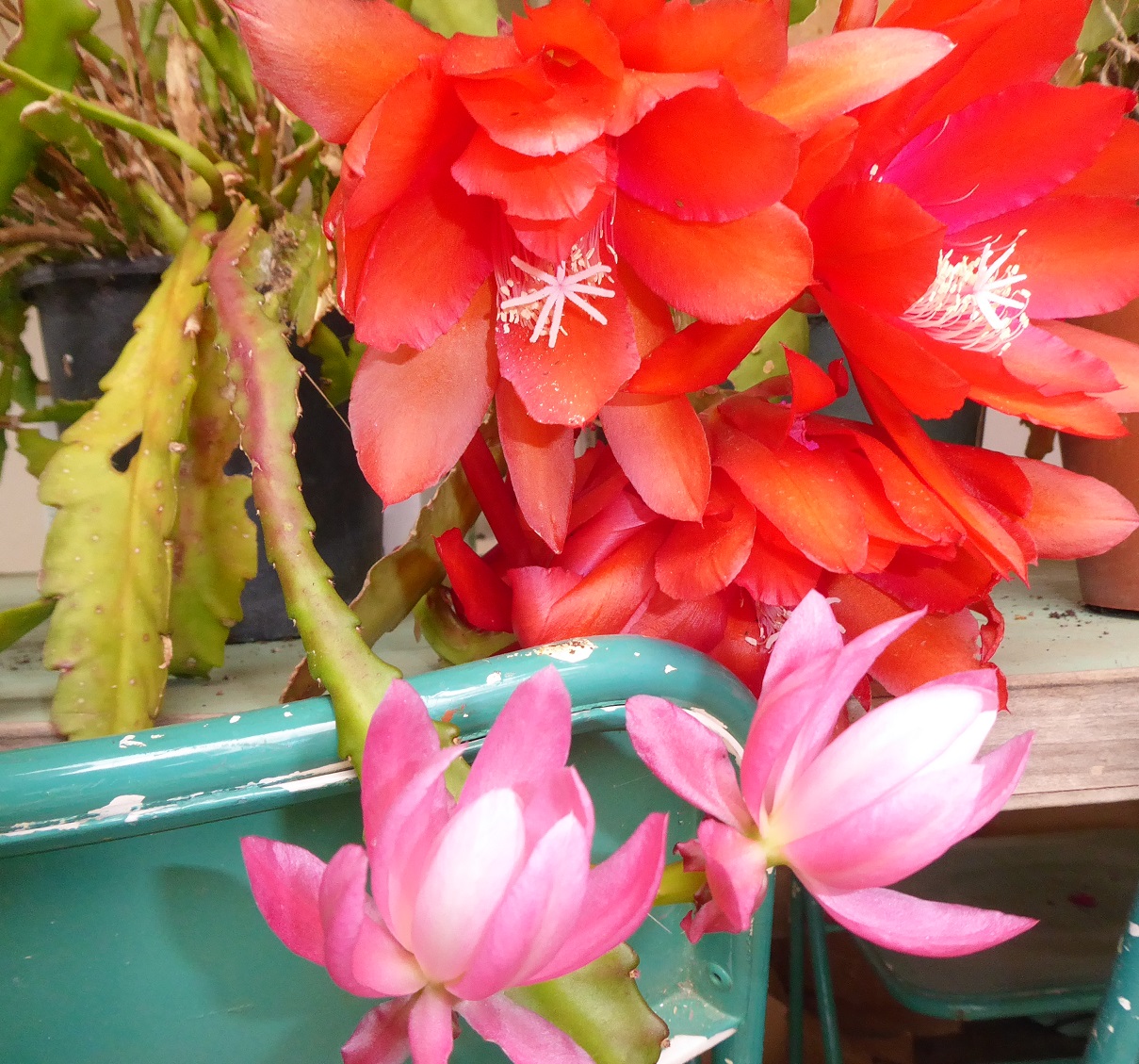
The other has an increasing clump of dumpy stems covered in prickles from which flower buds emerge. The large brilliant red iridescent double flowers remain open for a few days. These flowers are also triggered by the promise of rain, but the flowering in November was exceptional and the entire clump was covered in blossom.

Lastly I have a pale pink cactus which has similar short stems which make spreading clumps and it only flowers now in spring, but the large single flowers are exquisite, albeit short lived.

Fruit and veg

The veggie garden is dying back in the heat, but we are enjoying the courgettes. These are very rewarding to grow and one has to be vigilant as they can turn into giants overnight. The Lazy housewife beans are also starting to bear. These runner beans do well out here in the Boland and are delicious if picked before they get too old.

I was able to make us a pot of gooseberry jam from my pickings in mid-November. We have also been feasting on Logan berries. These ripened towards the end of the month and are a fleeting treat. The apricots are starting to ripen so more jam making is scheduled. The mouse birds are eating the peaches much to my annoyance. When I first came here there were none of these birds about, but their numbers are increasing.

As we move towards Xmas we are spending more time on the stoep/veranda in the heat of the day doing jigsaw puzzles. We share this with nesting rock pigeons, swifts and sparrows. It is a fairly busy and noisy household.

KSU November 2019

October 2019

As I write at the end of October we are shivering and the peak of the mountains to the east has a very light dusting of snow. We have had over 50 ml of rain in the past 5 days too, which has helped after the extremely dry early spring. I had been watering everything in the garden, but can hold off now for a week or two.

This month has its beauties in bold shades, but it is also hay fever month. The grass all runs to seed and the syringas flower. Both of these seem to trigger my sneezing. This year we have been lucky to be spared the howling south east wind which often arrives now and we have had some glorious days.

Every Saturday two men who work on the farm next door come to cut grass for me. It is vital that we get it all cut back now as fires are a hazard in summer. It also makes it easier to spot snakes as I wander about watering. Much of the grass is wild oats, but there is also something we call steekgras which has horrible prickly seed-heads which penetrate boots.

Purple glories

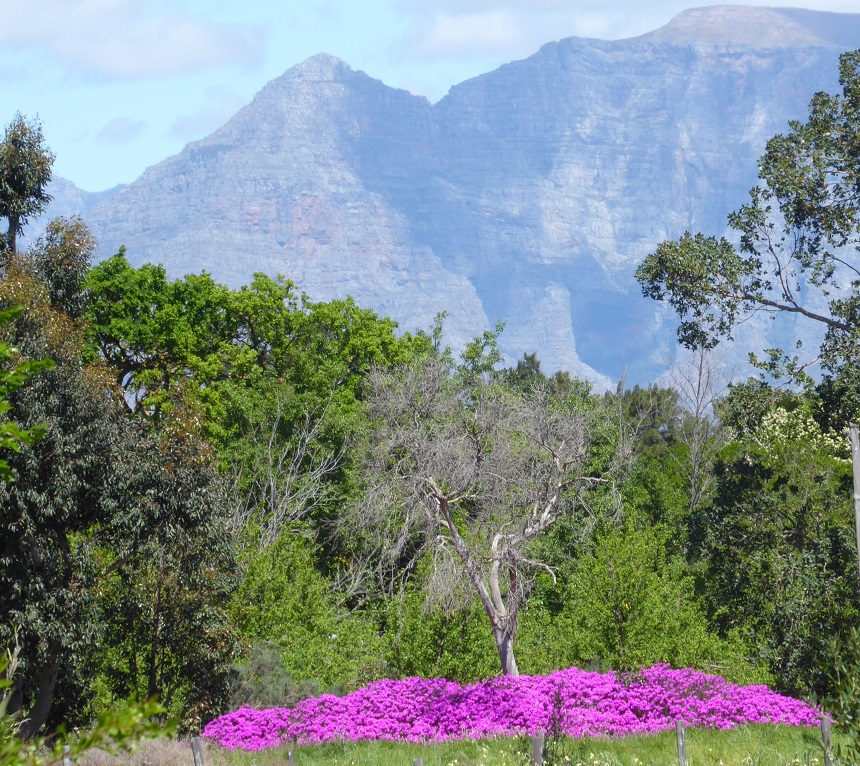
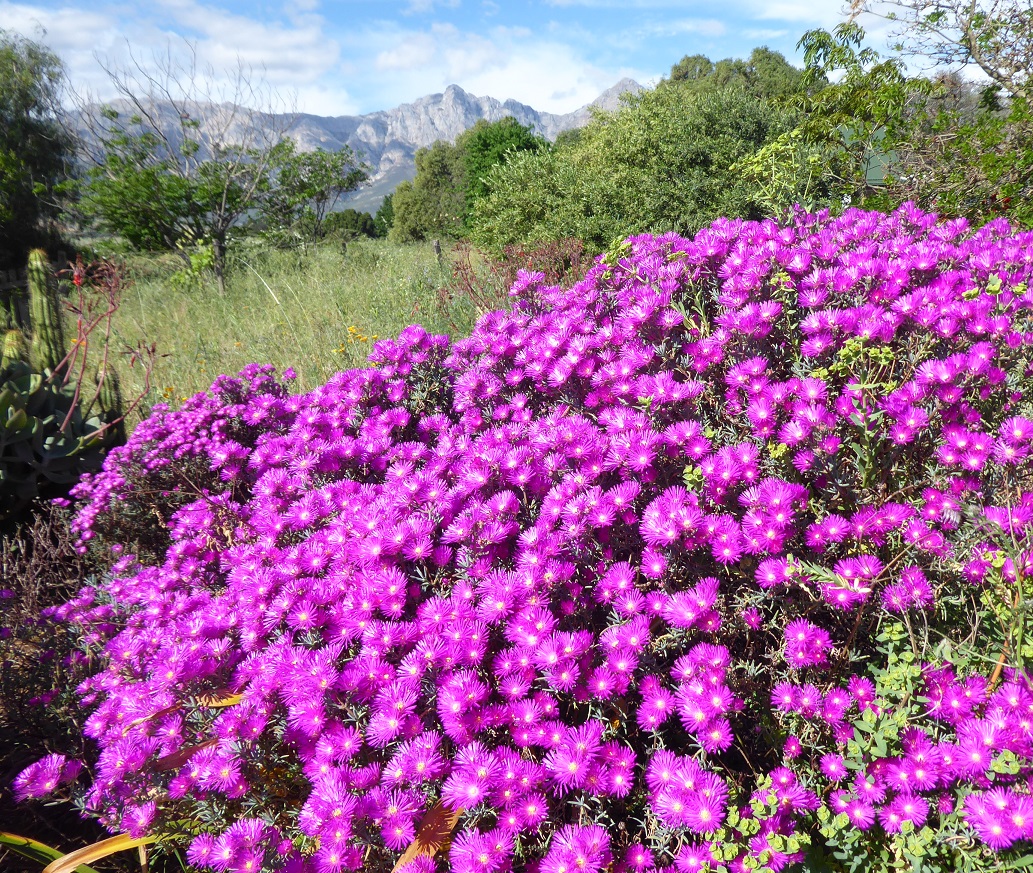
October had a dazzling welcome with big bushes of purple pink lampranthus planted by a neighbour flowering down our road. I also have big bush of it on one of the succulent mounds which has survived for about 15 years. There is nothing subtle about this vygie. This is prime time to visit the Karoo Desert Botanical Garden in Worcester as it has an impressive collection of vygies in shades or red, orange, purples and pinks. Take your sunglasses!

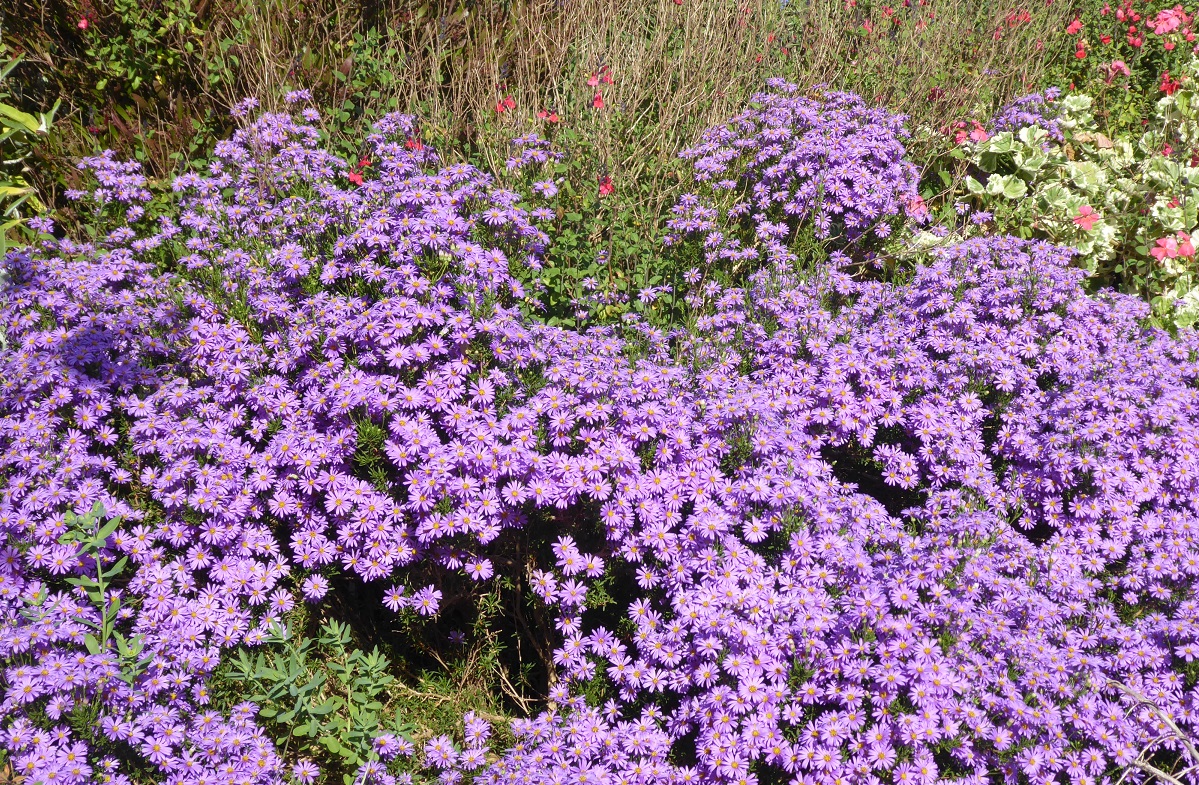
Felicia filifolia is also covered with small starry bright mauve purple flowers this month. This is another native plant and occurs widely in South Africa. It also does not need any water in summer. With its fine, light green leaves it is an attractive shrub even when not in flower and can spread to about 2 m x1 m. One has been growing in my garden for about 12 years now and dazzles for about three weeks every spring.

Growing near the Felicia is another stunning shrub, a Pride of Madeira (Echium candicans). With its towering spikes of tiny bright blue flowers and elegant grey leaves this is another joy in October. This shrub also doesn’t need water in summer, but it is fairly short lived and needs replacing every three or four years. Seedling do pop up sometimes when the mother plant dies.

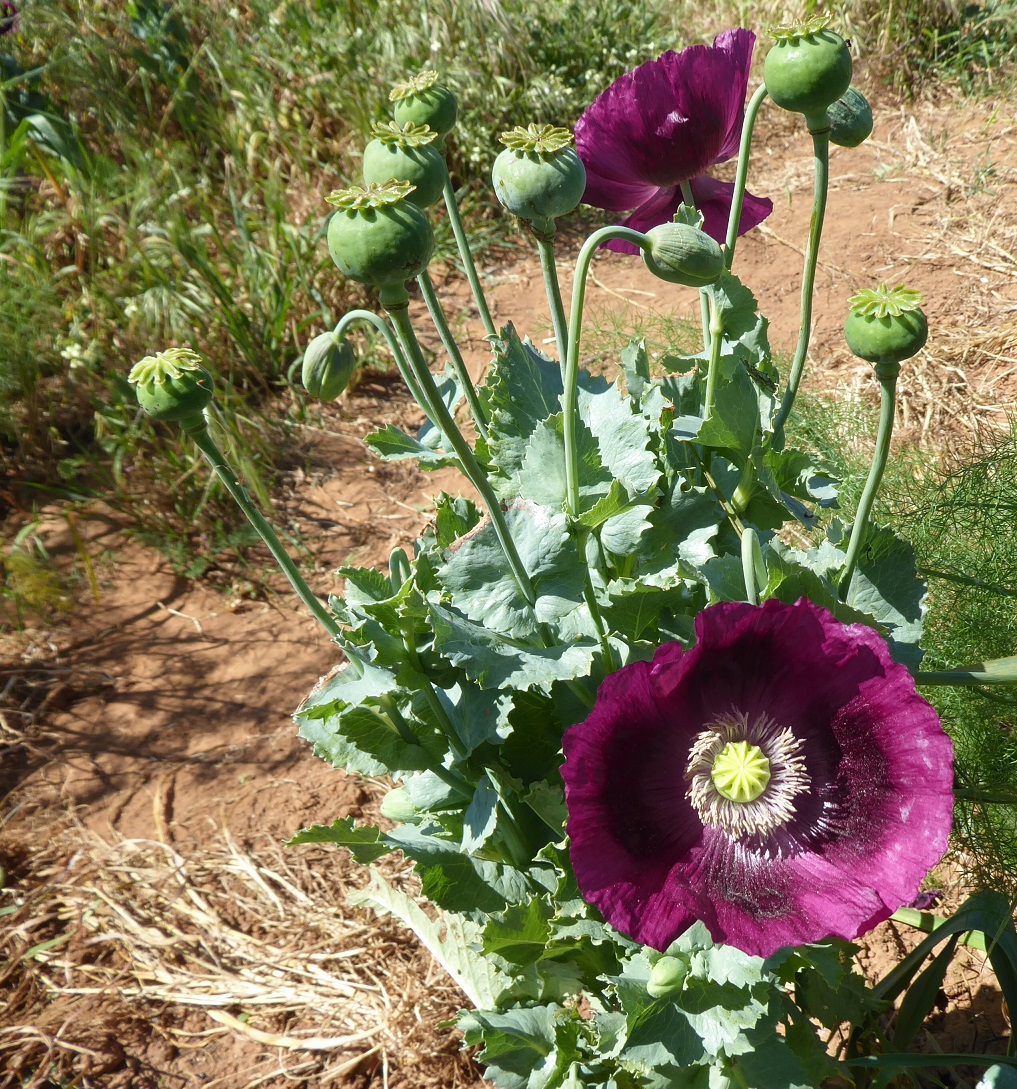
I love poppies and wish I could grow more. The opium poppies self-seed in the veggie garden and open their big purple flowers this month. I like their handsome silver grey leaves and silver pepper pot seed-heads too.

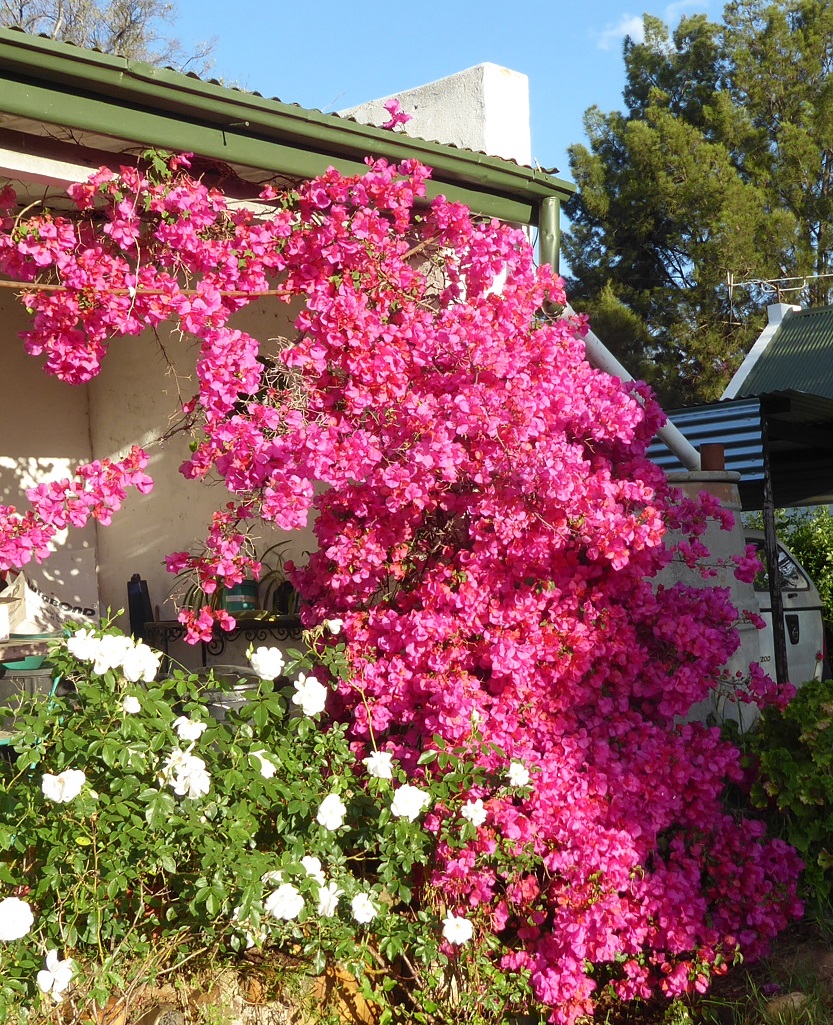
Bougainvilleas also start flowering this month. Growing up the side of my stoep is a bright pink purple bougainvillea which will be a joy all summer long.

Orange and red

I am very fond of pomegranates. They are attractive in almost all seasons and this month they bear their bright orange red flowers which show up brilliantly against their glossy green leaves. Aside from pomegranates which bear fruit, I have two purely decorative forms. One has double bright orange flowers which are fuller than the normal form and the other has striped cream and orange double flowers. I think this form is called ‘Madame Legrelle’ and it is a beauty. I once saw a pomegranate with yellow flowers in a garden in Alice, but unfortunately the cuttings I took did not grow.

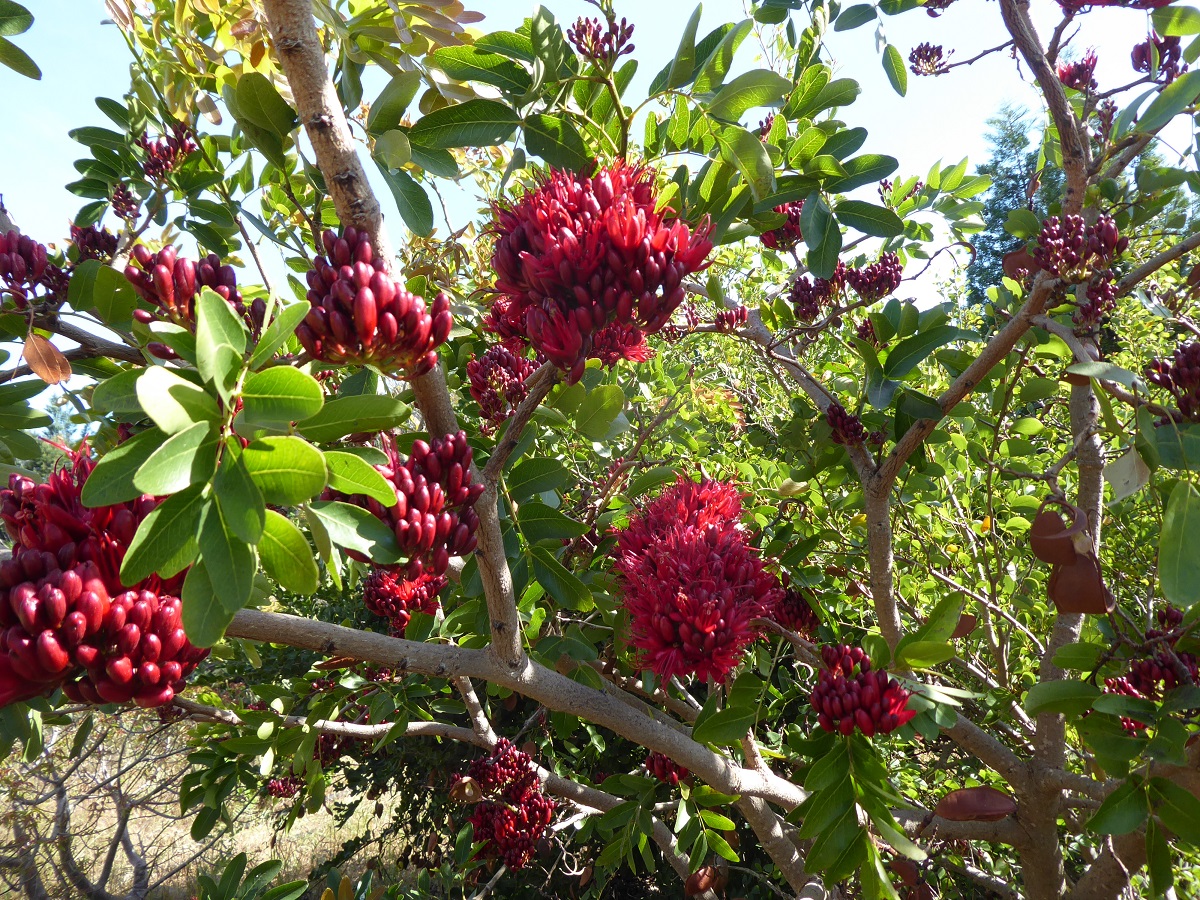
The other marvellous combination of red and green this month is the weeping boerboon, (Schotia brachypetala). In my garden this shrub starts its season with beautiful bronze new leaves which turn a fresh light green as the trusses of flowers form close the trunk and branches. My tree is still quite young and small, but is a treat for whole month of October.

Last of the glorious reds is a cactus with large red flowers with almost iridescent purple interiors. I am not sure of the name, but although fleeting this flowering is stunning. A smaller pink and white cactus also flowers now. I must track down the names.

White beauties

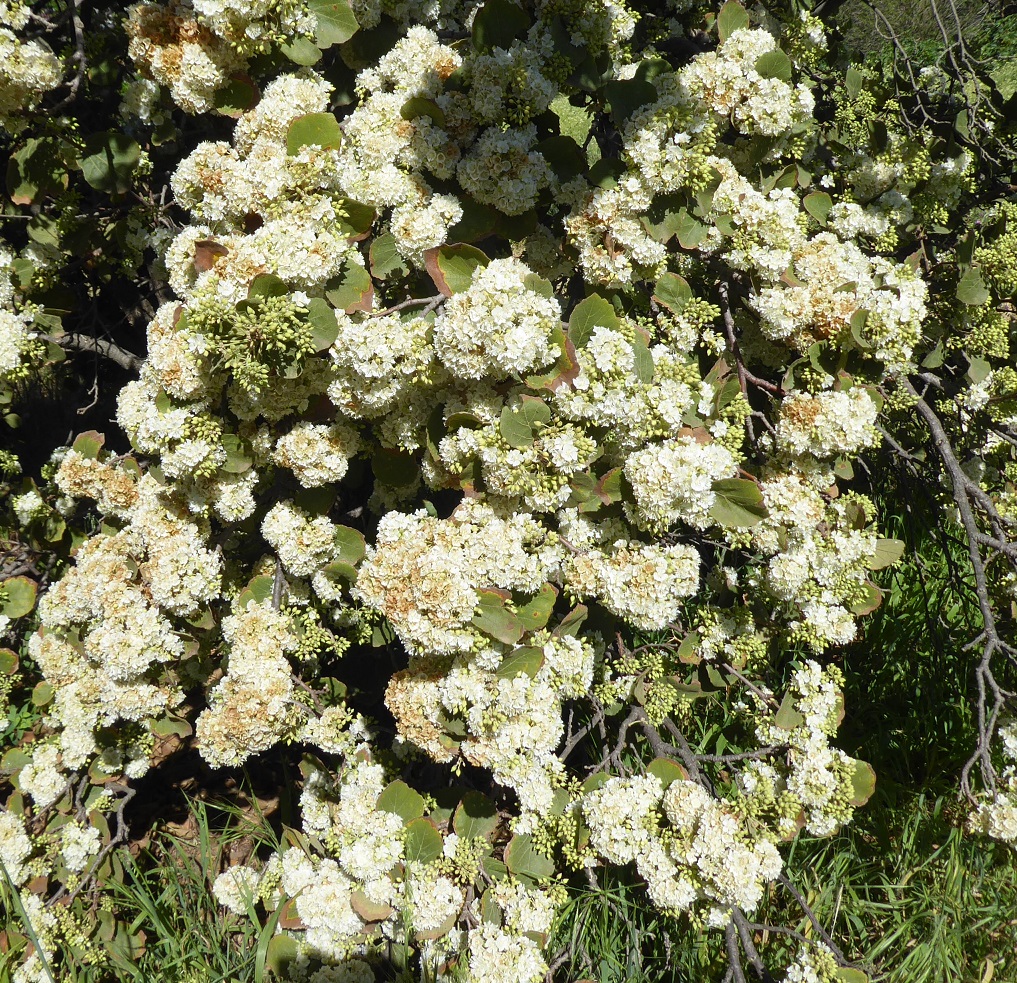
As a contrast to the bright colours, Dombeya rotundifolia the wild pear comes covered in trusses of white blossom early in the month. This tree comes from further north in South Africa, but mine has survived for 15 years, with very little summer water. Sadly the flowers turn tan within a week, so the pristine spectacle is short lived, but this little tree has attractive rounded grey green leaves in summer and warrants its place in the garden.

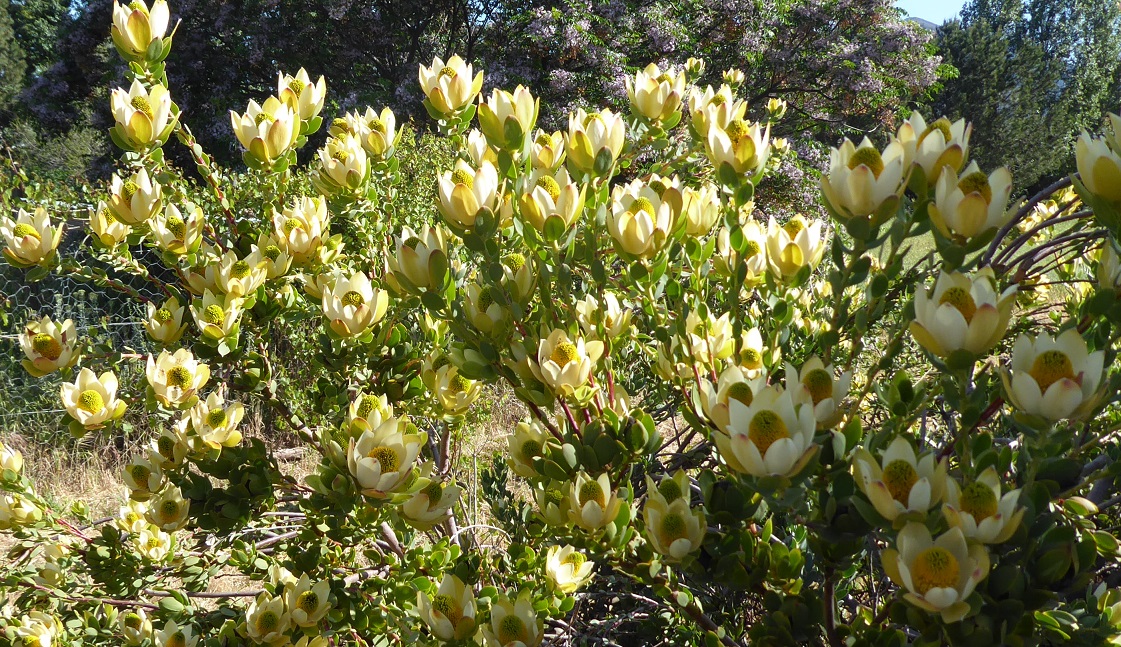
Quite near the Dombeya is a big Leucadendron bush which is also at its best this month. I think it might be L.discolor. It has limey green  yellow flowers which last well in the vase

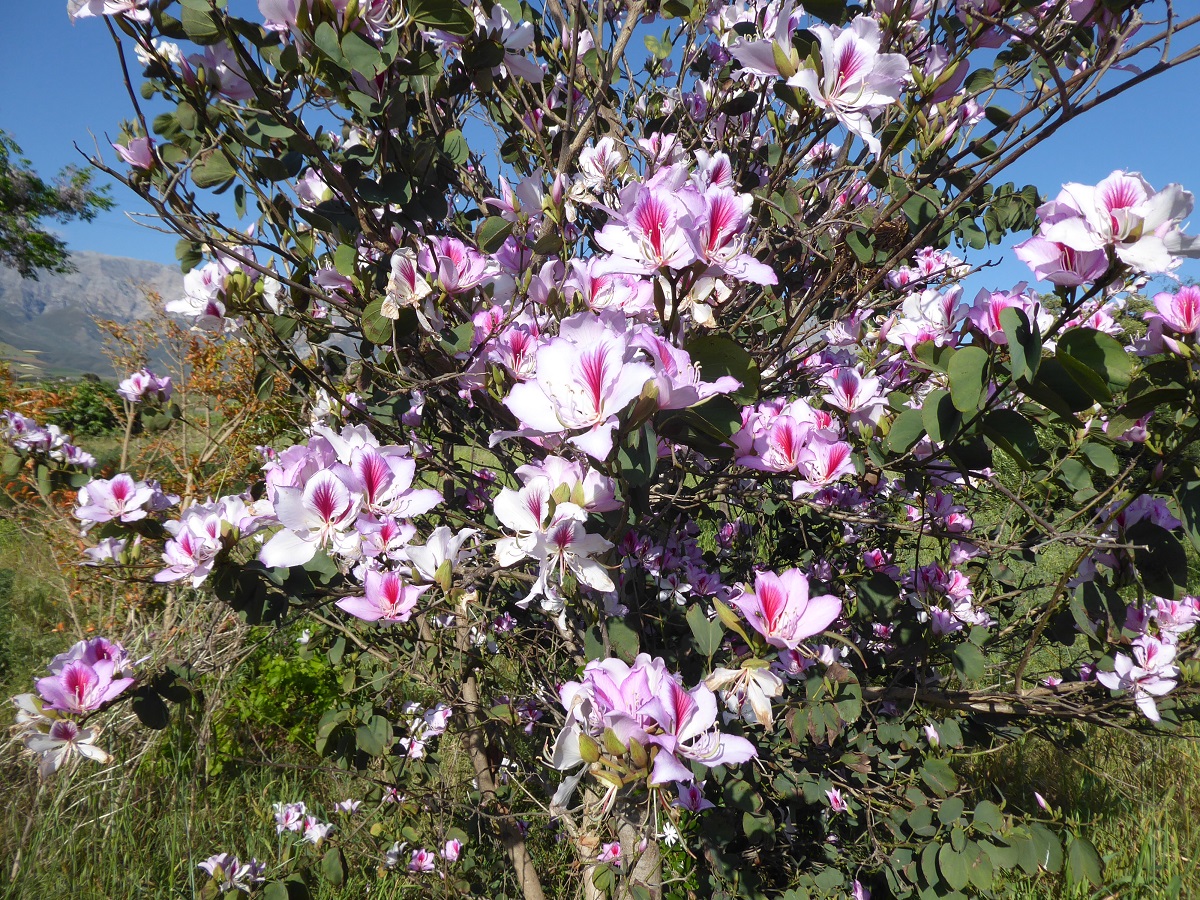
Although they are on the no no list I cannot resist the pink and white orchid-like flowers of Bauhinia variegata and these trees are the glory of the garden now in October. But even more special in my view is the pure white form which has a touch of green to the flowers. These flowers are lightly scented and as beautiful as magnolia blossoms. I planted it near a dense green yellowwood to emphasize the purity and beauty of these exquisite white flowers.

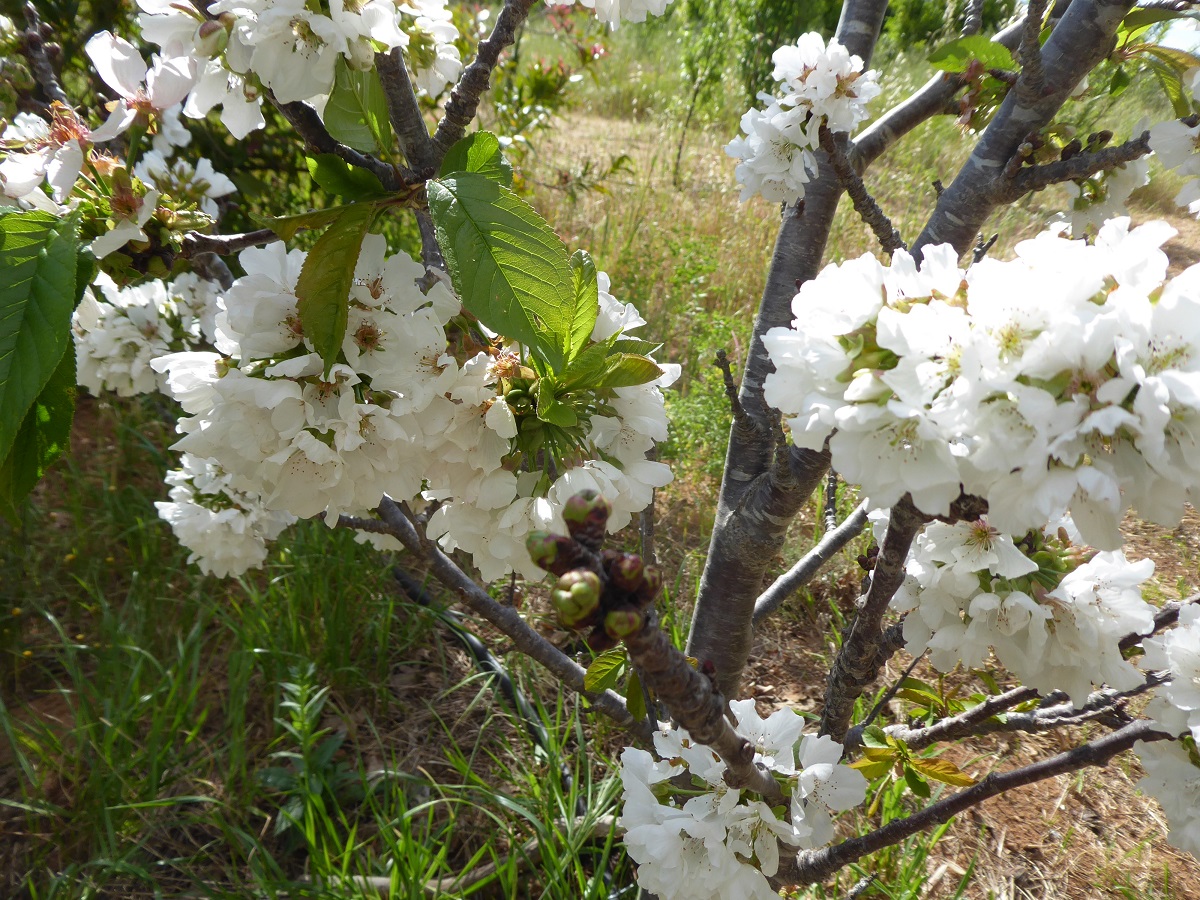
Gardeners are often a little crazy and I have planted 2 fruiting cherries. This climate is too hot for cherries and they are not thriving. If I get 5 cherries it is a lot, but when the little trees bear their pure white flowers, they are beautiful.

Although more cream than white, the olives also flower this month, their small lacy flowers a harbinger of the crop to come.

Scents of October

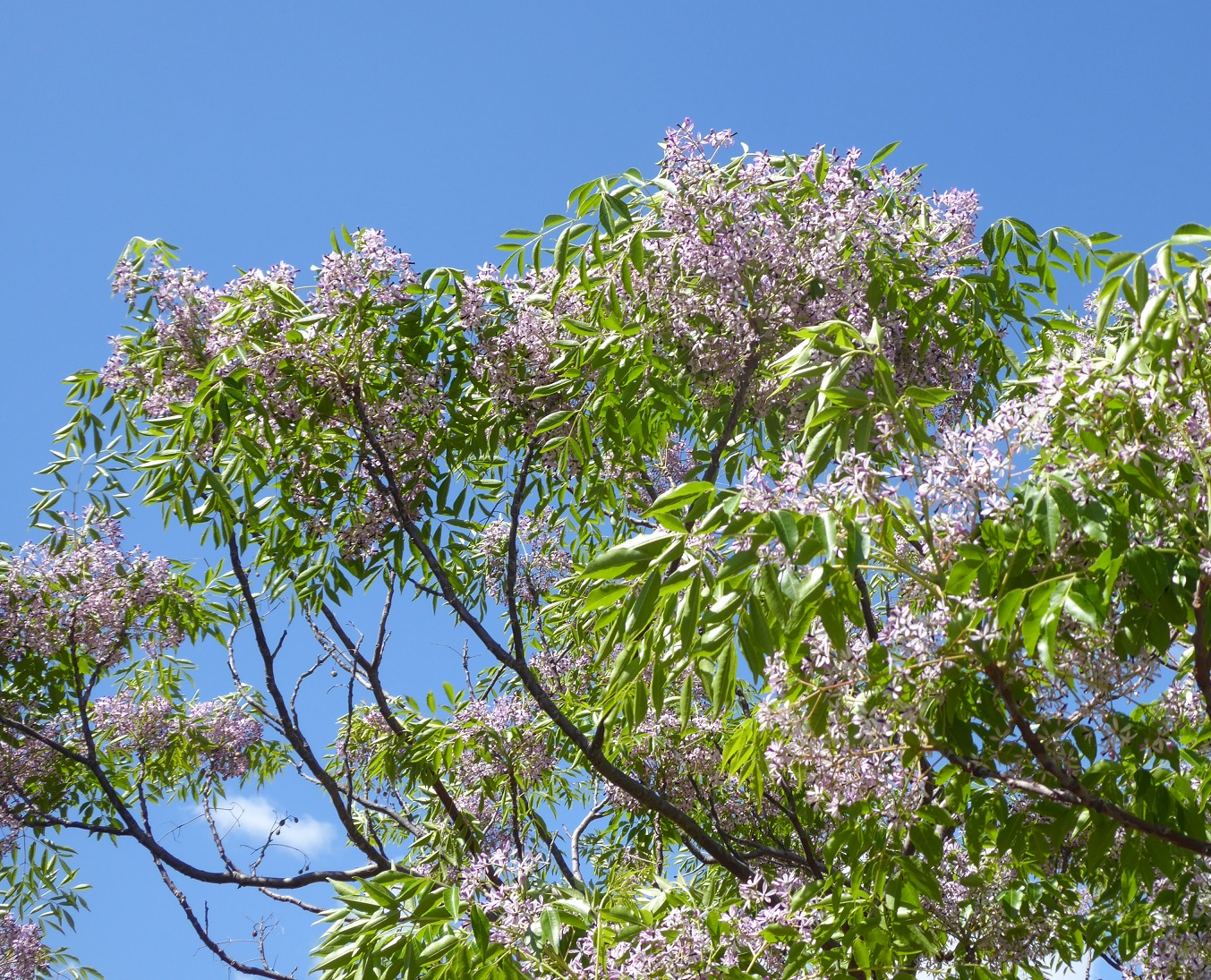
The garden in early October is pervaded by the scent of syringa, or Persian lilac (Melia azedarach) as it is sometimes called. With trusses of lilac coloured flowers, this is another plant on the no no list and I do diligently remove seedlings, but have left some trees. They are nowhere near as invasive as the wild olives in my garden.

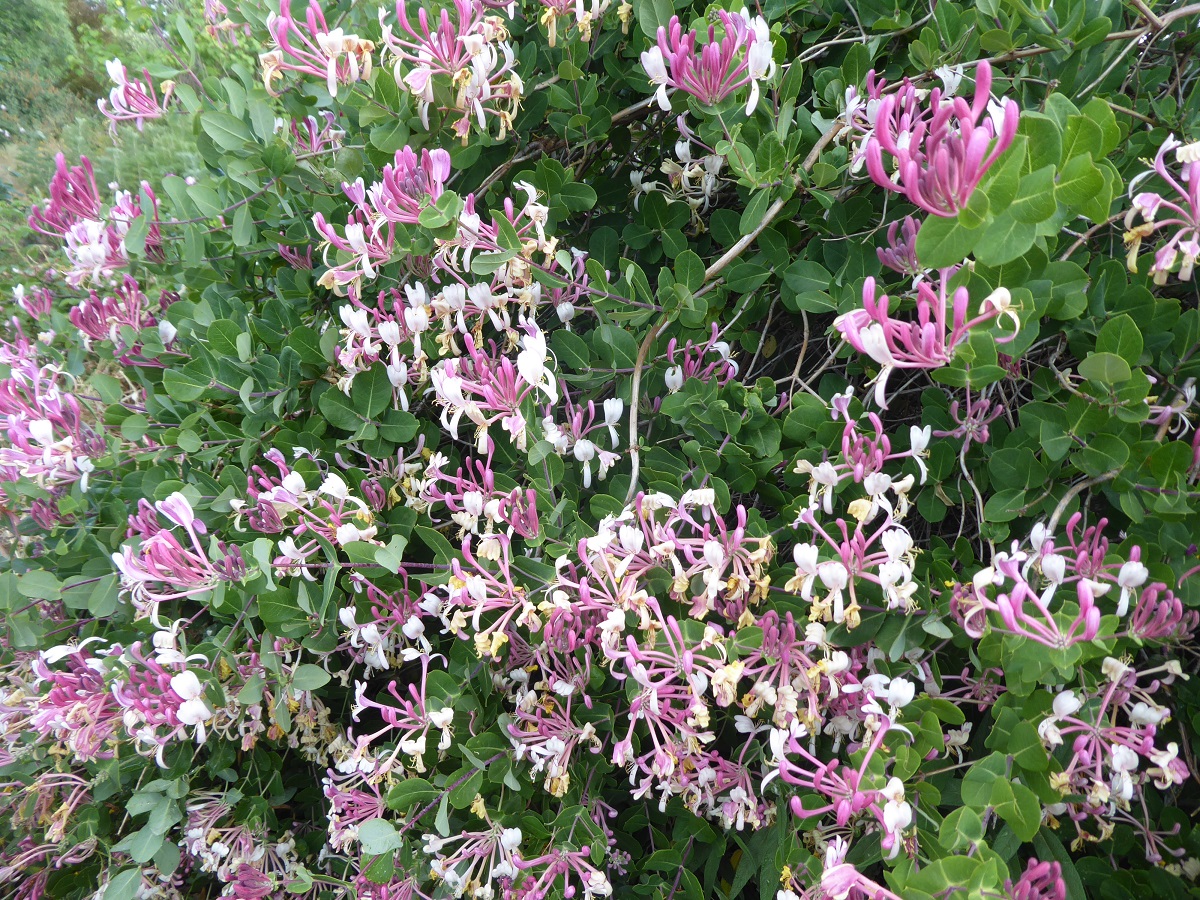
The other gloriously scented plants are the honeysuckles which are especially nice this month. In the rose garden is an enormous bush of European or Belgian honeysuckle ( Lonicera periclymenum) with flowers in shades of cream and pink which looks lovely beside apricot roses. And growing next to our cottage is a huge mass of the climbing cream and white Japanese honeysuckle (Lonicera japonica). The former only flowers for about a month now, but the other will flower all summer long. I also have a plant which might be a hybrid between the two.

Another glorious scent in October is that of the common mock orange, (Philadelphus coronarius). The bushes in the rose garden come covered in pure white single flowers enhanced by yellow stamens. There is something virginal about this shrub with its sweetly scented flowers and pale green leaves, but is surprisingly tough, surviving with very little water. I also have a mock orange from Mexico which I got from Peter and Barbara Knox- Shaw. It does not flower as well, but it equally strongly scented.

The orchard is redolent with the scent of real orange blossom in October. Now is the time I make my van der Hum liqueur. The old Cape recipe calls for naartjie peel and a handful of orange blossom which one soaks in brandy with other spices for 40 days.

Roses and Irises

I love old fashioned roses and grow quite a few of them. October is the month when they are at their best and the old rose garden was one of the first gardens I planted when I came to KSU 16 years ago. It is a joy to be there now and to drink in their perfume and admire their subtle colours, but it isn’t that easy to capture the essence of their enchantment in photographs.

In mid October we travelled to Barrydale for a weekend to see the gardens in bloom there. It is a charming little town with some lovely and interesting gardens and it was very nice to see lots of old roses still growing along boundary fences, including a glorious bush of an apricot coloured rose I could not identify. I took some cuttings- ever hopeful.

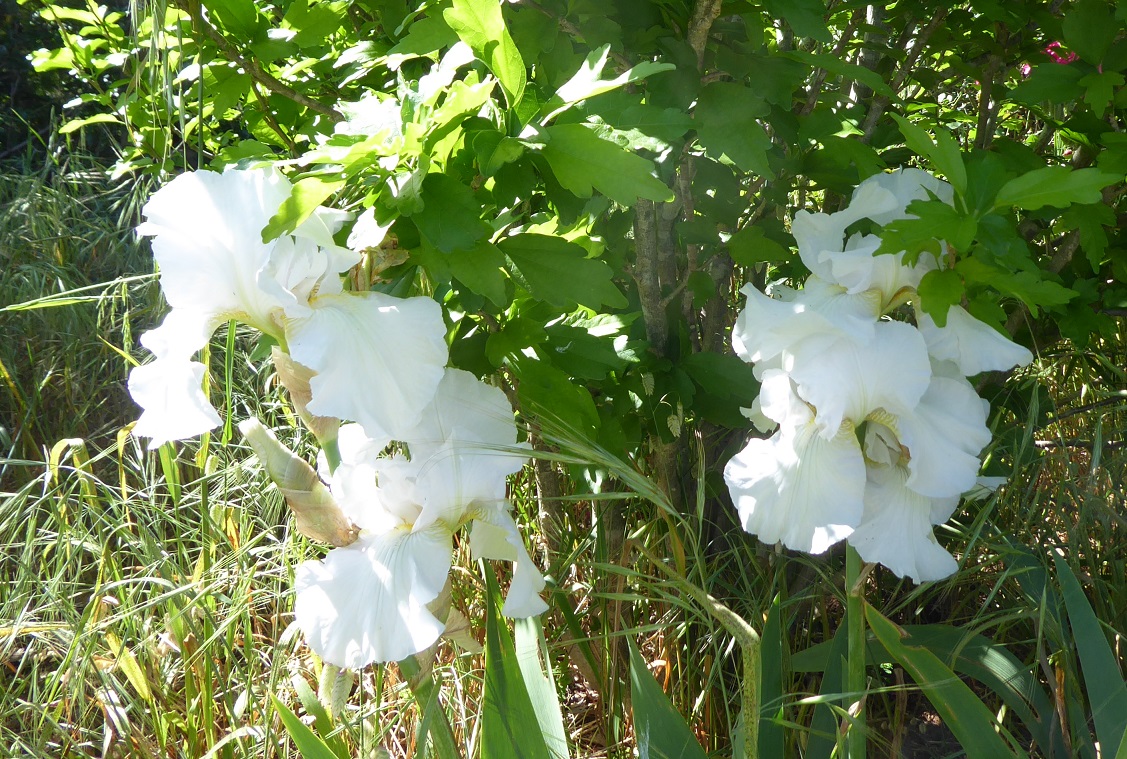
I also love bearded irises and have a large collection, but sadly they do not do well here. The wretched moles disturb them and we just don’t seem to have enough cold, or enough rain for them. This year very few have flowered. I guess I should move them to fresh ground. There is something so special about their elegant flowers that I continue to hope for a better year.

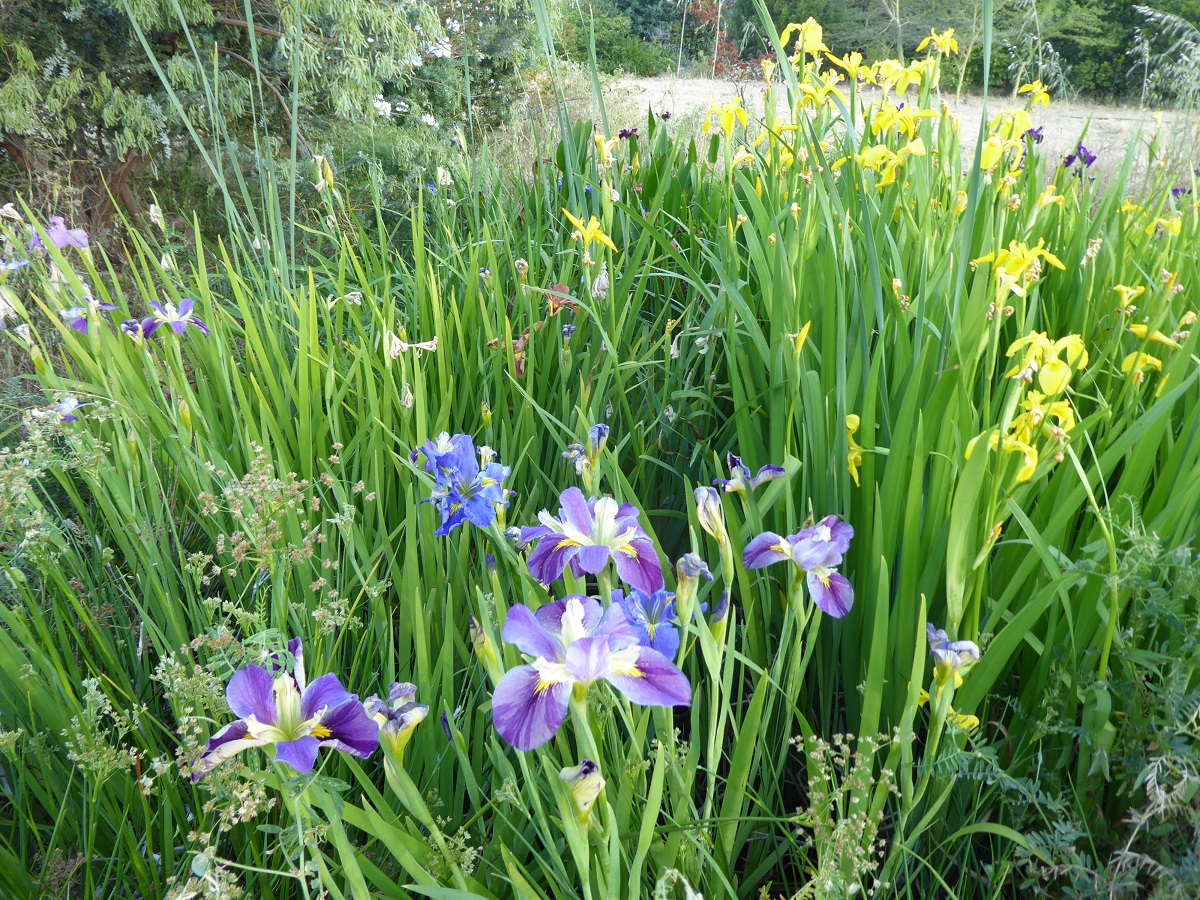
Louisiana irises do much better. A few years ago I made a shallow pond for my collection of about 10 different varieties. Usually they flower in September, but they have been later this year them. For about a month this little pond looks great.

Tasks and treats in October

October is also the month when the pelargoniums are at their best. Often incorrectly called geraniums my mum and I have made quite a collection of species and garden hybrids. I need to take cuttings now after they have flowered as often lovely cultivars will disappear off the market and cannot be replaced if one loses a plant.

This month I planted my dahlia tubers and hope they do better than last year. I also planted more beans and courgettes, watermelons, butternuts, pumpkins and gem squash for the summer. The asparagus plants have shot up now that we are no longer picking spears and make a waving green forest about a metre high. I hope to pick enough Cape gooseberries to make some jam and we have enjoyed a few artichokes.

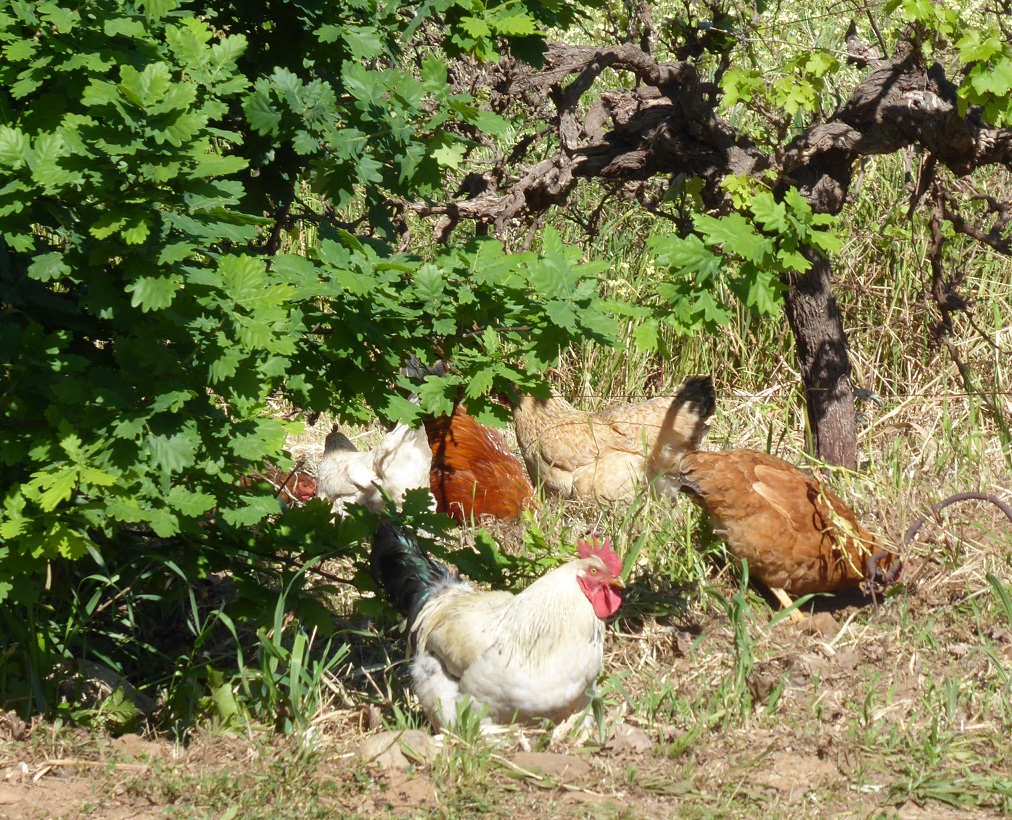
The fruit season is about to start and we can buy early peaches and nectarines. Summer is definitely on the way. The swifts and hoopoes are about as are my neighbour’s chicks who spend a lot of time scratching in what remains of the old vineyard.

KSU October 2019 gallery
May 2019
We are on the threshold of winter, but although we  had some cold evenings and about 30 ml of rain on the 20th of May, I was still watering the vegetable garden at the end of the month. The pump is not stowed for the winter yet.

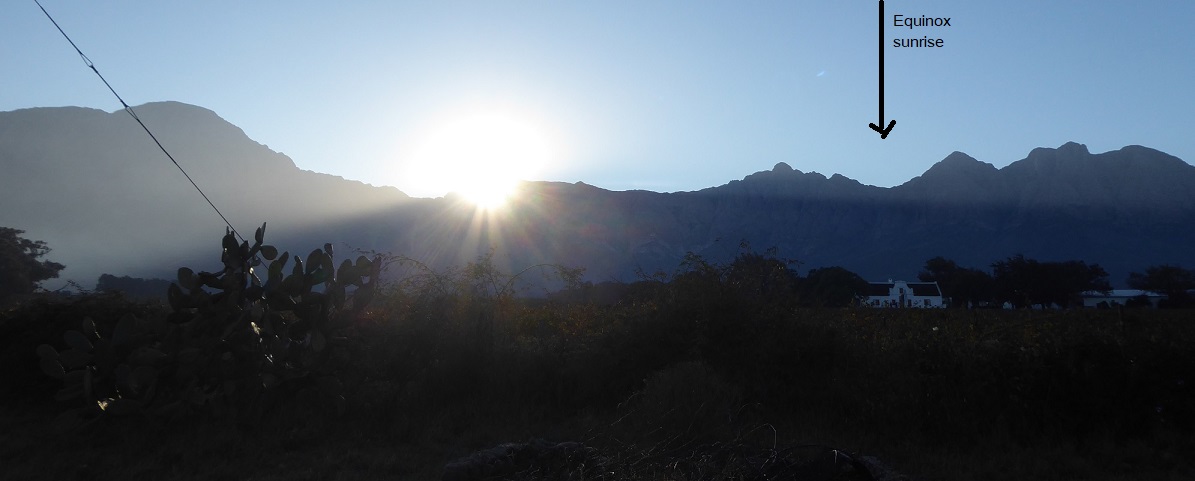
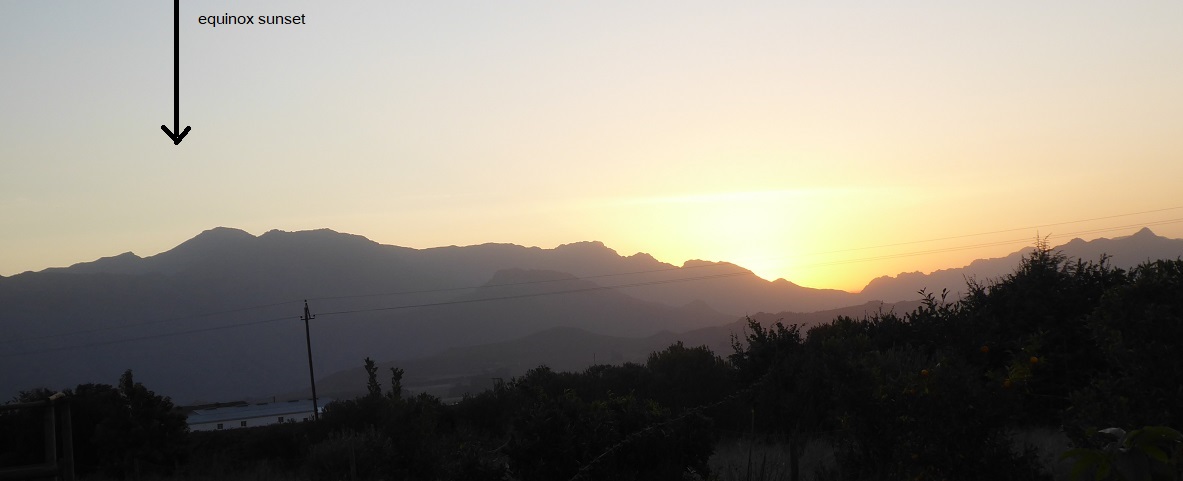
The sun has moved almost as far north as it goes and days are shorter with the sun rising after 8:30 and setting before 5:30.  Fortunately  afternoon sunshine is prolonged as the sun is setting in a gap between two mountain ranges.   Many days are sunny and mild, but the dreaded south easter still pounds  sometimes and brings a tablecloth of clouds roiling over the mountains.

We hurried to get the roofs painted again in May and in the vineyards the winter work of pruning has begun.  The glorious autumn colour of the vine leaves  disappears as just the stems and a few shoots are  left for next season.

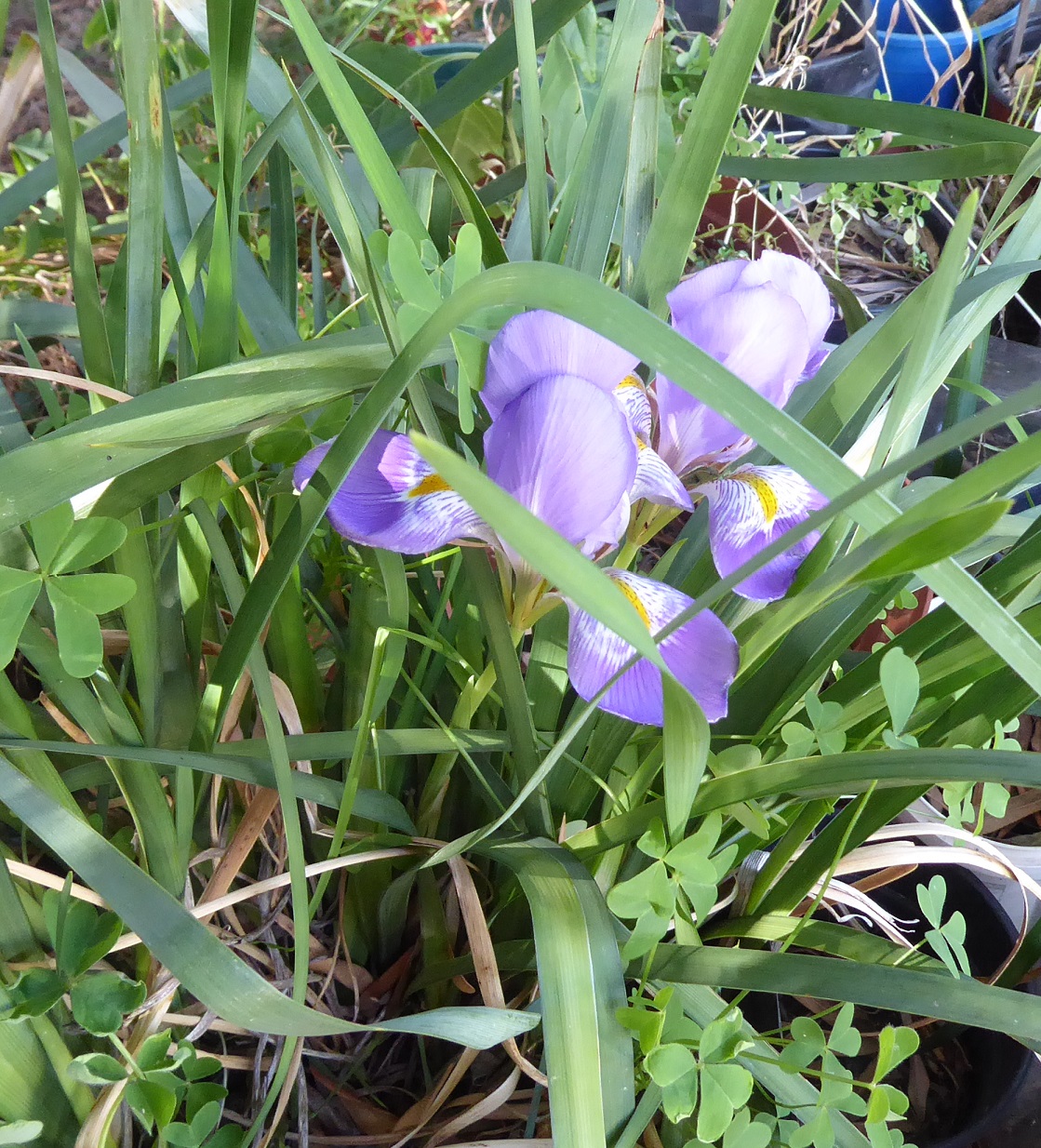
One of the joys of early May was the Algerian iris (Iris unguicularis). Despite its common name the distribution of this iris is listed by Wikipedia as Greece, Turkey, Western Syria and Tunisia. The exquisite lilac blue flowers marked with white nestle between its strap shaped dark green leaves. It is not commonly grown at the Cape but I have seen it growing happily in a neglected garden in the sandveld where it had hot sun in summer and almost no sun in winter. I was lucky enough to find some plants in a nursery in Montagu but am still trying to find the perfect place for it in my garden.

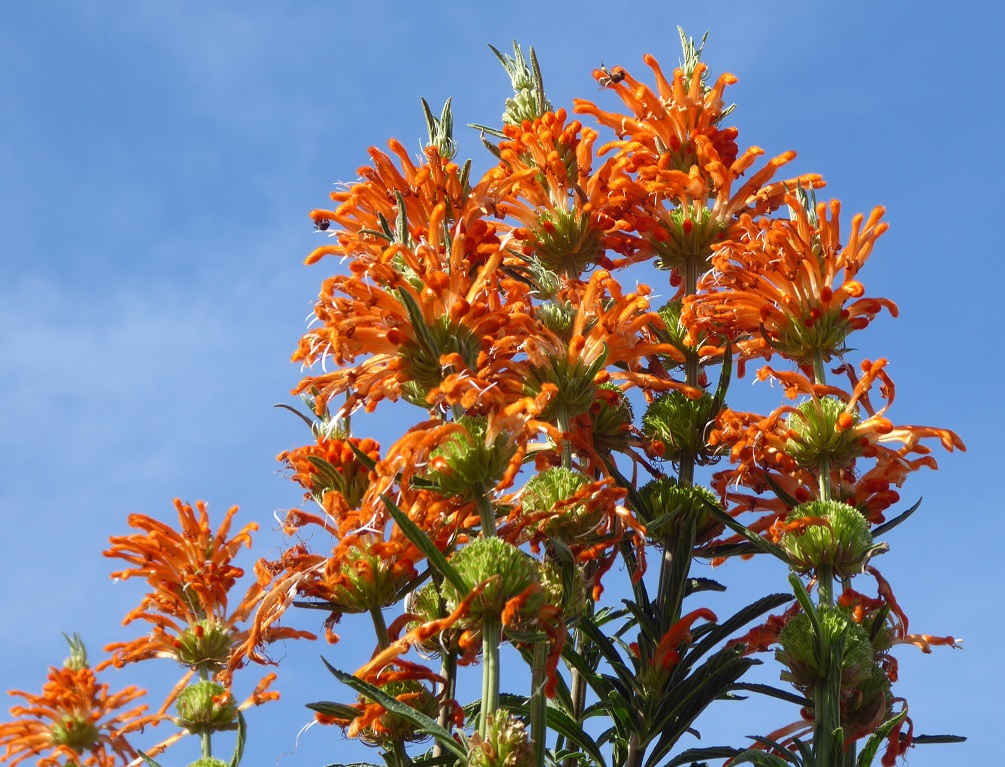
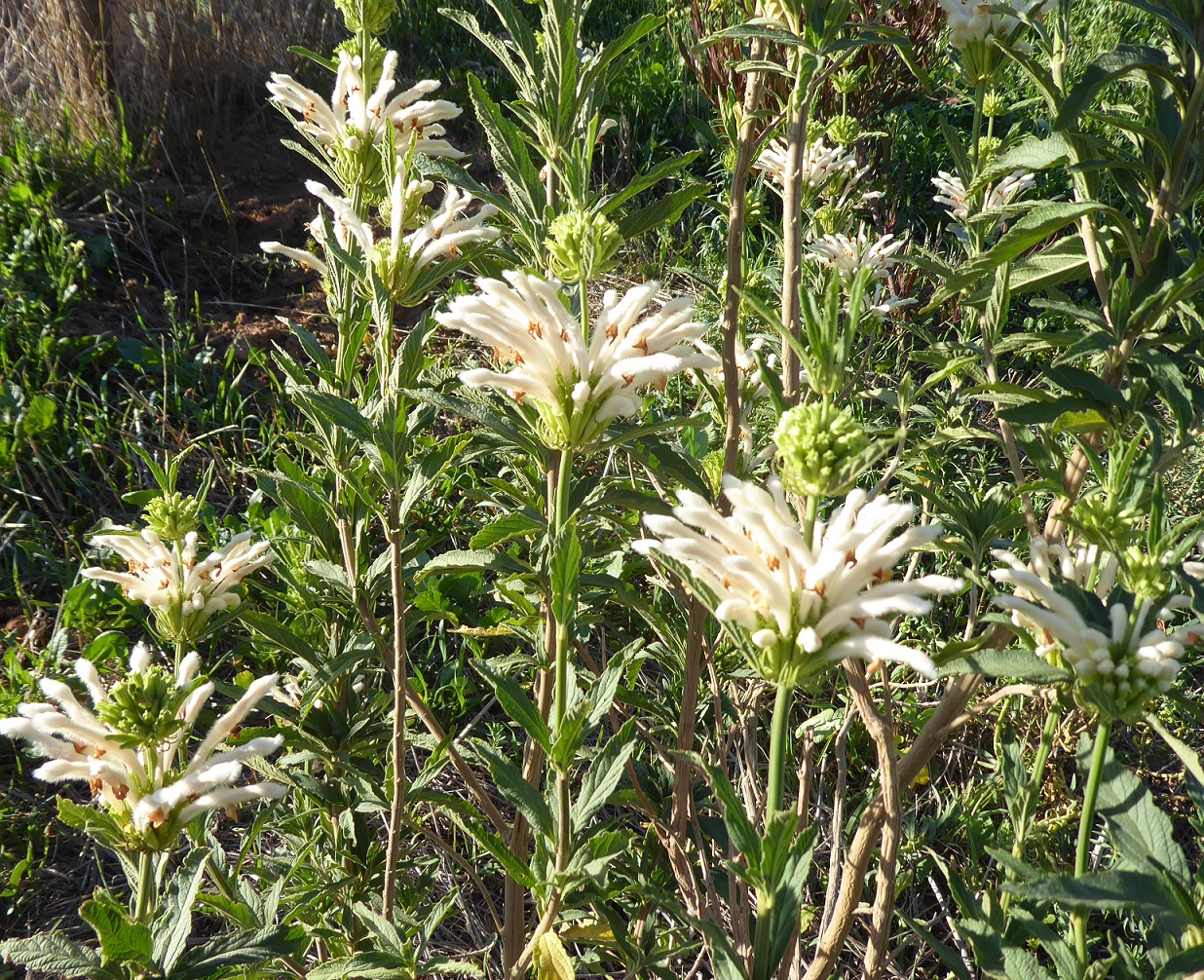
Another joy this month has been Leonurus leonotis or wild dagga. The sunbirds love this plant and the gay orange flowers against a blue sky are very cheering. I have an enormous old bush which has been in the garden for about 15 years.  I also have a white form which I plan to plant next to a cypress and have just acquired the rusty, biscuit coloured one which is a subtle mix of the two.  They survive conditions here at KSU, not needing much water in summer, and I like the aromatic fragrance the leaves give off on hot days and when they are crushed.  I believe they have medicinal properties too.

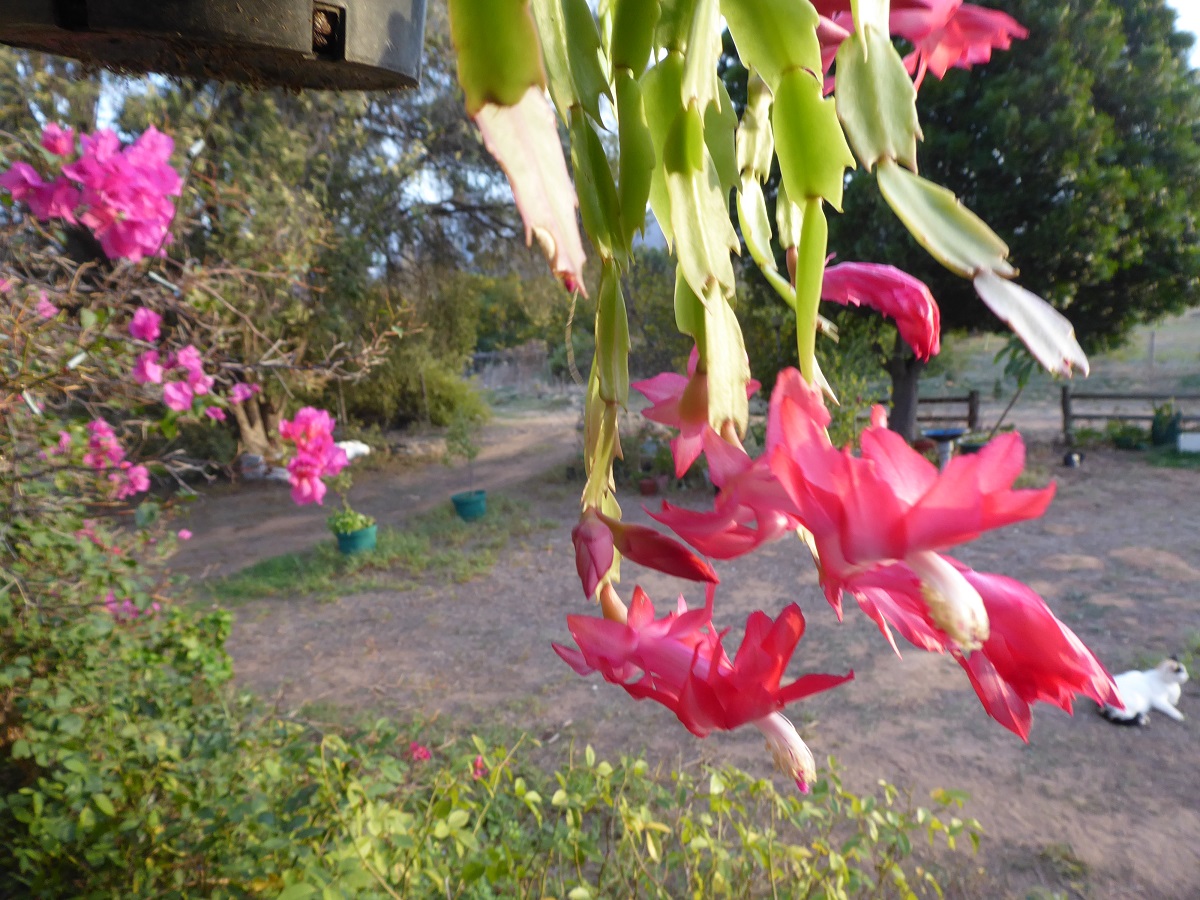
Growing in pots at the edge of the stoep we have some cacti.  I am not sure of the names but one decided to flower for us this month. I think it is a form of the Easter cactus (Schlumbergera sp.) The pink flowers were a delight, toning with the nearby bougainvillea.

Nuts and citrus

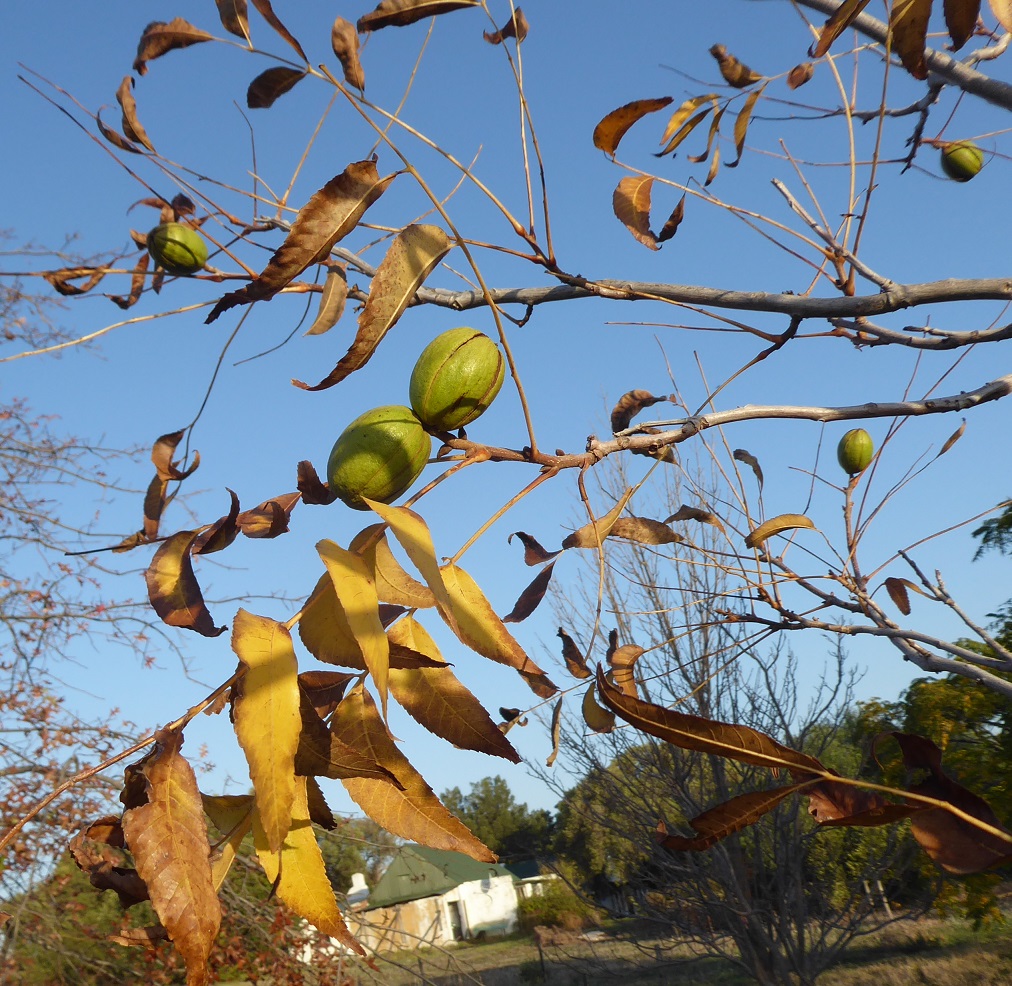
Pecans and macadamias ripen now in May. Sadly most of my macadamias were stolen but I have been able to harvest most of the pecans from my 3 small trees. Although they have been in almost 15 years, they are not big. I am not too upset about the macadamias as I find it almost impossible to open the nuts. Even bashing them with a hammer is tricky as they are round and skitter away. Both nuts are delicious and we look forward to nibbling them on winter evenings, along with the almonds which we harvested in January.

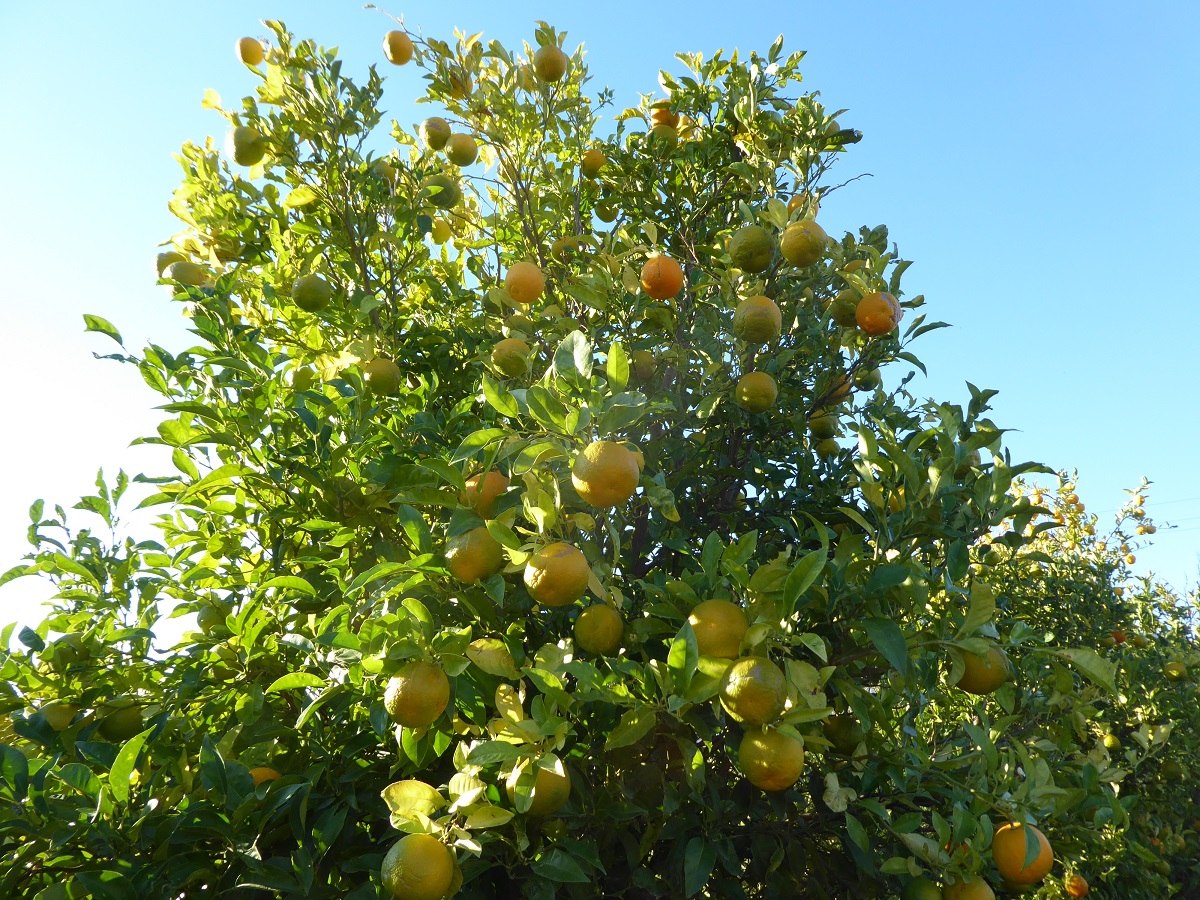
Winter is citrus season here at the Cape. I have 3 naartjie (clementine) trees but also had the fruit stolen. The Seville oranges and the orange coloured lemon have not been raided though. The Seville oranges are not quite ripe enough yet for making marmalade. I am hoping to make some limoncello if I can harvest enough lemons from my unique orange coloured lemon. This variety is very like the Cape rough lemon but the fruits are orange when they ripen. I was lucky enough to be given a small tree of this plant from a garden in the Grabouw district where I admired it at an Open Garden many years ago. The Tahiti limes which have been ripening all summer are still providing fruits. This is a great tree for the home garden as it produces small limes for months, especially in summer when lemons are difficult to find.

Medlars and custard apples

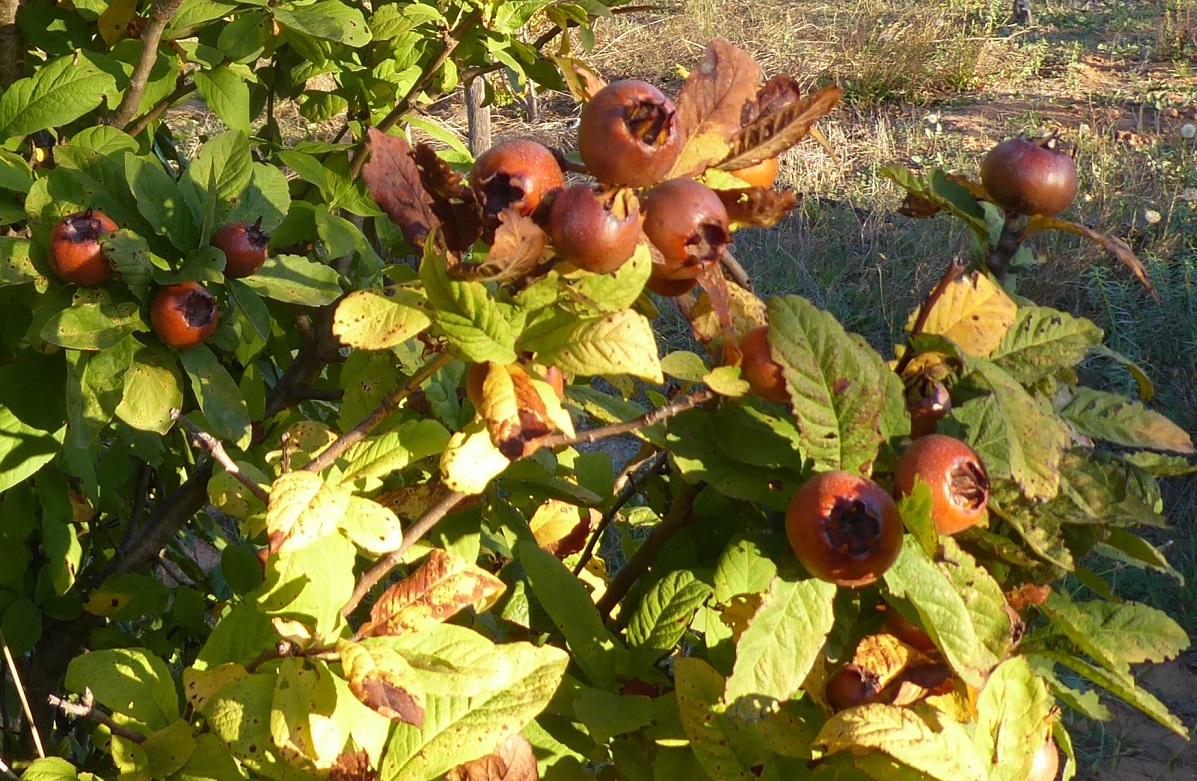
The medlar is an old fashioned fruit related to apple. It is not uncommon on old Cape farms. My plant is a compact bush with lovely big white flowers in spring and the leaves turn yellow and a lovely russet red in autumn. The small brown fruits need to be “bletted”, left to become soft, before they are eaten and then they have a strange taste, a little like port wine. They are an acquired taste.

I use almost all the harvest to make chutney from a recipe for apple and medlar chutney which I downloaded off the internet, but which I think originally came from Hugh Fearnley – Wittingstall. I use no apples, just medlars. A vegetarian friend says it is cheers up lentils no end, but it is quite a hassle to make. The medlars need to be boiled first and then put through a sieve to remove the seeds and bits of skin. Finally the thick mix with the spices needs to be cooked and stirred to prevent it catching on the bottom of the pot. Like an evil beast it  spits boiling splatters all over the kitchens and woe betide  if they land on you. I have two bad burns to pay for the 14 bottles  stowed away for the year ahead.

This is not perfect custard apple country. They are semi tropical fruits, but are so delicious that we couldn’t resist trying them. We have two bushes. They have strange little green flowers and I try to cross pollinate, but we still only get a few fruit which take all summer to ripen. They are a real treat now in autumn and one has to watch carefully as they do not change colour as they ripen, they just fall off the bush.

Harbingers of spring

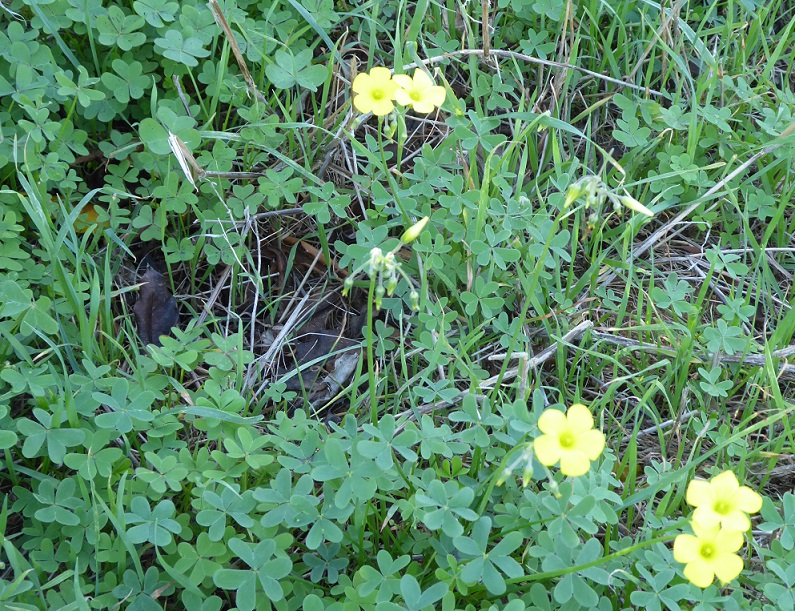
It is strange to be talking of spring while we are still in autumn, but here at the Cape the flower season starts now in autumn and traditionally May was always the month when oxalis made a showing. There are about 600 species of these at the Cape. Sadly with global warming and the lack of autumn rain, the flowering season of these little bulbs has been pushed back, but the ubiquitous Oxalis pes caprae which covers KSU in winter has started flowering. These are regarded as weeds in many parts of the world, but here I accept them as part of tapestry of winter and enjoy their cheerful yellow flowers. Locally known as suurings, they are sometimes used to add tartness to stews and bredies.

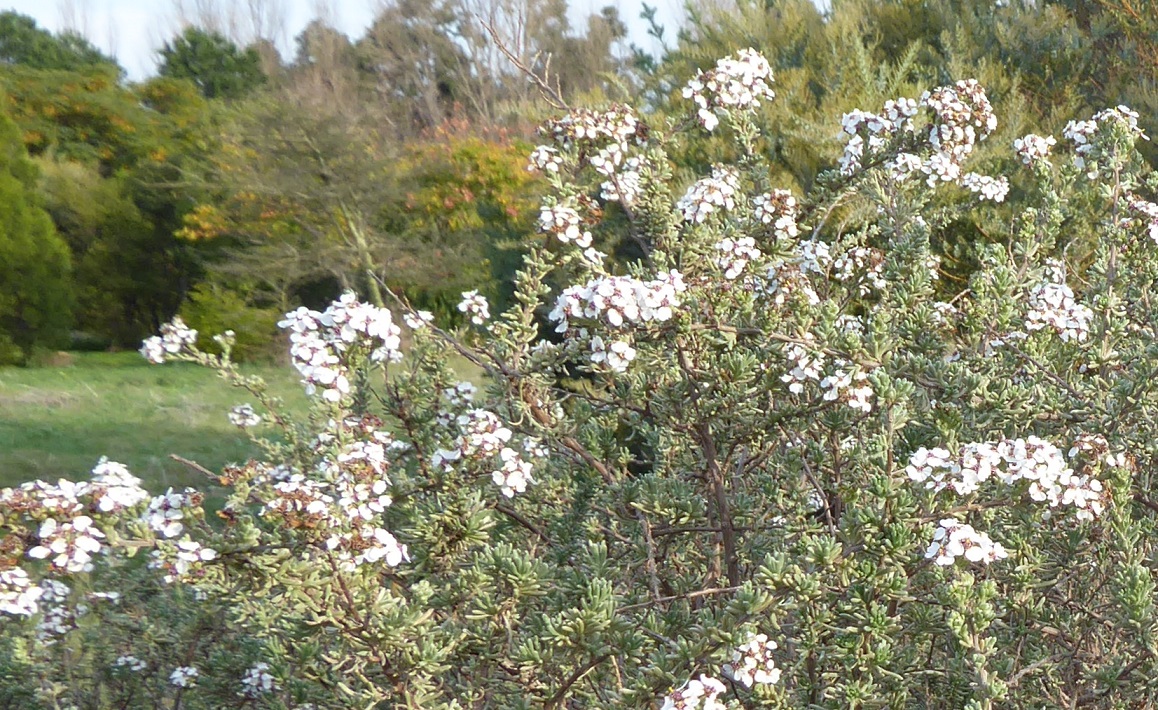
The wild rosemary (Eriocephalus africanus) has also started flowering. These tough shrubs with their small grey green leaves need no water in summer. Their heads of little white flowers are fresh and cheerful and will be followed by woolly seedheads.
The true rosemary is also flowering now. I have a lovely deep blue variety and have just acquired a bush with pink flowers.

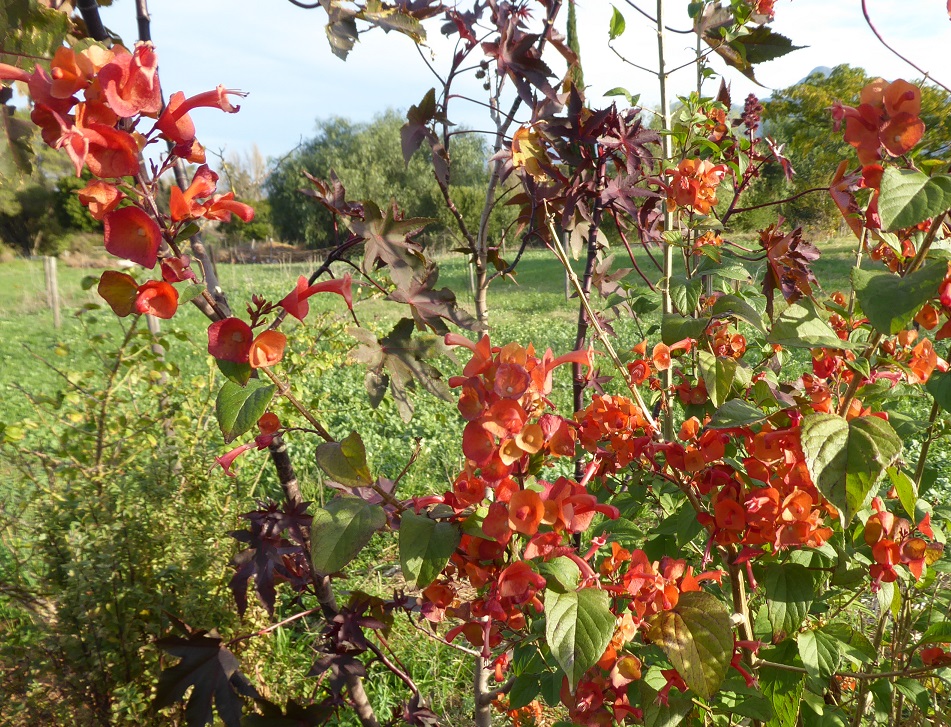
Another star of autumn is the orange holmskioldia or Chinese hat bush from the Himalayas (Holmskioldia sanguinea) which looks lovely when viewed against the sun. It grows near a purple castor oil bush and the two colours look good together.

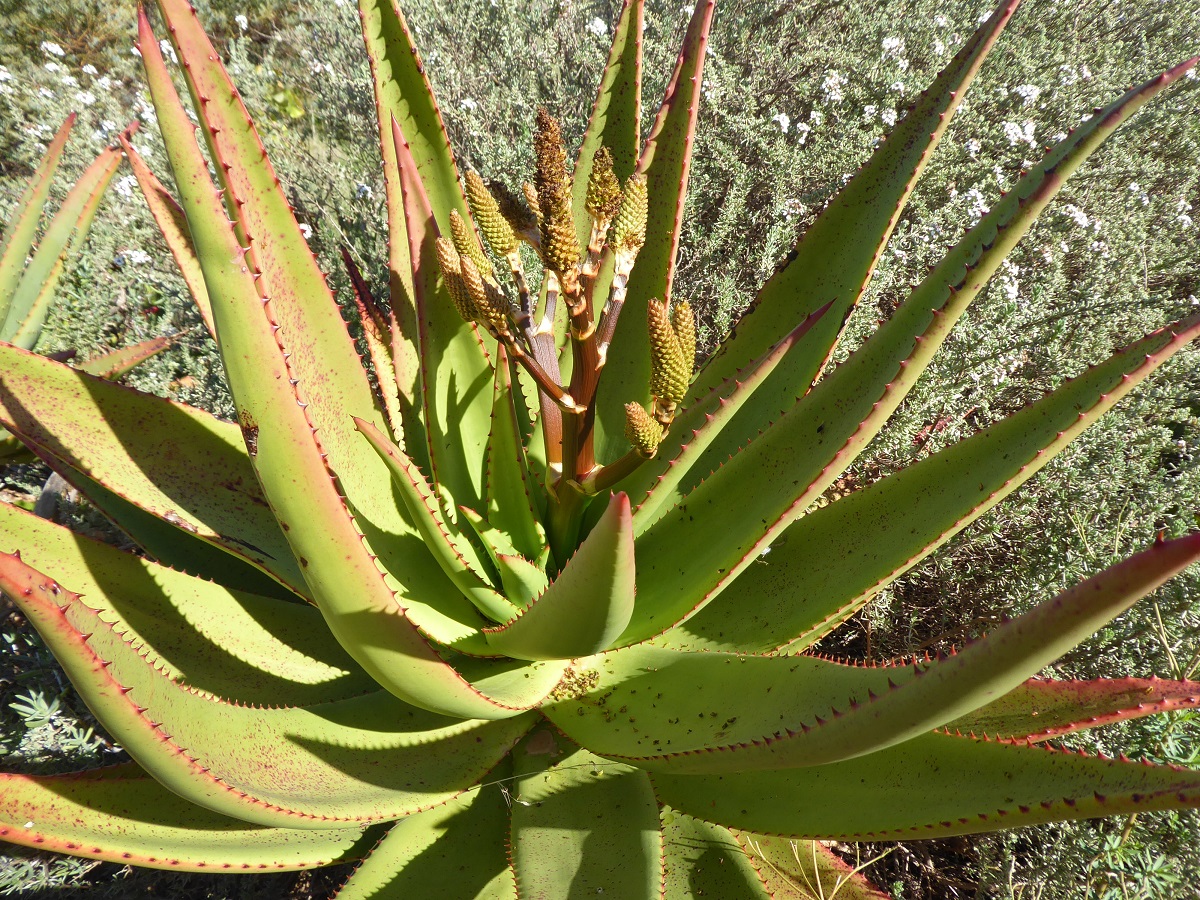
In a normal year I would be looking forward to the aloes flowering now in winter, but I have been horrified to find that all the aloe buds have been eaten by something. I am not sure if it has been hungry birds or some strange mites which have devastated all the flowering stems leaving them blackened and barren. Only one clump on the boundary seems to have escaped.

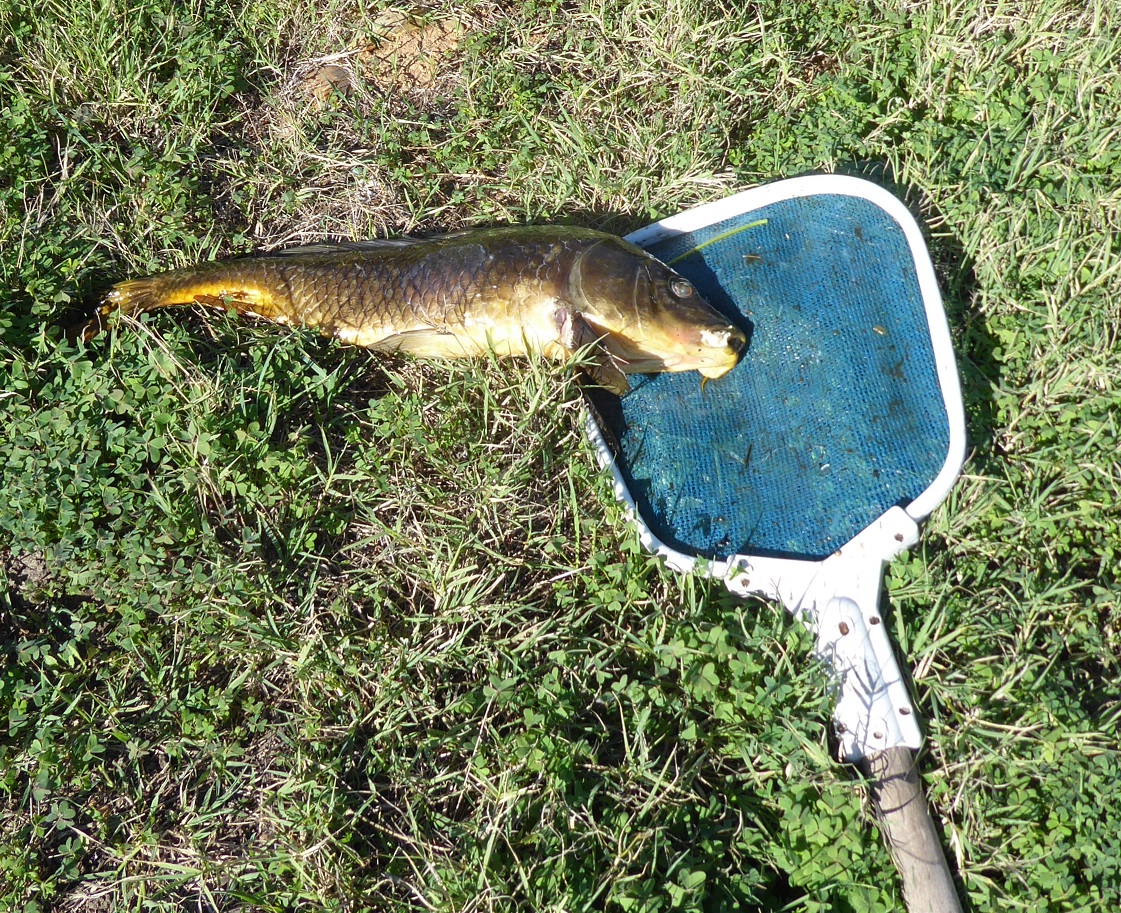
To compound the sadness of the month, I found one of the big carp in the pond floating on top of the waterlilies.  We acquired 2 carp several years ago to live in the pit which holds the garden irrigation water. In spring we moved them to the lily pond as the pit had to be replastered. They survived the hot summer days and I am not sure why one has died now. Perhaps the waterlily leaves dying back at the end of the season have depleted the oxygen in the water. It am not sure how we will catch the other one to return it to the deeper pit.

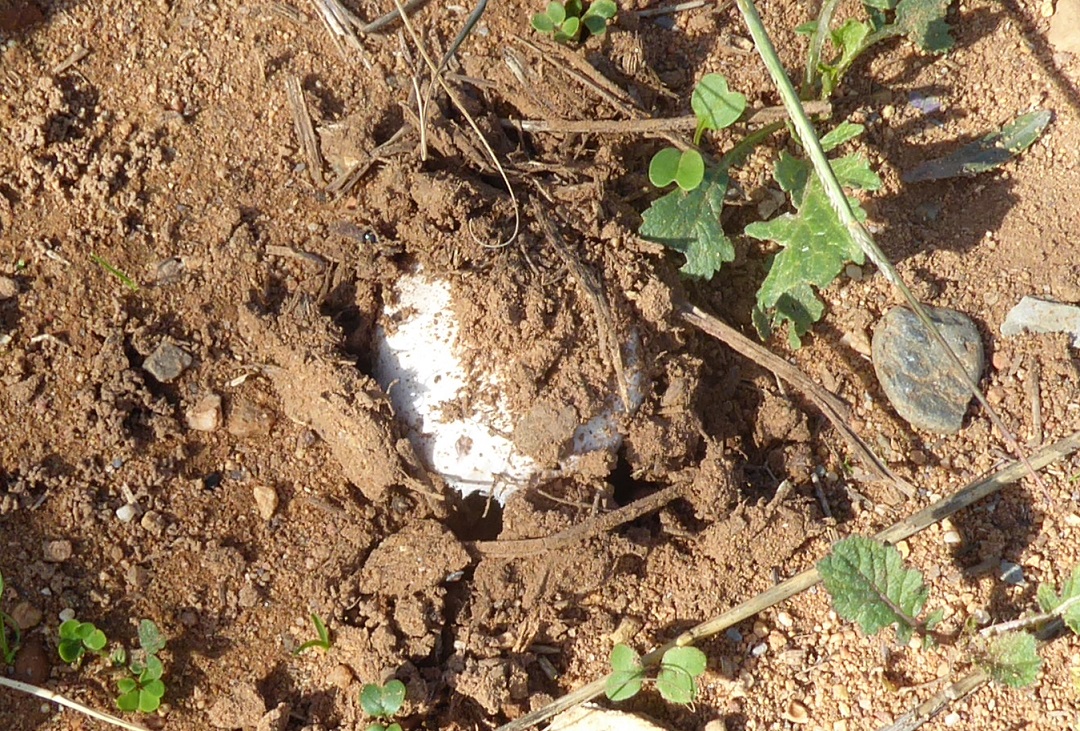
The  month ended on a high note though; the  rain at the end of May  triggered one of the delights of autumn, field mushrooms. These pop up across the farm and there is nothing like a plate of them simply fried in butter. A yummy way to end May, which when I look at a collection of the harvest wasn’t so bad after all.

KSU May 2019 Gallery