November 2019

I am late with  this post as we are already in December. As I write a cold south east wind is blowing. This is normally associated with early spring, but we have had some extremely hot days and summer is definitely here. The spring bloom has faded and we are reliant on summer stalwarts for colour, however looking back November  had many stars.

Roses

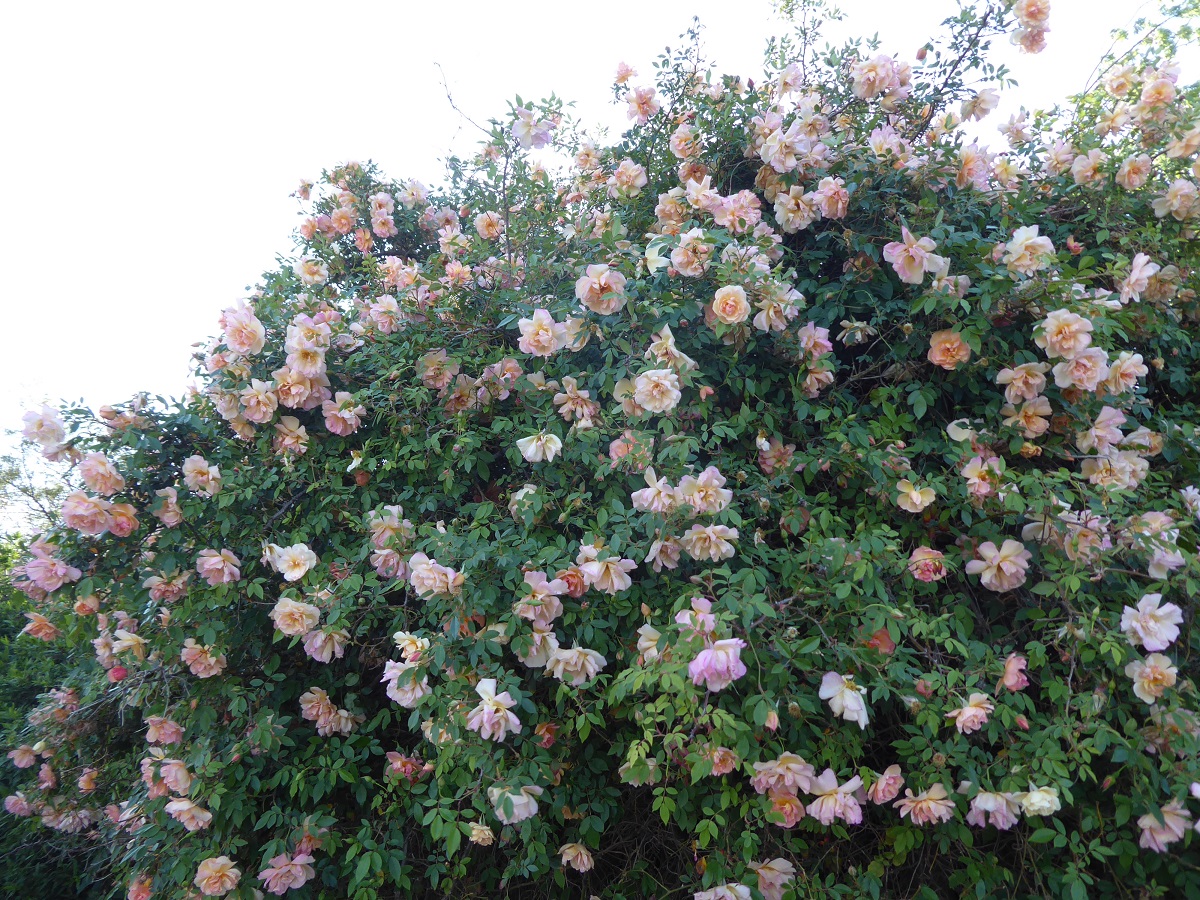
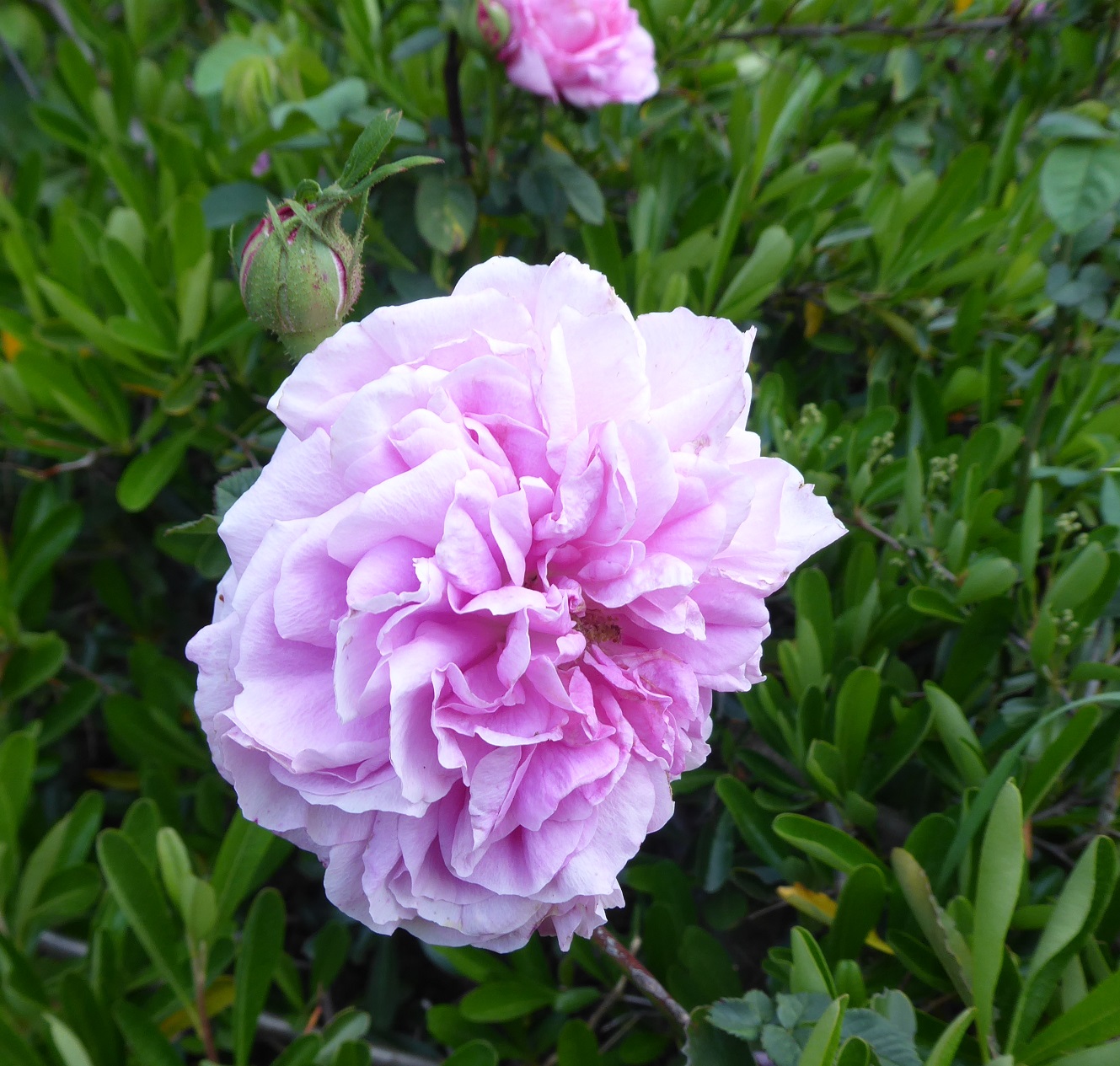
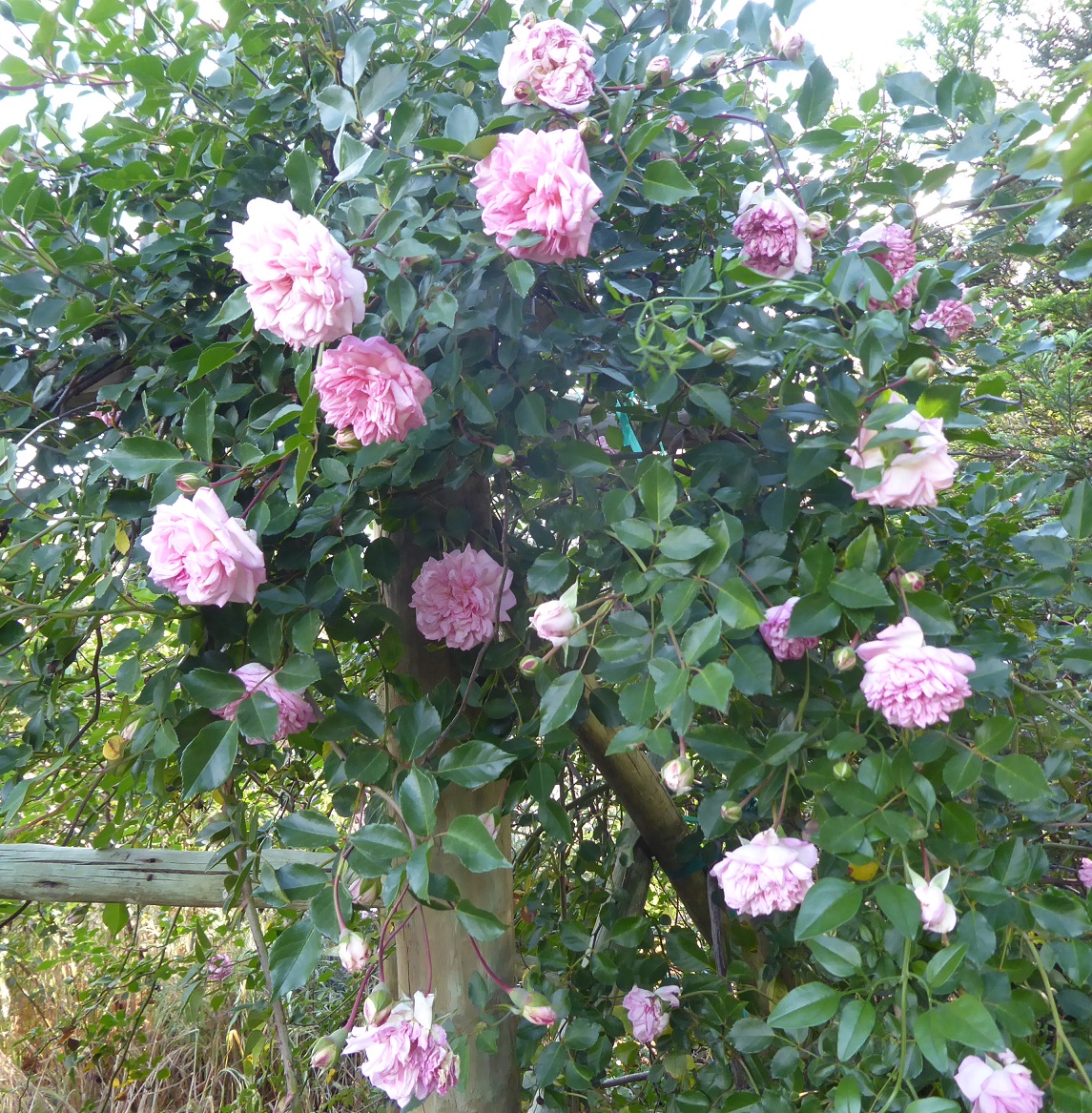
Early November was a glorious time in the garden. All the rambling roses were at their peak. One of my favourites is an old rambler with clusters of small very double soft pink heavily scented flowers. It is the rose which forms the boundary hedge at the old Boschendal rose garden. I am not sure of the name. I have two big bushes tangled up with a rampageous musk rose and a cerise purple old climbing rose called Russelliana. To be out in the garden in the early morning when the scents of all these roses are heavy in the air is to be in heaven.

There are several musk roses in the garden. Most have large clusters of single white flowers. One has delightful semi double flower. All are scented and most are vigorous growers with particularly vicious thorns making them ideal barrier plants.

November is also when the old Wichurana ramblers such as Dorothy Perkins flower. These roses have small glossy leaves and are common at the Cape surviving in old country hedges. Dolly as we fondly call her has clusters of bright pink flowers and vicious thorns, but no scent. She makes a charming picture growing in the plumbago on the boundary fence. I also have a darker pink red form for Dolly which might be the rose called Excelsa. It makes a huge bush tangled up with a rose which has clusters of single pink flowers with white centres.  I grew it from slip gathered on the side of the road near Joubertina in the Eastern Cape

The other very special Wichurana rambler to flower in November is the blue rose, Veilchenblau. I struggle to grow this rose well, but its flowers are a joy every year. I think it likes a little shade

Several years ago I bought two rose bushes from the university  Botanical garden in Stellenbosch. Their labels indicated that they had come from seed collected by the previous curator, Wim Tijmens, on a visit to China. Curator of this garden from 1966-1999, he was a great plantsman and I was delighted to give them a home. They have both done exceptionally well surviving with minimal water and make big bushes with smallish pale pink flowers. One is single, the other semi double

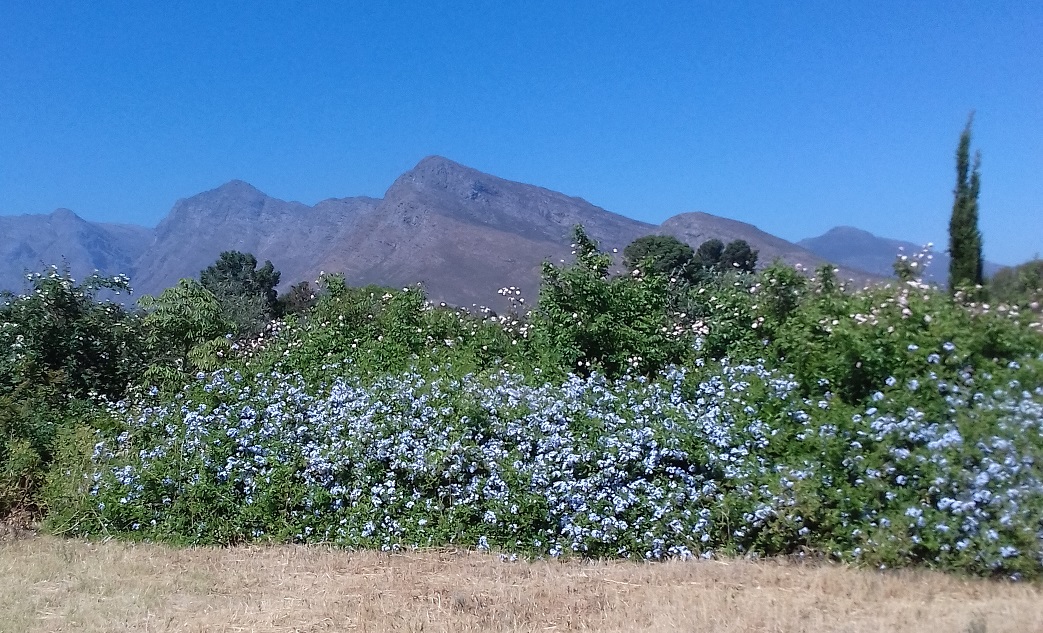
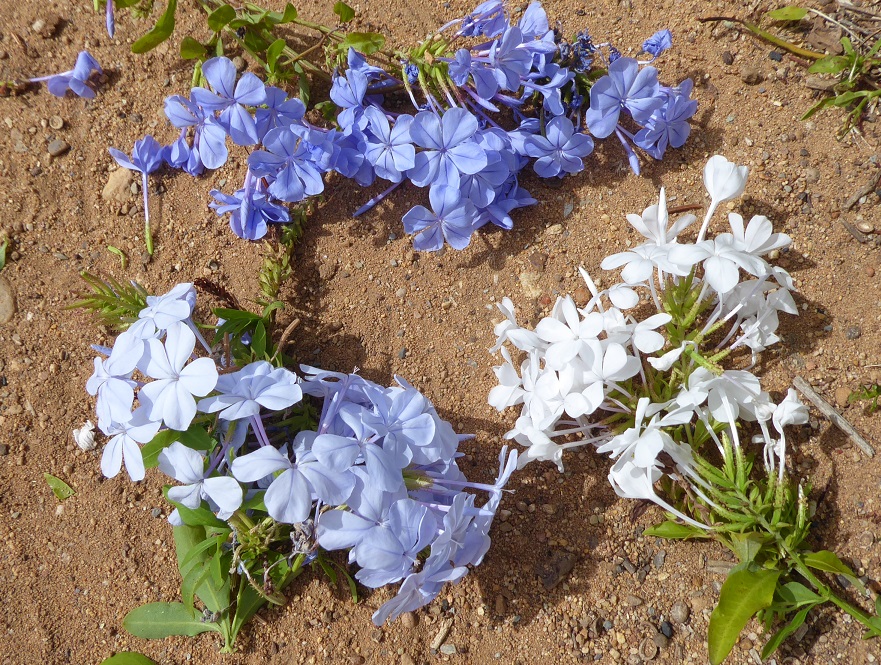
Towards the middle of the month the 3 huge bushes of Cécile Brunner or Bloomfield Abundance started flowering. I am not sure which it is as both have tall candlabras of pale pink exquisitely formed small flowers which tower up above the bushes. They were some of my earliest plantings and now they dwarf the plumbago hedge and everything around. They get no water in summer, but are thriving and their pale pinks blooms nodding over the blue hedge are pretty. I seem to have a soft spot for pink and blue combinations which make sophisticated gardeners shudder. What was the old rhyme – “pink and blue will never do, all the boys will wink at you” Well what is wrong with that!

Lastly it would be unfair to leave the roses without singing the praise of Mermaid. She was covered with her big yellow single flowers for about a month. Unlike the other rose mentioned, there will be more flowers as the summer progresses. Mermaid also has vicious spines and grows along the boundary fence surrounded by plumbago.

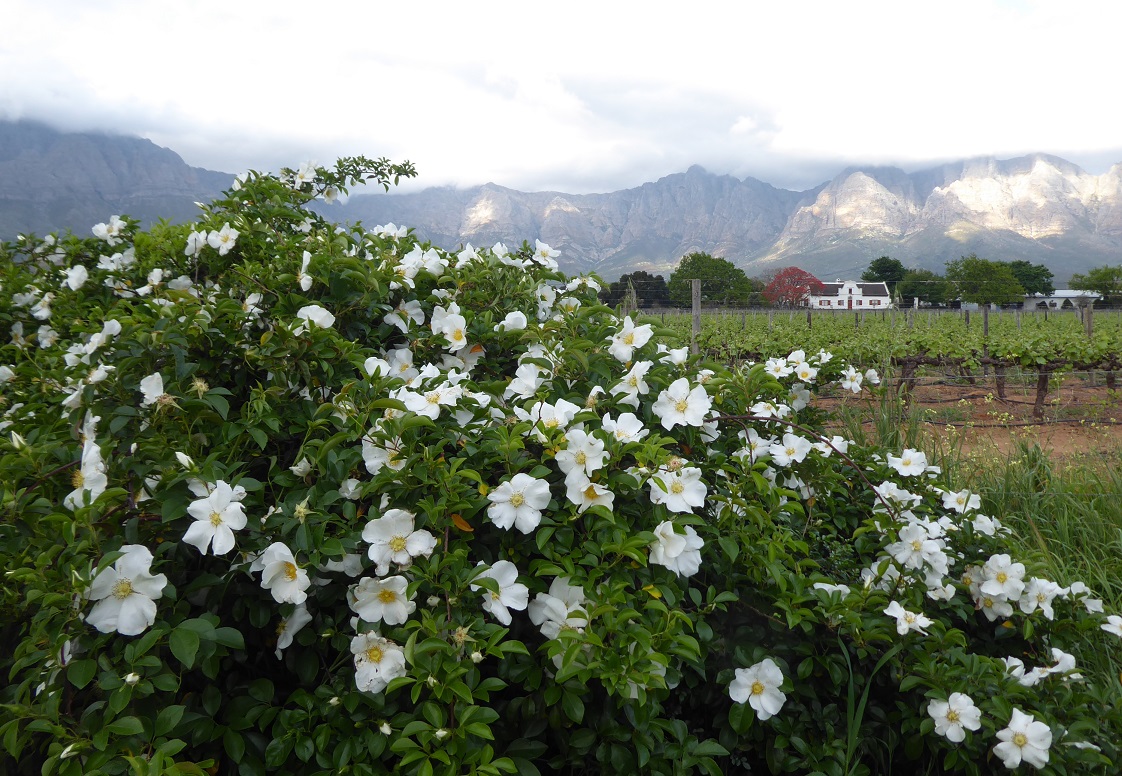
I was delighted to get her ancestor, Rosa bracteata, two years ago. This is also known as the Macartney rose and has single white flowers with bristly buds/calyxes and shiny foliage. A huge bush used to grow against the wall of the Castle in Cape Town, but last time I looked someone had set fire to it and I am not sure if it survived. This rose is sometimes confused with Rosa laevigata (the Cherokee rose) at the Cape but they are easy to tell apart. The leaves of R. laevigata usually have 3 leaflets, the flowers are bigger and occur very early in Spring, with a few in autumn. Leaves of R. bracteata have 5 or more leaflets, are glossier and it flowers later and on and off all summer. The buds are also bristly and the branches have brownish down.

Trees of November

Without a doubt, November is Jacaranda month. It is not only Pretoria that celebrates this tree, Boland towns also have magnificent specimens, often covered in  lilac purple flowers without a leaf to be seen. Our young trees have leaves while in flower and are not yet as spectacular. The sight of the flowers against the clear blue  sky is very special, as is the lilac carpet of fallen flowers. These trees are on the invasive aliens list and there are parts of the country where they should not be grown.  They are  best grown in a courtyard or paved area where you can grow other plants in pots and you can enjoy the carpet of fallen flowers. Very little will thrive in the soil under a Jacaranda.

Another tree which flowers this month is the Catalpa (Catalpa bignonioides) or Indian bean tree.  Despite the common name this tree is native to the south eastern states of the USA. These trees have large pale green hairy leaves and their tubular scented white  foxglove-like flowers with maroon speckled interiors come in drooping clusters. They like water and my tree is struggling, but farms nearby have some magnificent specimens. I first saw this tree near Zoo Lake in Johannesburg almost 50 years ago and have always wanted to grow one. It is closely related to the Paulownia with lilac flowers which I tried to grow, but lost.

The Jamboes tree also bears its clusters of creamy white fluffy flowers now.  These if we are lucky will grow into tasty rose apples to enjoy at Easter.  This tree is a member of the Eugenia family and has glossy leaves which emerge an attractive bronze red.   Jamboes used to be common in old Cape gardens, but they are seldom seen now.

Lovely white shrubs.

I have several pretty white shrubs which look great in November. First is Romneya coulteri, a poppy with spectacular big white flowers with yellow centres. Fried egg plant is one of its common names. This is a wandering perennial plant which sends up tall stems (about 2m) of greyish silver leaves. It is tricky to get established and will only grow from root cuttings taken in the middle of winter (June). It comes from California and Mexico and does well in the sandy soils of the Cape, but you need a big space to do it justice as once it gets going it will spread over several metres. From my front veranda I can see it displayed against the purple dodonea, but the real joy is to stand under the plants and look at the sky through their crepe paper like flowers. It is very drought tolerant and gets no summer water.

The carissas are also in flower this month and Carissa edulis in particular has been fabulous. The whole bush was covered in clusters of white flowers emerging from pink buds. The sweet scent is glorious, and I picked a big branch for the vase and enjoyed the fragrance indoors for a week.

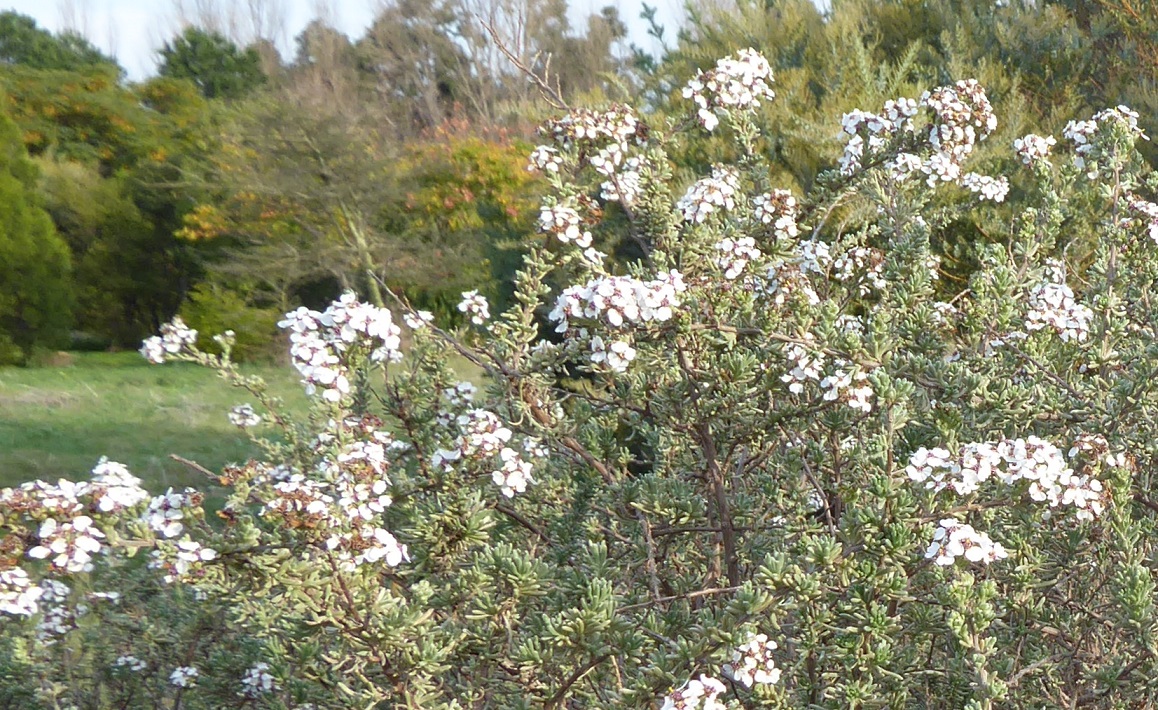
Escallonia is also a valuable shrub in the garden. Its evergreen foliage always looks healthy and is a good foil to the plant’s  clusters of small waxy pristine white flowers. You do get pink and red colour forms, but I prefer the white.   I should prune and shape the plant more to enhance its value.

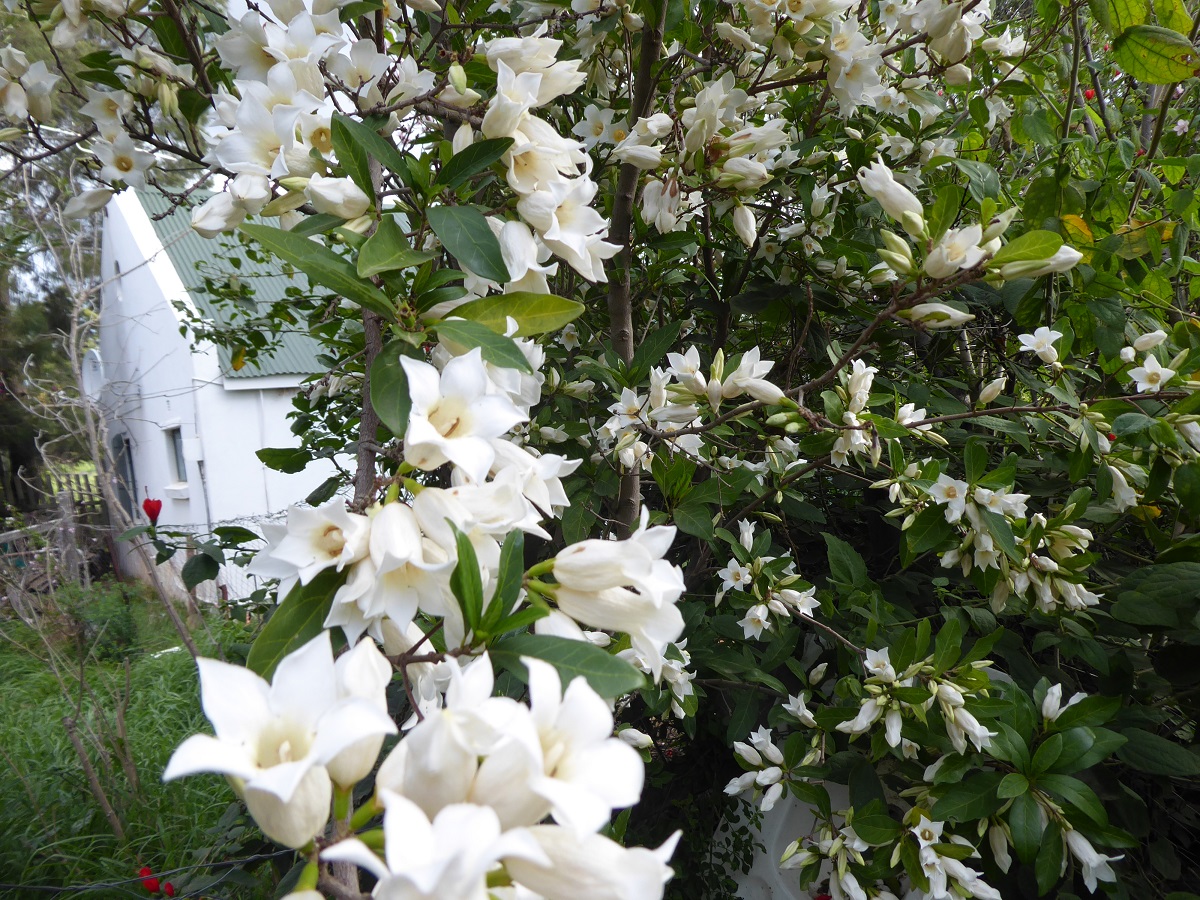
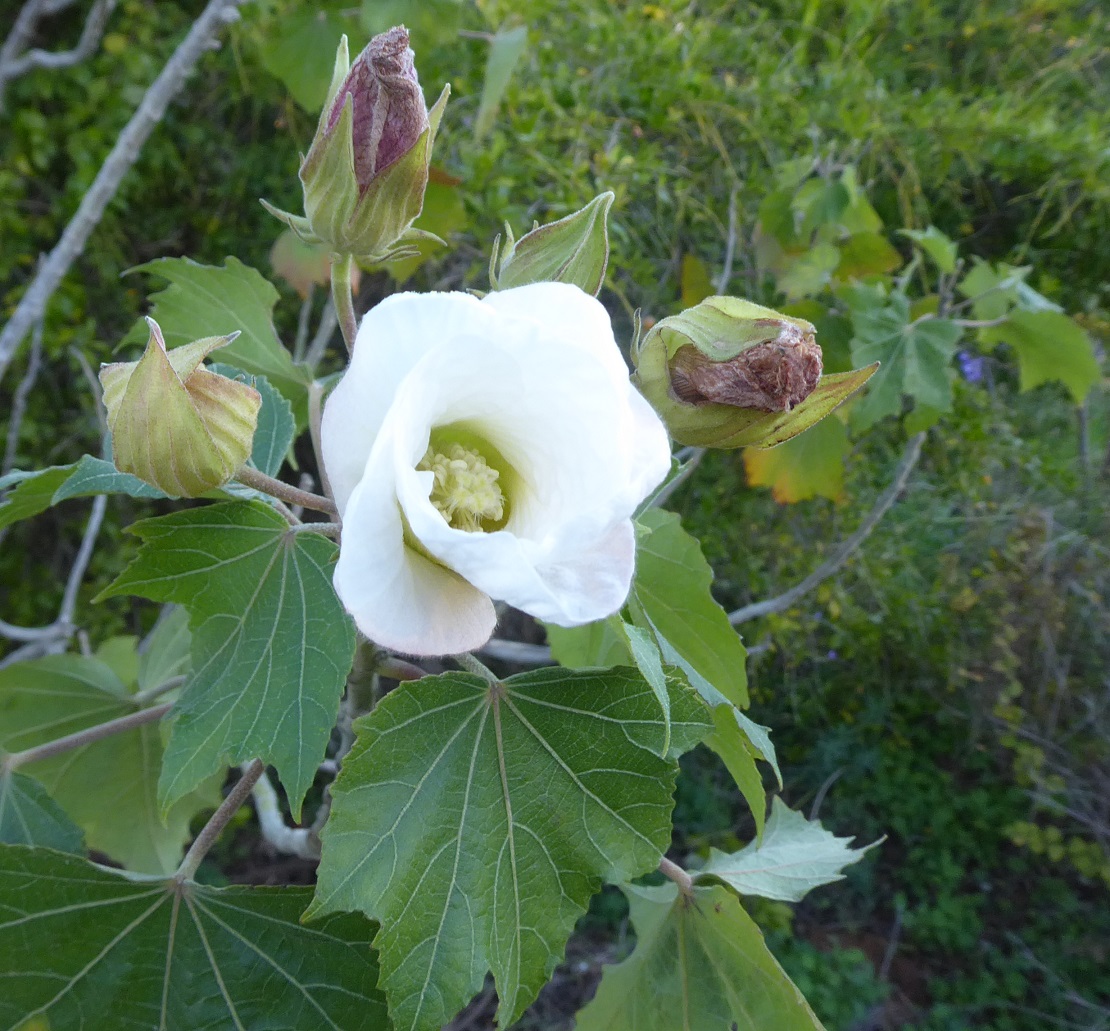
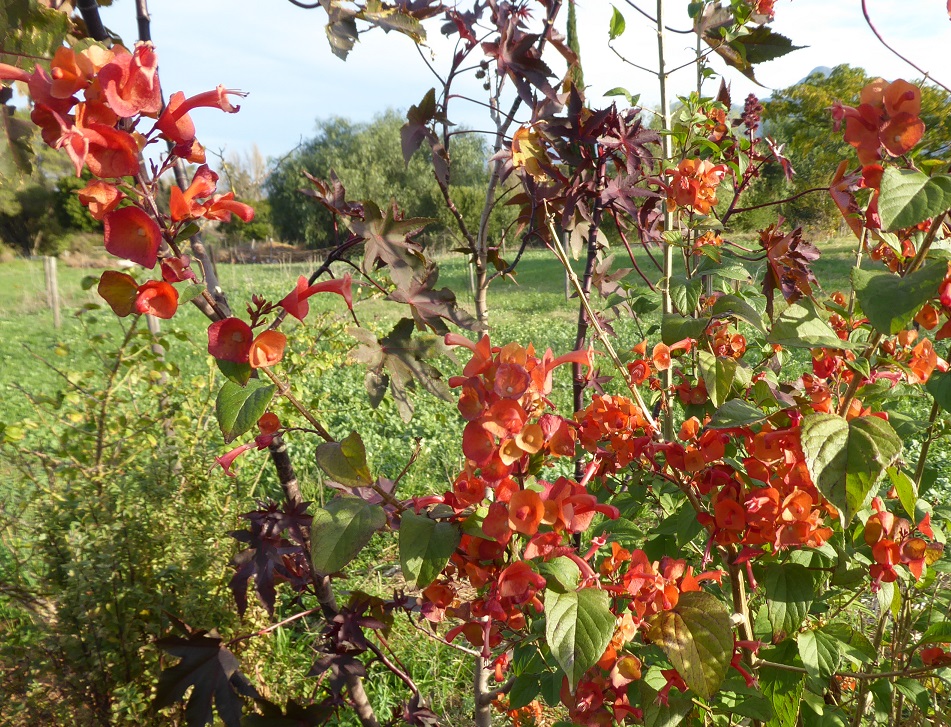
Lastly is  sweetly scented Bauhinia bowkeri. This scrambling shrub comes from the Eastern Cape, but has done exceptionally well here. The white flowers emerge from  unusually coloured mink brown buds and cover the big bush for at least a month at this time of the year. It has typical twinned bauhinia leaves which are a fresh green.

Cacti

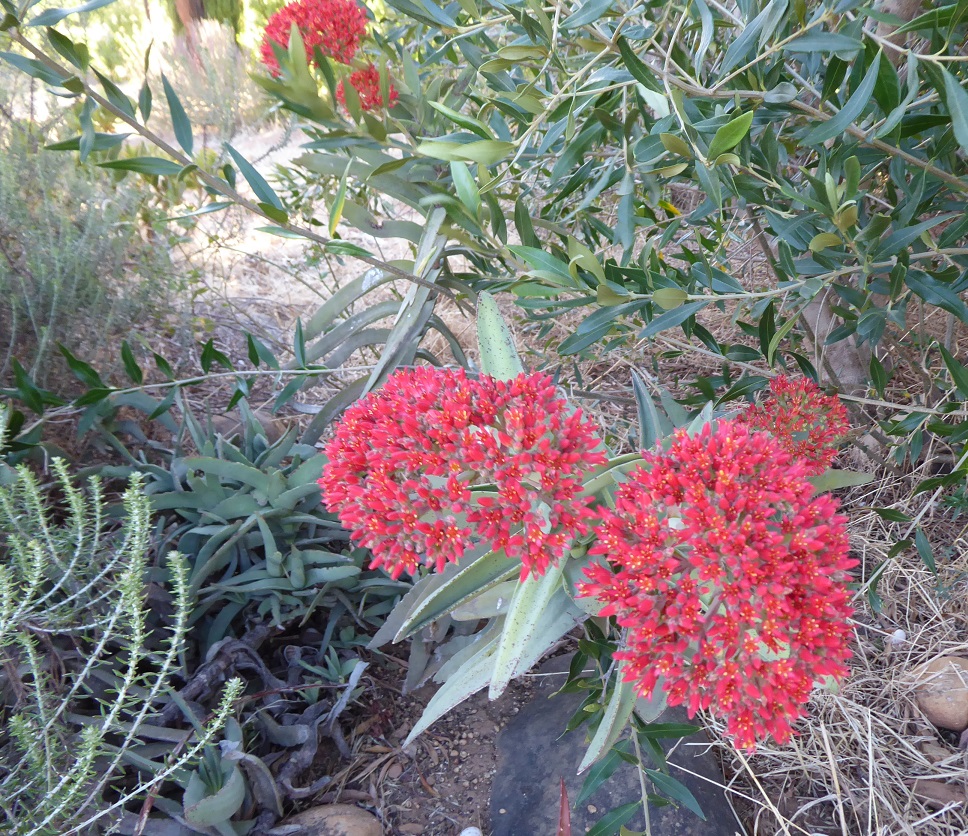
Early in November we were treated to a spectacular flowering of the red cacti on the succulent beds. These cacti usually sense approaching rain and time their flowering to coincide with the rain. I should try to find out what they are called, but meanwhile we just enjoy them.

One grows as a cluster of tallish columns (about .5m) and has small red flowers that stick all the way up the stems. It flowers off and on all summer as fronts pass.

The other has an increasing clump of dumpy stems covered in prickles from which flower buds emerge. The large brilliant red iridescent double flowers remain open for a few days. These flowers are also triggered by the promise of rain, but the flowering in November was exceptional and the entire clump was covered in blossom.

Lastly I have a pale pink cactus which has similar short stems which make spreading clumps and it only flowers now in spring, but the large single flowers are exquisite, albeit short lived.

Fruit and veg

The veggie garden is dying back in the heat, but we are enjoying the courgettes. These are very rewarding to grow and one has to be vigilant as they can turn into giants overnight. The Lazy housewife beans are also starting to bear. These runner beans do well out here in the Boland and are delicious if picked before they get too old.

I was able to make us a pot of gooseberry jam from my pickings in mid-November. We have also been feasting on Logan berries. These ripened towards the end of the month and are a fleeting treat. The apricots are starting to ripen so more jam making is scheduled. The mouse birds are eating the peaches much to my annoyance. When I first came here there were none of these birds about, but their numbers are increasing.

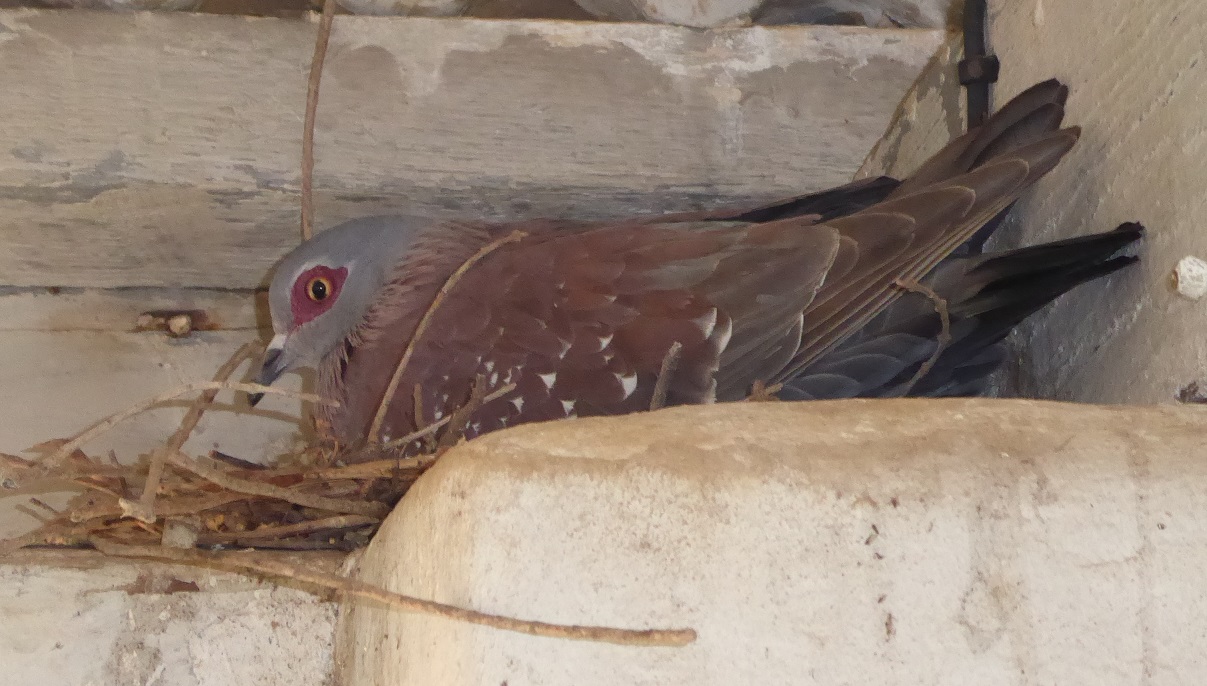
As we move towards Xmas we are spending more time on the stoep/veranda in the heat of the day doing jigsaw puzzles. We share this with nesting rock pigeons, swifts and sparrows. It is a fairly busy and noisy household.

KSU November 2019

October 2019

As I write at the end of October we are shivering and the peak of the mountains to the east has a very light dusting of snow. We have had over 50 ml of rain in the past 5 days too, which has helped after the extremely dry early spring. I had been watering everything in the garden, but can hold off now for a week or two.

This month has its beauties in bold shades, but it is also hay fever month. The grass all runs to seed and the syringas flower. Both of these seem to trigger my sneezing. This year we have been lucky to be spared the howling south east wind which often arrives now and we have had some glorious days.

Every Saturday two men who work on the farm next door come to cut grass for me. It is vital that we get it all cut back now as fires are a hazard in summer. It also makes it easier to spot snakes as I wander about watering. Much of the grass is wild oats, but there is also something we call steekgras which has horrible prickly seed-heads which penetrate boots.

Purple glories

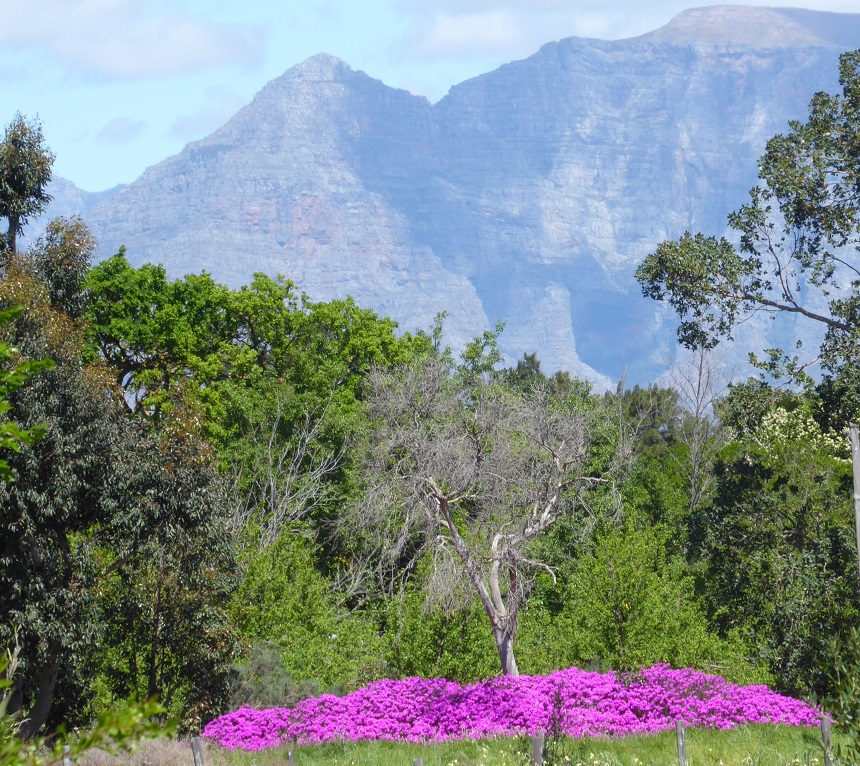
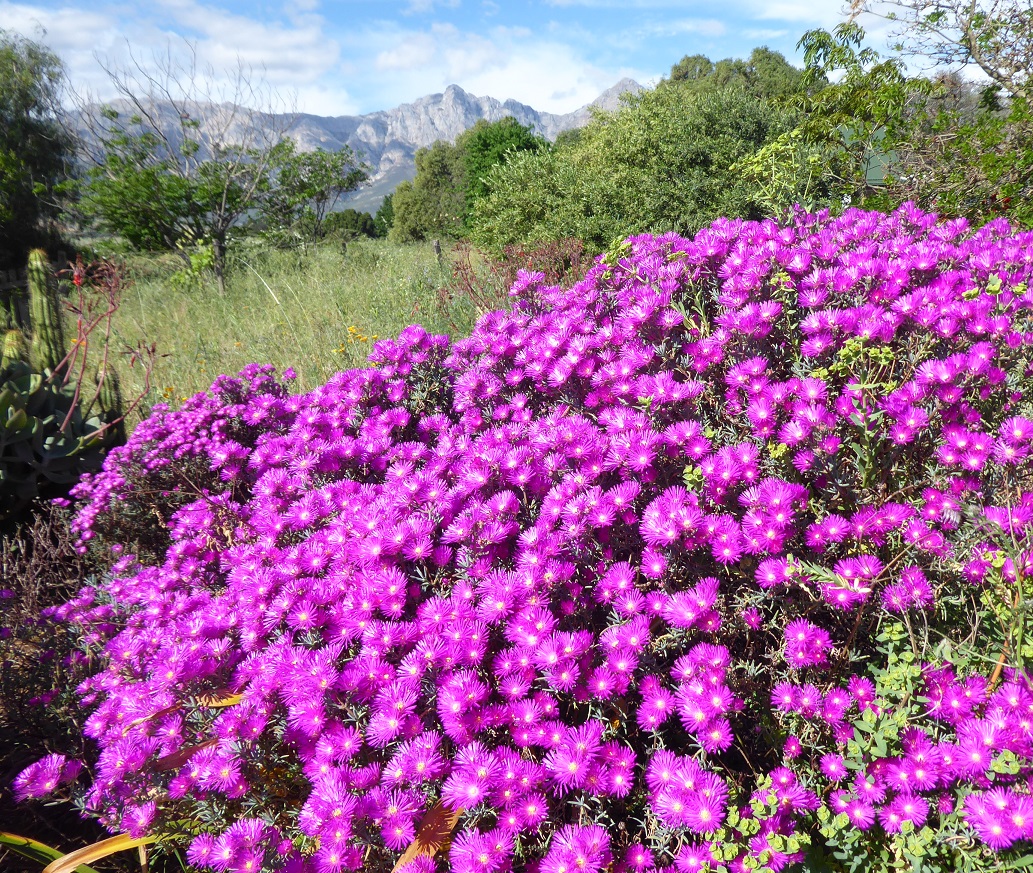
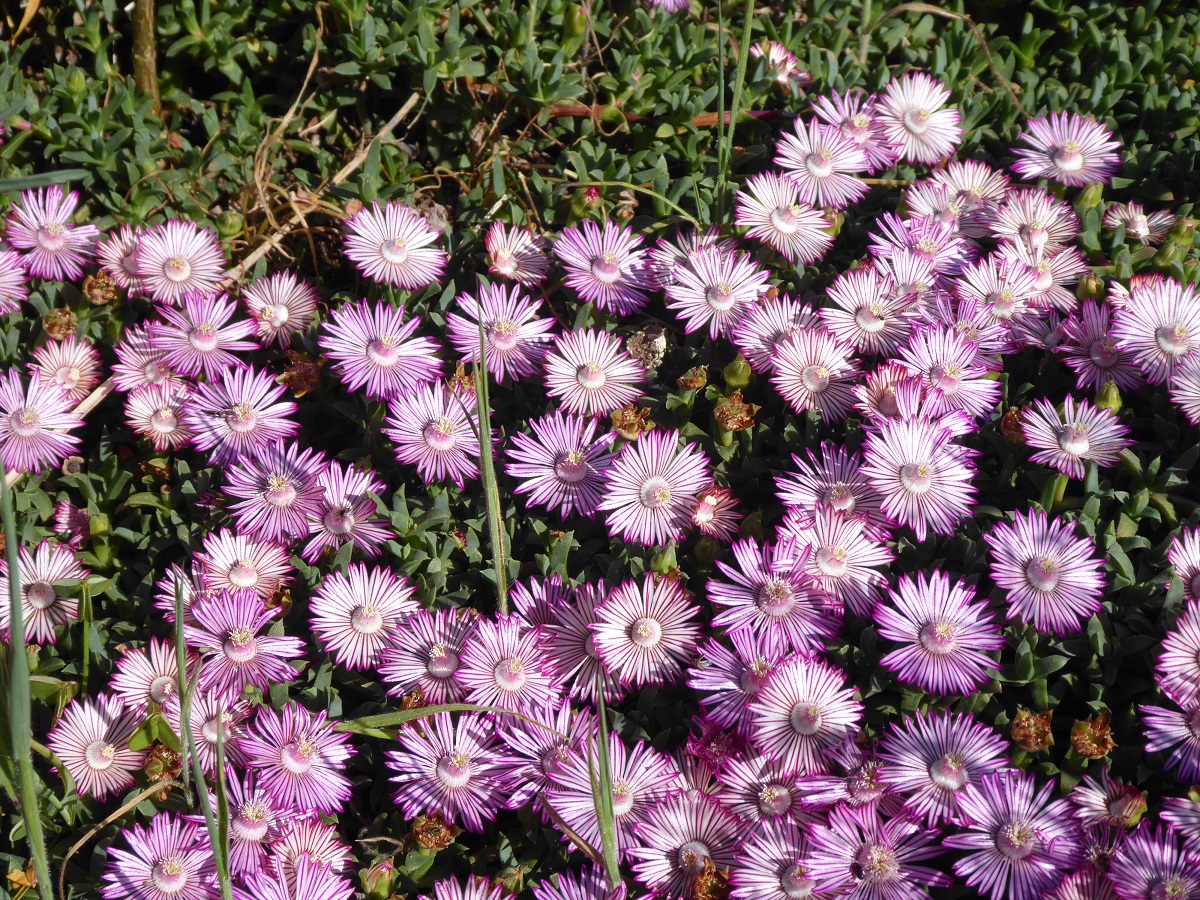
October had a dazzling welcome with big bushes of purple pink lampranthus planted by a neighbour flowering down our road. I also have big bush of it on one of the succulent mounds which has survived for about 15 years. There is nothing subtle about this vygie. This is prime time to visit the Karoo Desert Botanical Garden in Worcester as it has an impressive collection of vygies in shades or red, orange, purples and pinks. Take your sunglasses!

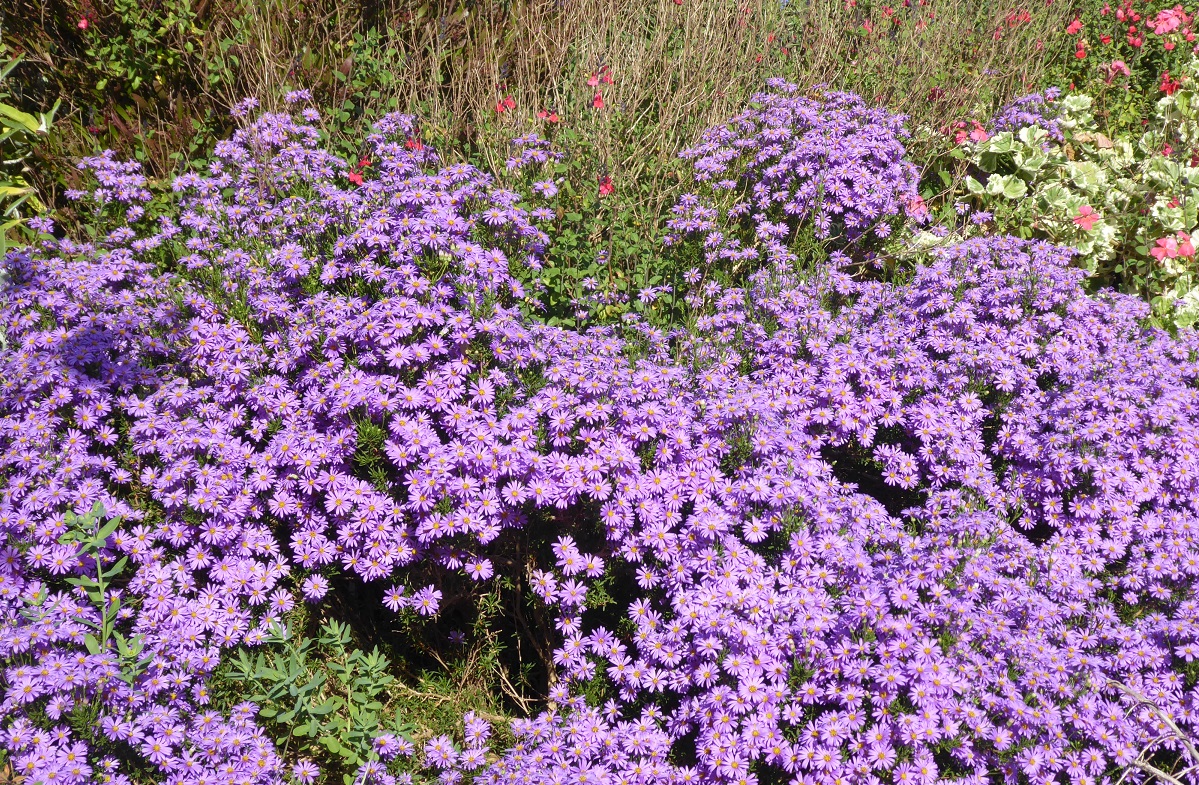
Felicia filifolia is also covered with small starry bright mauve purple flowers this month. This is another native plant and occurs widely in South Africa. It also does not need any water in summer. With its fine, light green leaves it is an attractive shrub even when not in flower and can spread to about 2 m x1 m. One has been growing in my garden for about 12 years now and dazzles for about three weeks every spring.

Growing near the Felicia is another stunning shrub, a Pride of Madeira (Echium candicans). With its towering spikes of tiny bright blue flowers and elegant grey leaves this is another joy in October. This shrub also doesn’t need water in summer, but it is fairly short lived and needs replacing every three or four years. Seedling do pop up sometimes when the mother plant dies.

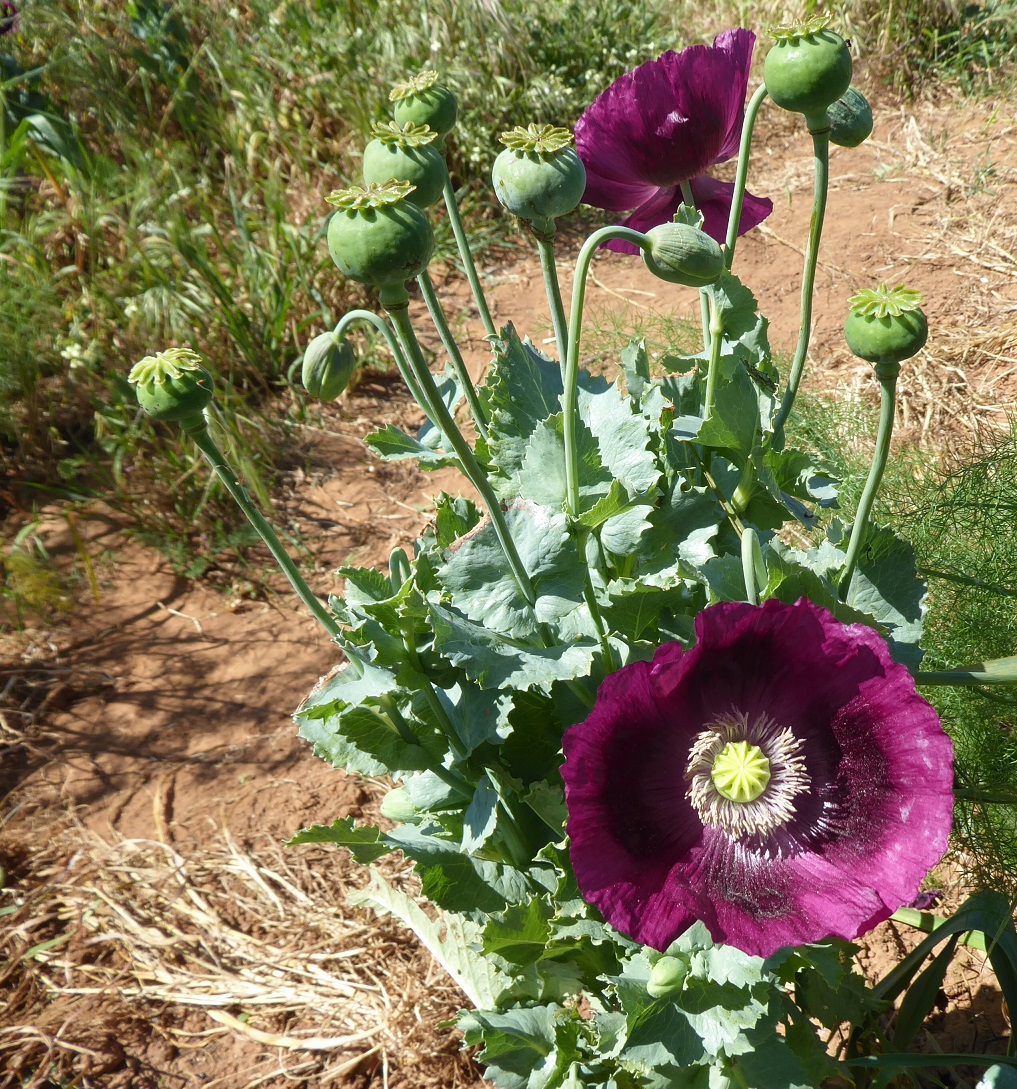
I love poppies and wish I could grow more. The opium poppies self-seed in the veggie garden and open their big purple flowers this month. I like their handsome silver grey leaves and silver pepper pot seed-heads too.

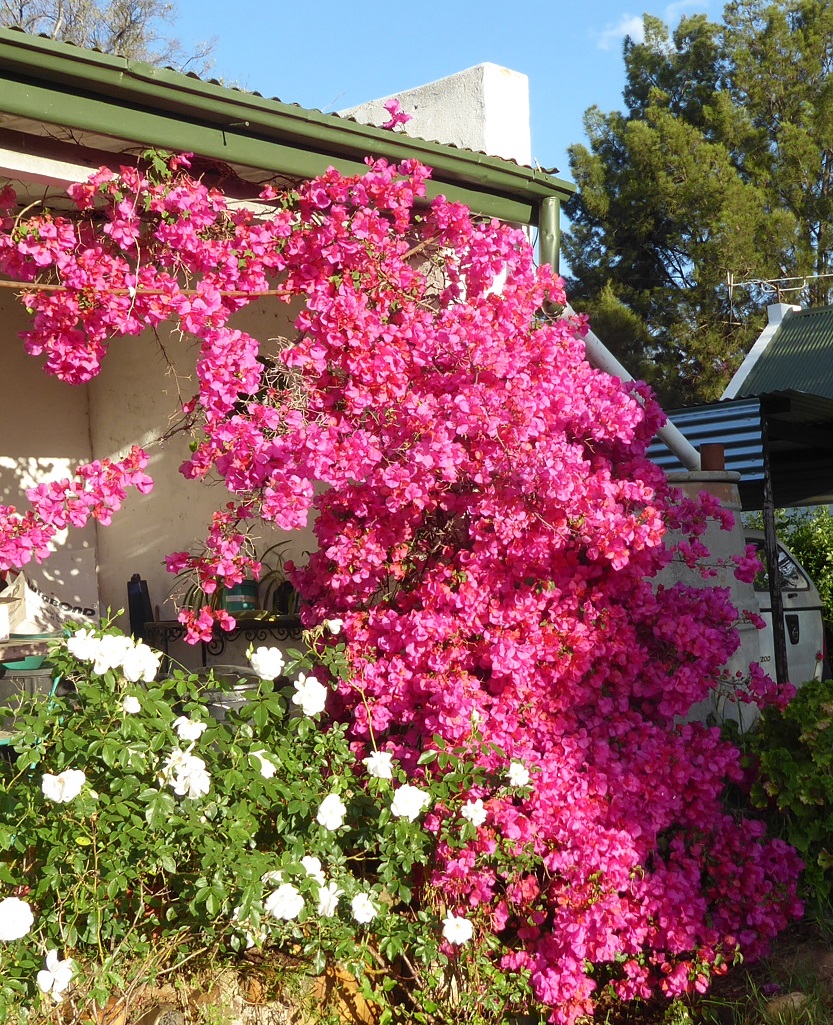
Bougainvilleas also start flowering this month. Growing up the side of my stoep is a bright pink purple bougainvillea which will be a joy all summer long.

Orange and red

I am very fond of pomegranates. They are attractive in almost all seasons and this month they bear their bright orange red flowers which show up brilliantly against their glossy green leaves. Aside from pomegranates which bear fruit, I have two purely decorative forms. One has double bright orange flowers which are fuller than the normal form and the other has striped cream and orange double flowers. I think this form is called ‘Madame Legrelle’ and it is a beauty. I once saw a pomegranate with yellow flowers in a garden in Alice, but unfortunately the cuttings I took did not grow.

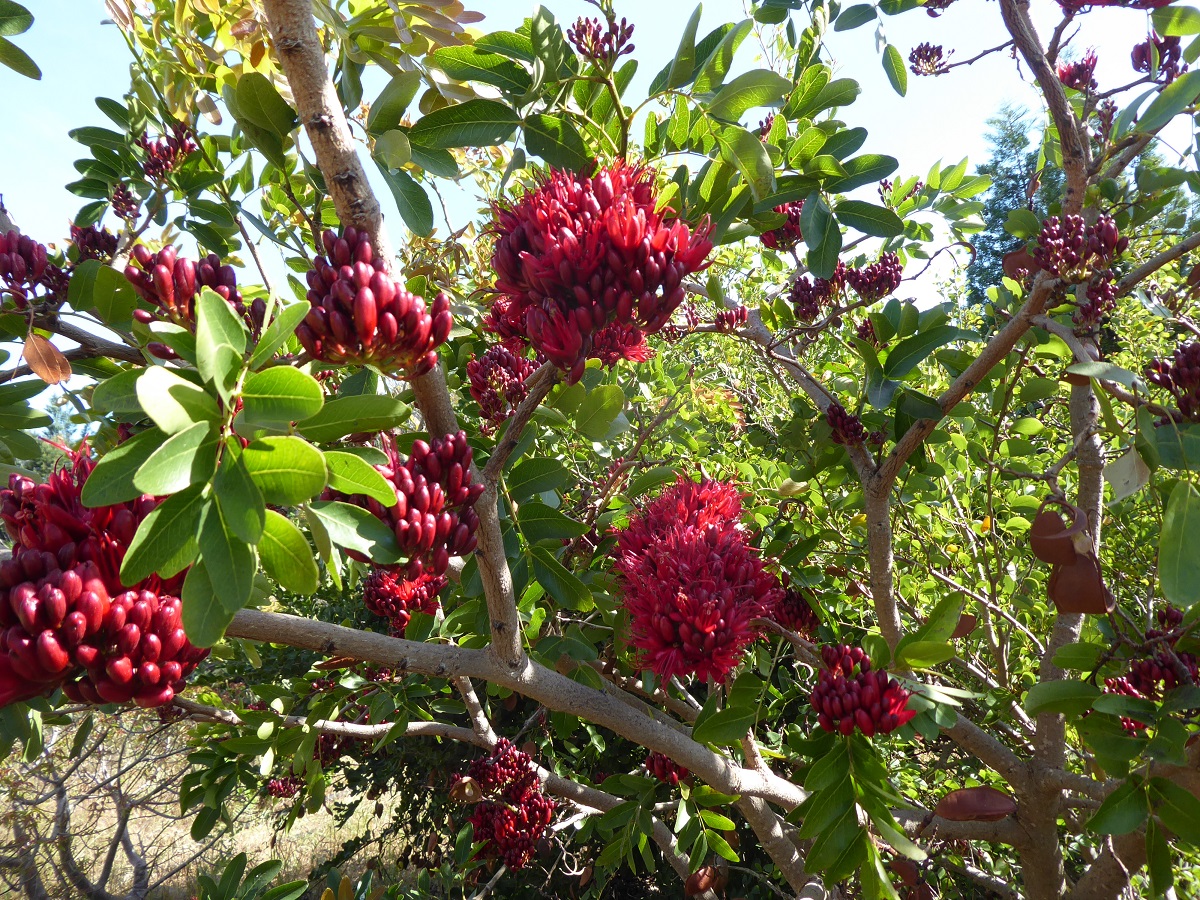
The other marvellous combination of red and green this month is the weeping boerboon, (Schotia brachypetala). In my garden this shrub starts its season with beautiful bronze new leaves which turn a fresh light green as the trusses of flowers form close the trunk and branches. My tree is still quite young and small, but is a treat for whole month of October.

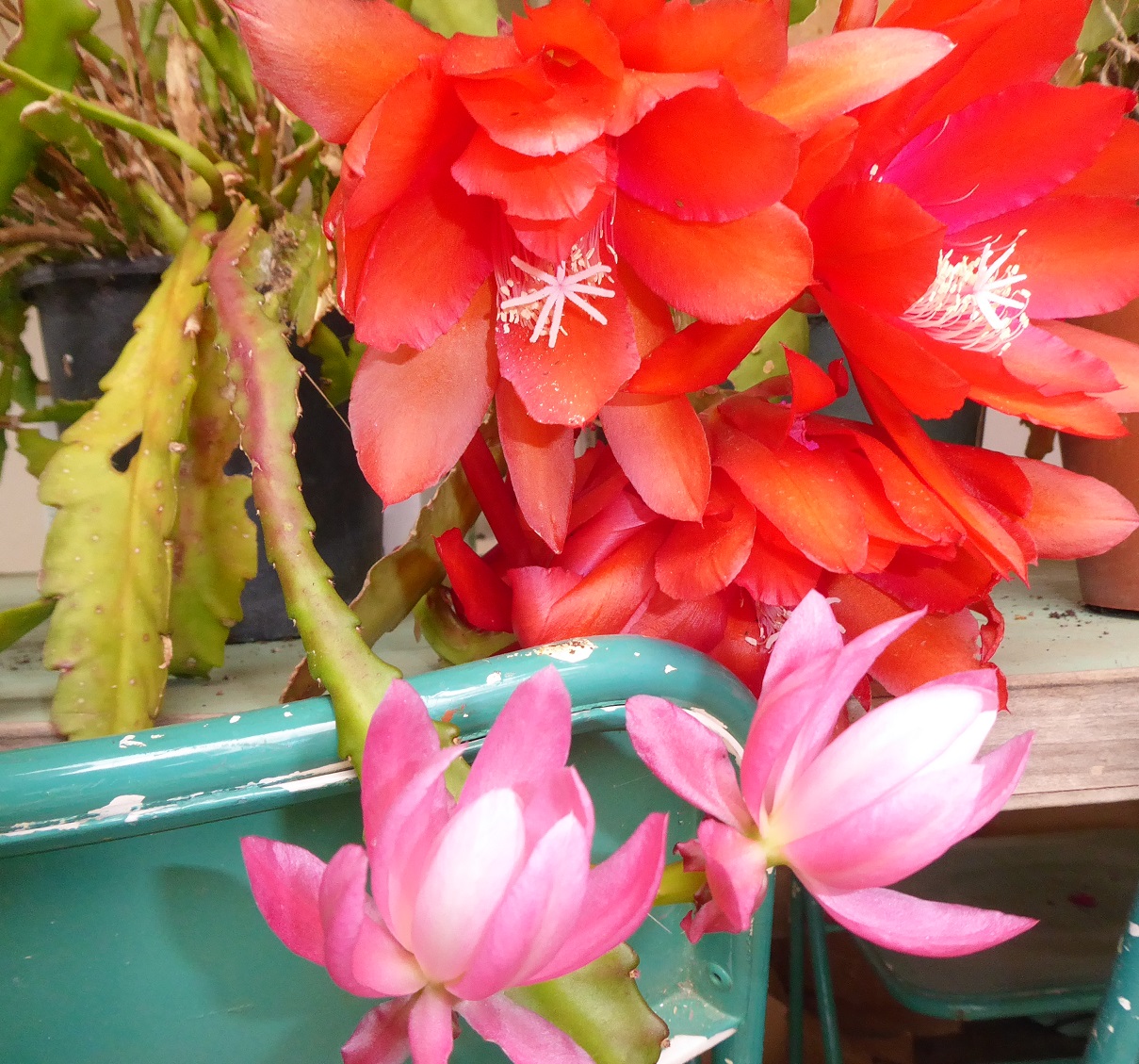
Last of the glorious reds is a cactus with large red flowers with almost iridescent purple interiors. I am not sure of the name, but although fleeting this flowering is stunning. A smaller pink and white cactus also flowers now. I must track down the names.

White beauties

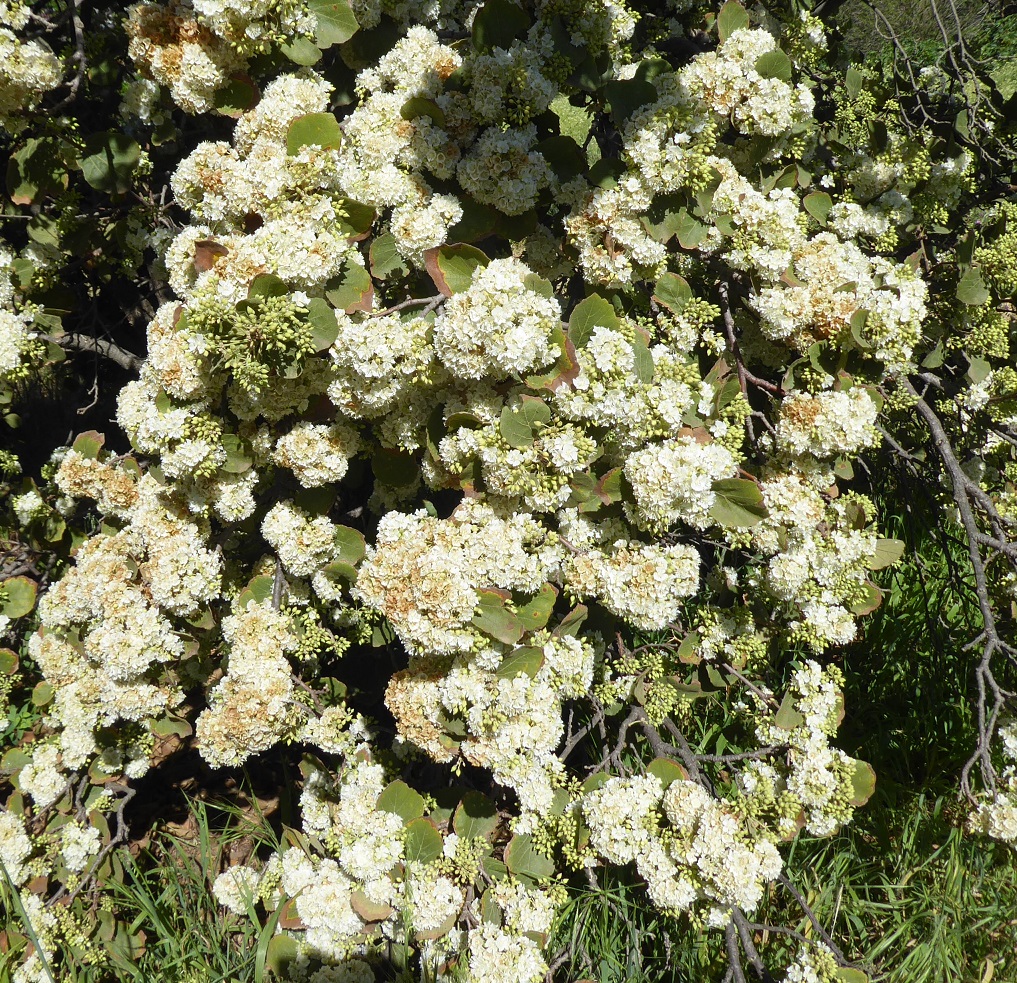
As a contrast to the bright colours, Dombeya rotundifolia the wild pear comes covered in trusses of white blossom early in the month. This tree comes from further north in South Africa, but mine has survived for 15 years, with very little summer water. Sadly the flowers turn tan within a week, so the pristine spectacle is short lived, but this little tree has attractive rounded grey green leaves in summer and warrants its place in the garden.

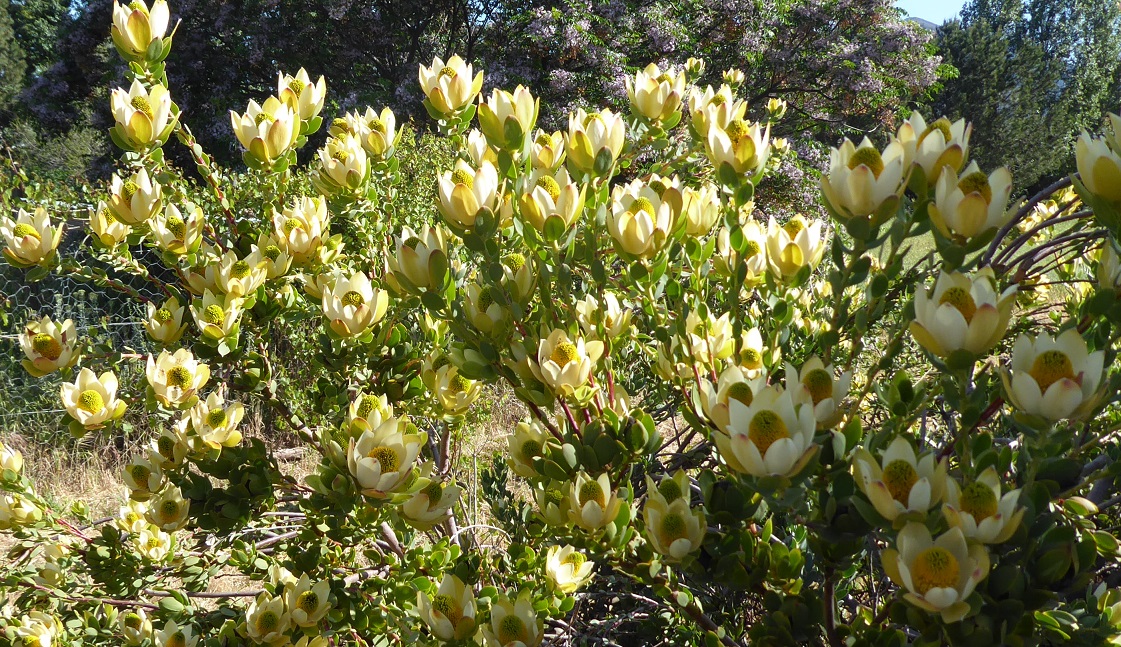
Quite near the Dombeya is a big Leucadendron bush which is also at its best this month. I think it might be L.discolor. It has limey green  yellow flowers which last well in the vase

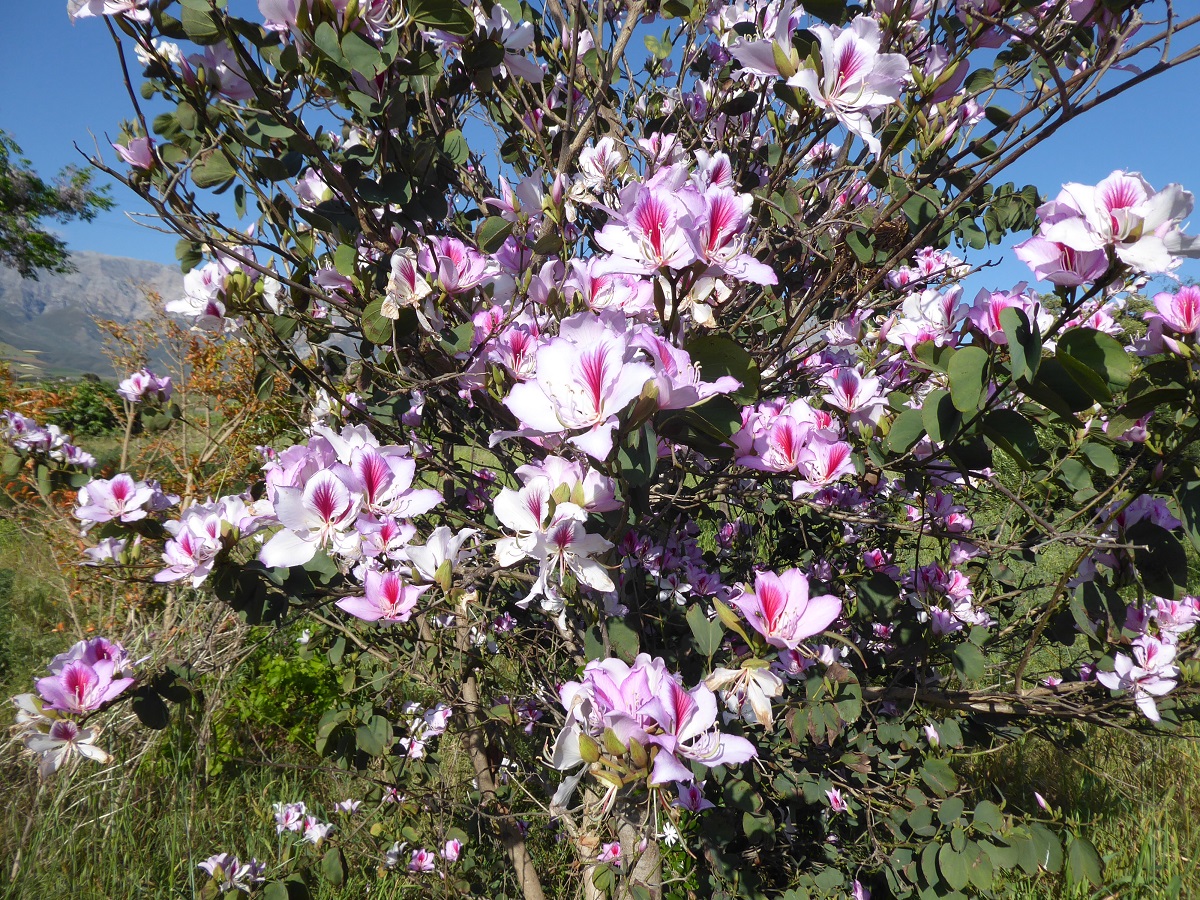
Although they are on the no no list I cannot resist the pink and white orchid-like flowers of Bauhinia variegata and these trees are the glory of the garden now in October. But even more special in my view is the pure white form which has a touch of green to the flowers. These flowers are lightly scented and as beautiful as magnolia blossoms. I planted it near a dense green yellowwood to emphasize the purity and beauty of these exquisite white flowers.

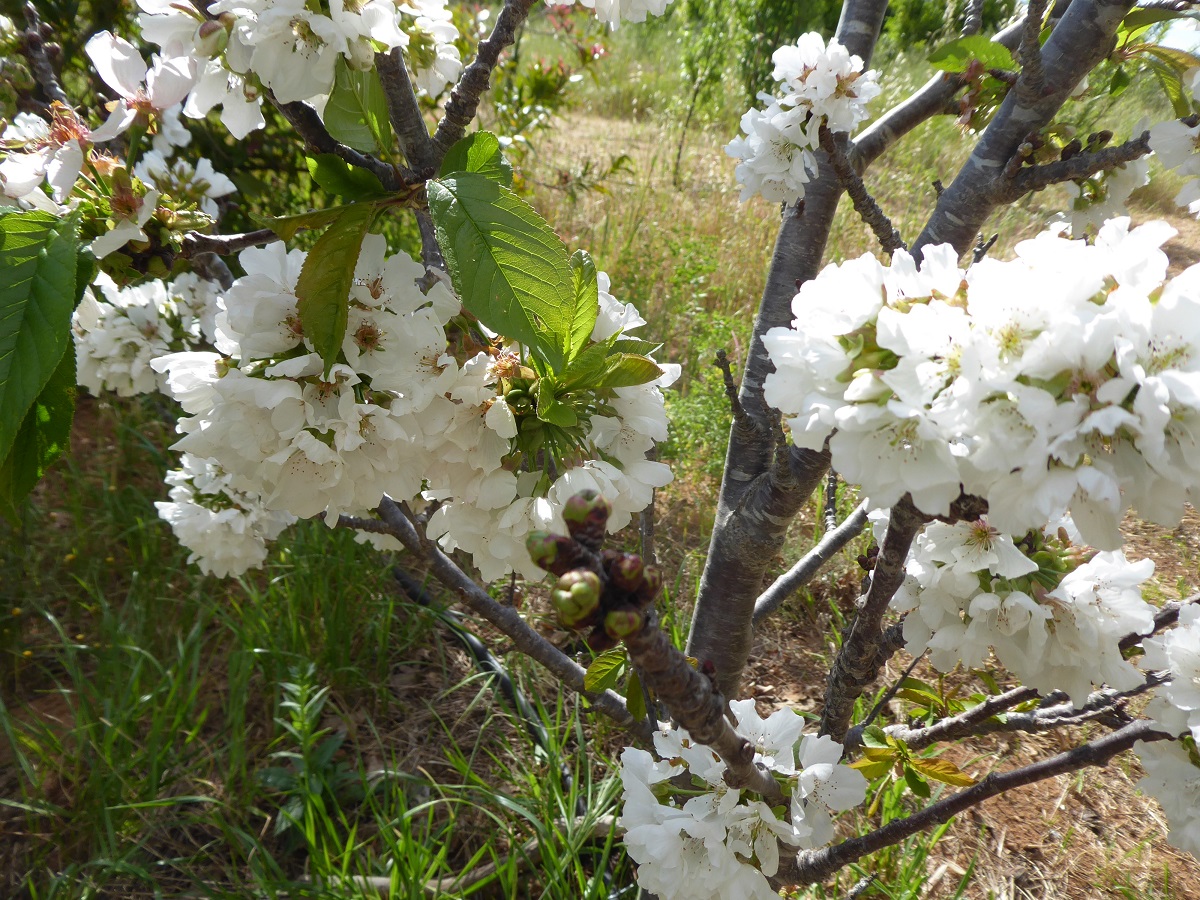
Gardeners are often a little crazy and I have planted 2 fruiting cherries. This climate is too hot for cherries and they are not thriving. If I get 5 cherries it is a lot, but when the little trees bear their pure white flowers, they are beautiful.

Although more cream than white, the olives also flower this month, their small lacy flowers a harbinger of the crop to come.

Scents of October

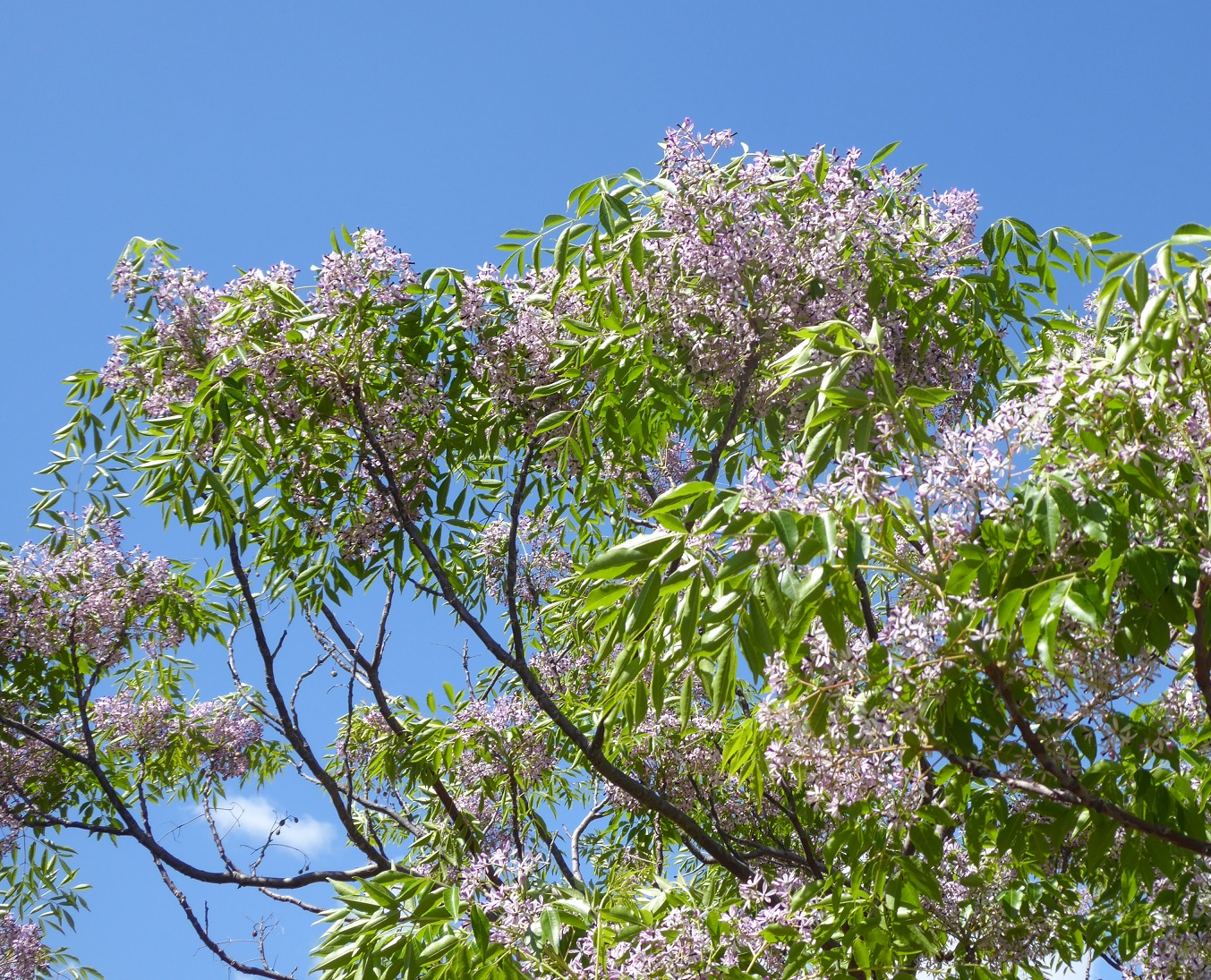
The garden in early October is pervaded by the scent of syringa, or Persian lilac (Melia azedarach) as it is sometimes called. With trusses of lilac coloured flowers, this is another plant on the no no list and I do diligently remove seedlings, but have left some trees. They are nowhere near as invasive as the wild olives in my garden.

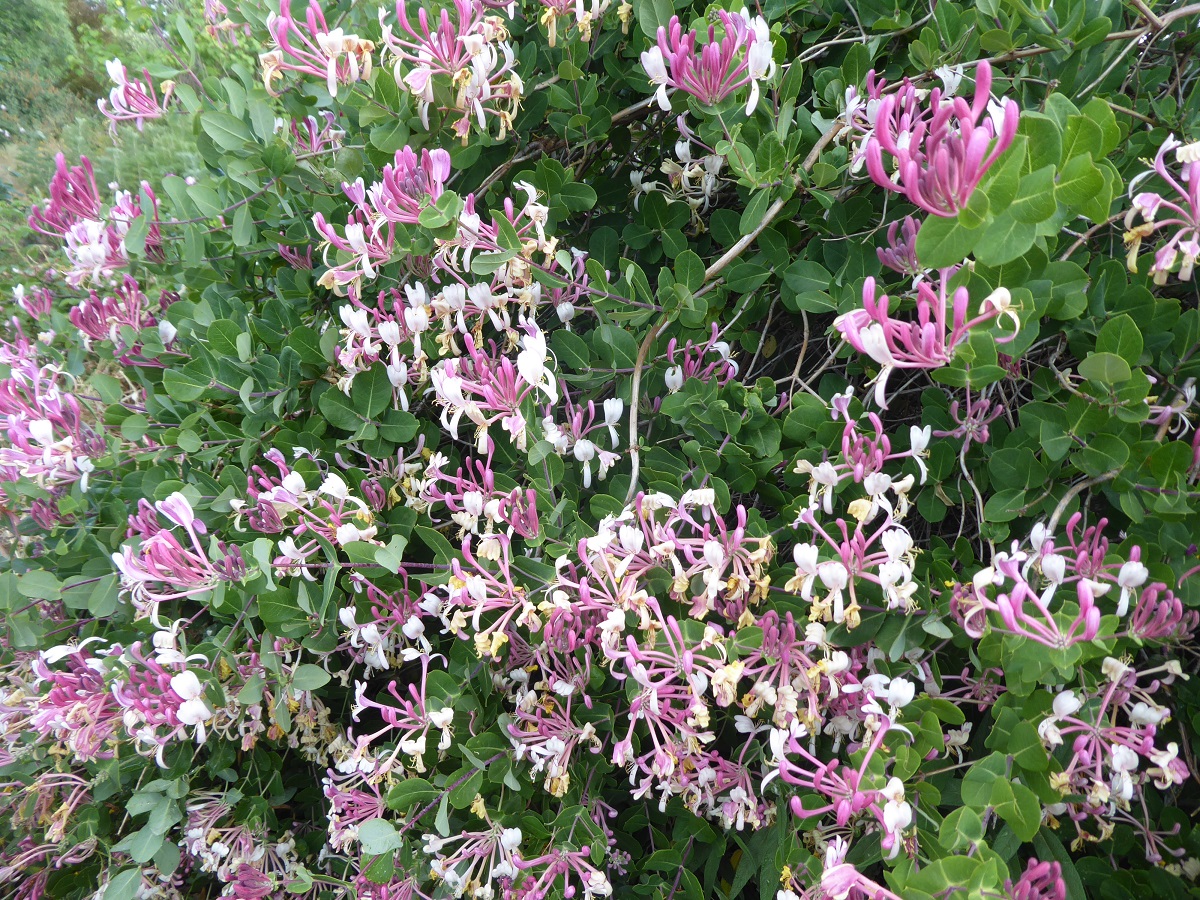
The other gloriously scented plants are the honeysuckles which are especially nice this month. In the rose garden is an enormous bush of European or Belgian honeysuckle ( Lonicera periclymenum) with flowers in shades of cream and pink which looks lovely beside apricot roses. And growing next to our cottage is a huge mass of the climbing cream and white Japanese honeysuckle (Lonicera japonica). The former only flowers for about a month now, but the other will flower all summer long. I also have a plant which might be a hybrid between the two.

Another glorious scent in October is that of the common mock orange, (Philadelphus coronarius). The bushes in the rose garden come covered in pure white single flowers enhanced by yellow stamens. There is something virginal about this shrub with its sweetly scented flowers and pale green leaves, but is surprisingly tough, surviving with very little water. I also have a mock orange from Mexico which I got from Peter and Barbara Knox- Shaw. It does not flower as well, but it equally strongly scented.

The orchard is redolent with the scent of real orange blossom in October. Now is the time I make my van der Hum liqueur. The old Cape recipe calls for naartjie peel and a handful of orange blossom which one soaks in brandy with other spices for 40 days.

Roses and Irises

I love old fashioned roses and grow quite a few of them. October is the month when they are at their best and the old rose garden was one of the first gardens I planted when I came to KSU 16 years ago. It is a joy to be there now and to drink in their perfume and admire their subtle colours, but it isn’t that easy to capture the essence of their enchantment in photographs.

In mid October we travelled to Barrydale for a weekend to see the gardens in bloom there. It is a charming little town with some lovely and interesting gardens and it was very nice to see lots of old roses still growing along boundary fences, including a glorious bush of an apricot coloured rose I could not identify. I took some cuttings- ever hopeful.

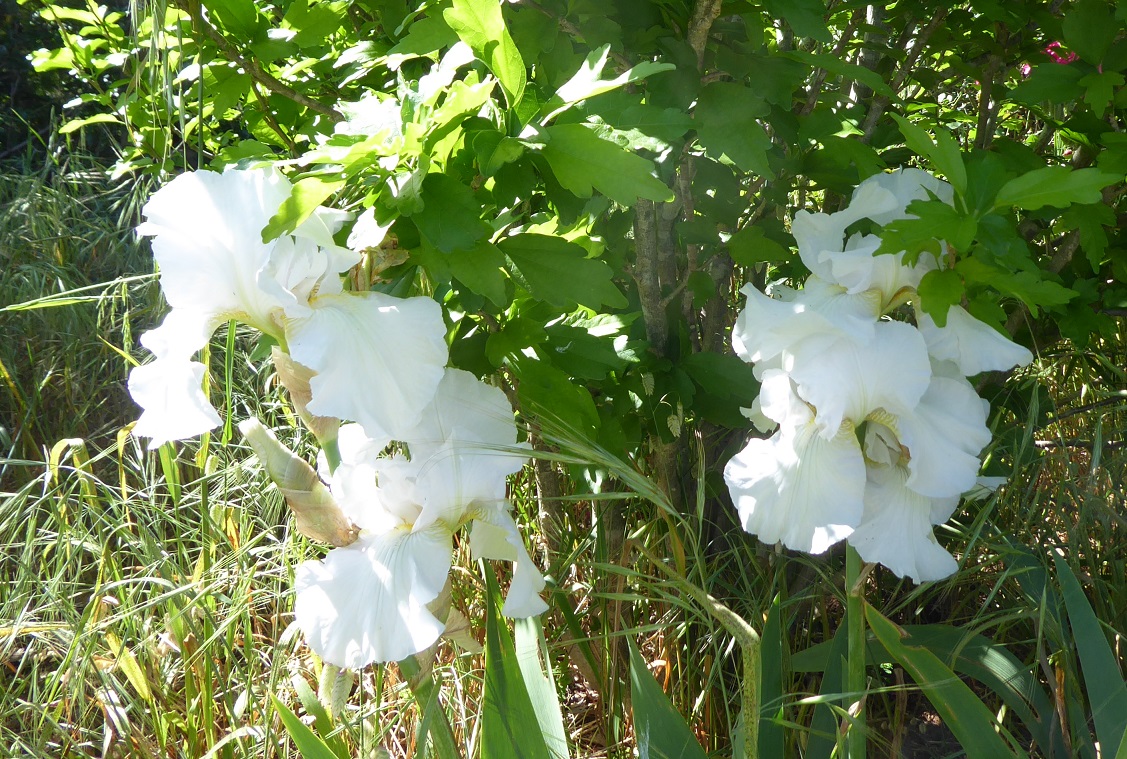
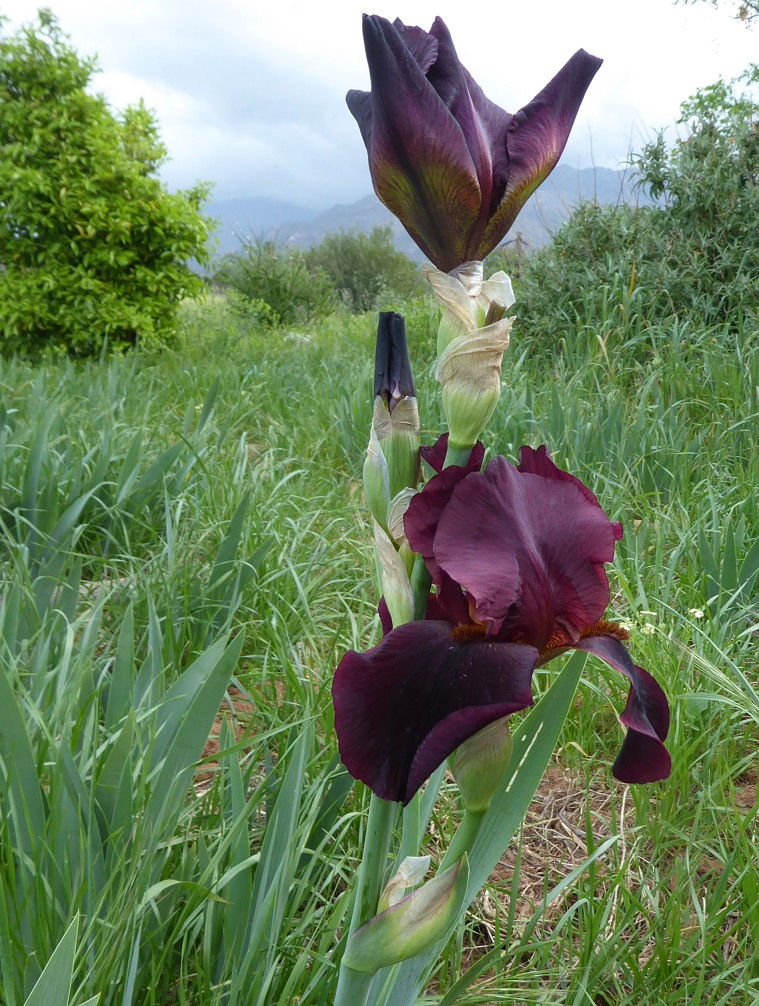
I also love bearded irises and have a large collection, but sadly they do not do well here. The wretched moles disturb them and we just don’t seem to have enough cold, or enough rain for them. This year very few have flowered. I guess I should move them to fresh ground. There is something so special about their elegant flowers that I continue to hope for a better year.

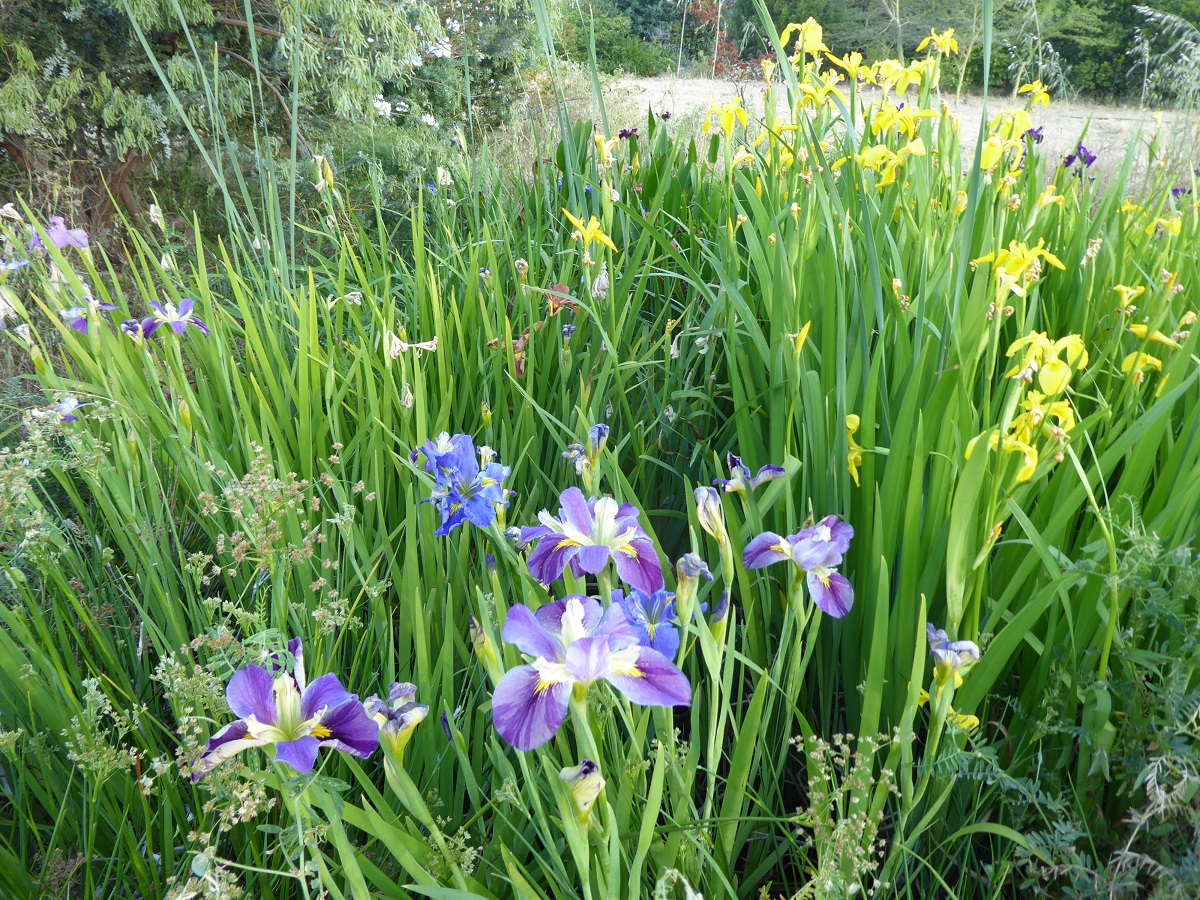
Louisiana irises do much better. A few years ago I made a shallow pond for my collection of about 10 different varieties. Usually they flower in September, but they have been later this year them. For about a month this little pond looks great.

Tasks and treats in October

October is also the month when the pelargoniums are at their best. Often incorrectly called geraniums my mum and I have made quite a collection of species and garden hybrids. I need to take cuttings now after they have flowered as often lovely cultivars will disappear off the market and cannot be replaced if one loses a plant.

This month I planted my dahlia tubers and hope they do better than last year. I also planted more beans and courgettes, watermelons, butternuts, pumpkins and gem squash for the summer. The asparagus plants have shot up now that we are no longer picking spears and make a waving green forest about a metre high. I hope to pick enough Cape gooseberries to make some jam and we have enjoyed a few artichokes.

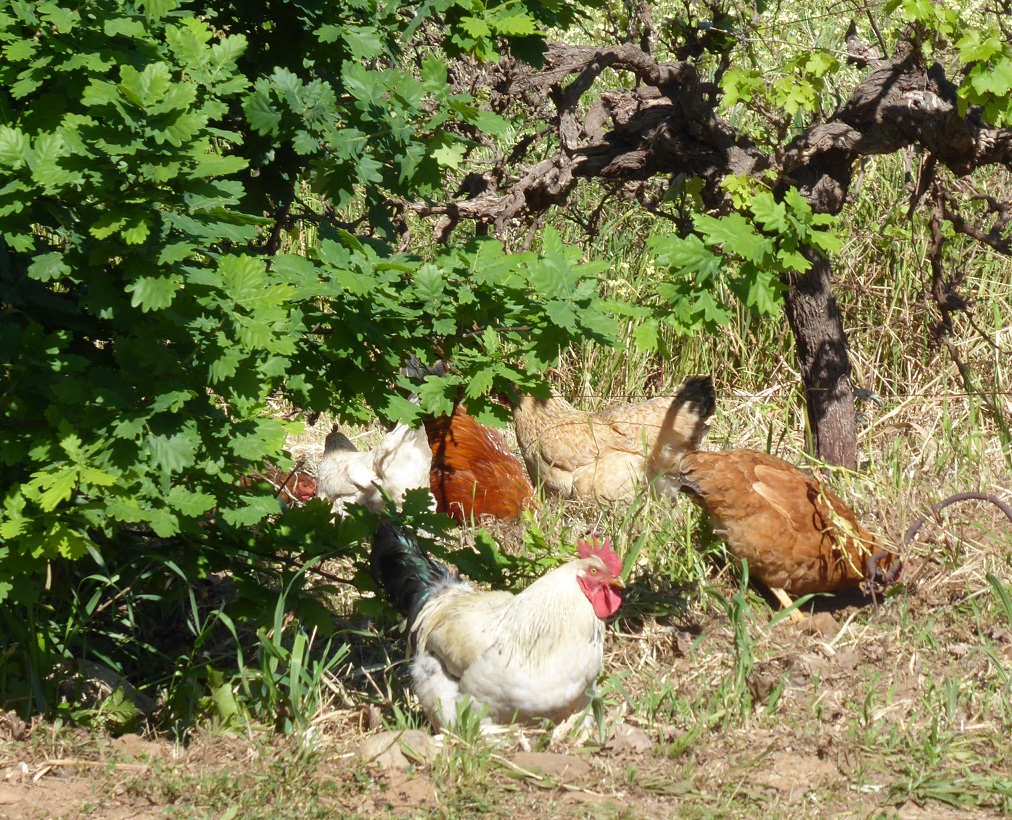
The fruit season is about to start and we can buy early peaches and nectarines. Summer is definitely on the way. The swifts and hoopoes are about as are my neighbour’s chicks who spend a lot of time scratching in what remains of the old vineyard.

KSU October 2019 gallery

September 2019
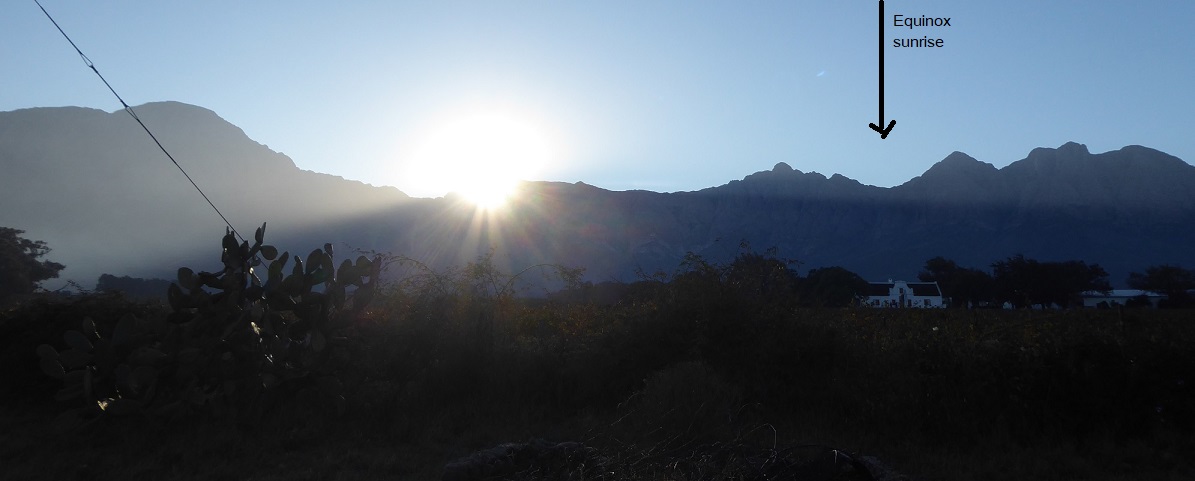
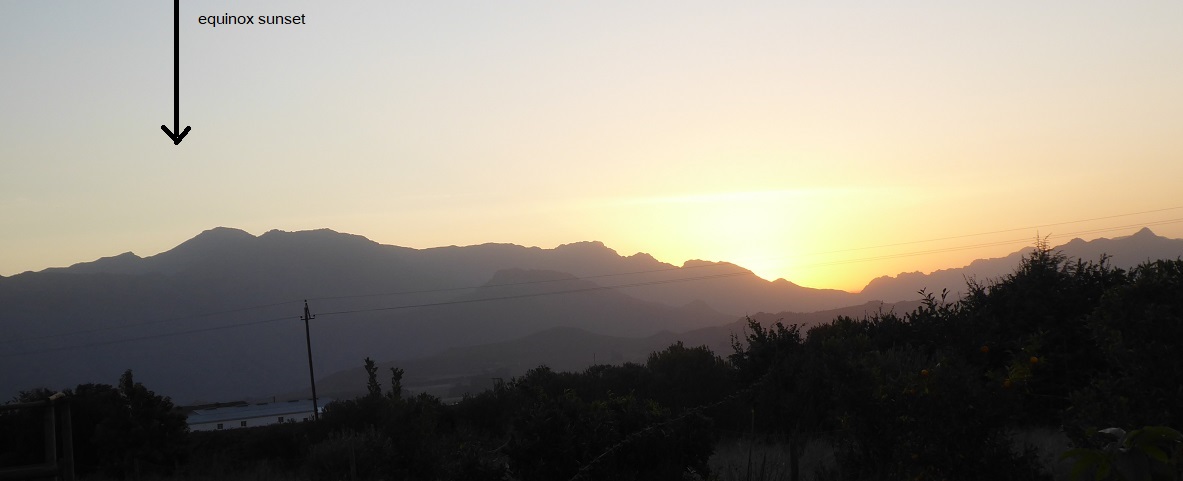
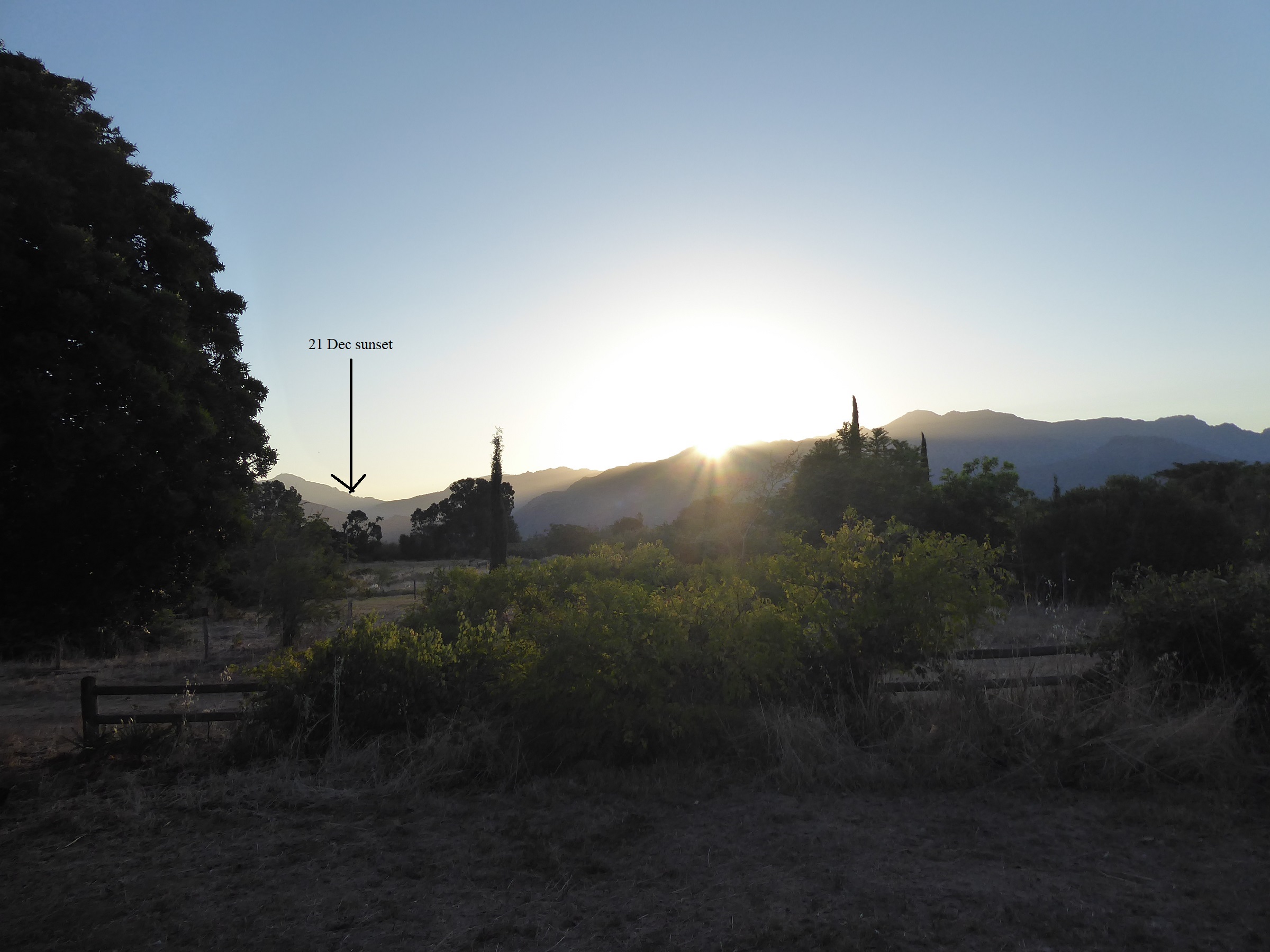
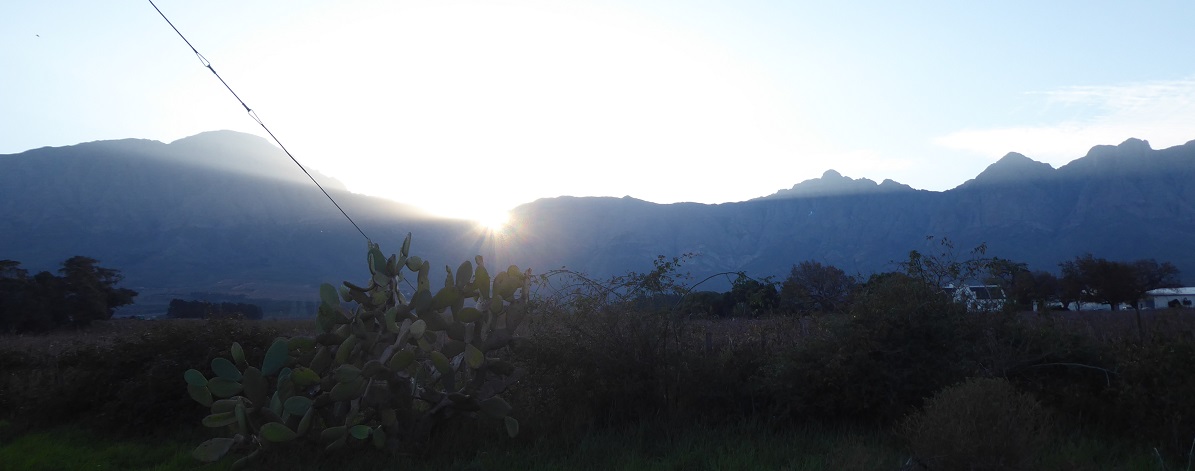
September is high spring at KSU, a month of pink and white fleeting glories. It is also the equinox, when the sun sets behind the highest peak in the mountains to the west and starts its gallop down to the dip which gives us our long summer evenings. The sun rose just before 7:30 am and set at about 6:10 pm on the 21st September. It has also been unseasonably hot with a temperature of 35°C one day and we have had very little rain, less than 5ml for the whole month. This does not augur well for the summer ahead.

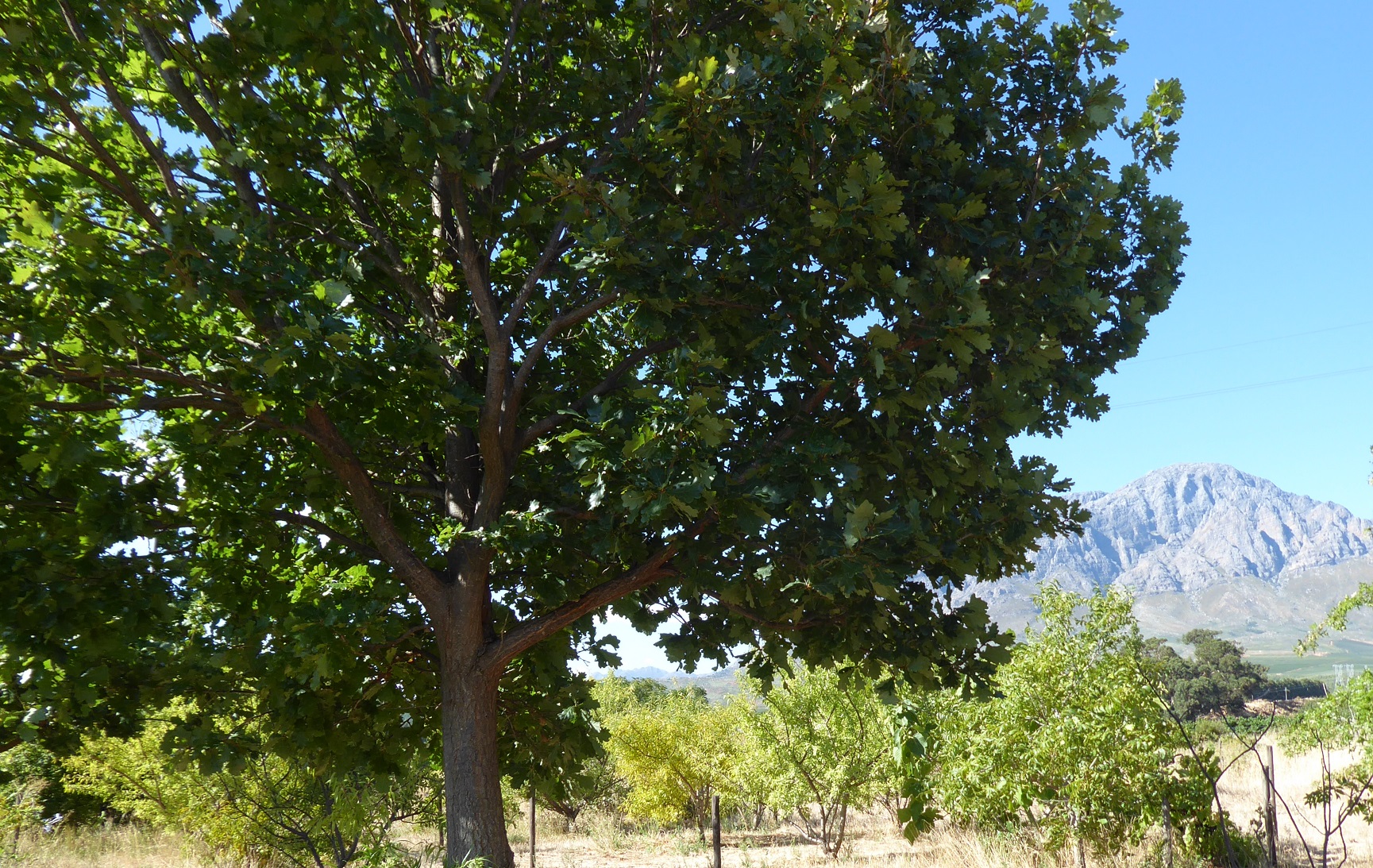
The vineyards started leafing out at the beginning of the month as the oaks (Quercus robur) got their fresh green leaves.  Is there anything lovelier than an oak tree  with spring foliage? Now at the end of the month almost all deciduous  trees are in leaf and we are surrounded by fresh green. However, we have started cutting the grass as it goes to seed. Soon the green carpet of winter will give way to the summer browns.

Pink and White

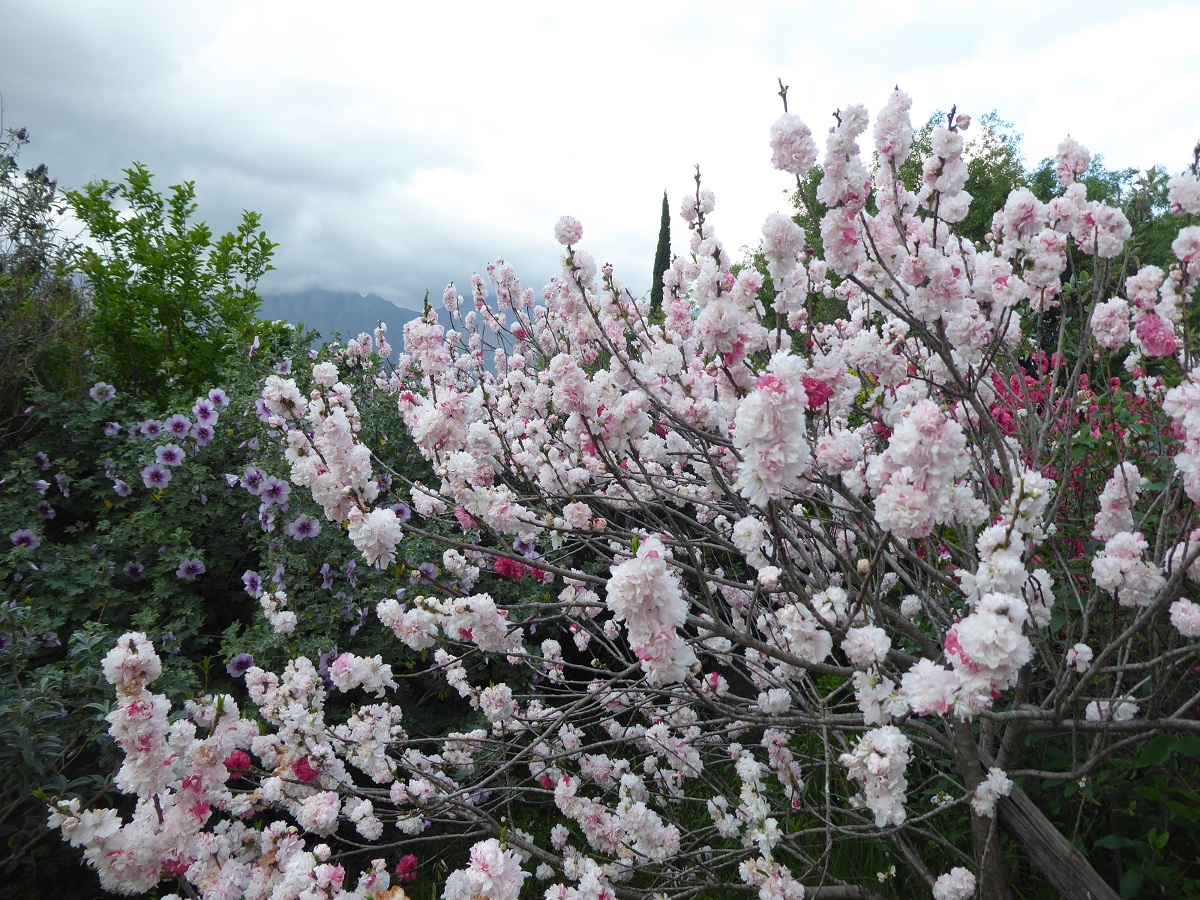
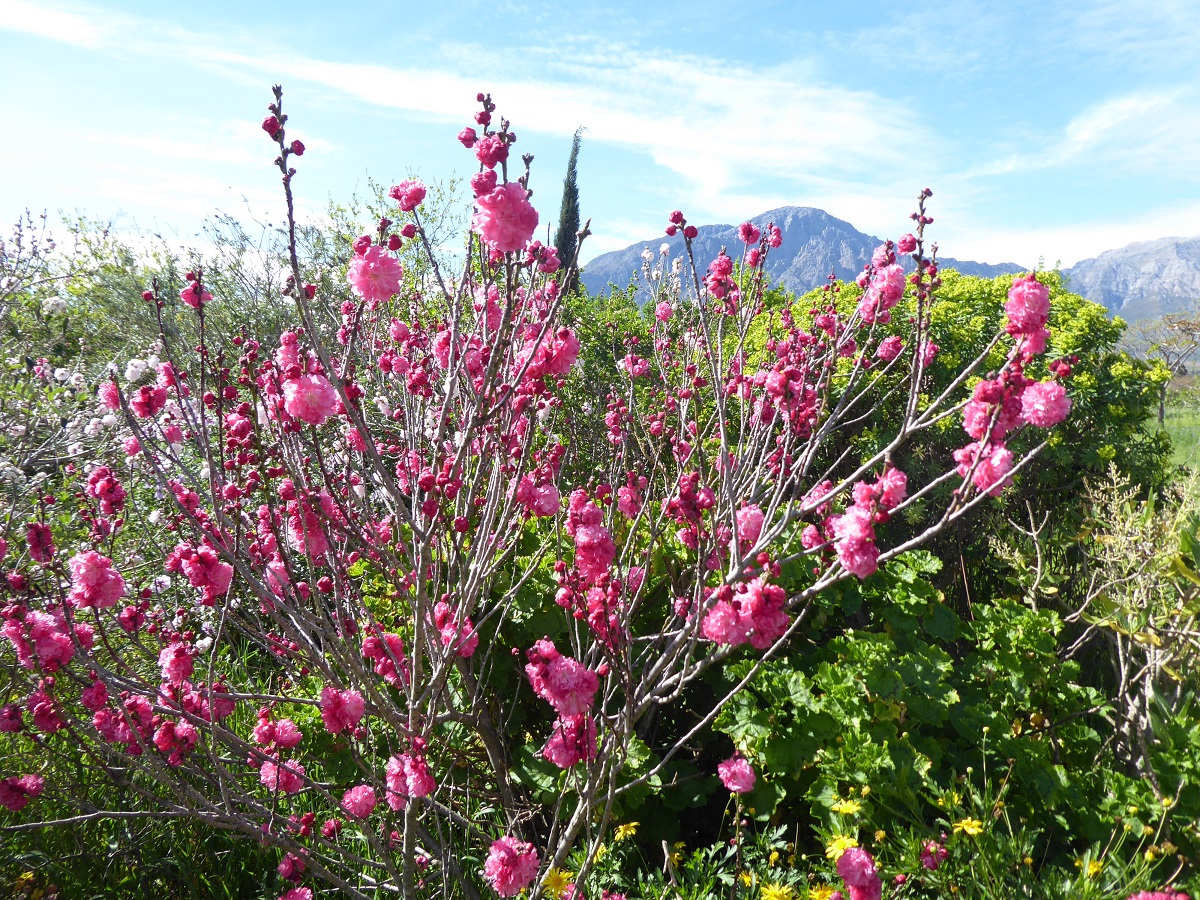
Leading the pack of pink and white glories of September are the flowering peaches (Prunus persica). All mine have double flowers and a few white fleshed small peaches later in the season. There is nothing subtle about these beauties; the bright pink in particular is shocking and vulgar and against a blue sky absolutely splendid; the white is crisp and pristine and my favourite is the white flecked with pink. Even 15 years ago it was difficult to find these plants and I was delighted to get them from an old nursery near the Drostdy in Tulbagh, long since closed.

From there I also bought my magnificent wisteria (Wisteria sinensis) which is also a joy at this time of the year. For years I have been meaning to build it an elegant pergola, but it still just sprawls making a big heap and engulfing Cape May bushes in the hedge. The scent is fabulous and it flowers for weeks, with a few blossoms lingering on into summer.

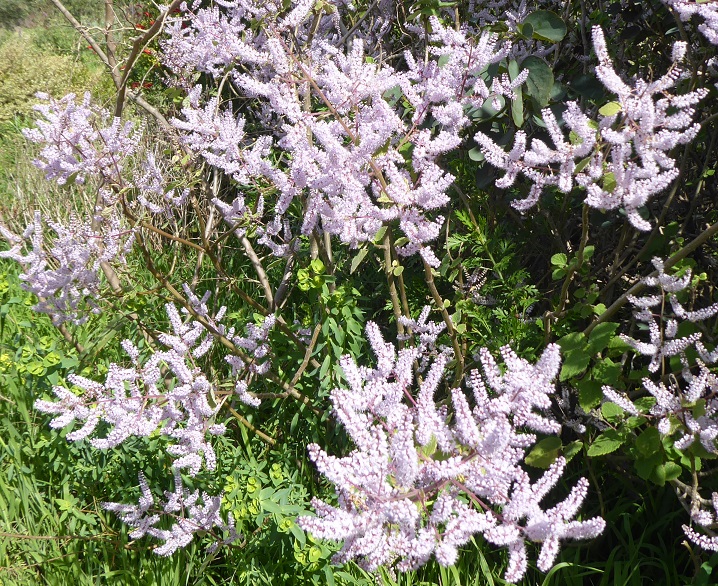
Flowering with the wisteria, Cape May is a tough old plant, out of fashion and much under-estimated. It comes in single and double forms and despite the name is neither from the Cape nor a hawthorn. I think the botanical name is Spiraea reevesiana or S. cantoniensis and it comes from China, but seems to do very well here at the Cape and makes a large semi deciduous bush, needing no summer watering. In spring it is covered in heads of small white flowers. In our family there is a belief that it is unlucky to pick it to bring indoors.

The English May or Hawthorn (Crataegus sp.) is also covered in creamy white flowers this month. I grow it because I like the shape of the leaves and I thought it would be lovely with roses scrambling up in it. Also it has nice red autumn berries, but the flowers have a rather unpleasant scent.

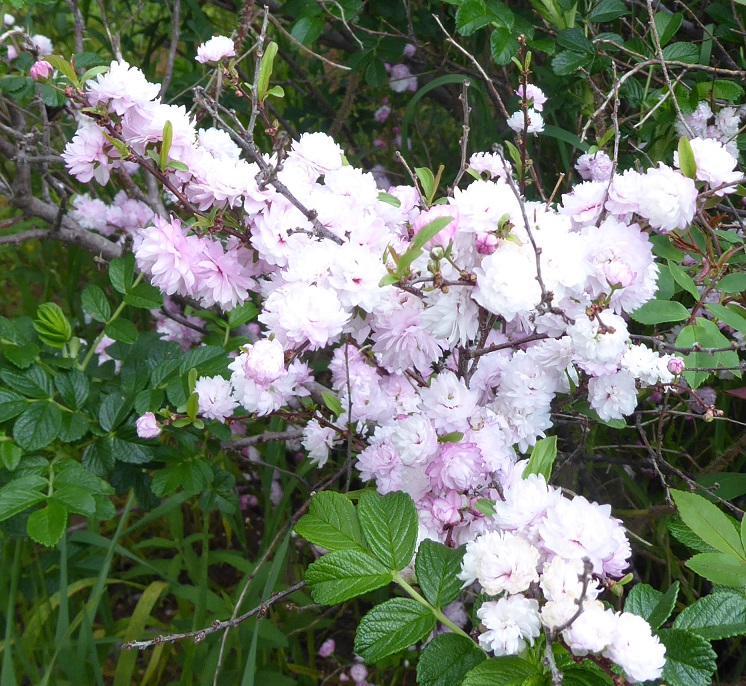
Another prunus looking lovely this month is one with small double fluffy almond pink flowers whose name I have never known. It grows to about half a metre and spreads to make a small clump.

The crabapples and quinces are also pink and white beauties of the month. The quince hedge is a sea of silvery green new leaves and pale pink single flowers.

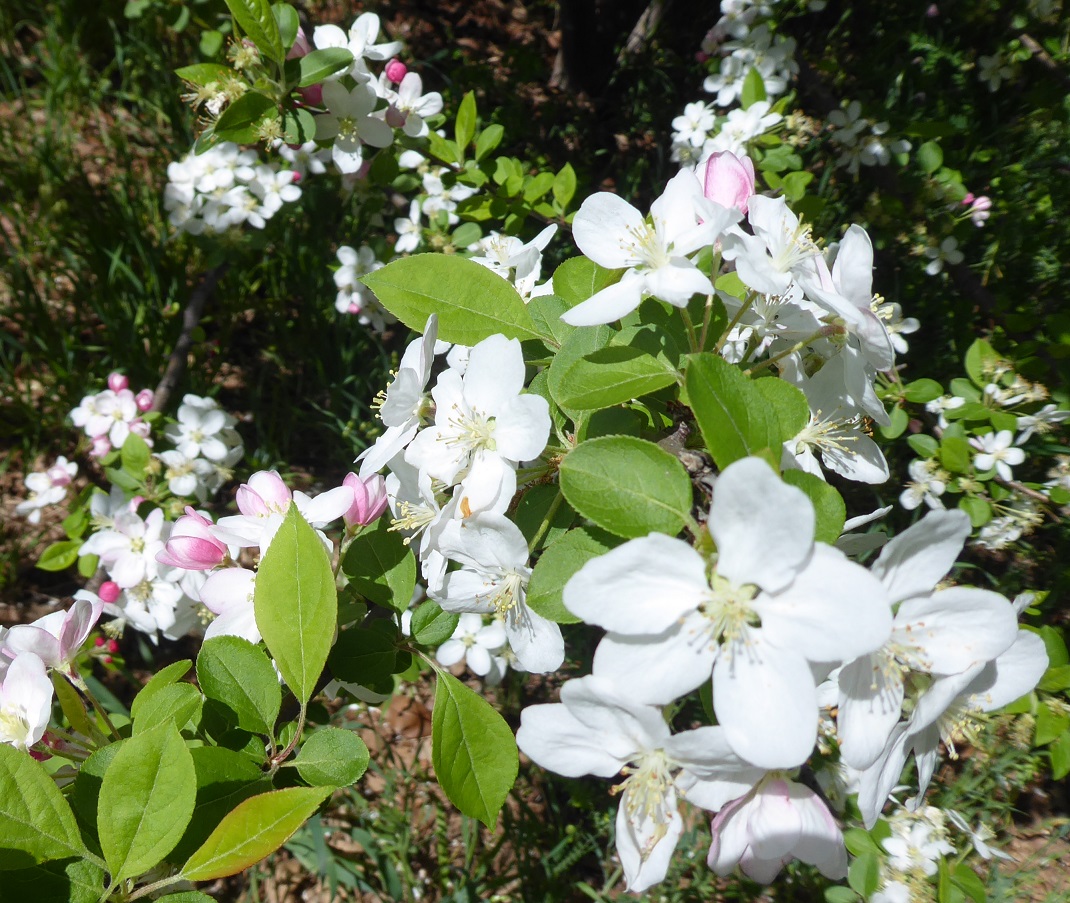
I have 3 crab apple trees, all with single white flowers emerging from red buds. The flowering is fleeting, a week to 10 days and it is all over.

The flowering quinces (Chaenomeles sp.) are excellent shrubs here. When I arrived at KSU, three old bushes of the common red form were some of the only plants in the garden of the old cottage. They get no water in summer but reward me with flowers from late winter onwards. The mousebirds eat the first blossom, but this month, the birds have other targets and the bushes are a resplendent crimson. I also have a pure white form and another which has pale pink and white flowers. In autumn they reward one with highly scented hard fruits.

The big lavender bushes are past their best, but a small dwarf lavender with pink tufty bracts at the top of the flower spikes is looking splendid.

Jasmines and Viburnums

Continuing our pink and white theme, but with a glorious scent is the Chinese jasmine (Jasmine polyanthum). In warmer areas with more water this plant can be a bit of a thug, but here it is kept in check and we can enjoy the lovely heads of long tubal flowers, pink in bud opening white.

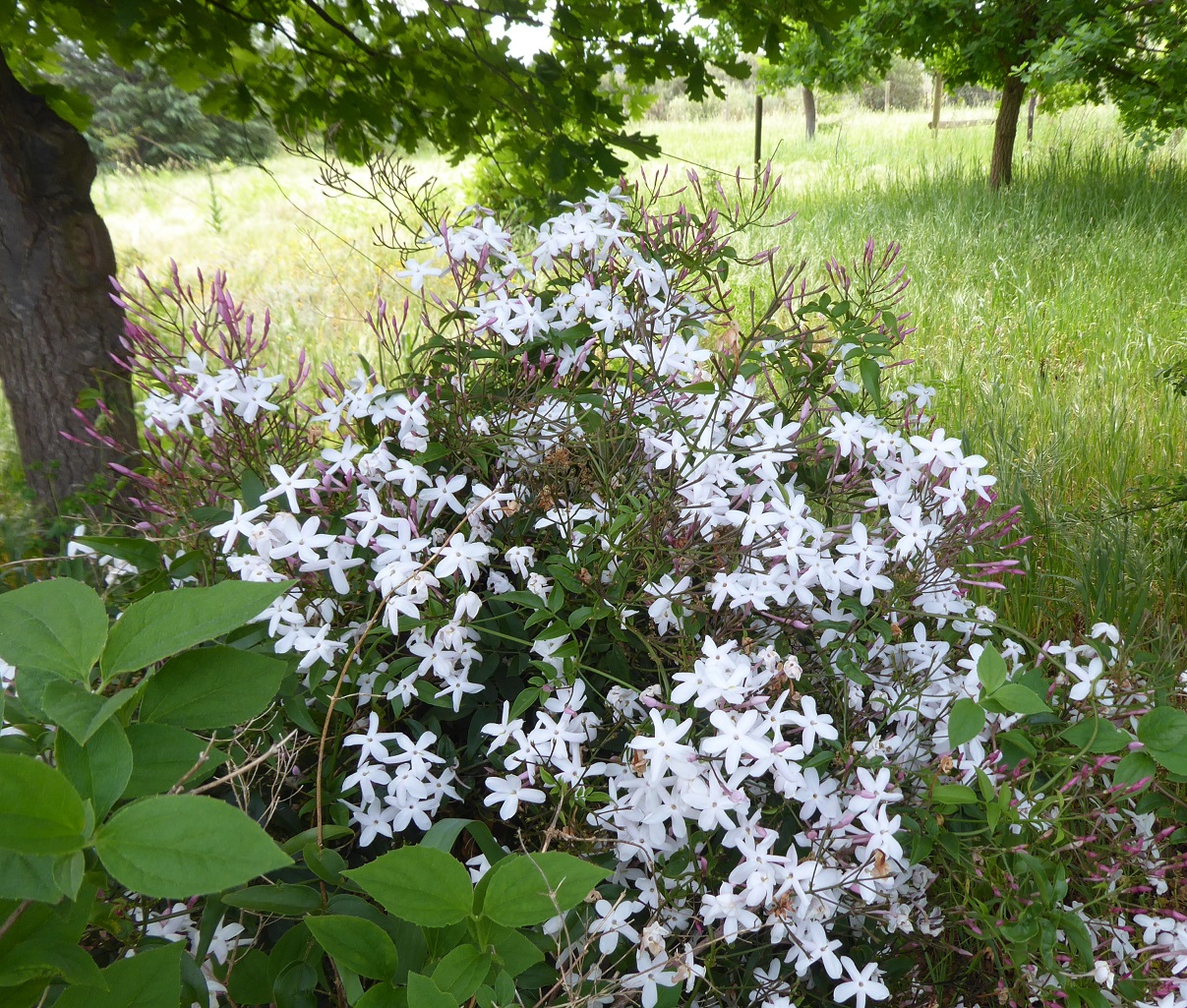
One of native Jasmines, Jasmine multipartitum is also at its best this month. I have 2 forms; one with smaller flowers and paler green leaves that winds its way through a plumbago hedge; the other a more bushy form with sturdy darker green leaves a much bigger flowers. Both are heavily scented and a delight.

Less common at the Cape are the two yellow jasmines flowering now. One is I think called Italian jasmine ( J.humile ‘revolutum’) which makes a large bush with fresh green leaves and tubular lightly scented yellow flowers and the other which has been flowering since winter makes a big weeping shrub with unscented flowers. I am not sure of the name; it may be J.mesnyi, but it is a tough shrub and makes a nice background plant.

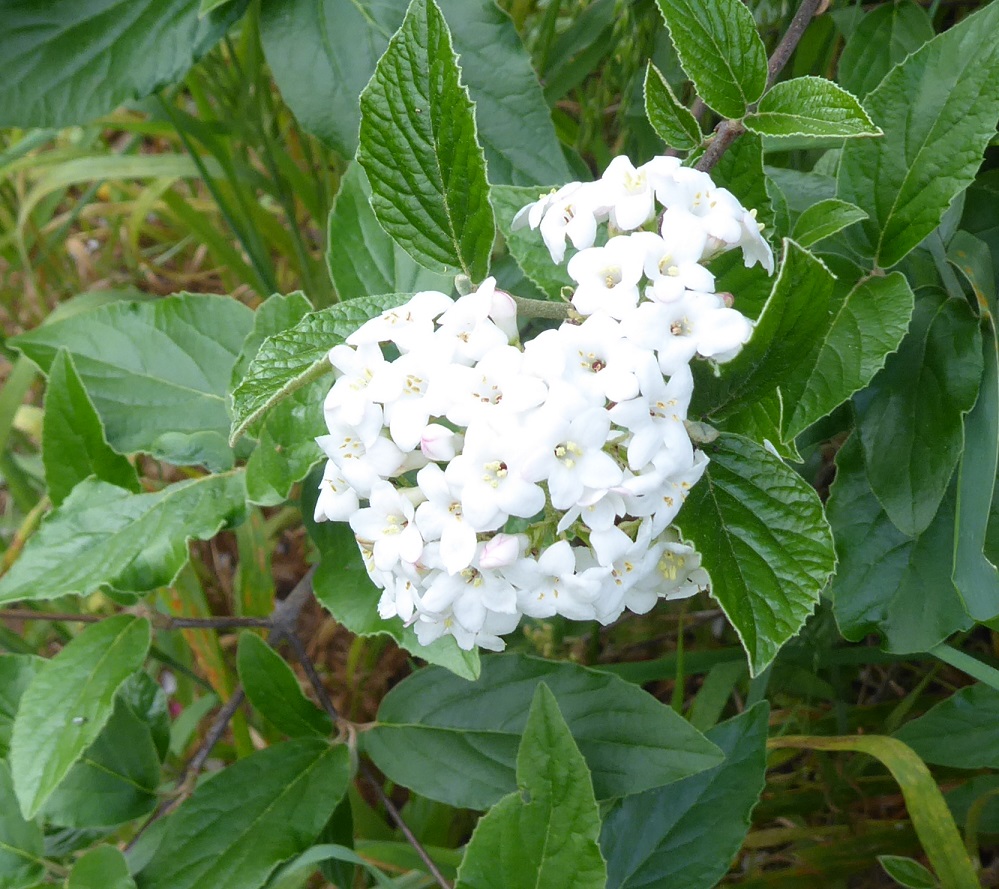
Flowering near the peaches and lending them some scent is what I think is Viburnum burkwoodii. This is an unexpectedly tough shrub with deciduous dark green leathery foliage and round heads of small deliciously scented white flowers which emerge from pale pink buds. One flower-head is enough to scent a whole room.

More common here at the Cape is Viburnum tinus. This has big heads of unscented white flowers emerging from pink buds and flowers from winter into spring and is evergreen. I seem to have 2 forms, one which has bigger shinier leaves and bigger flowerheads than the other. They both have blue black fruits later.

Another viburnum which grows into a dense evergreen tree here at the Cape with healthy paler green leaves is Viburnum sinensis. Although some websites list the flowers as fragrant, I have not noticed this. They are smaller and creamy white. It is a very fast growing plant though and would make a good large hedge. My shrub is still very young.  I think all these viburnums come from China.

Indigenous beauties

One of the loveliest sights of the month has been the September bells in flower. This little tree (Rothmannia globosa) comes covered in scented white tubular flowers. Ours grows near the house and may have its feet down in the septic tank. Beside it is a seedling peach whose pink flowers appear at the same time.  The Rothmannia  is a joy for several weeks and this year I picked a branch for the vase where it lasted for a week.

Another very pretty shrub which flowered for several weeks is the white form of Podalyria calyptrata. The common form is pink. This shrub grows naturally in the mountains around here and has silvery grey leaves. It makes a big bush and comes covered in beautifully scented sweetpea like flowers. Ours is growing along a seasonal furrow and gets lots of water in winter.

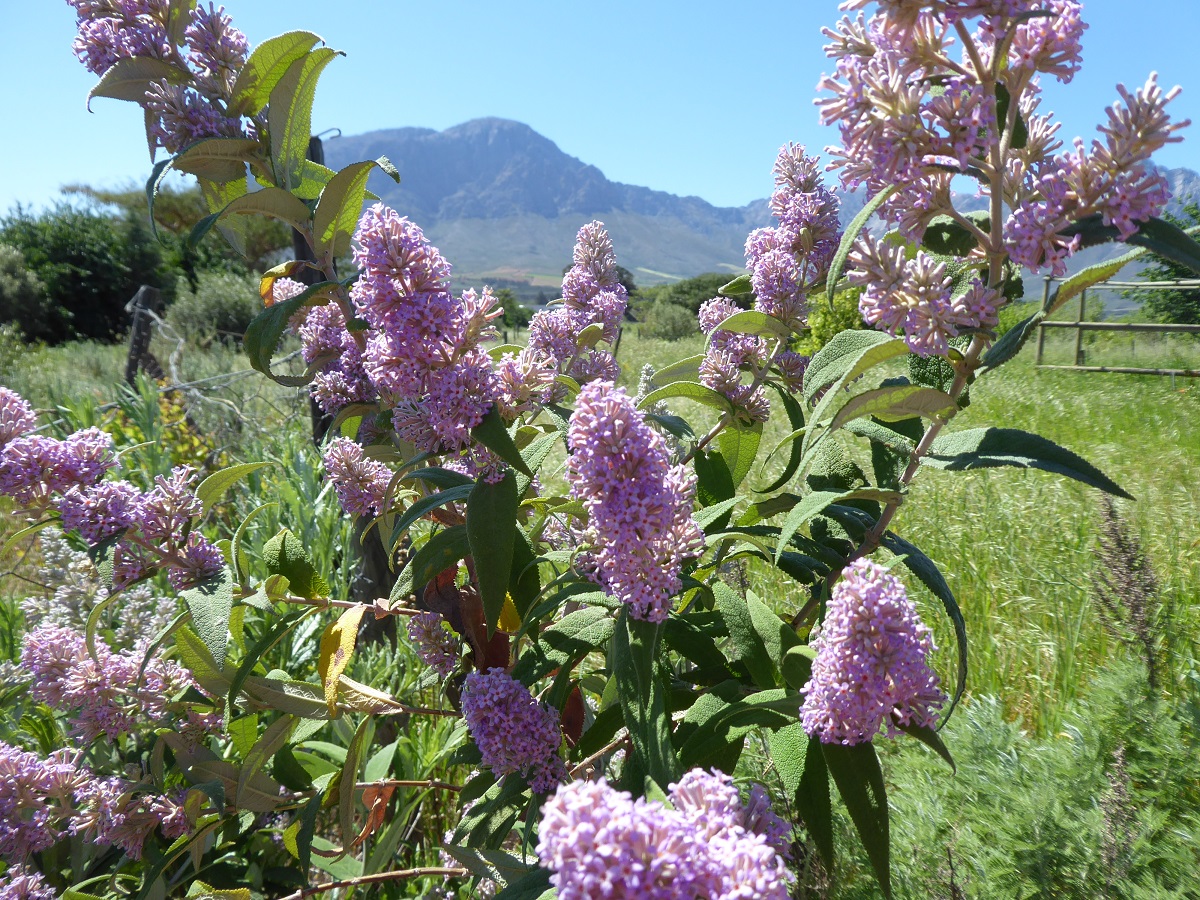
Another gloriously scented treat this month has been the large bush/small tree of Buddleja salvifolia. My form has lovely lilac flowers to complement its grey sage like leaves. Buddleja scent seems to waft on the wind and one bush can scent a large area.

The confetti bushes (Coleonema album) are covered in tiny white flowers. They are not scented , but their fine foliage is aromatic. I have planted 4 along a path where one will need to force ones way through and so brush against the scented leaves.

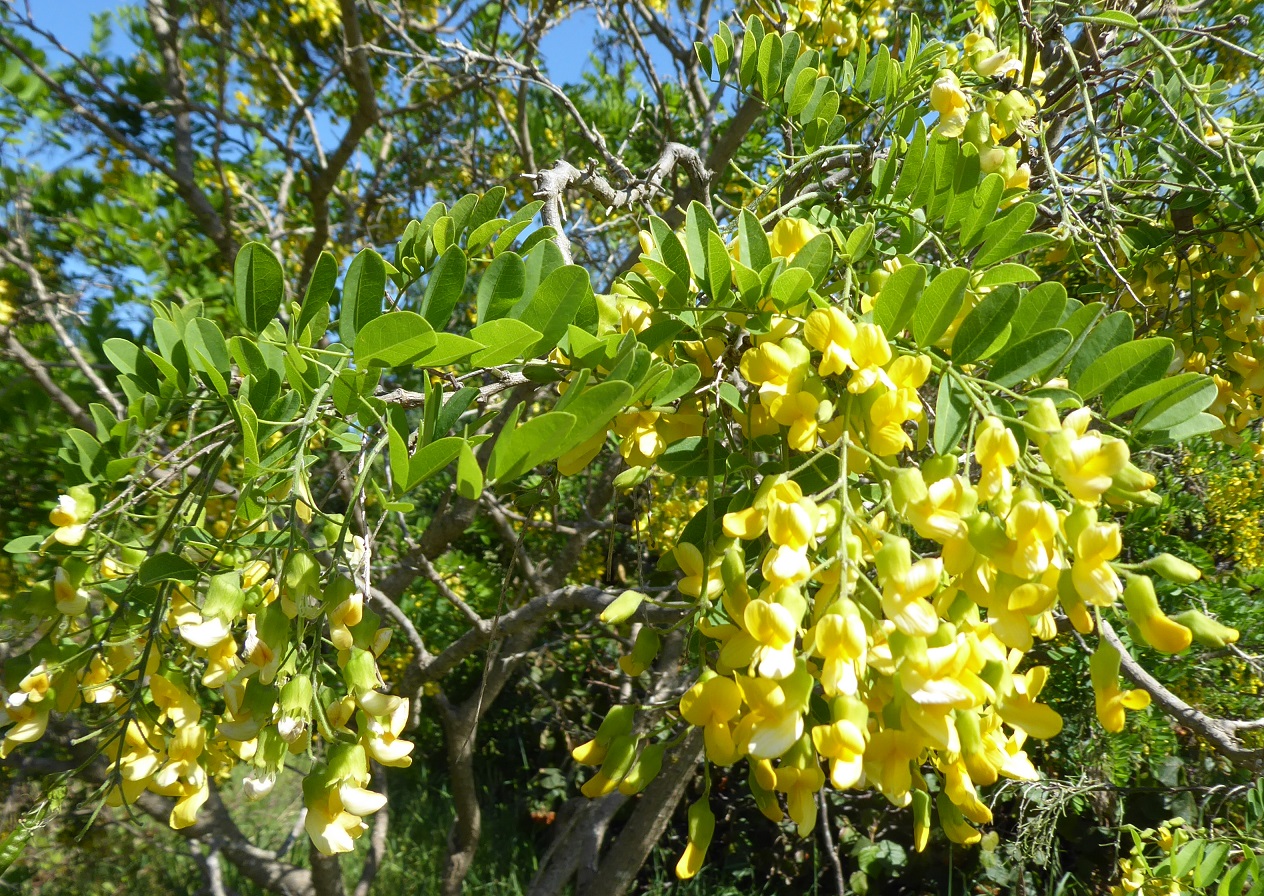
Breaking away from the pink and white theme, the pale yellow laburnum like flowers of Calpurnia aurea are also a treat. This little tree flowers in autumn and spring here at KSU.

Early September is also the peak of the indigenous bulb season here at the Cape. We do have a few pots of of these to enjoy. One of the best scented is Freesia leichtlinii  subsp. alba. Growing across the garden is a strange little green orchid which flowers this month too. I have no idea what it is called.

Early roses

Called the dog rose here at the Cape, the big single white Cherokee rose (Rosa laevigata) is in full bloom now. It is a glorious sight with long waving branches of big white flowers. It makes an excellent barrier plant as it has big hooked thorns. It only flowers now in spring, but what a flowering. I once had its offspring, the beautiful pink single Anemone rose which came from the same nursery in Tulbagh as my wisteria, but sadly I have lost it.

Also in flower this month is the rose we call the Paarl rose. This climber has clusters of scented pink flowers and rough foliage and it runs about. I have it scrambling up into a wild olive. We collected it from beside the N1 about a km from the tunnel tollgate where it was growing wild beside the road and thriving on neglect. Houses are built there now and the rose has been totally obliterated. This rose has a long flowering period and it is the similar to a rose on our home farm in the Eastern Cape. It might once have been used as a root stock.

Another pink rose which runs about and is in flower this month is the rose which Gwen Fagan in her beautiful rose book listed as R.centifolia. This has very full, highly scented, quartered flowers. Sometimes they are a little misshapen. It also thrives on neglect.

The single white rugosa rose is also starting to flower. This is another runner and it rewards one with big bright hips later.

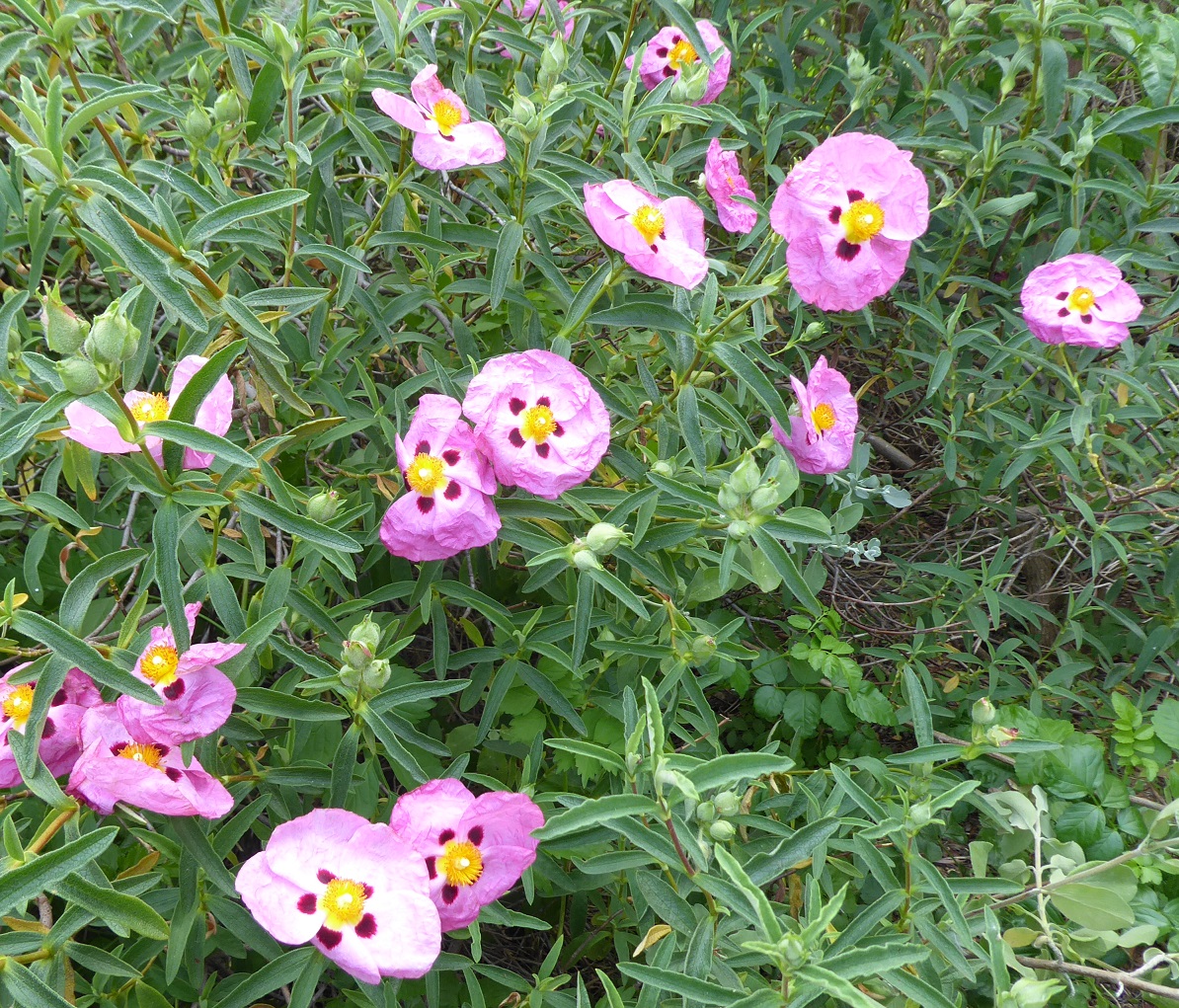
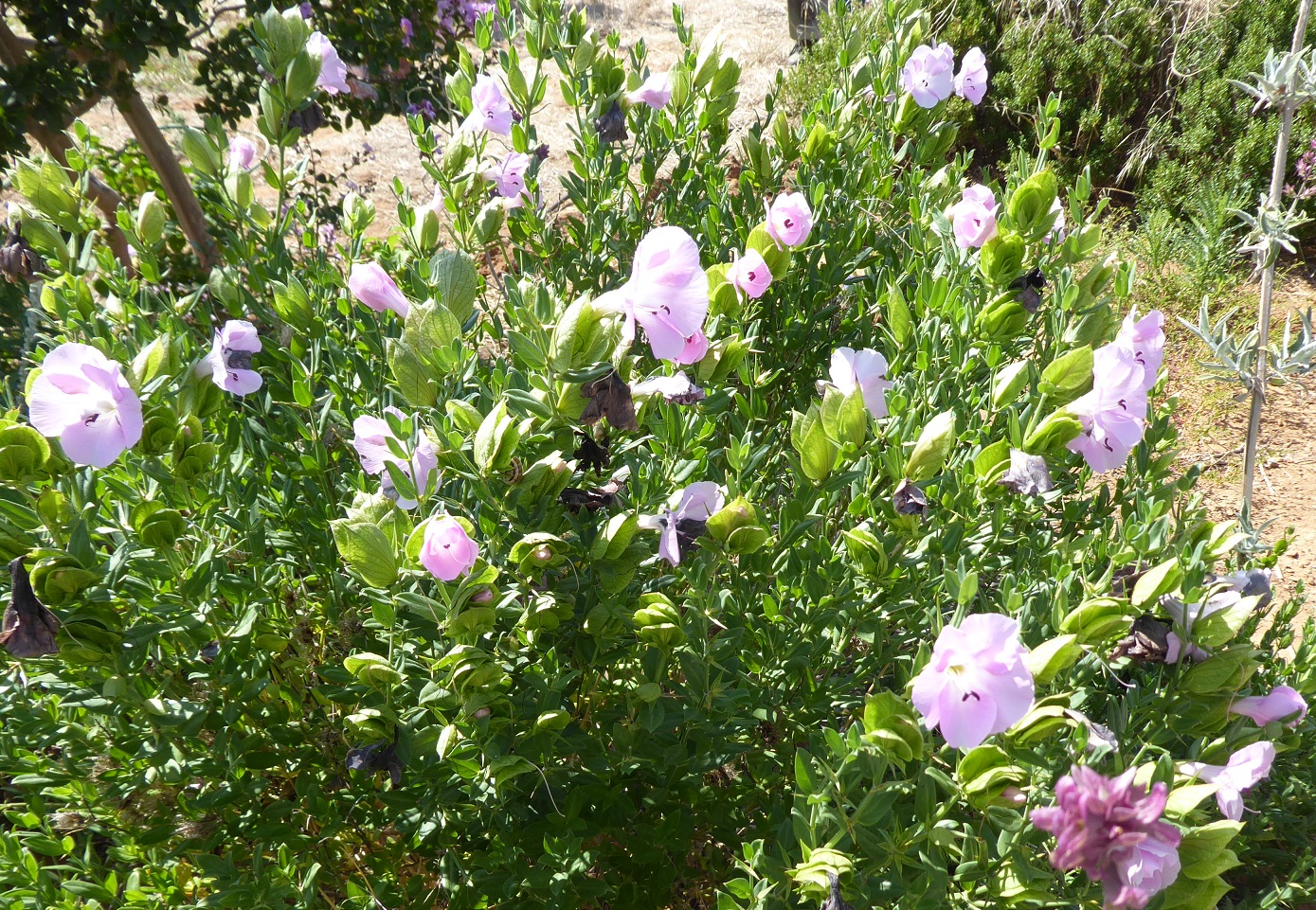
Not a rose, but just a showy with big bright pink flowers enhanced by maroon central spots, is  a cistus. Usually very short lived here, I have 1 bush I have managed to keep going for over a decade by never watering it in summer. I think they die of fungal disease, or perhaps they need a limey soil. I cherish this Mediterranean plant and wish I had more. It is in full bloom now.

A little bit of California

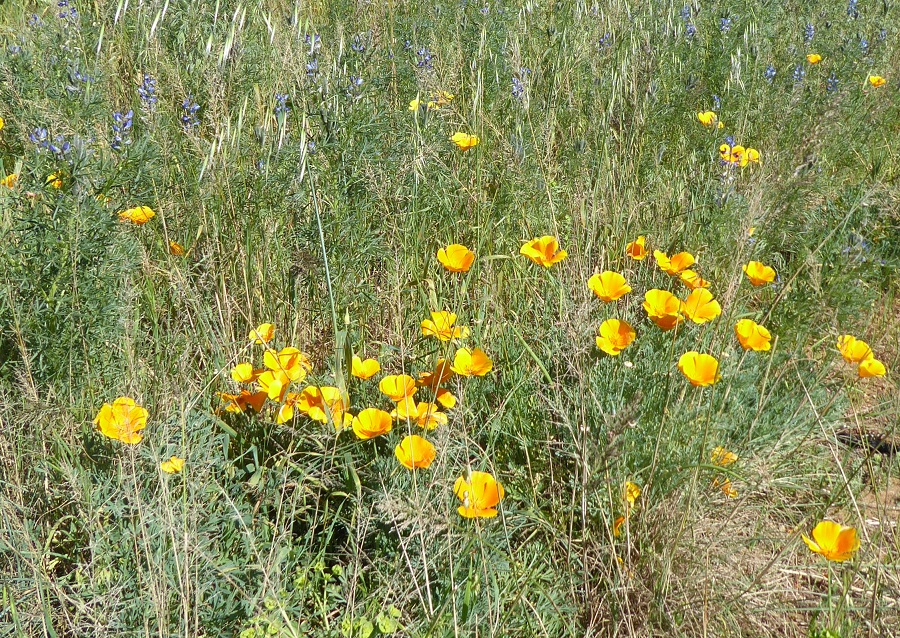
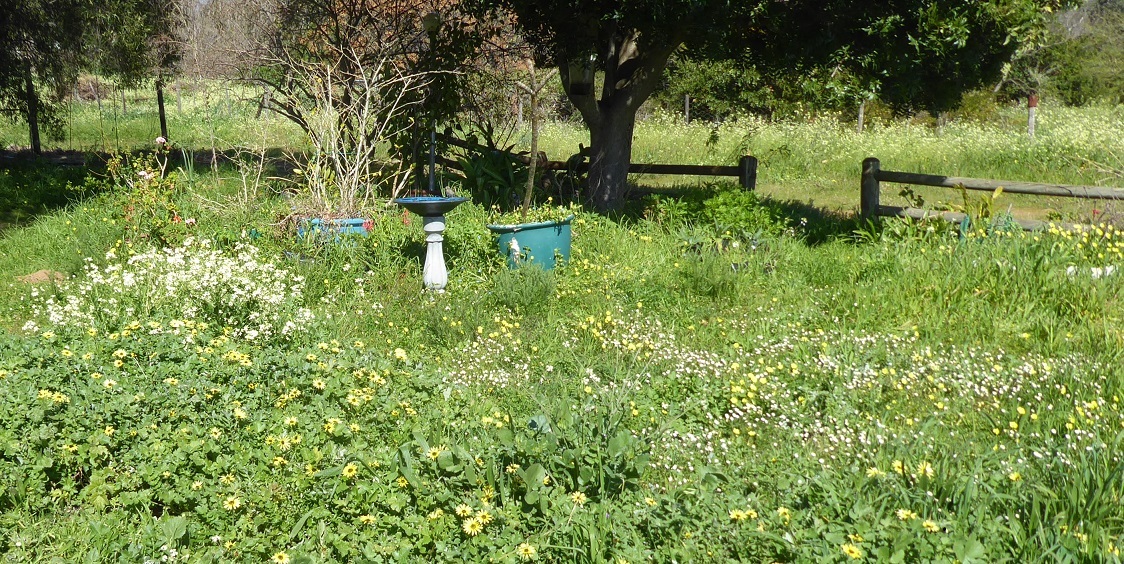
For a few weeks in September, the succulent mounds are surrounded by a sea of blue lupins punctured by bright orange Californian poppies (Eschscholzia). They all self-seed and this vibrant treat is an annual event.

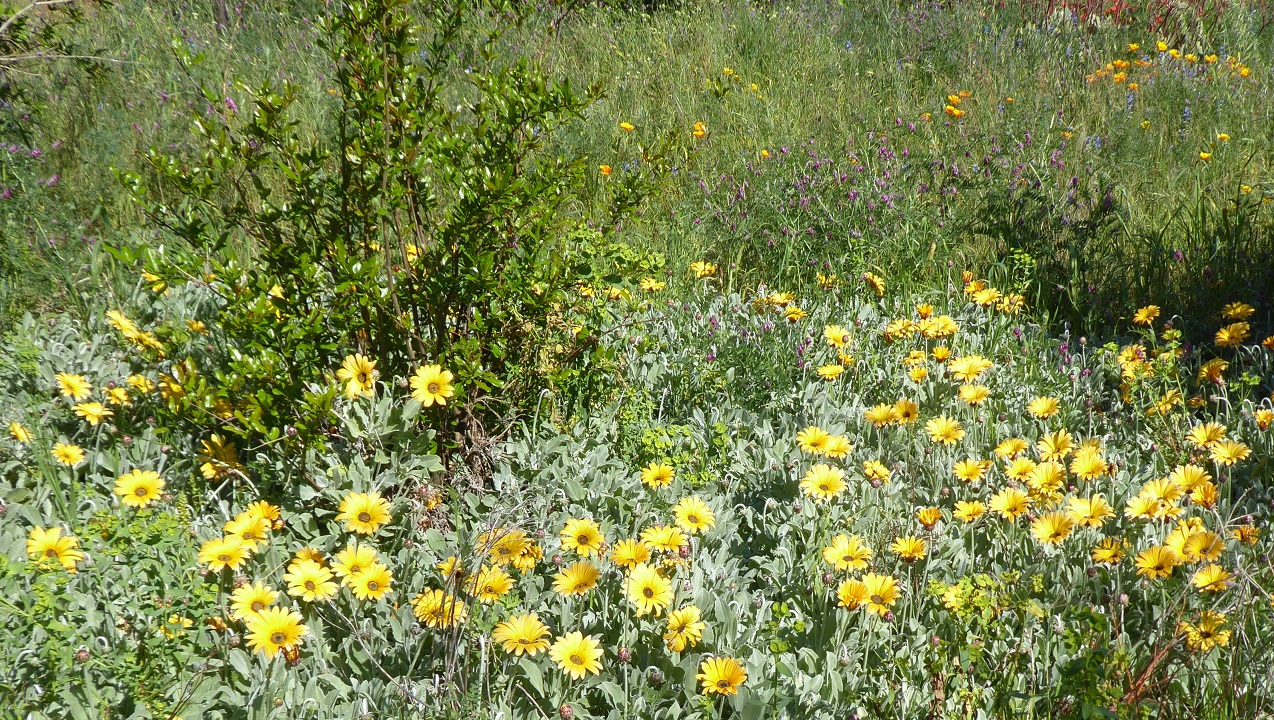
Scrambling through the lupins is a strange little purple vetch which is probably a weed, but which adds to the charm. Close by a patch of grey leafed arctotis daisies is also covered in large butter yellow flowers which have stripes of red on the reverse. This bright ensemble is a contrast to the predominantly pink and white colour scheme of the month. I see from Wikipedia that the Californian poppies can also be used as a food or garnish. Their foliage is silvery grey and fine, very decorative.

Off-setting all these bright colours are the euphorbias which are also sporting their yellow green flowers now. I have several different bushes about the garden and they are a lovely foil for more colourful plants close by.

On the succulent mounds themselves, a tough ground hugging little pink  mesemb is in flower. I bought it in a six pack seedling tray from the Kirstenbosch nursery but have mislaid its name.

The delicacies of spring

Not only is September full of blossom and scent, it is also the season for asparagus. For my mum and I this is the highlight of the year in the veggie garden. I have 2 rows with about 8 plants in each and this provides us with plenty of spears. I feed it very well in early autumn when the rains come with old manure and if I can, also provide some chopped up well washed kelp. Once the plants have leafed out, I don’t water them unless the season is very dry and I cut back the foliage in April before feeding the plants.

The peas are coming to an end and we have a few broad beans, but these don’t really flourish here. I think winters are not cold and wet enough. The plants flop over too. Perhaps I won’t bother next winter.

Florentine fennel though is a treat which is almost carefree. The plants self-seed and grow like weeds in winter at KSU. We cook them in lots of ways;  baked with chicken and olives and tomatoes in the oven, or following a friend’s advice, just cut up and tossed in a bit of olive oil and coarse salt and baked.

As September comes to an end we need to brace ourselves for the southeasters, the heat and flies that lie ahead.   The joys of September  are fleeting, but looking ahead the irises are starting to bloom led by Hell’s fire. There are big bushes of purple lampranthus to lead us into October and we can look forward to watching the chicks of the speckled pigeon who is nesting on a pillar on the verandah.

September 2019 gallery
 

August 2019
Time has sped by since I last wrote this blog and the worst of winter is over. I escaped the coldest and wettest period when I went to the UK for almost three weeks towards the end of July for a family wedding. Here is a description of my trip. While I was away we had a few light snow falls on the mountains and about 100 ml of rain.

Trees to welcome spring

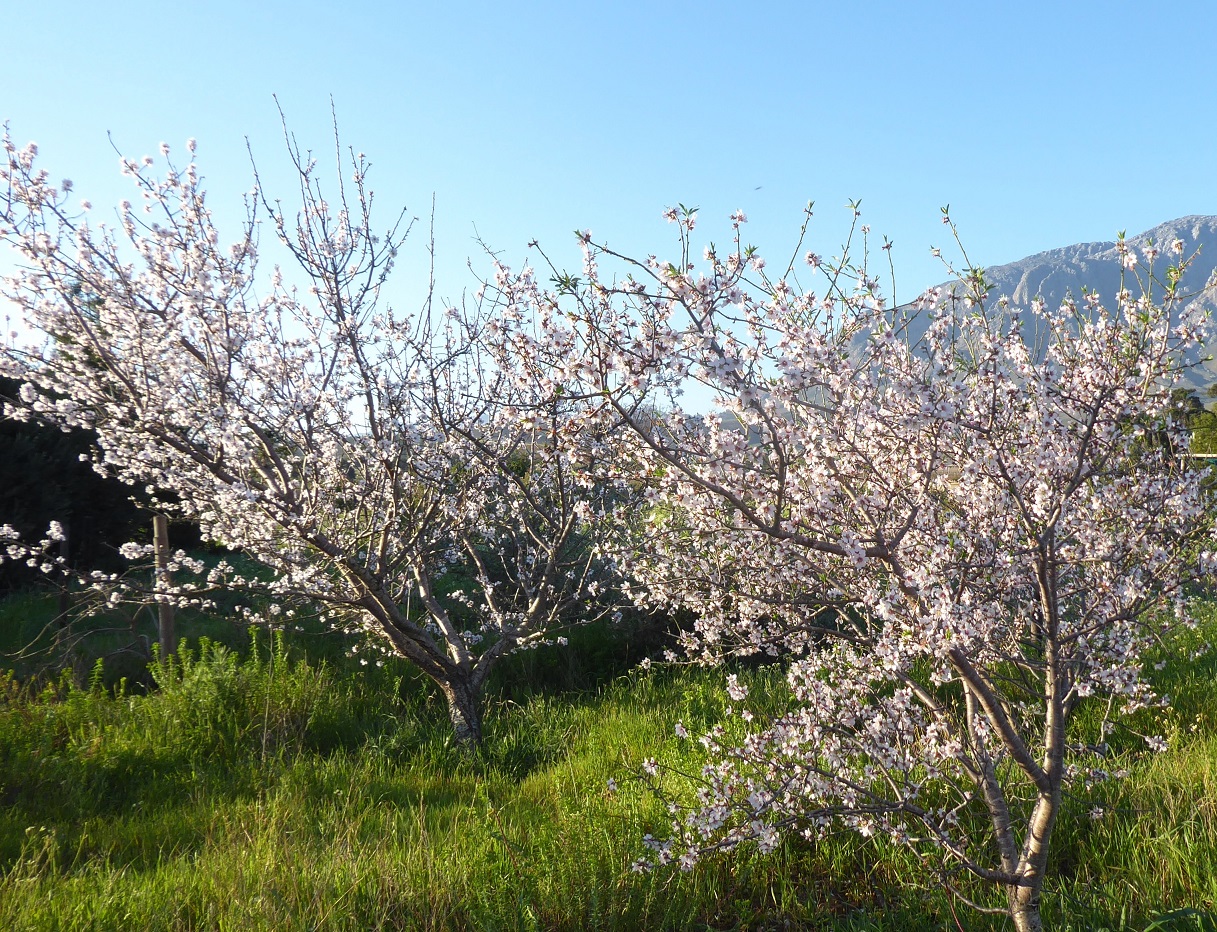
The days are getting longer with the sun rising at 8 am and setting around 6 pm. It feels as if spring is here with the almond trees in full bloom. I hope for a good crop of nuts this summer. I have noticed some bees and midges among the flowers which are an exquisite pale pink in colour. Against a blue sky, the trees in bloom are almost as lovely as a bevy of brides.

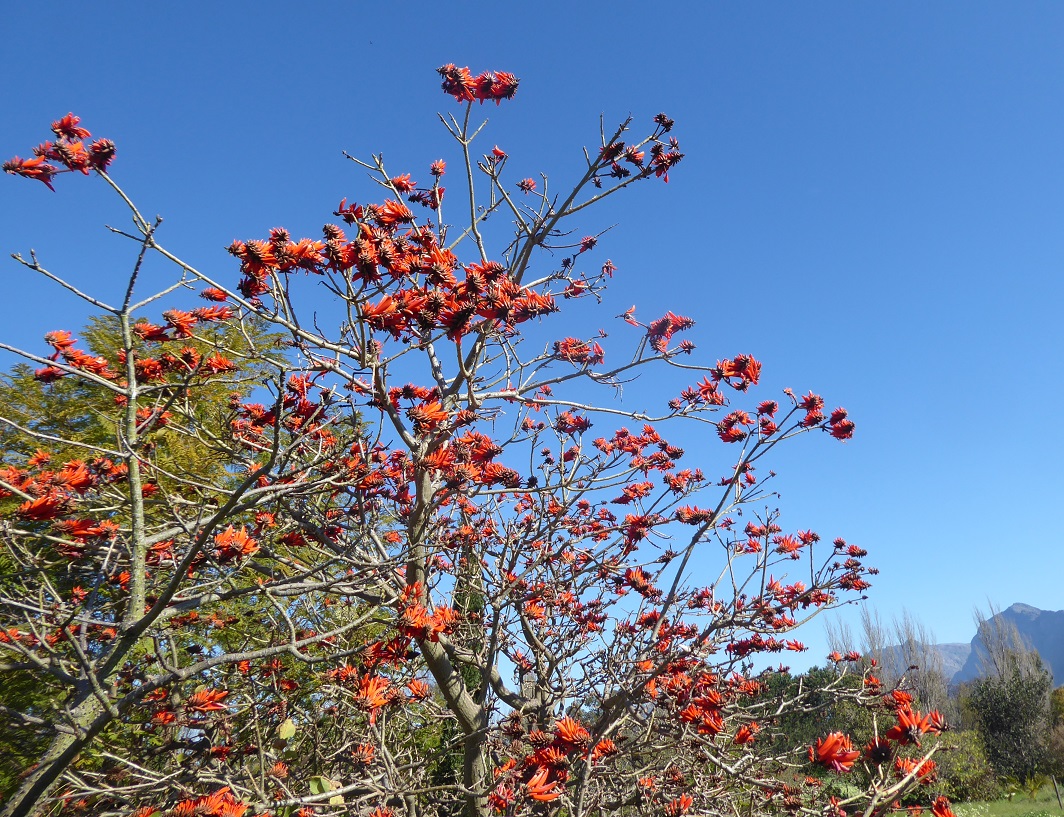
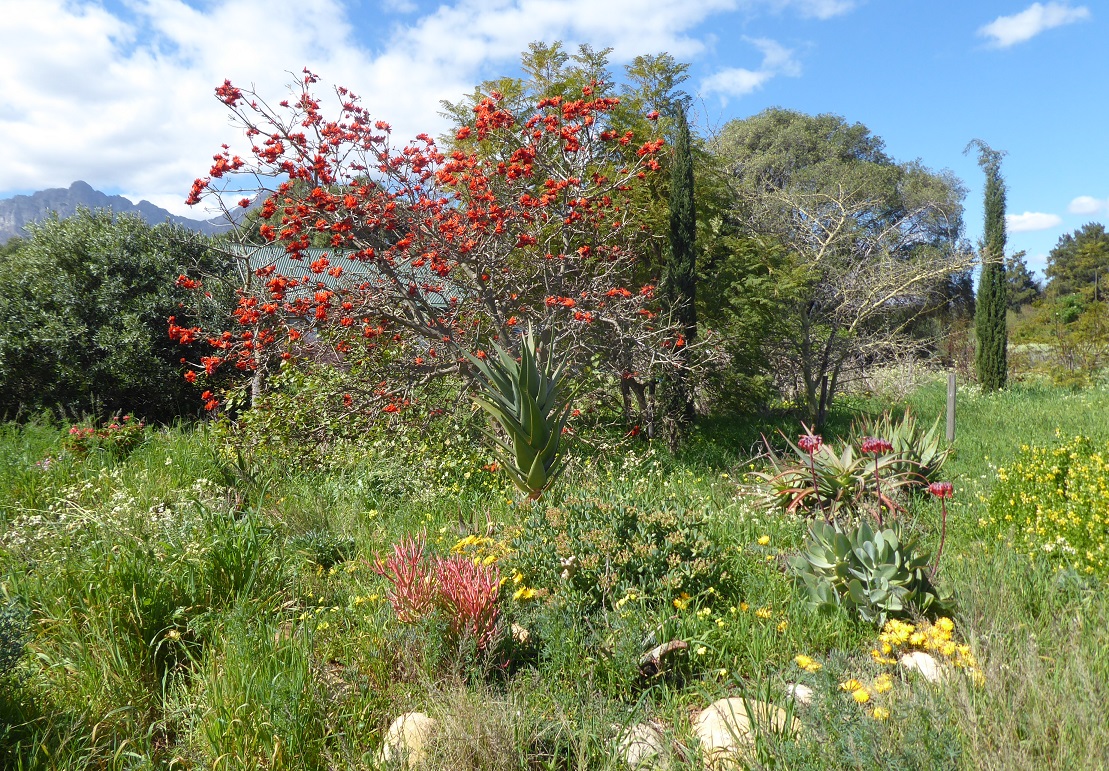
From the verandah we admire Erythrina lysistemon , the lucky bean tree, covered in crimson flowers. The malachite sunbirds love it and are always darting in and out, but they are shy and difficult to photograph. This tree is a star of the garden for about two months. It comes from the interior of SA, but does well here and there are splendid specimens in Worcester. I also have Erythrina caffra from the east coast but it flowers a little later. I grew my tree from seed collected from a white form in Port Elizabeth many years ago, but the flowers of mine are the usual orange.

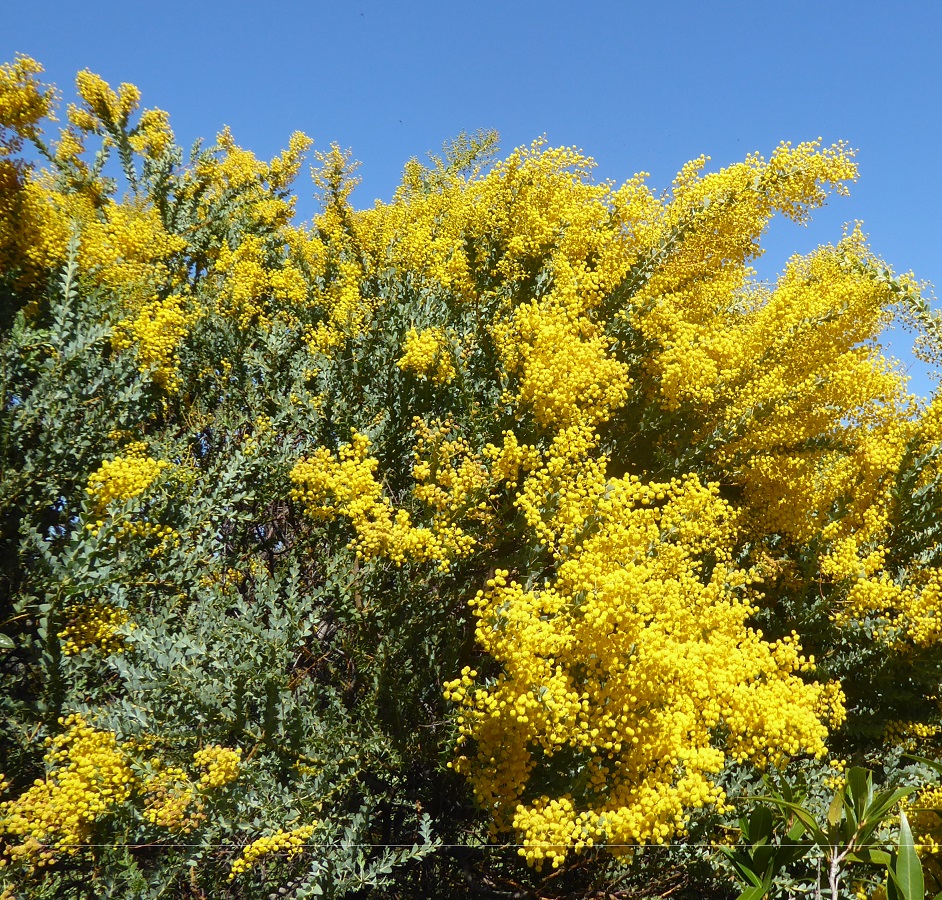
For a fortnight now we have a blaze of yellow in the garden. This is from 2 trees of Acacia cultriformis, the knife leafed wattle, from Australia. The flowers are very fleeting, but the trees are tough and have beautiful grey leaves which look good all summer long. Sadly we can no longer grow other grey leafed Australian wattles such as Acacia baileyana and A. podalyriifolia as they are deemed invasive.

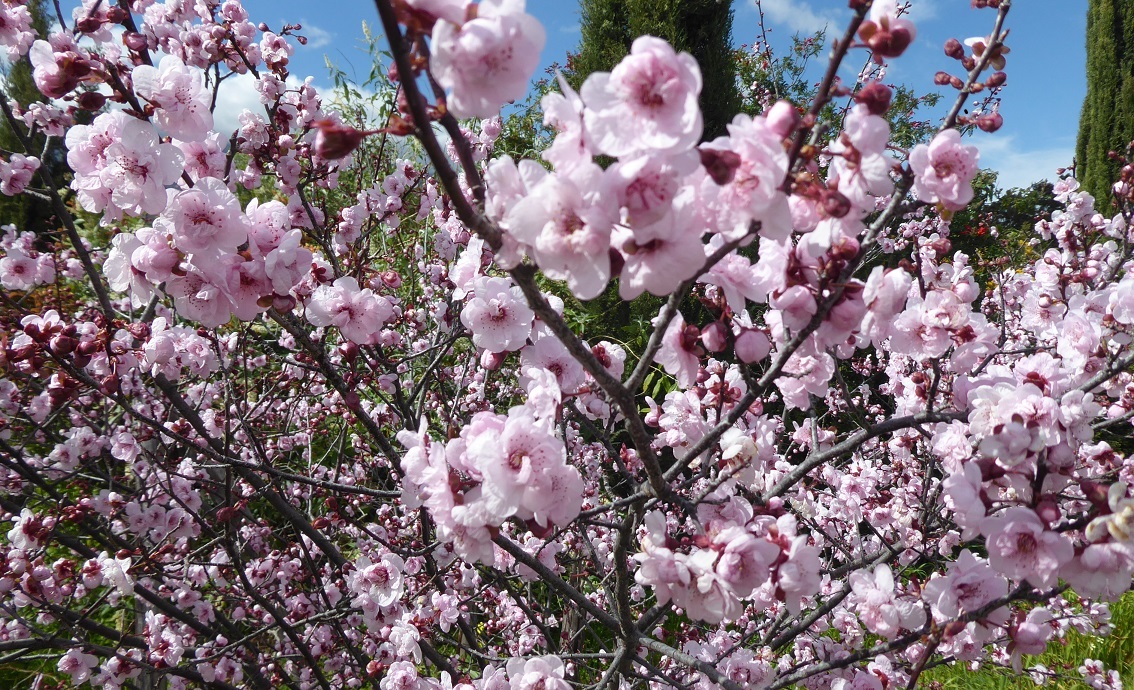
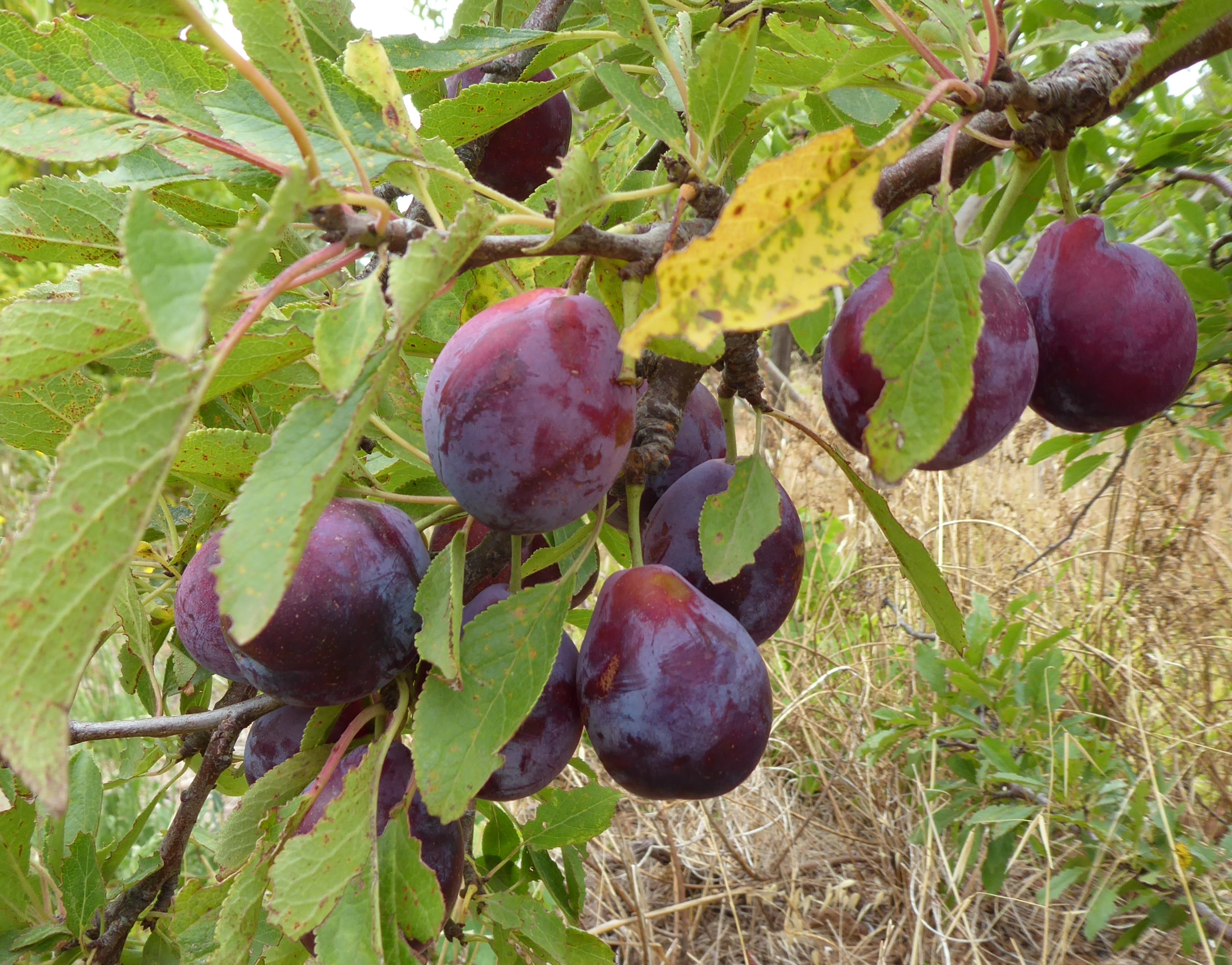
Although flowering cherries do not grow here as it is too hot, flowering plums /prunus and peaches do well. As I write one of the purple leafed plums with pale pink double flowers is in full bloom. I grew it from a slip from a very old tree neglected in the garden at Welgelegen at UCT. This old house had some special plants in the garden but many have been swept away or have died from neglect. I am very pleased to have saved the plum. Nearby I have one with fragrant single white flowers which comes from Fresh woods the beautiful garden of Peter and Barbara Knox Shaw in Elgin. It is called Vesuvius and has very dark purple leaves and little cherry sized plums later in the season. These 2 and the common single pink prunus make a little purple grove when their leaves appear.

Other early spring treats

Nearby is the old rose Souvenir de Madame Leonie Viennot with soft peach pink and cream flowers. The plan is one day she will scramble up into the prunus, and the purple foliage will enhance her flowers. Such are the hopes of gardeners.

One little cluster that always delights me at this time of year is a combination of Salvia africana-lutea, Buddleja glomerata (Karoo buddleja) and the purple leafed dodonea (Dodonea viscosa ‘Purpurea’). Salvia africana-lutea is the bruin salie or brown sage or salvia, whose flowers are uniquely coloured with dark brown bracts and paler brown/tan orange flowers. These are complemented by grey leaves. It is a tough plant from coastal areas of the Western Cape and does well here in the garden. It looks lovely growing near anything with cream flowers. I have another form too which has paler greeny bracts.

Buddleja glomerata has shiny silver leaves and bright yellow fluffy flowers. Unlike most buddlejas the flowers are unscented , the plant is incredibly tough and looks good all year round. It is growing near the purple dodonea, or sand olive whose foliage is even darker purple in winter and the 2 look stunning together.

The brown sage also grows near a cream lantana and near another buddleja with soft creamy yellow flowers. This is another plant that I grew from a slip from an old garden in Rondebosch. I think it is the cross between B. asiatica with white flowers and B. madagascariensis which I think has brighter yellow flowers. The flowers have a delicious fragrance and come in long spikes. It is quite a big, lax shrub and does not thrive for me as it doesn’t get enough water here.

When I returned from the UK, the garden was scented by Buddleja auriculata with its tawny, biscuit cream flowers in small spikes. It doesn’t look much, but the fragrance carries on the air and it is always a winter delight in the garden.

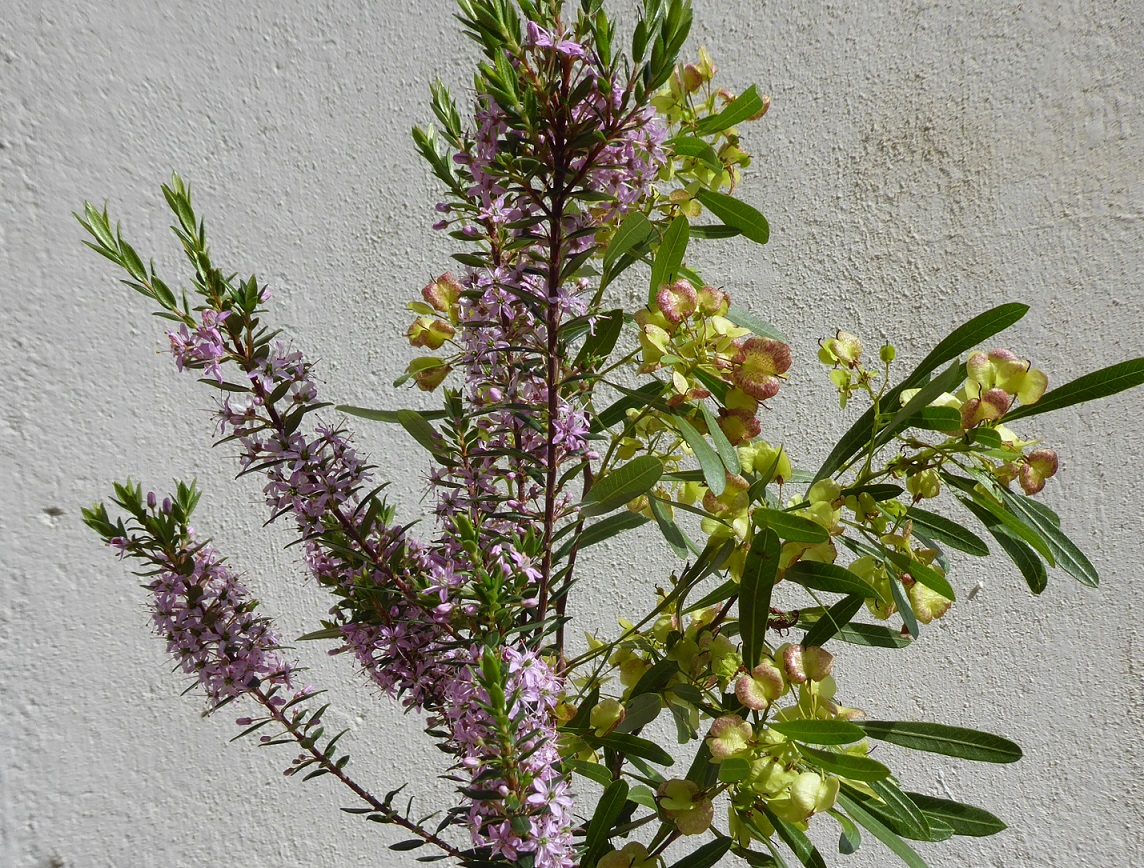
It is always fun to find a different form of a common plant. For years I have grown the rosemary with bright blue flowers and I was delighted to find a form with pale pink flowers to complement it. I plan to grow them side by side. The purple dodonea mentioned earlier isn’t native to SA, but the green leafed form, is. They are both garden stalwarts in dry areas with sandy soils. They are especially pretty now with their winged seeds which adorn the bushes. The limey green shading to creamy pink colours of the wings of the green sand olive complement a pink flowering buchu close by and they look good in a vase together.

One of the first harbingers of spring and which has been flowering since July is the beautiful tough climber Hardenbergia violacea from Australia. It has scrambled right to the top of the Searsia lanceolata tree and looks gorgeous with its clusters of bright purple flowers amidst the tree’s green leaves. This is a long lived creeper and I keep meaning to grow more from seed as I fear one day it might die. Competition from the Searsia roots must be fierce and I don’t often remember to water it in summer.

The poplars along the boundary have suddenly leafed out and the pomegranates are also looking lovely with their fresh bronze foliage.

Purple beauties

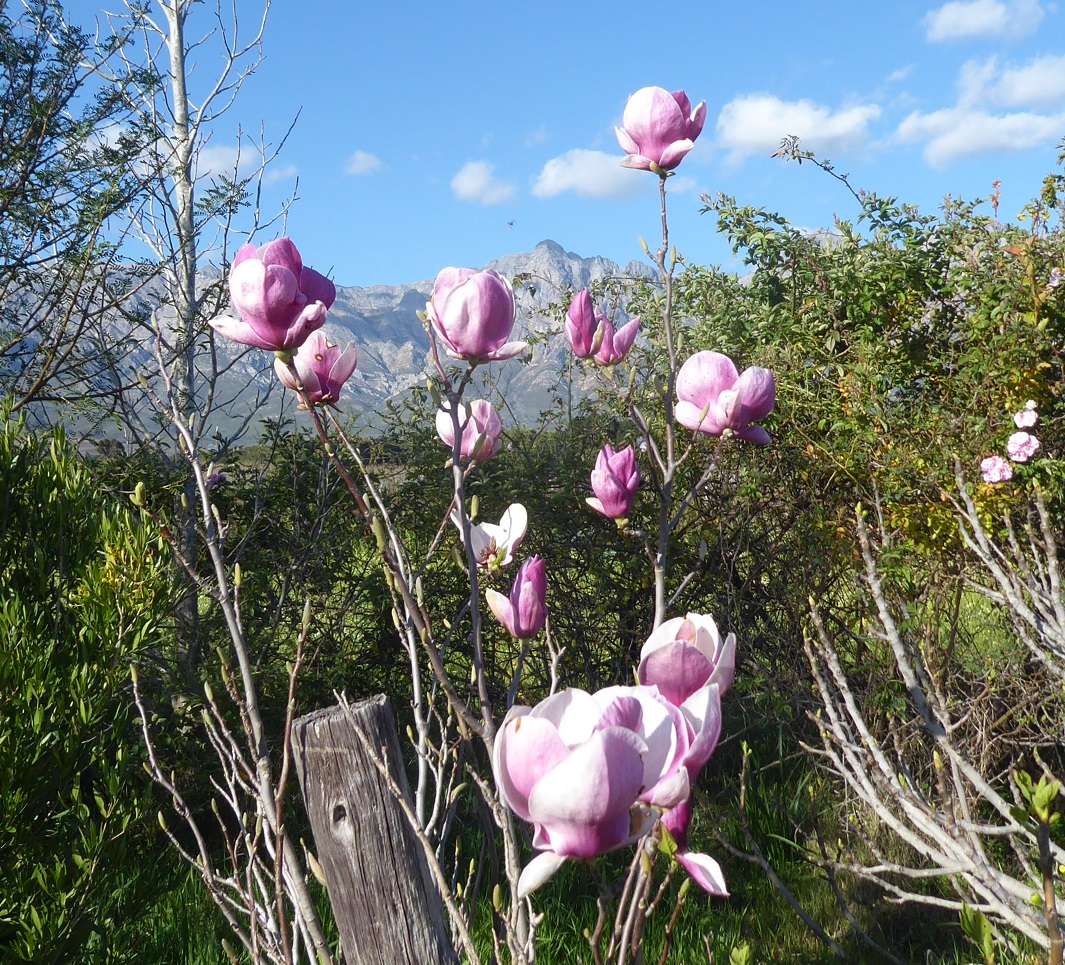
Another star of the garden this month is Magnolia soulangeana. My bush is still small, but this year it has rewarded me with more flowers than ever before – big purple pink goblets that are white within.

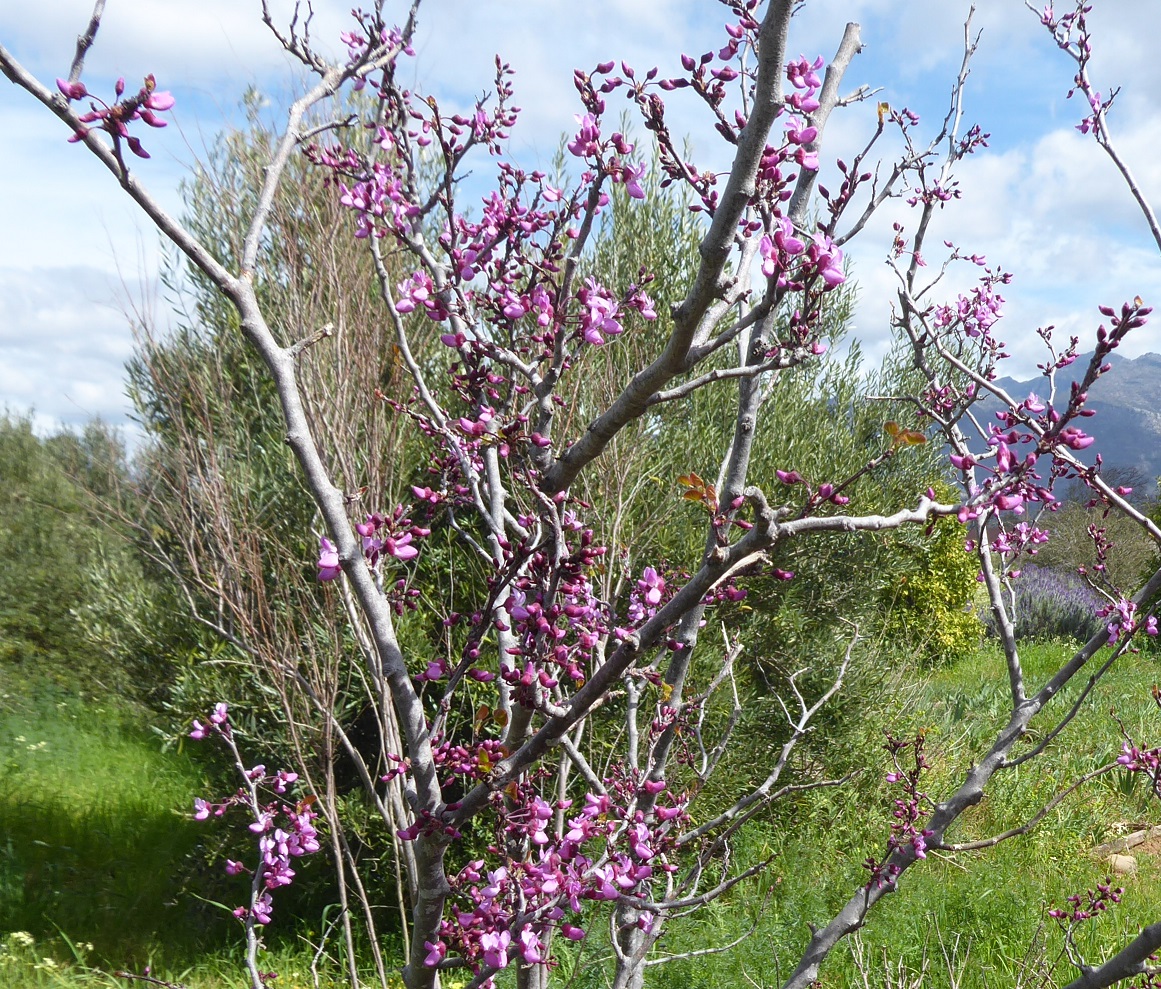
The Californian Judas tree is also flowering with tiny bright purple pink flowers clustered on the stems. It is a bit touch and go with this shrub as I never know whether to water it in summer or not. Parts of it have died back but it is still hanging in there.

Continuing in the lilac purple theme this month are the ginger bush (Tetradenia riparia), Geraldton’s wax bushes (Chamaelaucium uncinatum) and a beautiful bushy plant that I think is a tree mallow (Lavatera sp.). The ginger bush which comes from the northern part of SA has catkins of lilac flowers which make its other common name, the misty plume bush most appropriate. Flower colour can vary from white to a darker lavender. I also have a related species from Madagascar given to me by my late friend Gill Scott which I treasure. It has similar flowers, but greyer more lanceolate leaves.

Geraldton’s wax bushes come from Australia. They have tiny leaves which allow them to survive hot summers without water. The small saucer shaped flowers come in a range of purples, pinks and whites. They are exceptionally good as cut flowers lasting for weeks in the vase.

The tree mallow is a big bushy shrub with grey leaves and big hollyhock shaped flowers. I have two forms. One has clear pink flowers and the other lilac flowers with a darker eye. The shrubs flower for weeks now in spring and are great garden plants if one has the space for them.

Bromeliads

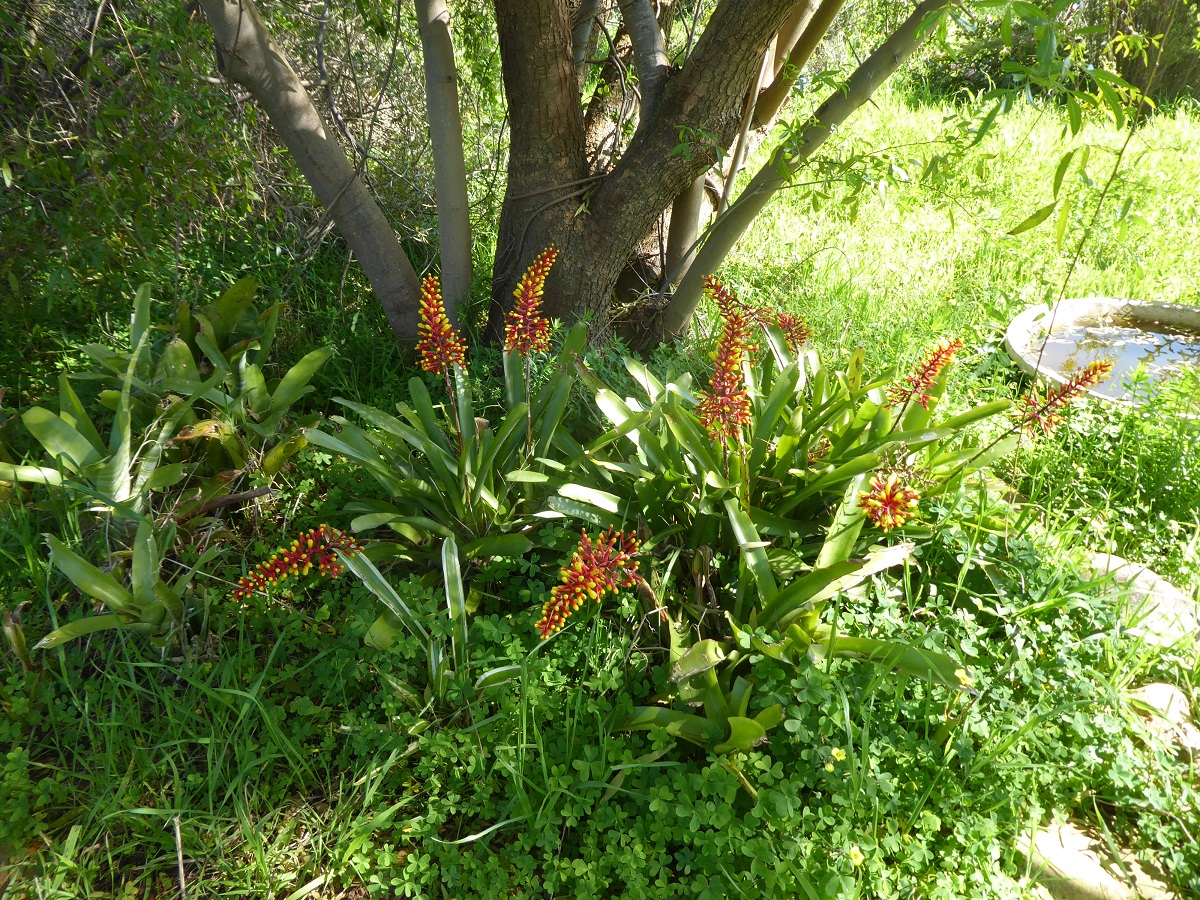
I am starting  small collection of bromeliads. They grow well in shady places and don’t seem to require too much water.  This month one with spiky red and yellow flowers has been flowering for weeks.  I also have 2 forms of the one called angel’s tears (Bilbergia nutans).  One far more delicate that the other.  The hanging flower stalks and bracts are shrimp pink and the flowers which hang like tassels a combination of pink, green, navy and yellow.

Succulent mounds

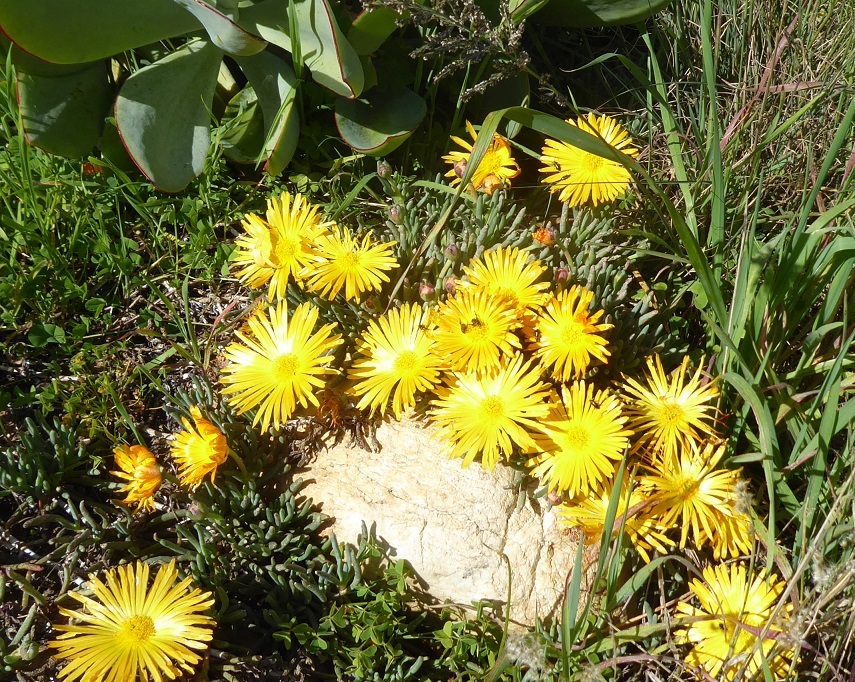
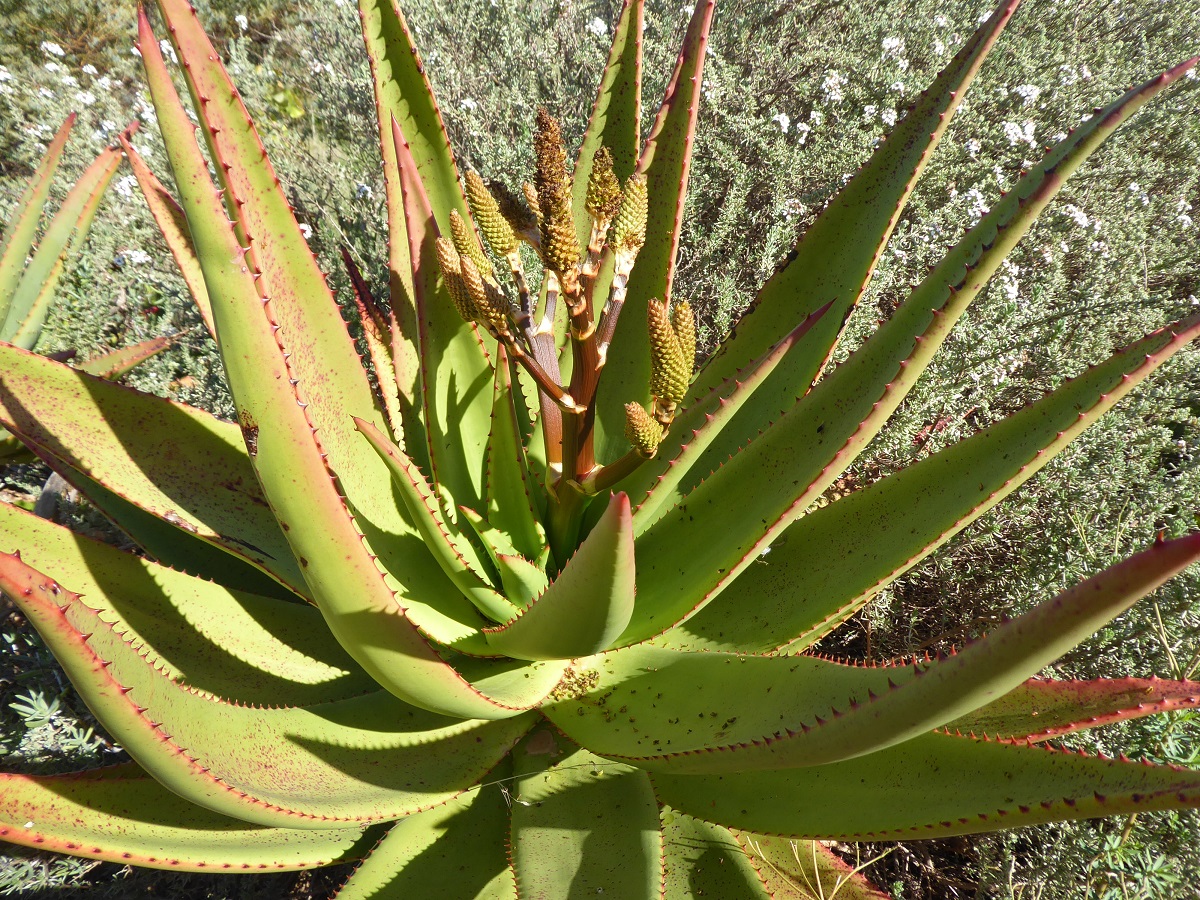
The succulent mounds are at their best in spring. Over the years I have planted many vygies/ mesembs, but although they flower in the first year, not many survive to flower the next year. One of the mesembs happy here is flat, creeping Jordaaniella dubia. This has bright yellow flowers which make bright patches on the mounds. One of the aloes which we bought in 2017 from the aloe nursery in Swellendam is also flowering with cheerful red and cream bicolour flowers. I think it might be Aloe cryptopoda bicolor.

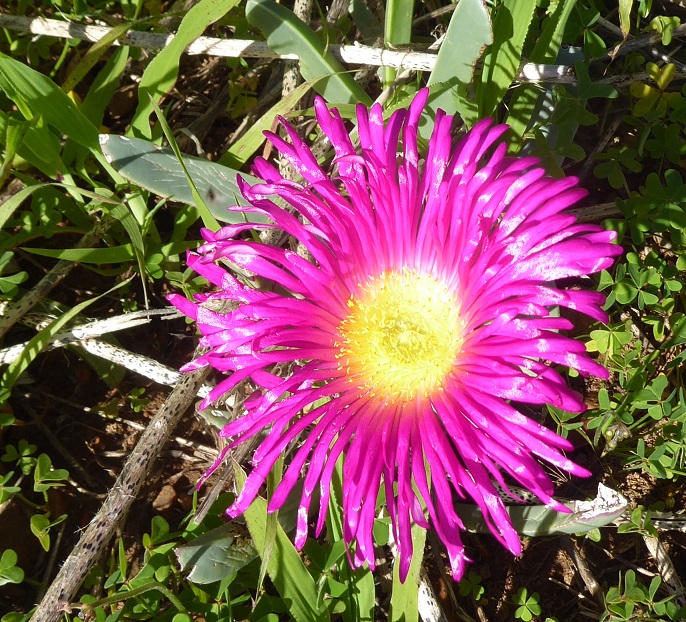
Growing close by is another vygie, given to me by my friend Tos Zeeman. It is a specially big bright purple pink carpobrotus and I hope the patch will be stunning when it establishes itself.  These vygies grow well on sunny banks.

Weeds glorious weeds

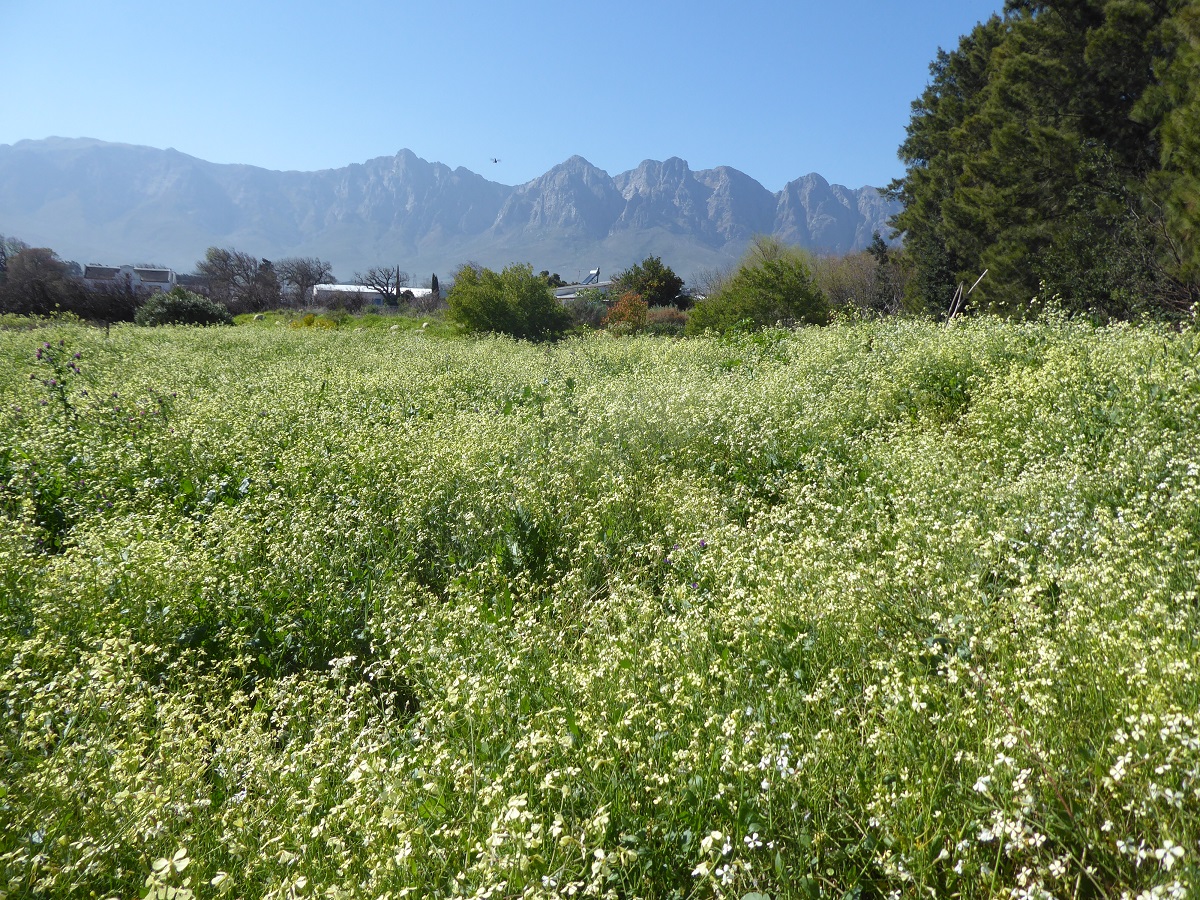
In August the whole farm is pale cream, awash with the flowers of a weed I call the wild mustard. This plant grows about 50cm tall and has leaves and flowers a bit like rocket, which is growing like a weed in the veggie garden. Here rocket, Florentine fennel and mustard lettuce all seed themselves each year. Florentine fennel in particular is a delicious vegetable. The other treats from the veggie garden this month are peas and celeriac and the asparagus is also starting to shoot.

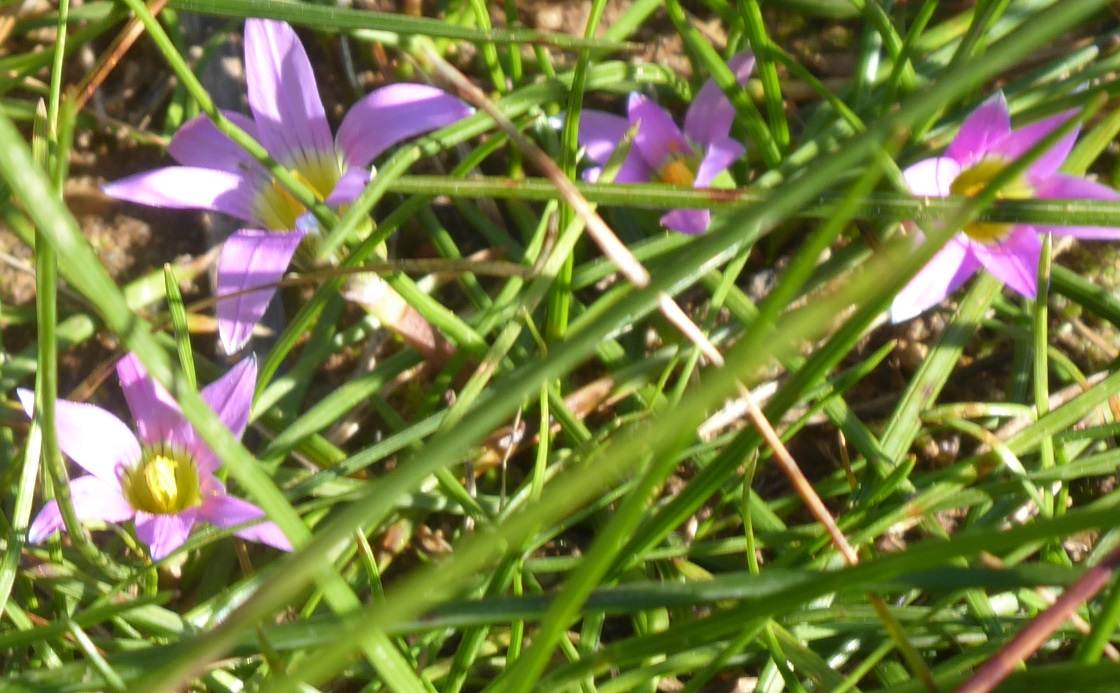
My front lawn also has some of the wild mustard, along with Arctotis daisies and small white flowers which might be a type of Cotula. Although many might frown upon this mess, I love the meadow look. It is such a contrast to the dry summer dust bowl. Tiny little purple flowers from a Romula species which has round grassy leaves also brighten empty areas.

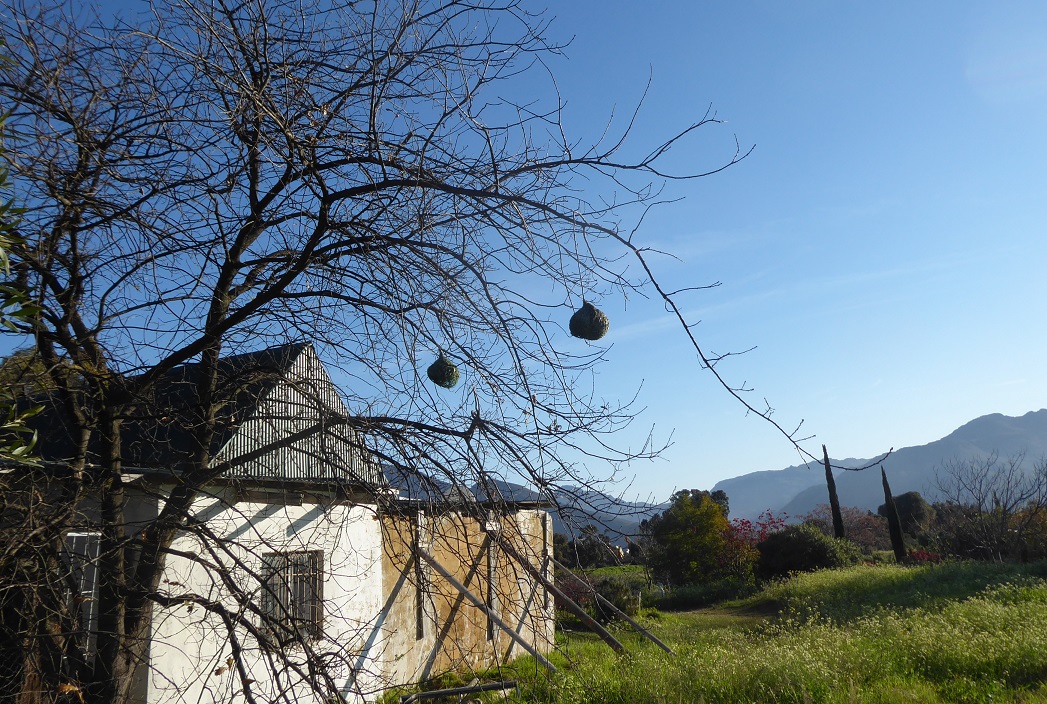
The birds are all busy making nests and the garden is alive with bird song. Weavers have selected a bare oak tree and owls have settled in the wild olives. One hears their hooting at night and one owl has decided a cypress is just the spot to set up watch at twilight.

August 2019 Gallery

June 2019

Winter has definitely arrived. The days are short and although it rose at 8:40 on the midwinter solstice, there is no warmth in the sun until after 10 am. Then it is lovely to find a sheltered spot and to bask like a dassie (Hyrax). By 4pm it is getting cool again. The sun set at 5:15pm at the solstice.

Although I have never experienced frost at KSU, winter nights are usually below 10 °C and often down to 3-5°C. The old cottage we live in has no fireplace. The large chimney breast attached to the kitchen had a wood stove in days gone by. Now we use the alcove for storage and rely on heaters for warmth.

Fortunately we have had more rain but often accompanied by gale force winds, but no snow yet. As I write I hear the rain falling on our tin roof and I have a blanket wrapped around my knees. They promise snow and it certainly feels cold enough.

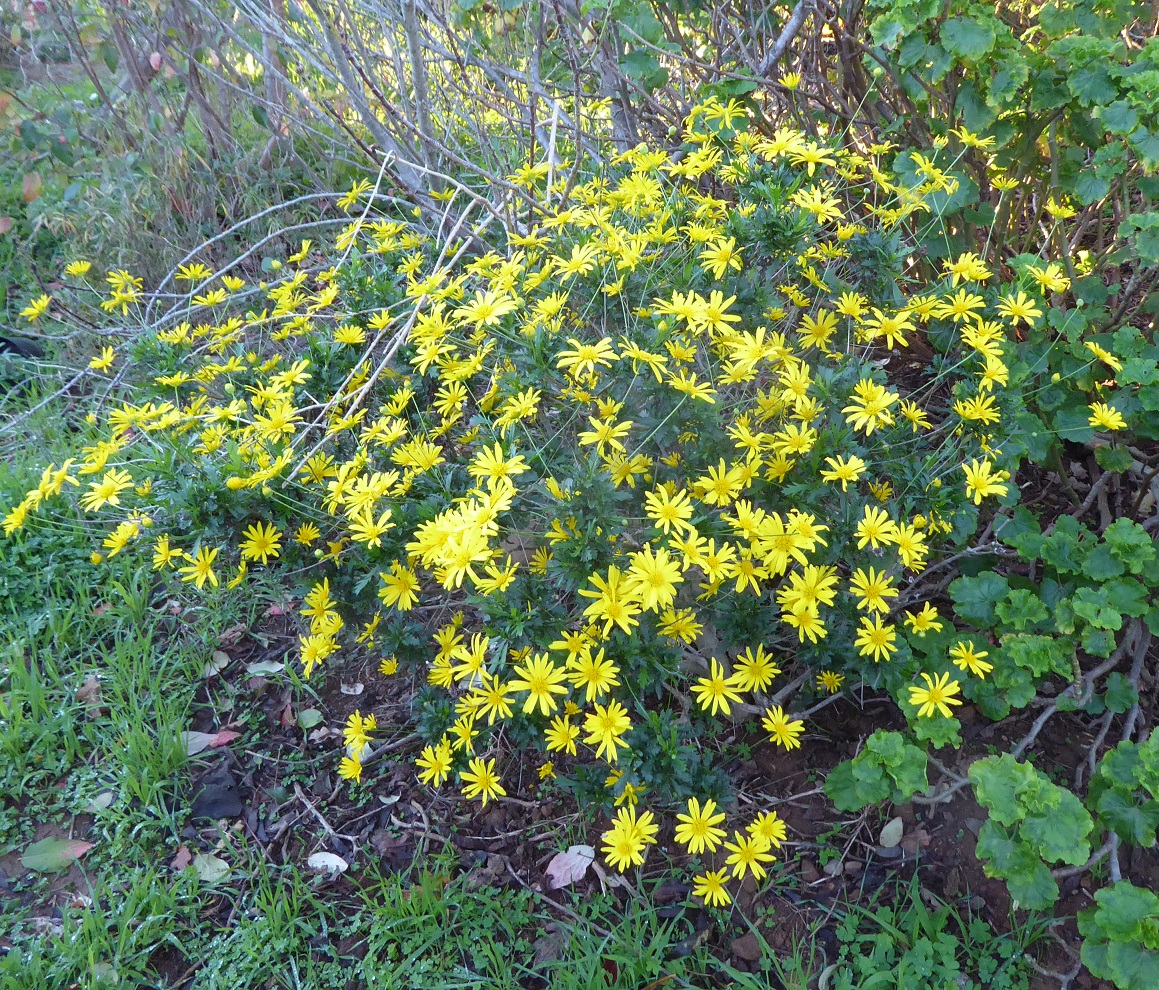
In the garden the tecomarias are still flowering as is the Mexican sage. Lavenders are coming into flower and they look splendid near the Seville oranges which are full of fruit.  In the old rose garden,  a small shrub which started off with variegated leaves which have reverted to plain green, is full of bright yellow daisy flowers. I think it is a euryops but cannot be sure.

The gales have blown most of the leaves off the trees and the oaks are almost bare, although some have retained drab brown leaves. The syringas, (Melia azedarach) which I should not be growing as they are on the invasive list, make a splendid show with their leaves turning bright yellow before they fall enhancing the yellow berries.   I think they will be even more splendid next month when the berries in the leafless tree light up the winter sky. These trees were here when I arrived.

The real joy of the garden is all the green; grass, oxalis and the wild mustard weed with its pale yellow flowers. The birds are celebrating too and the garden is alive with bird song. It is difficult to recall the pale brown of the summer months. Nowhere is this more noticeable than in the veggie patch which yields barrow loads of weeds for the compost heap.

Guavas and Seville oranges

There is little fruit at this time of the year, but we do have a single white guava tree. It is the only guava in the vicinity and the fruit is usually stolen. This year we erected a fence topped with razor wire around it and I harvested one bowl of fruit ( cost R500) before the birds attacked. Sometimes you just cannot win!

We also have 5 Seville orange trees and this year they have borne exceptionally well.  They are too bitter to eat, but  perfect for making marmalade.  That is a lot of marmalade so I have given away as many oranges as possible and taken some to the local padstals (farm stalls) to see if they can sell them.

Marmalade is one of the easiest jams to make. I use an old family recipe which works on the formula 1 fruit:3 water:2 sugar. Wash the fruit and remove any scars from the peel. If waxed, scrub to remove the wax. Cut the fruit up finely, removing pips and the pith between the segments. Take 4 cups of finely chopped fruit to 12 cups of water. Leave overnight to soak. Next day boil for about 45 mins until the fruit is soft and almost half the water has evaporated. Let it cool, then add a bit less than 8 cups of sugar. Boil up again until setting point reached.

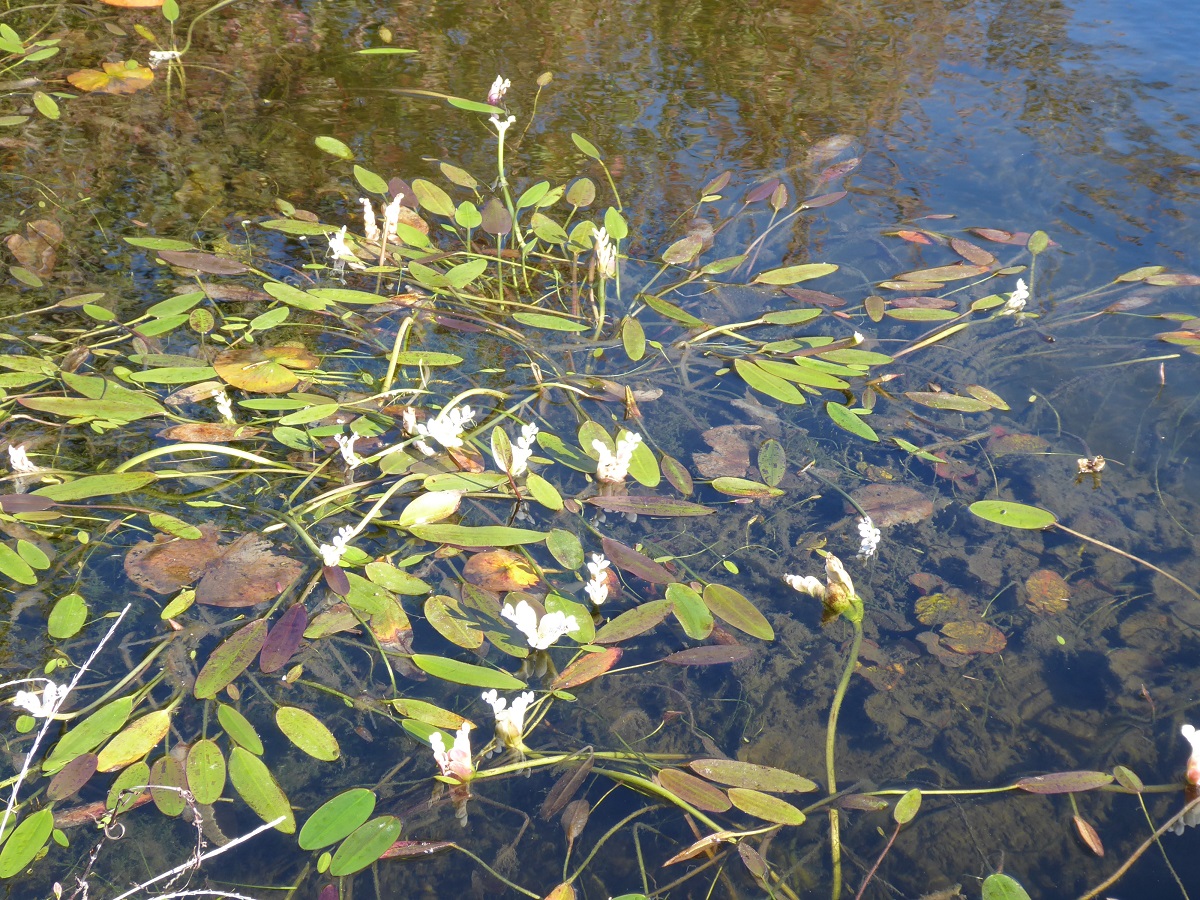
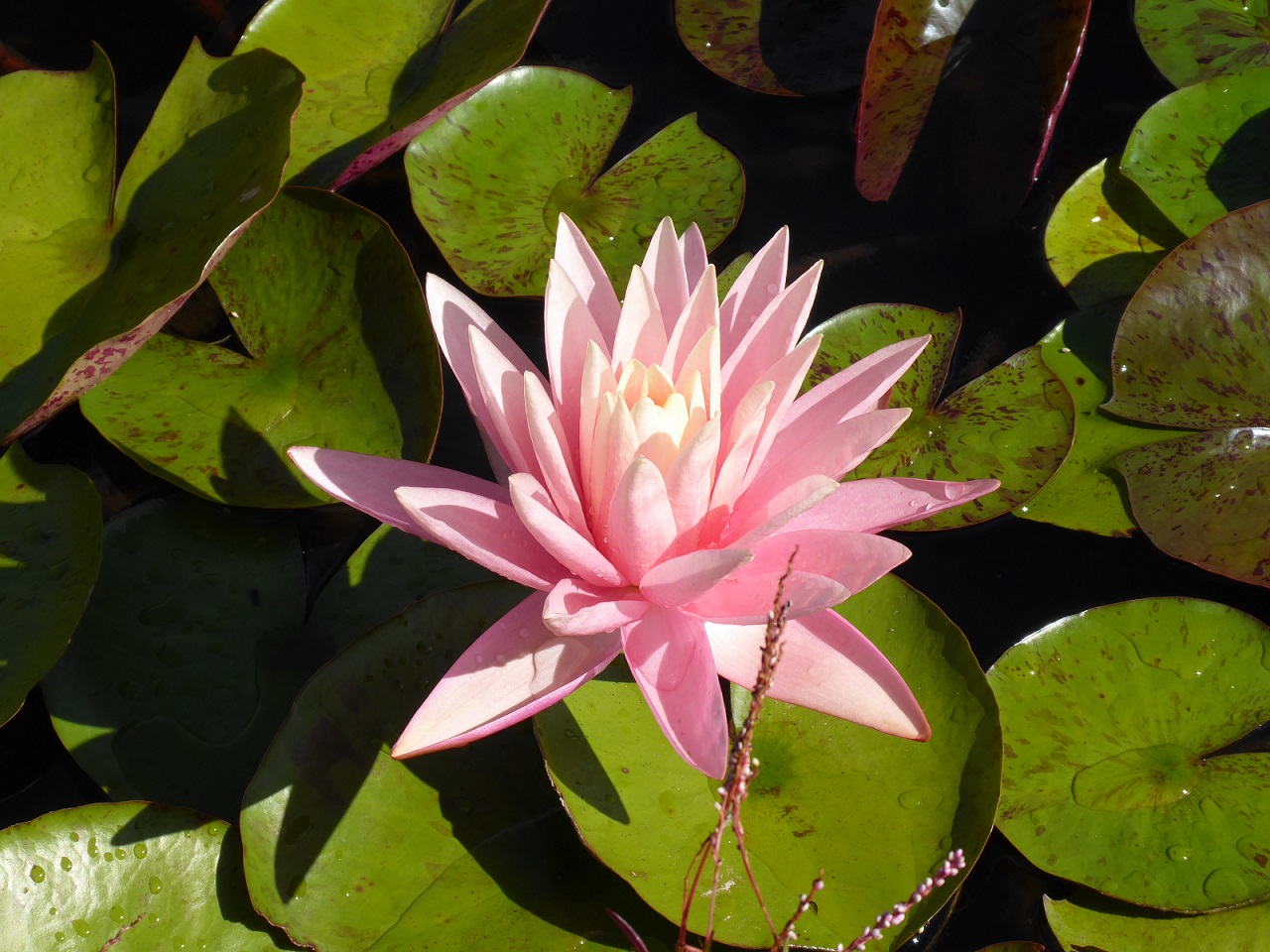
In the pond the waterlilies have died back. However the waterblommetjies  (Aponogeton distachyos) are flowering, but I haven’t waded in yet to collect any for bredies.

Succulent garden

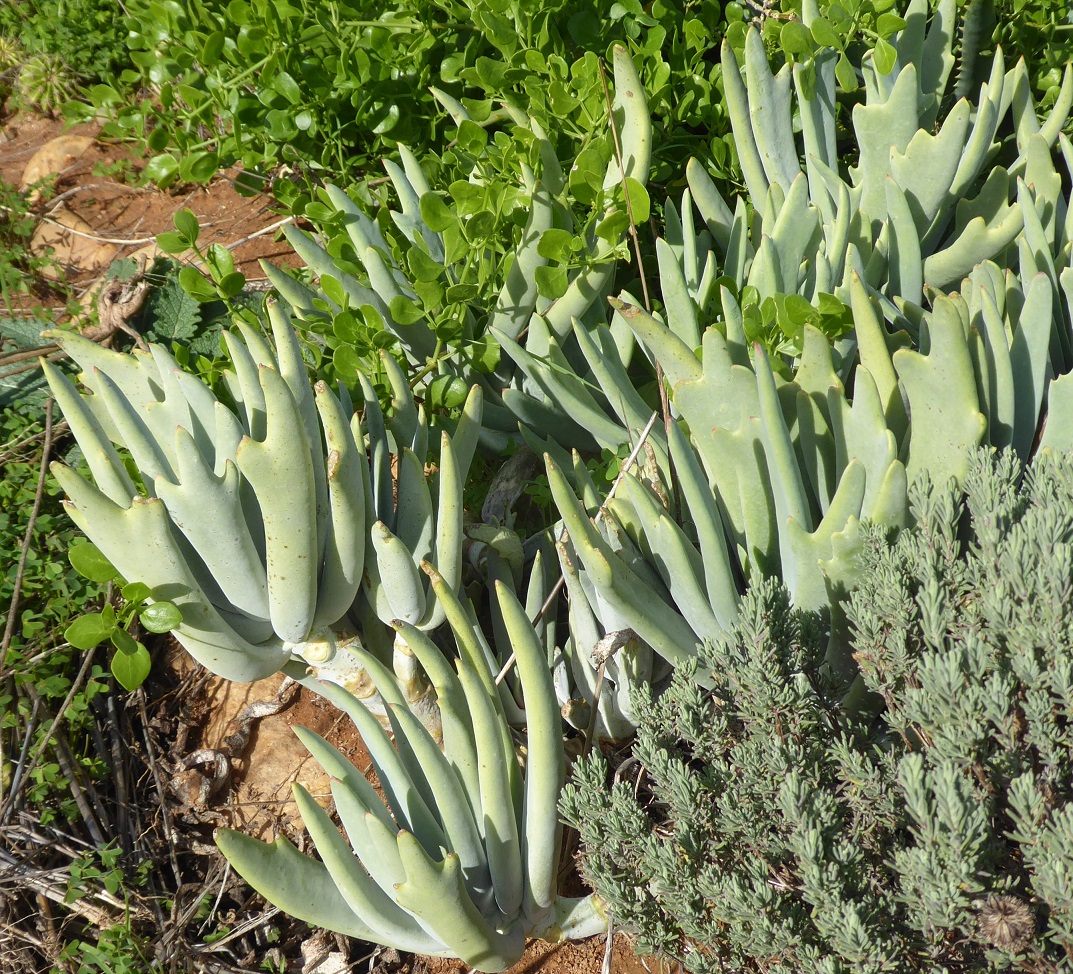
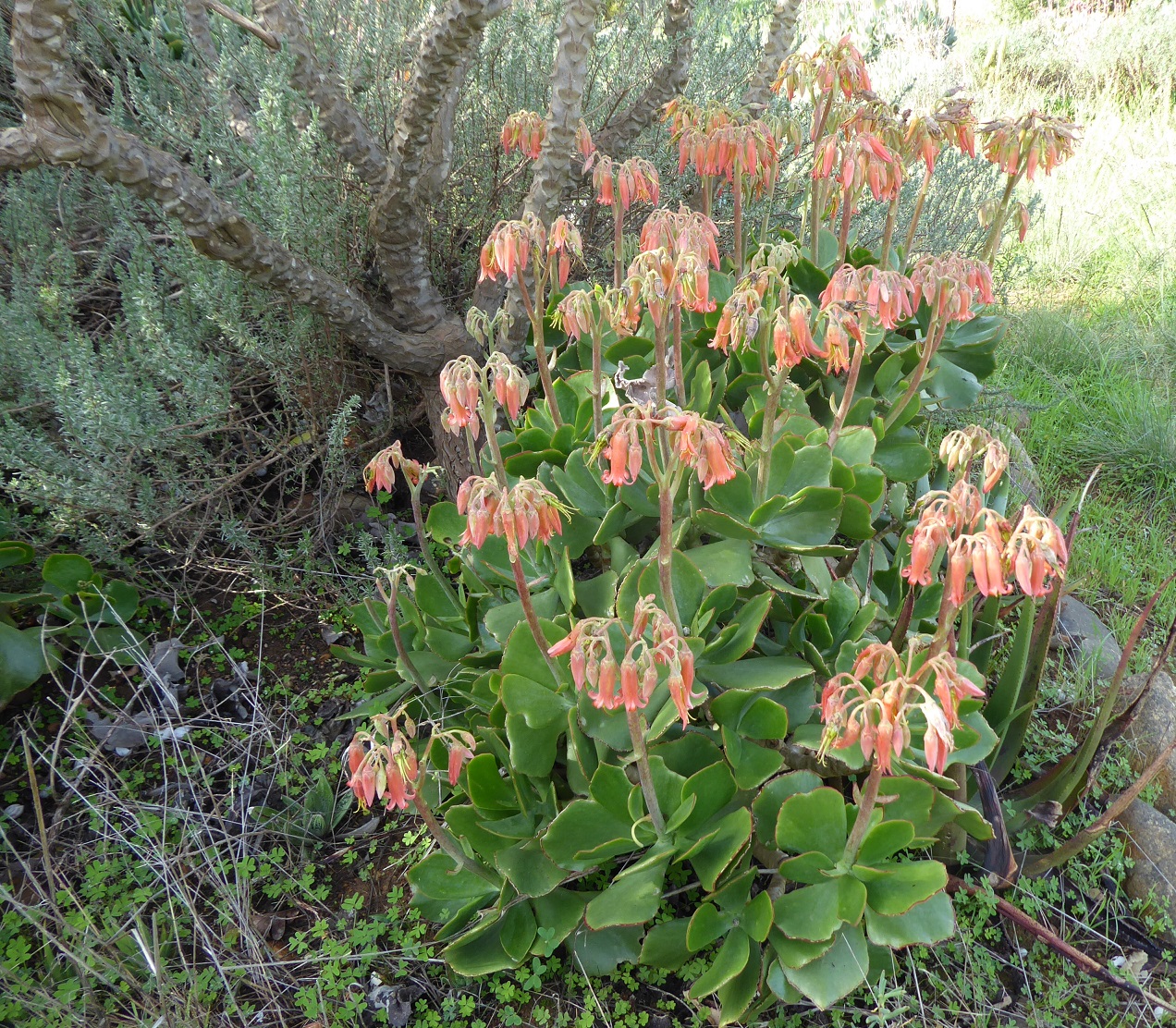
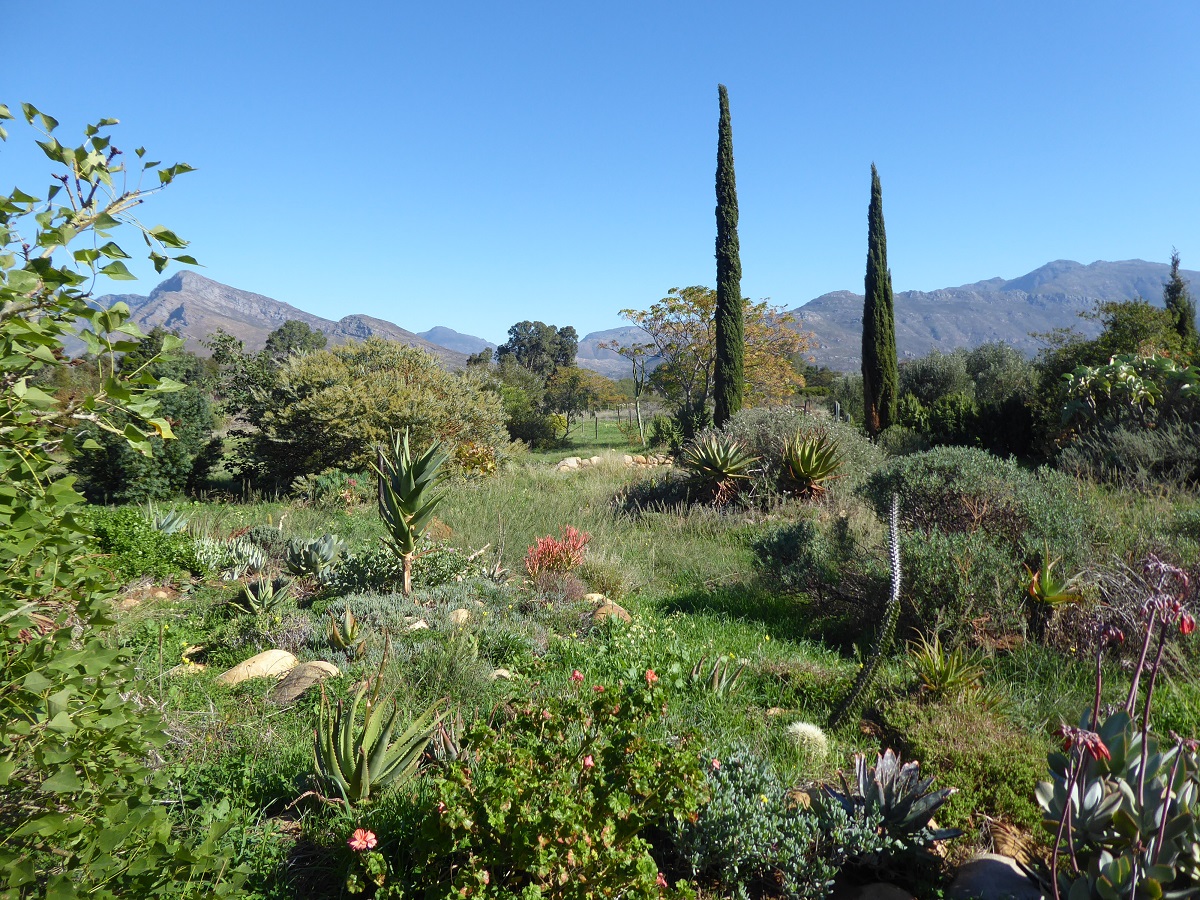
The most exciting section of the garden in winter are the succulent mounds. It is still too early for the mesembs, but the cotyledons are flowering – not as well this year as in the some years, but they are still very pretty. There are several varieties at KSU. I think they are all forms of Cotyledon orbiculata with different leaf shapes. Four varieties have grey leaves: one is round, the traditional pig’s ear shape with dark red flowers and another with similar leaves but pale pink flowers; another has thin round pencil shaped leaves and paler flowers; the final variety with grey leaves has forked shaped leaves. I also have a variety with green, round leaves and pink flowers.  Also in the succulent garden, the wild rosemary bushes are still covered in white blossom.

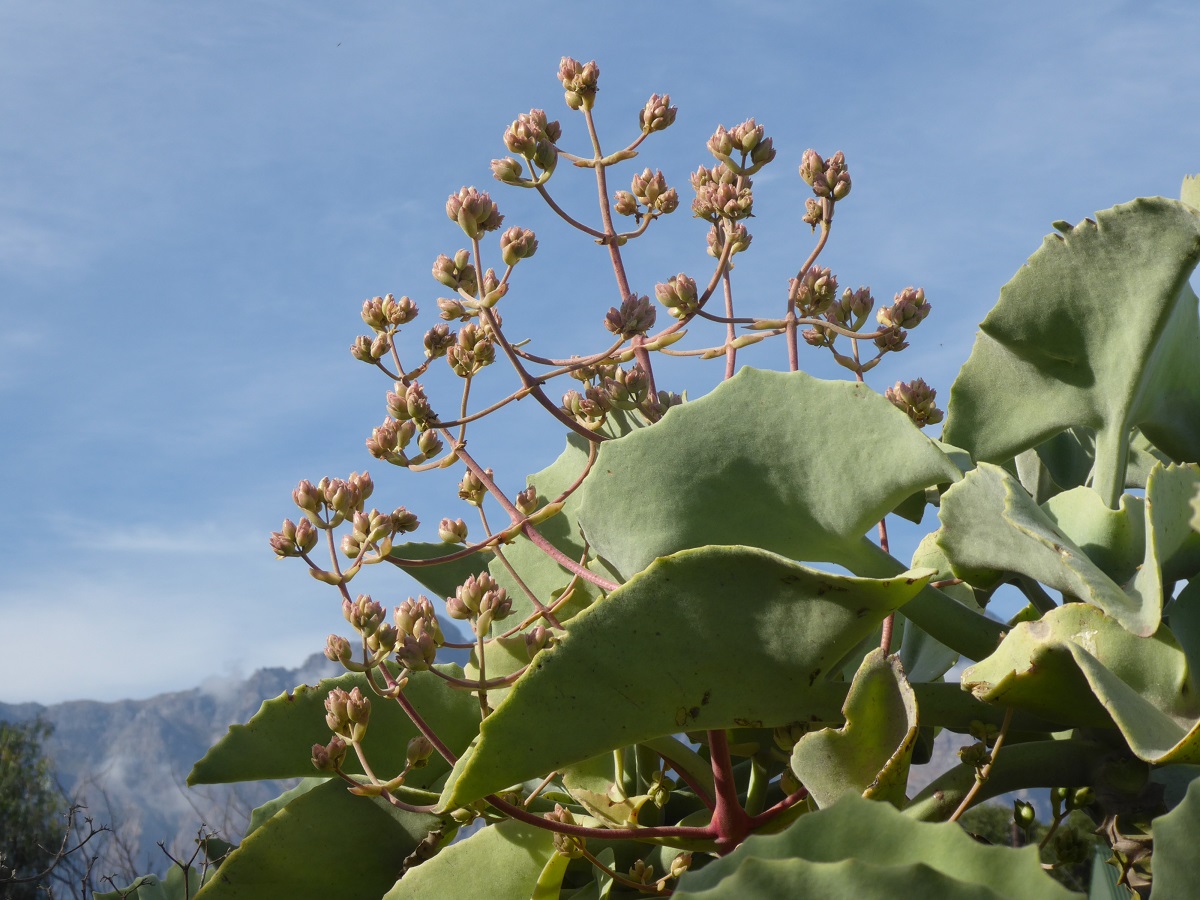
A splendid feature plant on the original succulent mound is a Kalanchoe beharensis, or elephant’s ear kalanchoe. This large succulent has big grey felted leaves and comes from Madagascar. It has fairly insignificant heads of pale pink flowers now in winter. Each year it grows a bit taller and its branches are marked with the scars of fallen leaves. It struggles a bit in our dry summers and requires water occasionally.

Euphorbias

I like euphorbias. They come in all shapes and sizes. One of the most splendid flowers now in winter, the poinsettia (Euphorbia pulcherrima) from Mexico, but grown the world over. Once it was very common to see the big bright red bracts of this shrub flowering in winter, but now they are only found in old fashioned gardens and impossible to buy from nurseries. They only sell the dwarf pot plant form. I will need to beg some cuttings in spring. I do have the limey yellow form however, growing near a maroon caster oil bush and it is delight at this time of year.

In KZN I have seen one with twisted red bracts called the Ramshorn poinsettia which is very eye catching. Many years back local nurseries were also selling a salmon pink form of the standard shape, but it has also vanished from  nursery stocks. If the cold has caused the leaves to fall at flowering time, so much the better.

Another euphorbia which I have only had for about a year, but which is slowly growing on a succulent mound is the Firesticks form of E.tirucalli, the rubber hedge euphorbia. This is currently a very fashionable plant, used extensively in landscaping. The normally green stems are bright orange in the top half of the plant. It doesn’t seem quite as tough as the original green form, but this is normal for sports which have less chlorophyll. I look forward to the increased display as the plant grows and becomes a feature of the mound both in summer and winter.

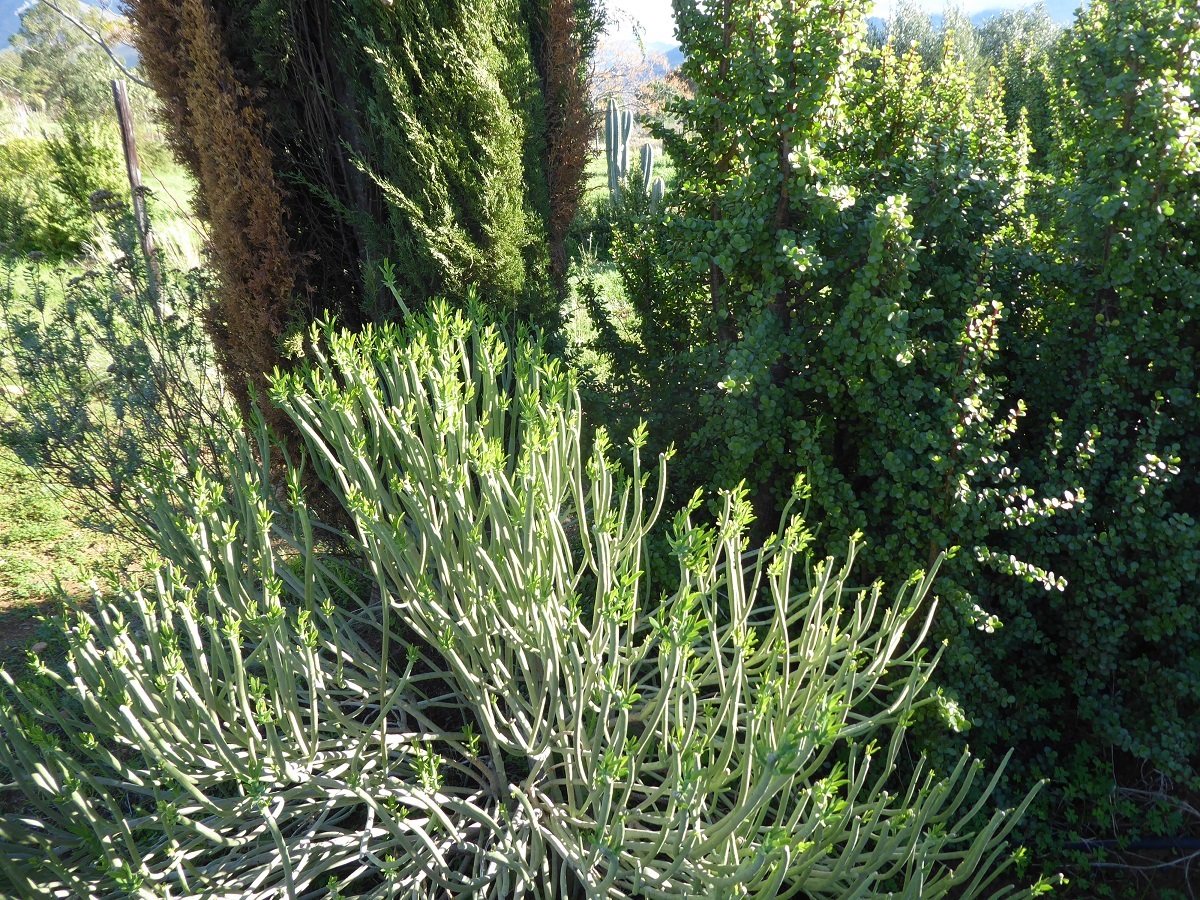
Lastly I have been admiring Euphorbia mauritanica, sometimes called the yellow or pencil milkbush because of its thin cylindrical stems. This is a common plant in the strandveld and succulent karoo and elsewhere in South Africa, but not always available in nurseries. All summer long its bare stems have formed a mound in front of a tall cypress and beside the spekboom hedge, now the bright green leaves are sprouting. I look forward to its yellow flowers in spring before the leaves fall as summer comes.  I very much enjoy the contrast of the 3 green plants together.

Big brother, the naboom, Euphorbia ingens, which looks like a cactus grows fairly close by. These last 2 euphorbias never get a drop of water in summer, but the others do. All euphorbias are poisonous and have milky latex which is an irritant. They must be handled with care. There are several other species at KSU.

In the pink

At the edge of the old rose garden is a large bush of  Hibiscus mutabilis that  is still flowering. This does not flourish at KSU and only comes into its own in autumn with the rain. I grew it from a slip from the tree which for many years grew at Rosebank station. I am not sure if it is still there. It is an intriguing plant with flowers that change colour, starting out white and turning pink.

In the Arderne garden in Claremont there are/were big bushes of  a double form which is even more lovely. I have a plant of this, but it is really struggling and needs far more water than I can provide. It is known as the Confederate rose as it does so well in the SE of the USA, although it hails from China.

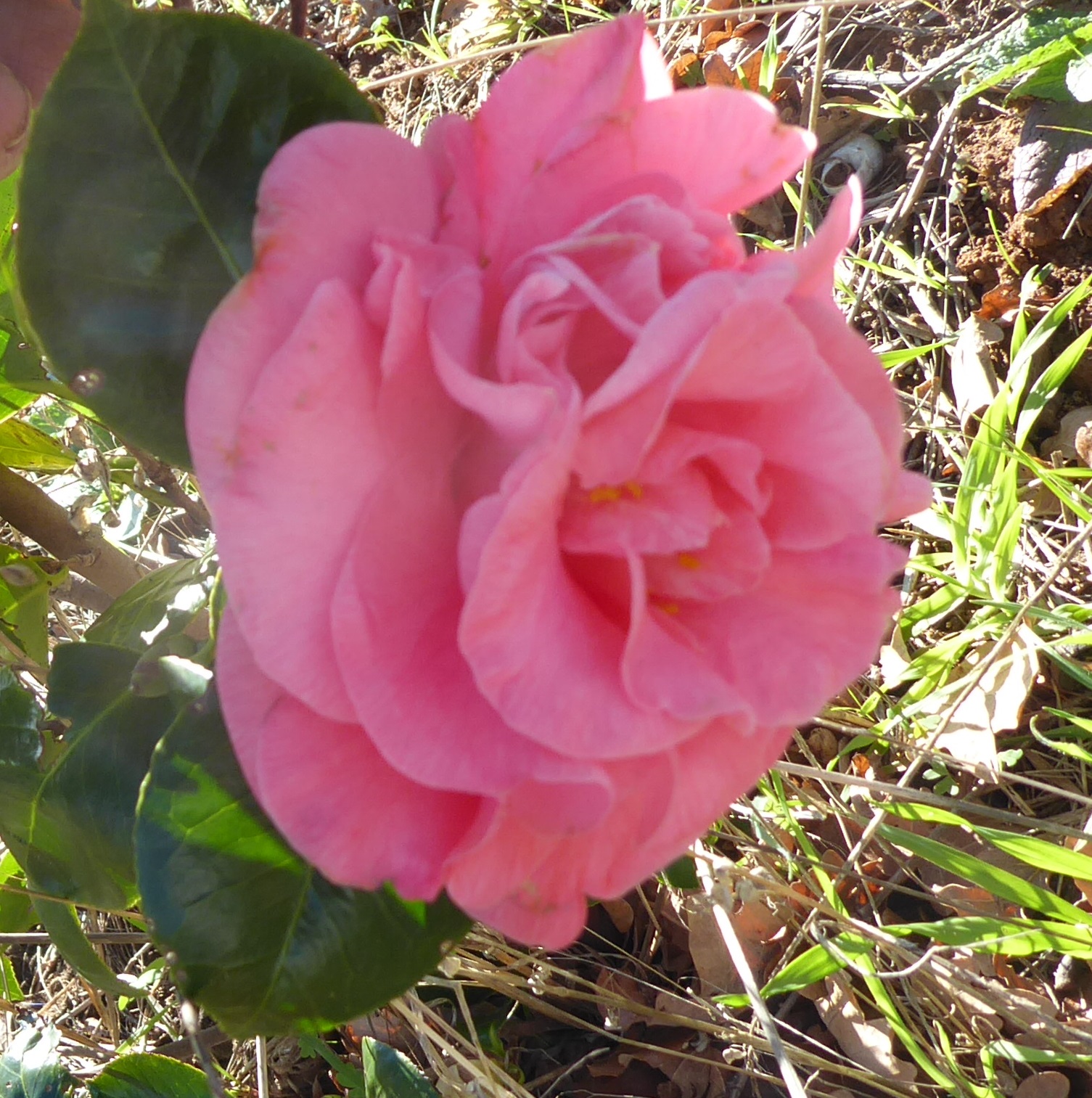
Other beauties from China are the camellias. I wish I could say they thrive here and they should as my neighbours have large bushes and the soil is very acid, but mine struggle and I have lost many of my treasured plants. I fear I will have to plant them all in pots if they are to survive. One has obliged with a beautiful pink flower.

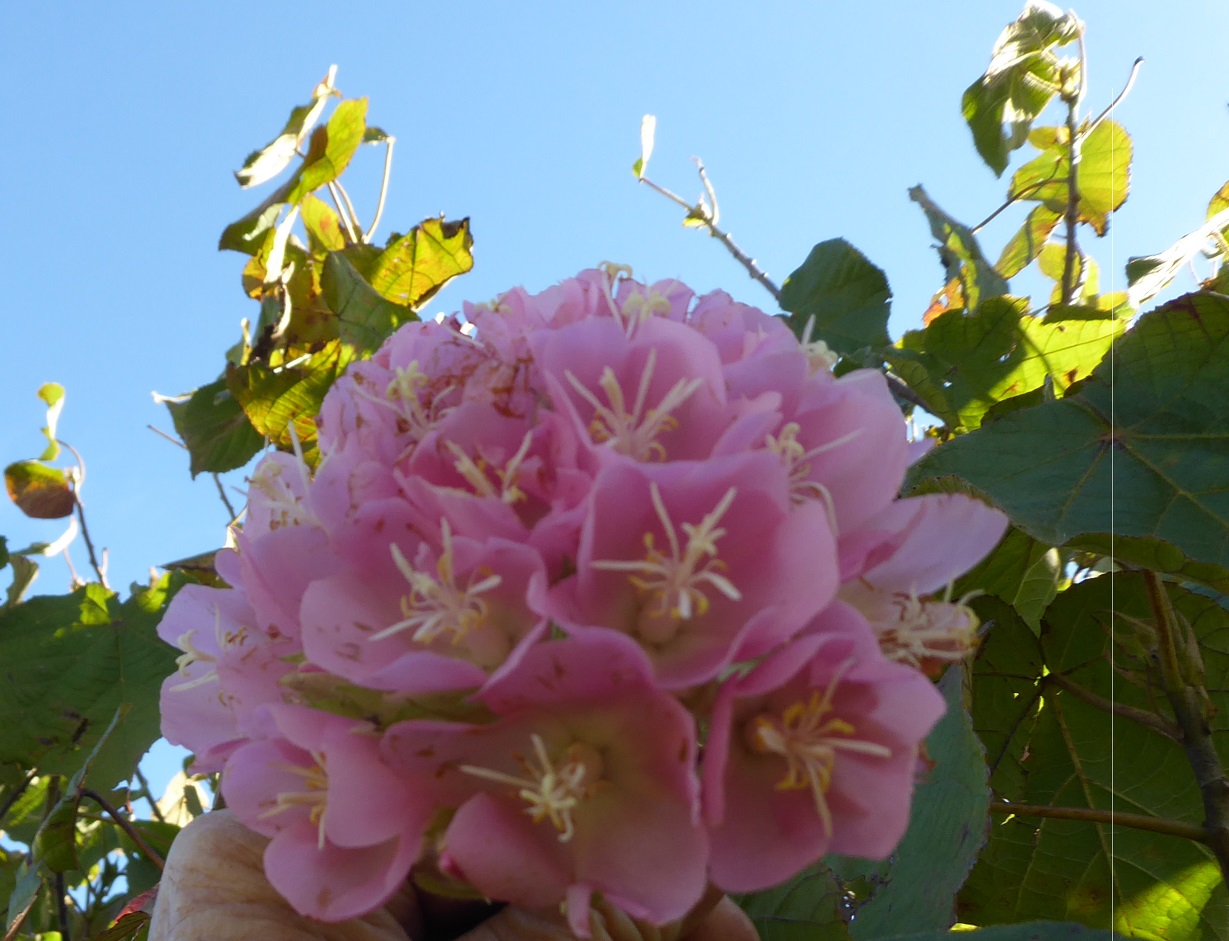
Last of the pinks is a dombeya. This big bush grows down near the pond and struggles a bit  in the summer, but survives with minimal water. The leaves and flowers are now being battered by the gales, but nevertheless the big hanging heads of pink flowers are a joy. I am not sure of the species, but I grew it from a slip from a huge bush which grows outside the old offices at Kirstenbosch. I think it might be the hybrid called Dombeya x cayeuxii.

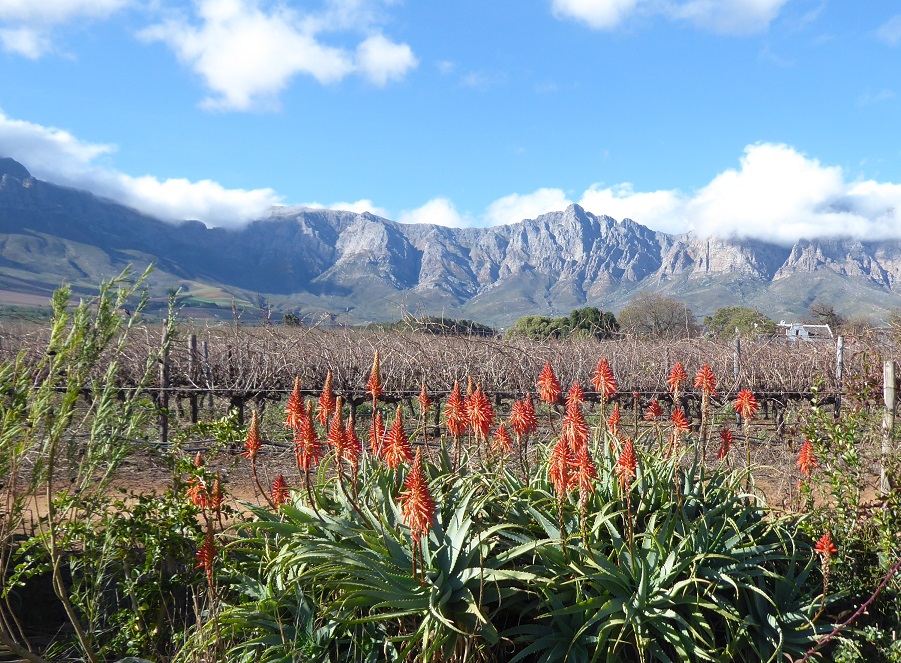
To end I want to celebrate Aloe arborescens, the only aloe to survive the mysterious enemy which ate all the buds off my other aloes. Here on the boundary fence they are the iconic winter image of KSU- only the snow on the mountain tops is missing- hopefully along with the peas I will be able to write about that next month.

June 2019 Gallery


May 2019
We are on the threshold of winter, but although we  had some cold evenings and about 30 ml of rain on the 20th of May, I was still watering the vegetable garden at the end of the month. The pump is not stowed for the winter yet.

The sun has moved almost as far north as it goes and days are shorter with the sun rising after 8:30 and setting before 5:30.  Fortunately  afternoon sunshine is prolonged as the sun is setting in a gap between two mountain ranges.   Many days are sunny and mild, but the dreaded south easter still pounds  sometimes and brings a tablecloth of clouds roiling over the mountains.

We hurried to get the roofs painted again in May and in the vineyards the winter work of pruning has begun.  The glorious autumn colour of the vine leaves  disappears as just the stems and a few shoots are  left for next season.

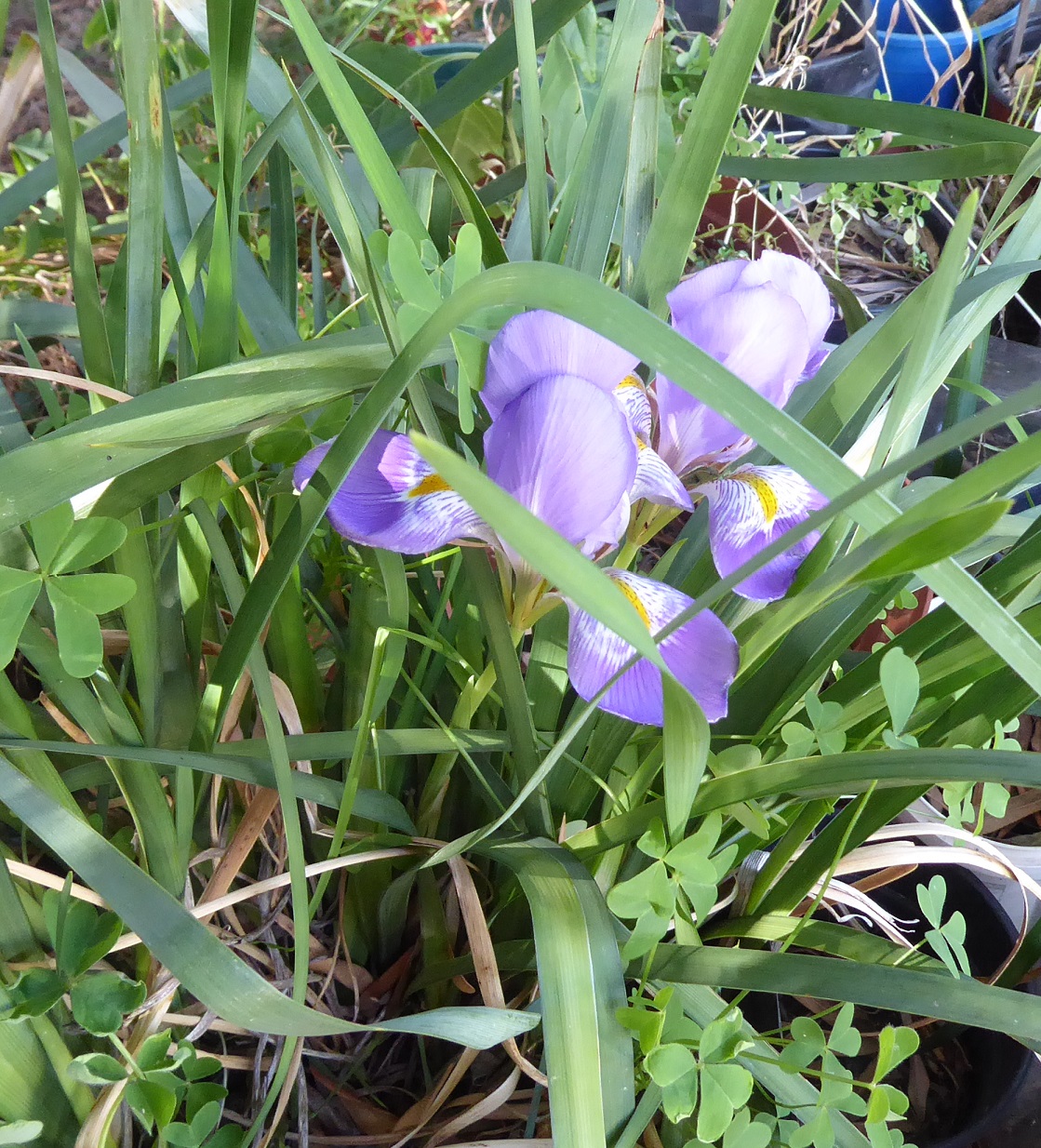
One of the joys of early May was the Algerian iris (Iris unguicularis). Despite its common name the distribution of this iris is listed by Wikipedia as Greece, Turkey, Western Syria and Tunisia. The exquisite lilac blue flowers marked with white nestle between its strap shaped dark green leaves. It is not commonly grown at the Cape but I have seen it growing happily in a neglected garden in the sandveld where it had hot sun in summer and almost no sun in winter. I was lucky enough to find some plants in a nursery in Montagu but am still trying to find the perfect place for it in my garden.

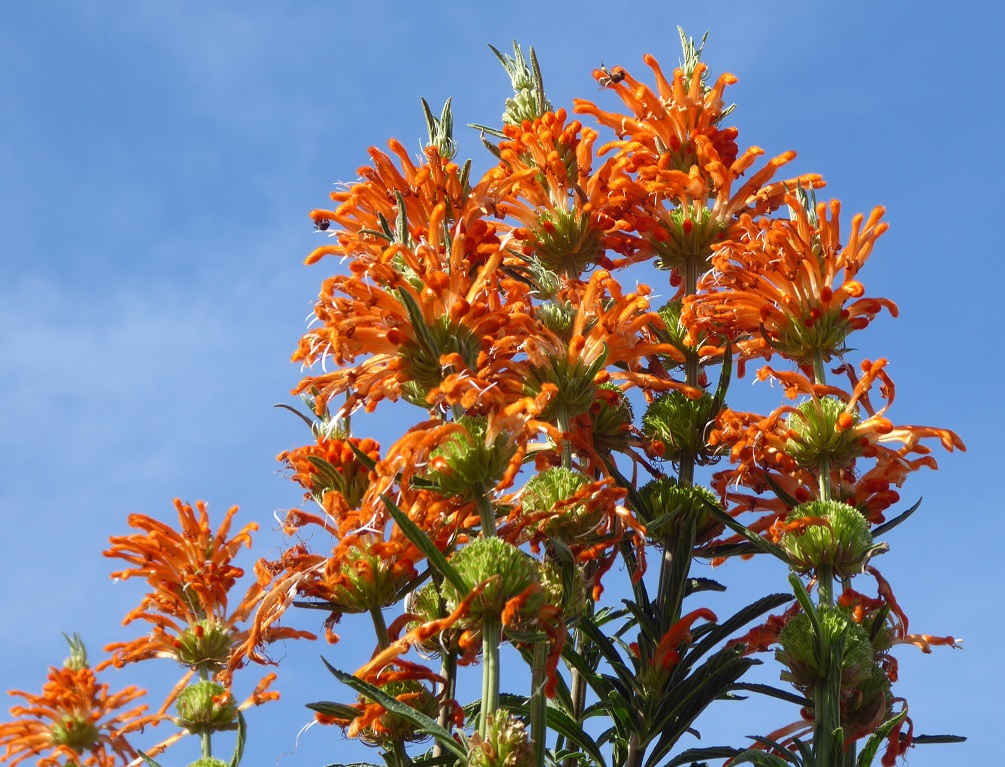
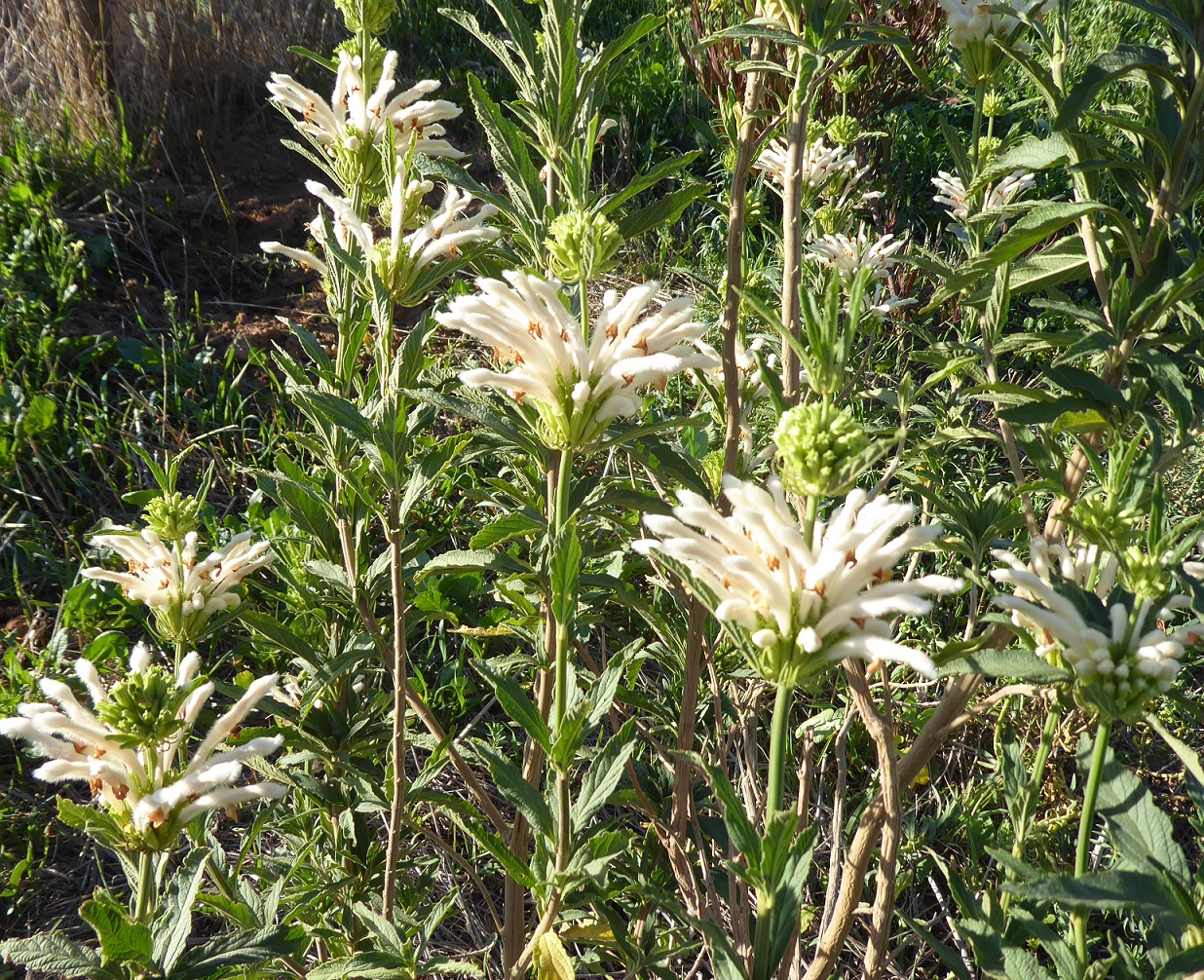
Another joy this month has been Leonurus leonotis or wild dagga. The sunbirds love this plant and the gay orange flowers against a blue sky are very cheering. I have an enormous old bush which has been in the garden for about 15 years.  I also have a white form which I plan to plant next to a cypress and have just acquired the rusty, biscuit coloured one which is a subtle mix of the two.  They survive conditions here at KSU, not needing much water in summer, and I like the aromatic fragrance the leaves give off on hot days and when they are crushed.  I believe they have medicinal properties too.

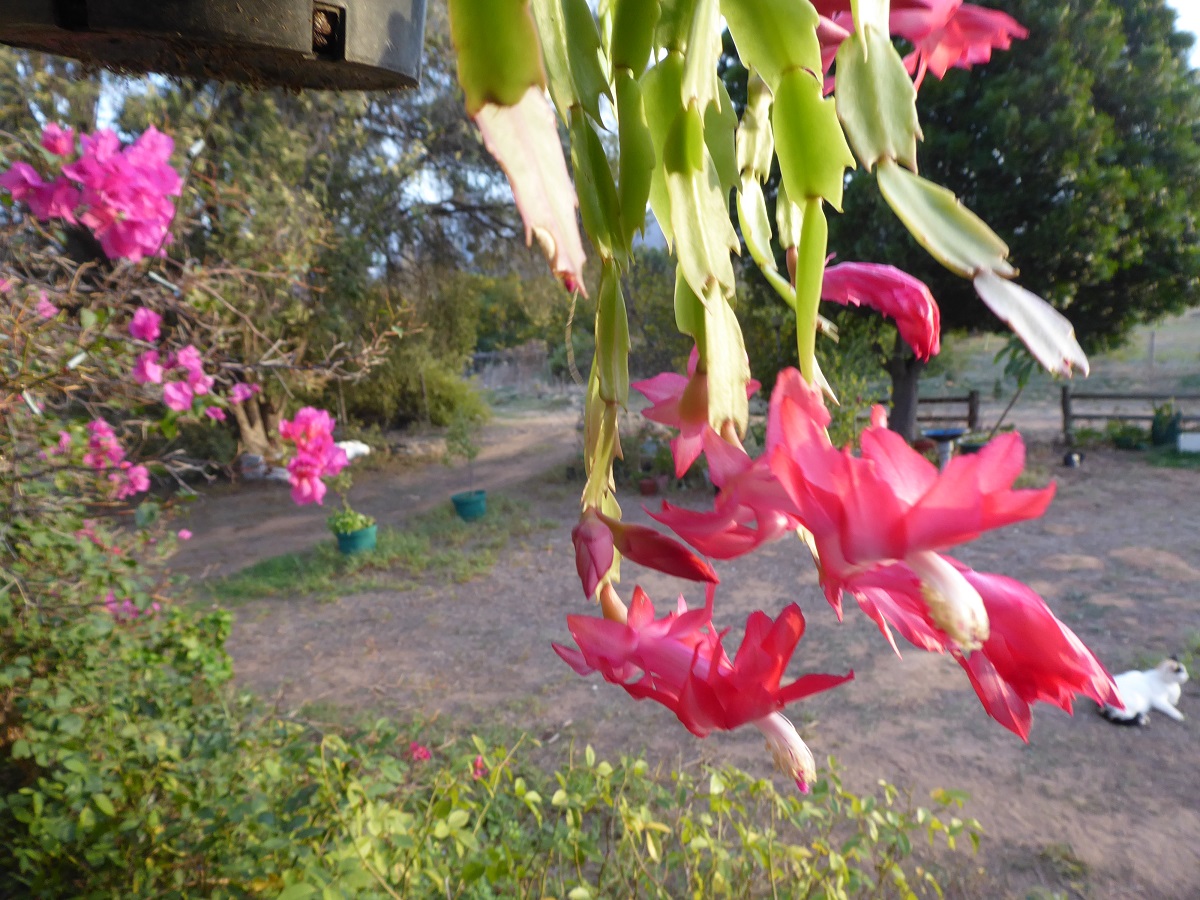
Growing in pots at the edge of the stoep we have some cacti.  I am not sure of the names but one decided to flower for us this month. I think it is a form of the Easter cactus (Schlumbergera sp.) The pink flowers were a delight, toning with the nearby bougainvillea.

Nuts and citrus

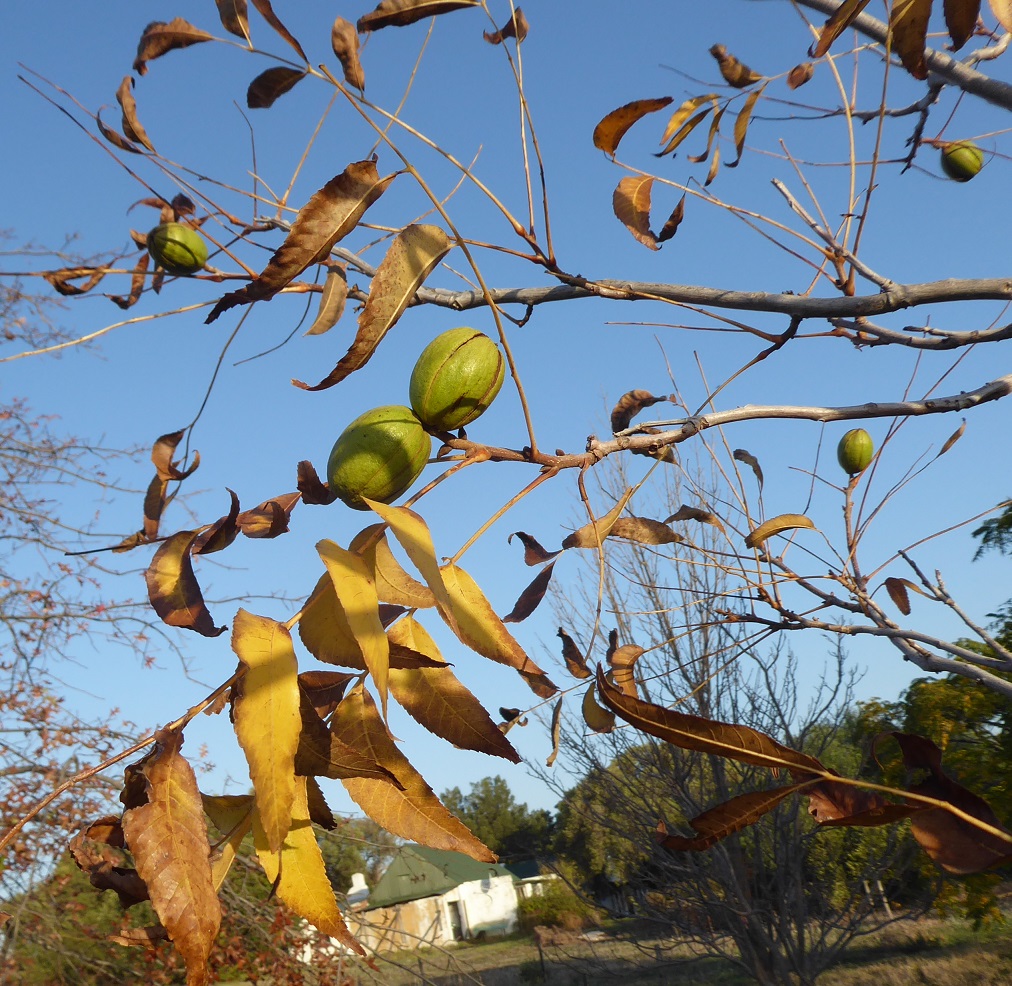
Pecans and macadamias ripen now in May. Sadly most of my macadamias were stolen but I have been able to harvest most of the pecans from my 3 small trees. Although they have been in almost 15 years, they are not big. I am not too upset about the macadamias as I find it almost impossible to open the nuts. Even bashing them with a hammer is tricky as they are round and skitter away. Both nuts are delicious and we look forward to nibbling them on winter evenings, along with the almonds which we harvested in January.

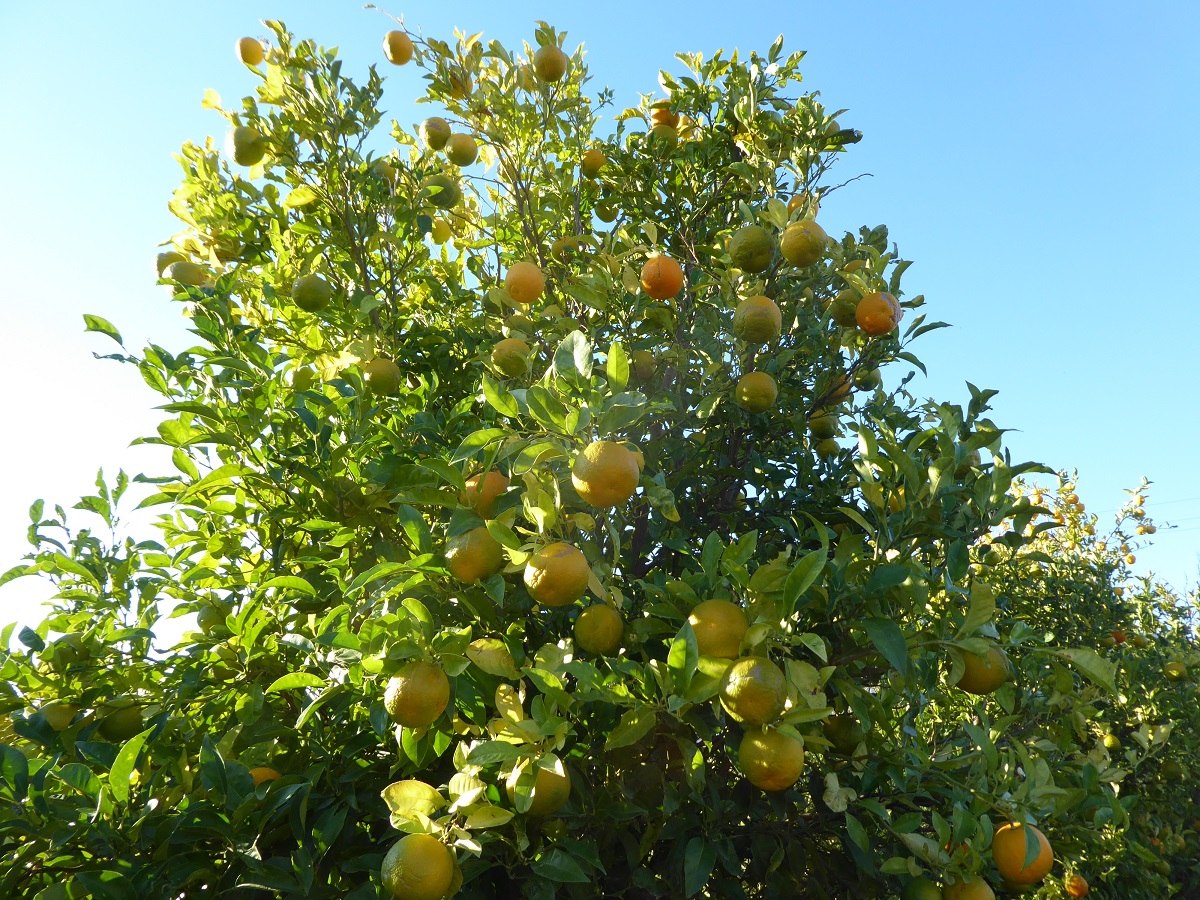
Winter is citrus season here at the Cape. I have 3 naartjie (clementine) trees but also had the fruit stolen. The Seville oranges and the orange coloured lemon have not been raided though. The Seville oranges are not quite ripe enough yet for making marmalade. I am hoping to make some limoncello if I can harvest enough lemons from my unique orange coloured lemon. This variety is very like the Cape rough lemon but the fruits are orange when they ripen. I was lucky enough to be given a small tree of this plant from a garden in the Grabouw district where I admired it at an Open Garden many years ago. The Tahiti limes which have been ripening all summer are still providing fruits. This is a great tree for the home garden as it produces small limes for months, especially in summer when lemons are difficult to find.

Medlars and custard apples

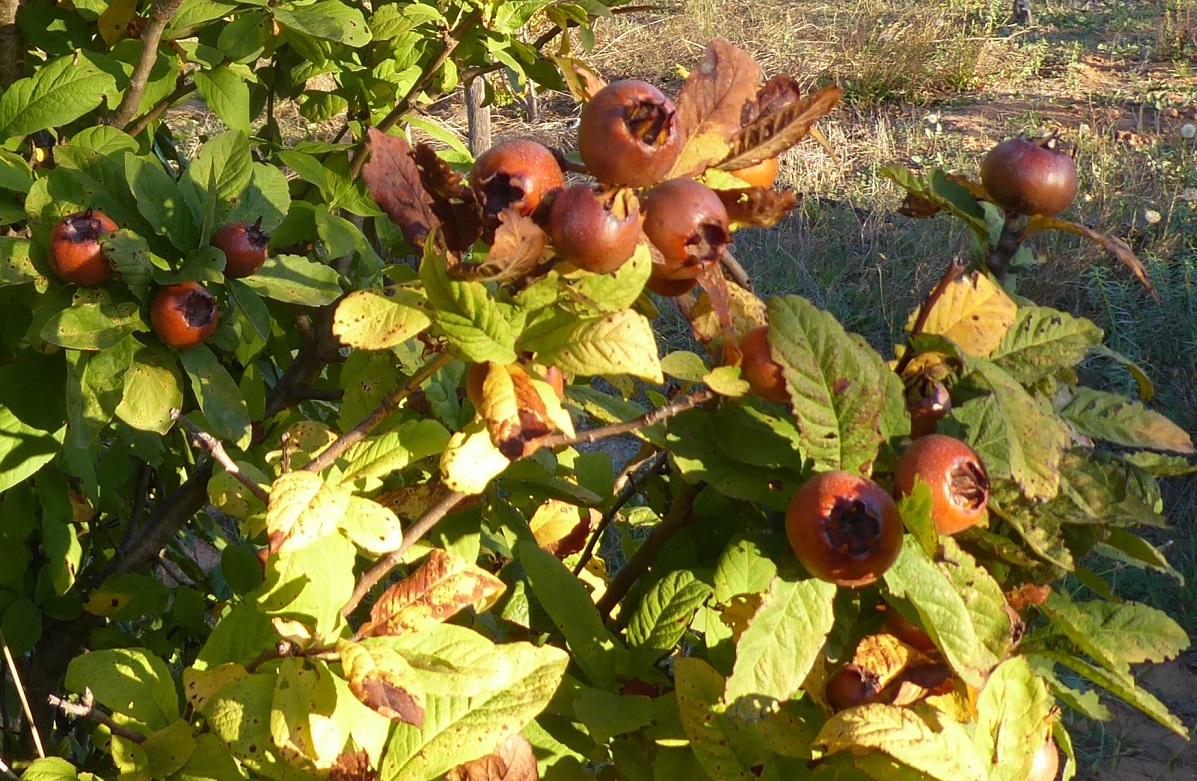
The medlar is an old fashioned fruit related to apple. It is not uncommon on old Cape farms. My plant is a compact bush with lovely big white flowers in spring and the leaves turn yellow and a lovely russet red in autumn. The small brown fruits need to be “bletted”, left to become soft, before they are eaten and then they have a strange taste, a little like port wine. They are an acquired taste.

I use almost all the harvest to make chutney from a recipe for apple and medlar chutney which I downloaded off the internet, but which I think originally came from Hugh Fearnley – Wittingstall. I use no apples, just medlars. A vegetarian friend says it is cheers up lentils no end, but it is quite a hassle to make. The medlars need to be boiled first and then put through a sieve to remove the seeds and bits of skin. Finally the thick mix with the spices needs to be cooked and stirred to prevent it catching on the bottom of the pot. Like an evil beast it  spits boiling splatters all over the kitchens and woe betide  if they land on you. I have two bad burns to pay for the 14 bottles  stowed away for the year ahead.

This is not perfect custard apple country. They are semi tropical fruits, but are so delicious that we couldn’t resist trying them. We have two bushes. They have strange little green flowers and I try to cross pollinate, but we still only get a few fruit which take all summer to ripen. They are a real treat now in autumn and one has to watch carefully as they do not change colour as they ripen, they just fall off the bush.

Harbingers of spring

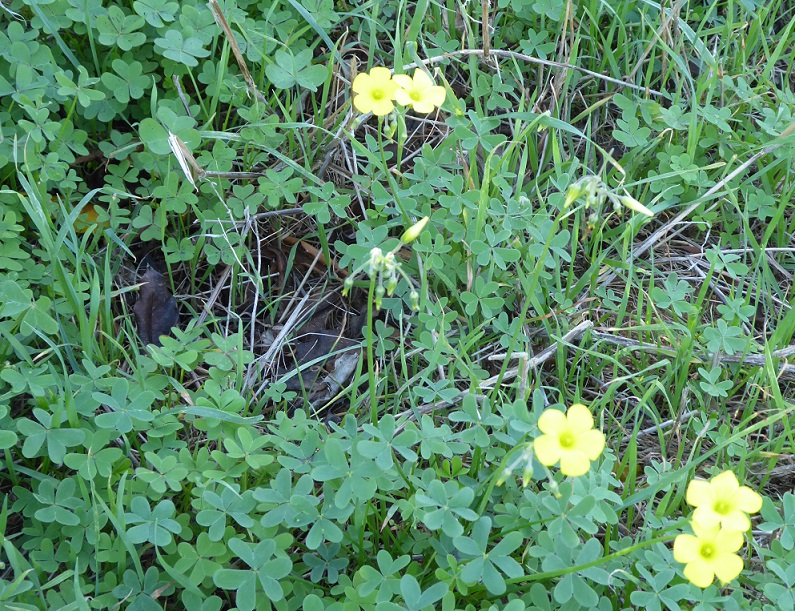
It is strange to be talking of spring while we are still in autumn, but here at the Cape the flower season starts now in autumn and traditionally May was always the month when oxalis made a showing. There are about 600 species of these at the Cape. Sadly with global warming and the lack of autumn rain, the flowering season of these little bulbs has been pushed back, but the ubiquitous Oxalis pes caprae which covers KSU in winter has started flowering. These are regarded as weeds in many parts of the world, but here I accept them as part of tapestry of winter and enjoy their cheerful yellow flowers. Locally known as suurings, they are sometimes used to add tartness to stews and bredies.

The wild rosemary (Eriocephalus africanus) has also started flowering. These tough shrubs with their small grey green leaves need no water in summer. Their heads of little white flowers are fresh and cheerful and will be followed by woolly seedheads.
The true rosemary is also flowering now. I have a lovely deep blue variety and have just acquired a bush with pink flowers.

Another star of autumn is the orange holmskioldia or Chinese hat bush from the Himalayas (Holmskioldia sanguinea) which looks lovely when viewed against the sun. It grows near a purple castor oil bush and the two colours look good together.

In a normal year I would be looking forward to the aloes flowering now in winter, but I have been horrified to find that all the aloe buds have been eaten by something. I am not sure if it has been hungry birds or some strange mites which have devastated all the flowering stems leaving them blackened and barren. Only one clump on the boundary seems to have escaped.

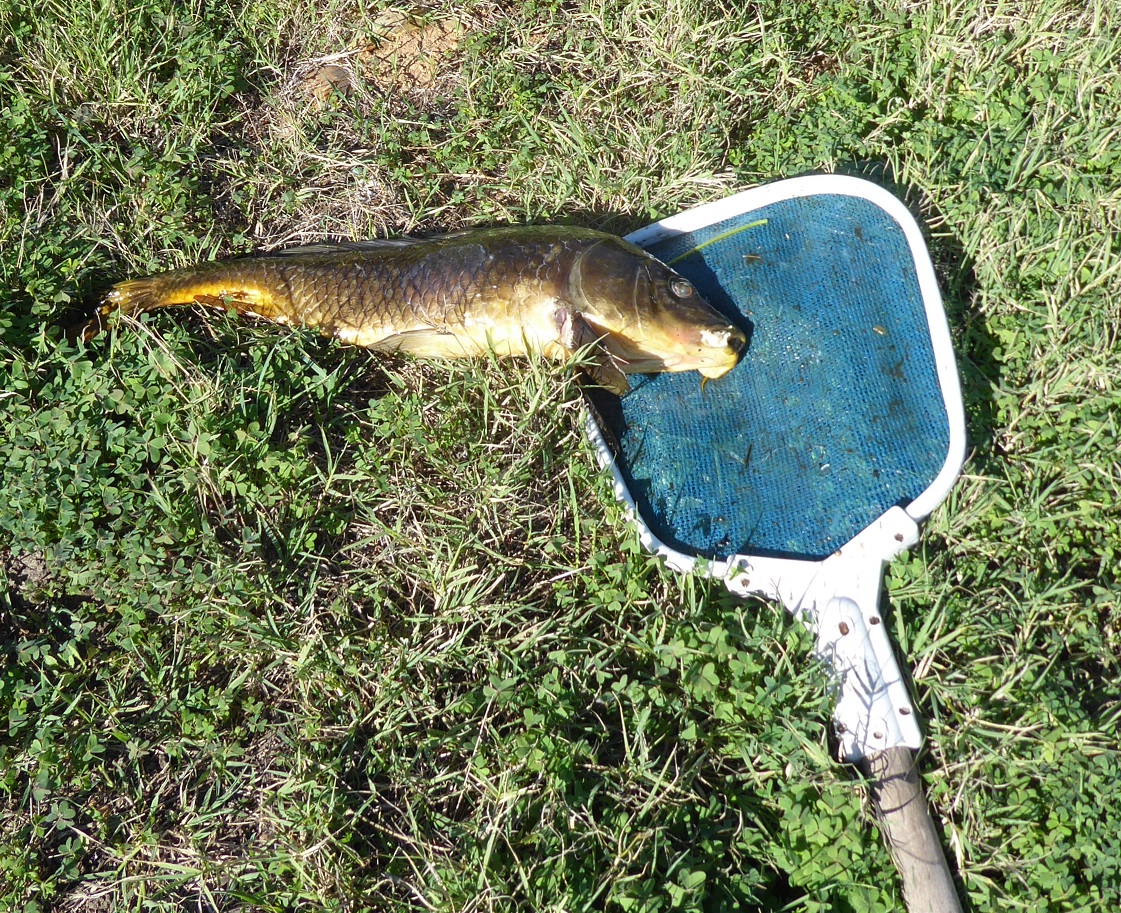
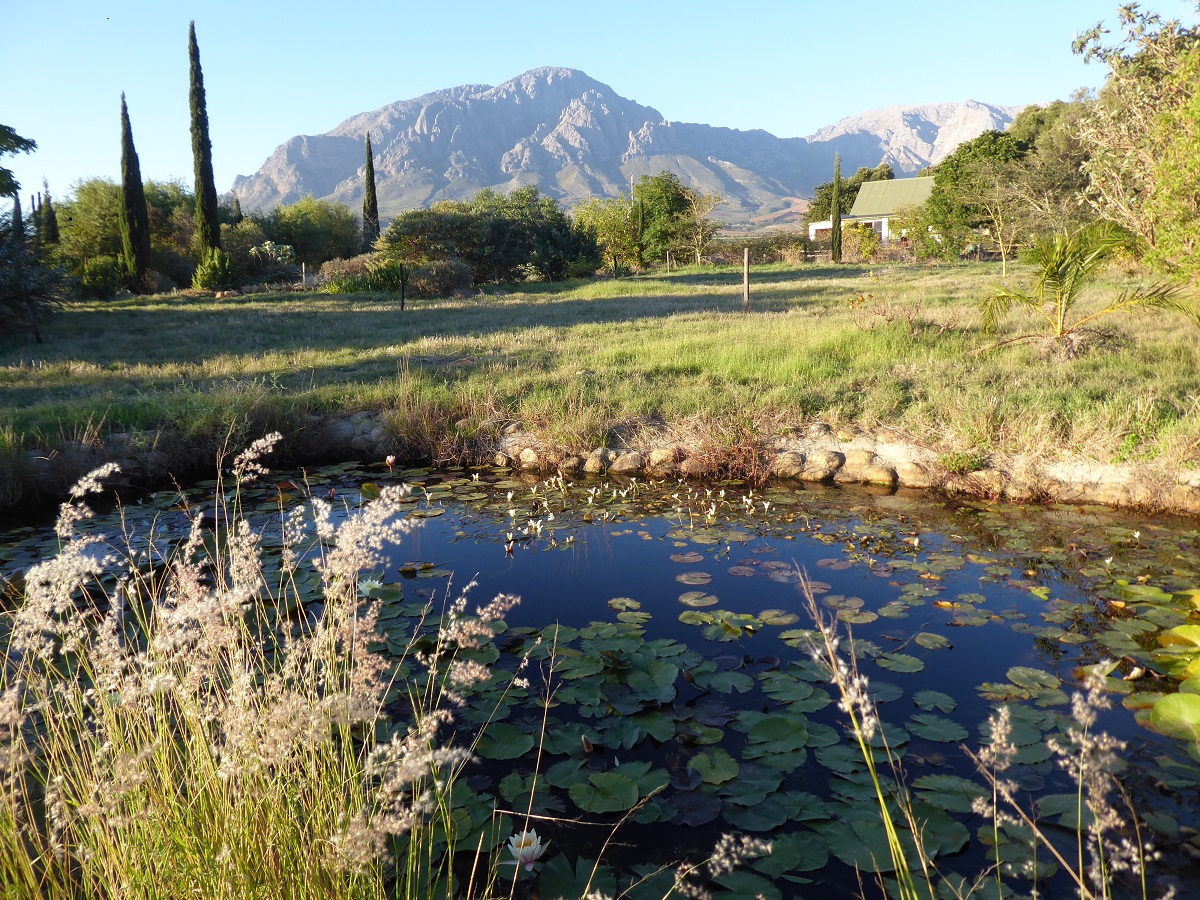
To compound the sadness of the month, I found one of the big carp in the pond floating on top of the waterlilies.  We acquired 2 carp several years ago to live in the pit which holds the garden irrigation water. In spring we moved them to the lily pond as the pit had to be replastered. They survived the hot summer days and I am not sure why one has died now. Perhaps the waterlily leaves dying back at the end of the season have depleted the oxygen in the water. It am not sure how we will catch the other one to return it to the deeper pit.

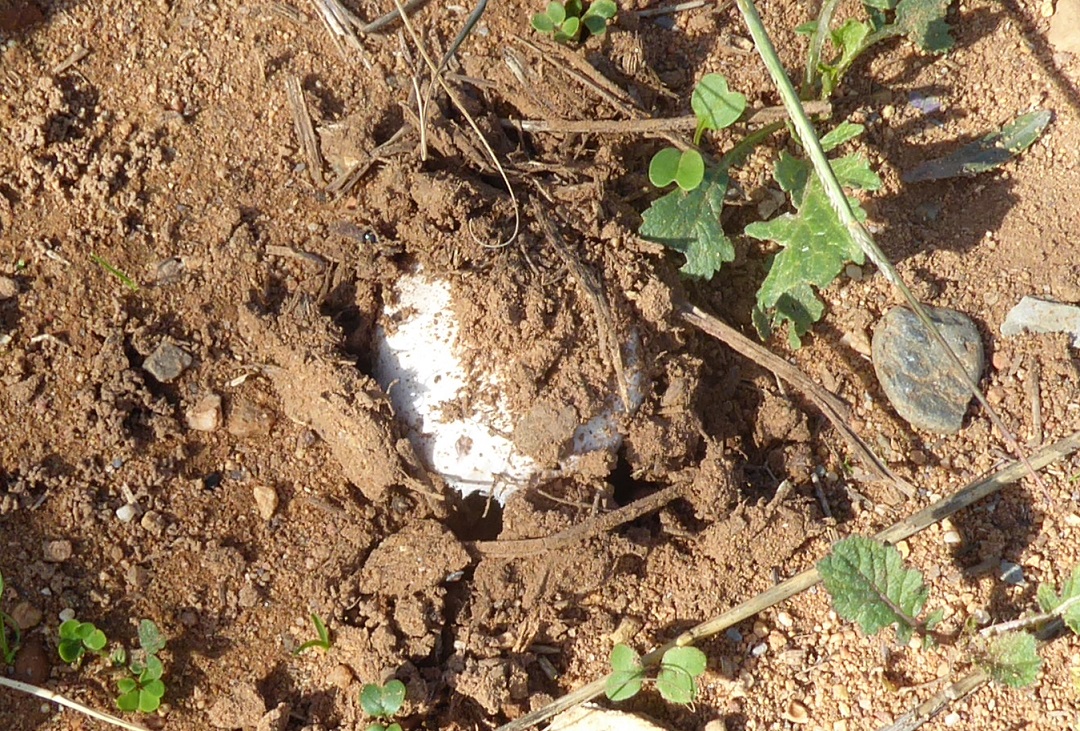
The  month ended on a high note though; the  rain at the end of May  triggered one of the delights of autumn, field mushrooms. These pop up across the farm and there is nothing like a plate of them simply fried in butter. A yummy way to end May, which when I look at a collection of the harvest wasn’t so bad after all.

KSU May 2019 Gallery
 

April 2019
Autumn has arrived. After 12 mm of rain in mid April the grass greened up.  A cold snap followed the rain and we rushed to find our winter pjs.   I am still having to water the garden  occasionally as it has not rained enough yet to saturate the soil. It is a pleasure being in the garden on the days the wind does not blow. Even the cypress trees look fresher against the crisp blue sky and the waterblommetjies have started flowering in the pond. Waterblommetjie bredie is a favourite winter stew here at the Cape.

Autumn colour

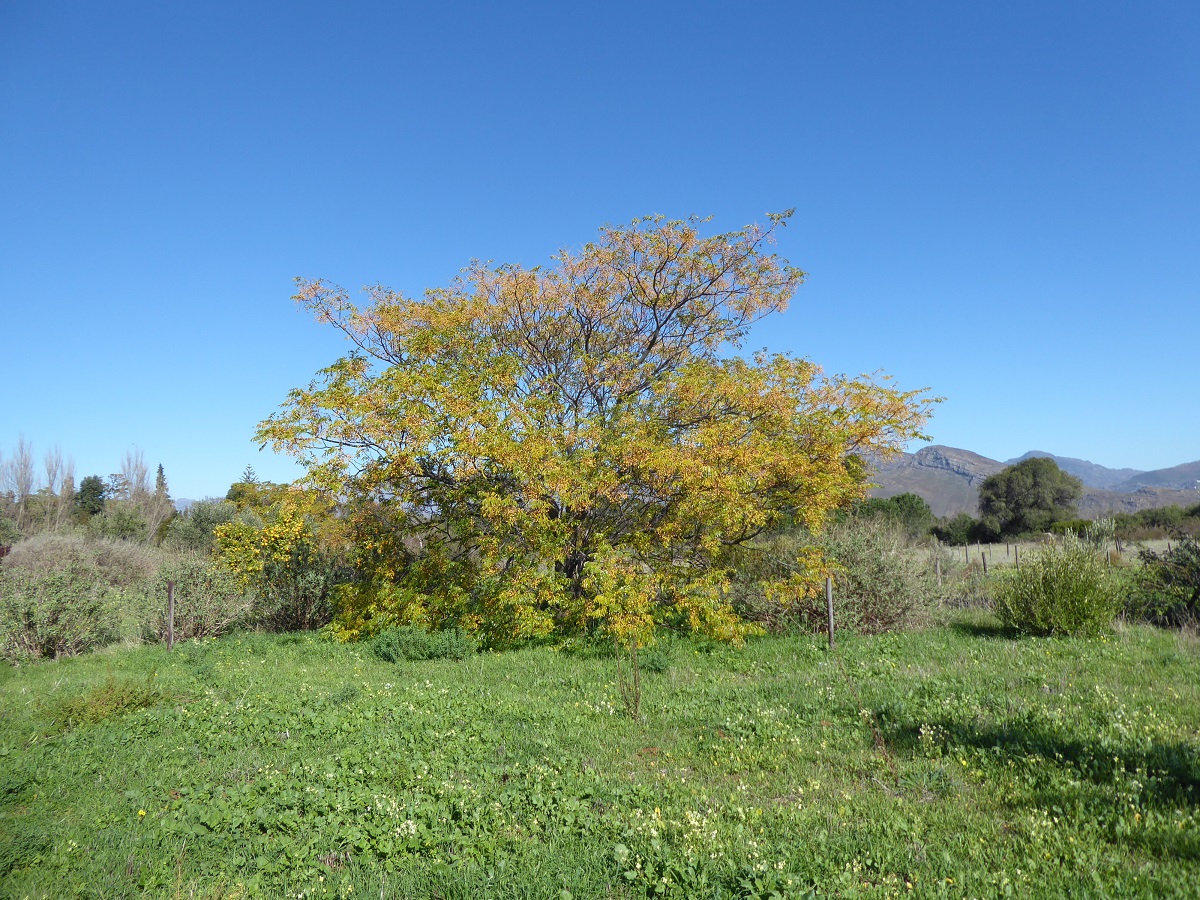
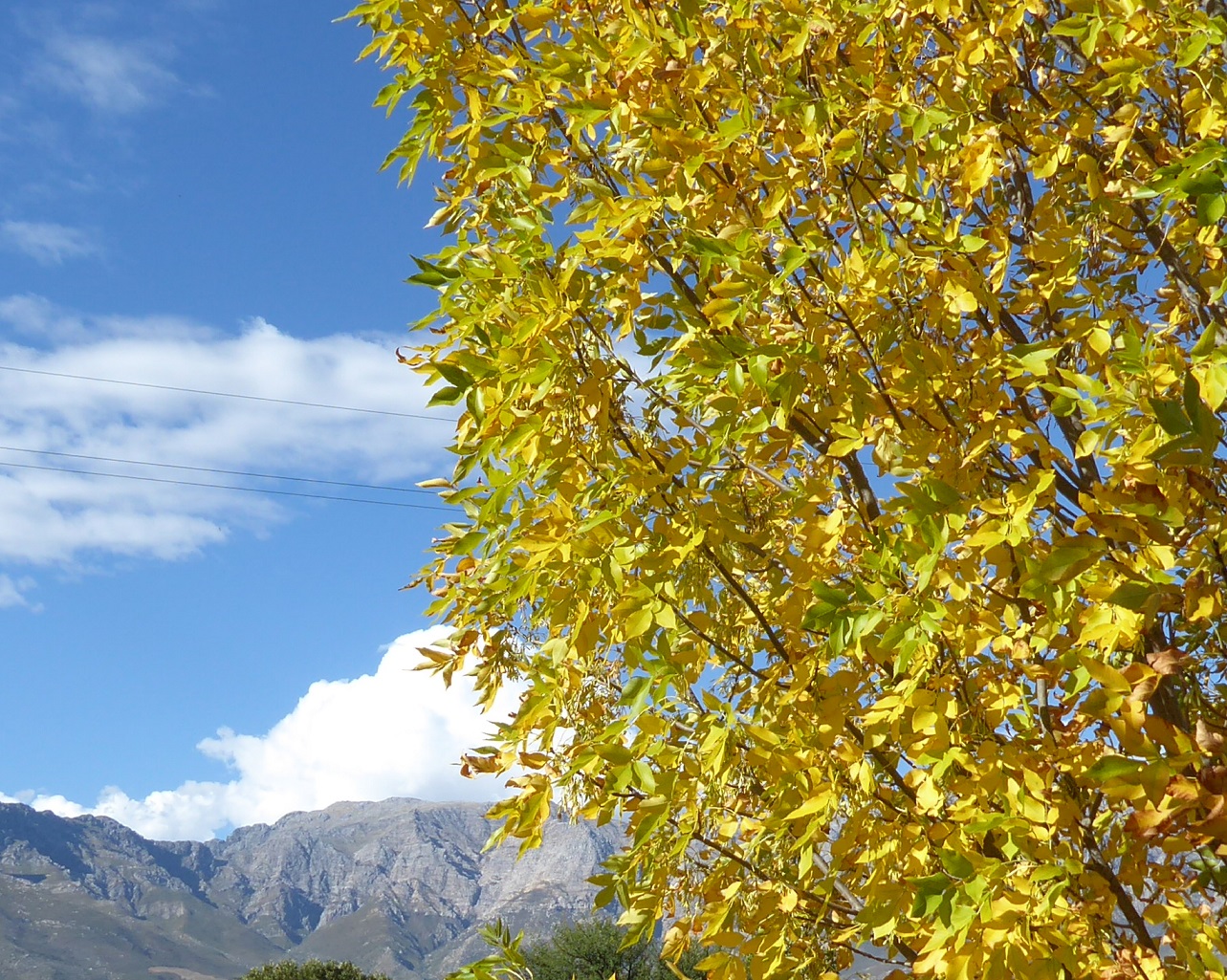
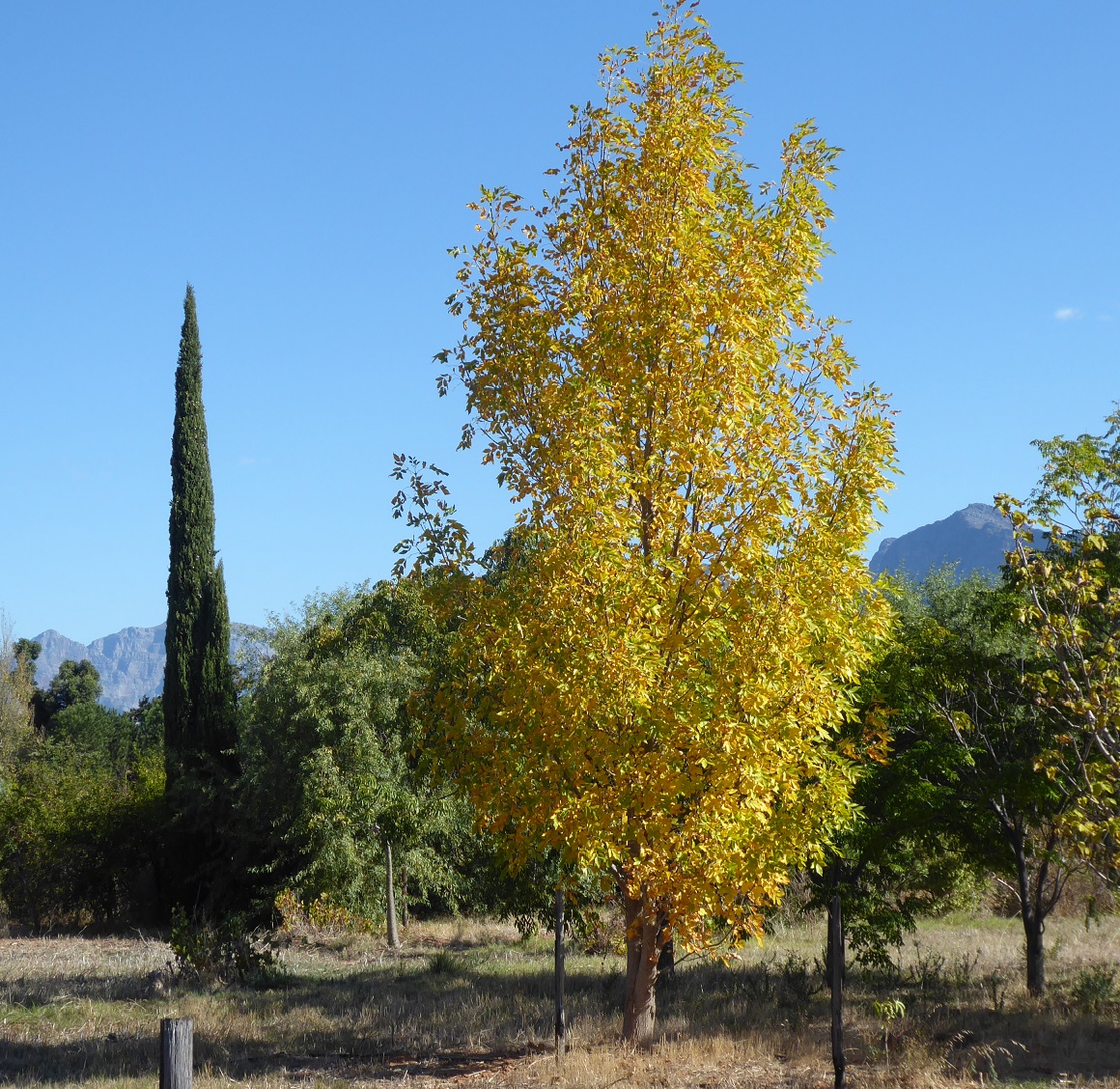
Leaves on some trees such as the pomegranates and ash started turning yellow and falling. It is not cold and wet enough for autumn colour to be a great feature here at KSU. Leaves usually brown off and drop at the end of summer without any autumn glory, but the ash is an exception. I am not sure which Fraxinus species it is. At least two grow in this part of the Cape. This one has bigger leaves and lovely autumn colour, being one of the first trees to lose its leaves. The persimmon tree leaves are turning red and glow like jewels in the autumn sunlight.

There are also some special berries to enjoy in autumn. The most spectacular are the red pyracanthas which have been ripening for a few months now. The birds eat some but leave enough for us to enjoy.

Fruit

April is also when we harvest the olives. I have 3  Frantoio trees and a Manzanilla which we pick for oil. Then there are several Kalamatas and Missions which I pick for table olives.  They were all planted about 14 years ago.  It took three of us a whole day to pick the Frantoios as the fruits are relatively small. We take the olives to be pressed at River Bend olive farm. Freshly pressed olive oil is totally delicious- green and thick. This year we got 9.6 litres from our 76 kilos of fruit. I have a bag of Kalamatas packed in coarse salt to cure and have given away part of the crop to friends.

The fruit season is drawing to a close, but we still have the rather strange pineapple guava (Feijoa sellowiana/Acca sellowiana) fruits to enjoy. This is an attractive tree from South America with silvery leaves and bright red flowers. The fruits remain green, and fall from the bush when ripe. They are about the size of a very big egg with a taste a little like a cross between a guava and pineapple, hence the common name. The best way to eat them is to cut them in half and eat them out with a teaspoon. Swastika fruit is another common name and when they are cut in half it is easy to see why.

Autumn activities

As soon as the autumn rains fall we rush to plant up the vegetable garden. I love peas especially mange tout varieties and so peas are the first things to go in. I make about 4 separate plantings to extend the season. I have started planting by the moon and try to plant seed with a waxing moon. I am not sure if it works. I also plant broad beans, although it isn’t really cold enough here for them to thrive. Garlic cloves and leek seeds also go in. This year I was very excited to find parsnip and celeriac seedling plugs at Hart’s nursery in Ottery, so some of them have gone in too.  I hope the self-seeding fennel will  form bulbs as we look forward to eating fennel in winter. There is also a spot for sweet peas in the veggie garden. All these  young plants are struggling a bit as we haven’t had enough rain yet.

The dahlias also need lifting in autumn. I store my tubers in sand over winter to prevent them rotting, but this year has been a total disaster for dahlias and most of my tubers had rotten before I lifted them.

April is also when the indigenous Cape bulbs start growing again. I have bought lots of little bulbs and seed and have planted up a trough and old sink. A few have gone directly into the soil- probably to make a tasty treat for the moles. Gardeners live in anticipation. Various lachenalias, sparaxis, moraeas, ferrarias, gladioli, cyanella and babianas all planted  to make a little jewel box in spring.

The big pot near the front door has also been planted up with primulas and pansies for the winter.

April stars

Koelreuterias bear terminal clusters of small yellow flowers in late summer and now in April their pinkish red seedpods are most decorative. This is a tough little tree and survives with little water. I am not sure if the species I have is K. paniculata or K.bipinnata. I  think the former, but I need to take a good look at the leaves. I grew the two trees I have from seed collected from a garden in Mowbray.

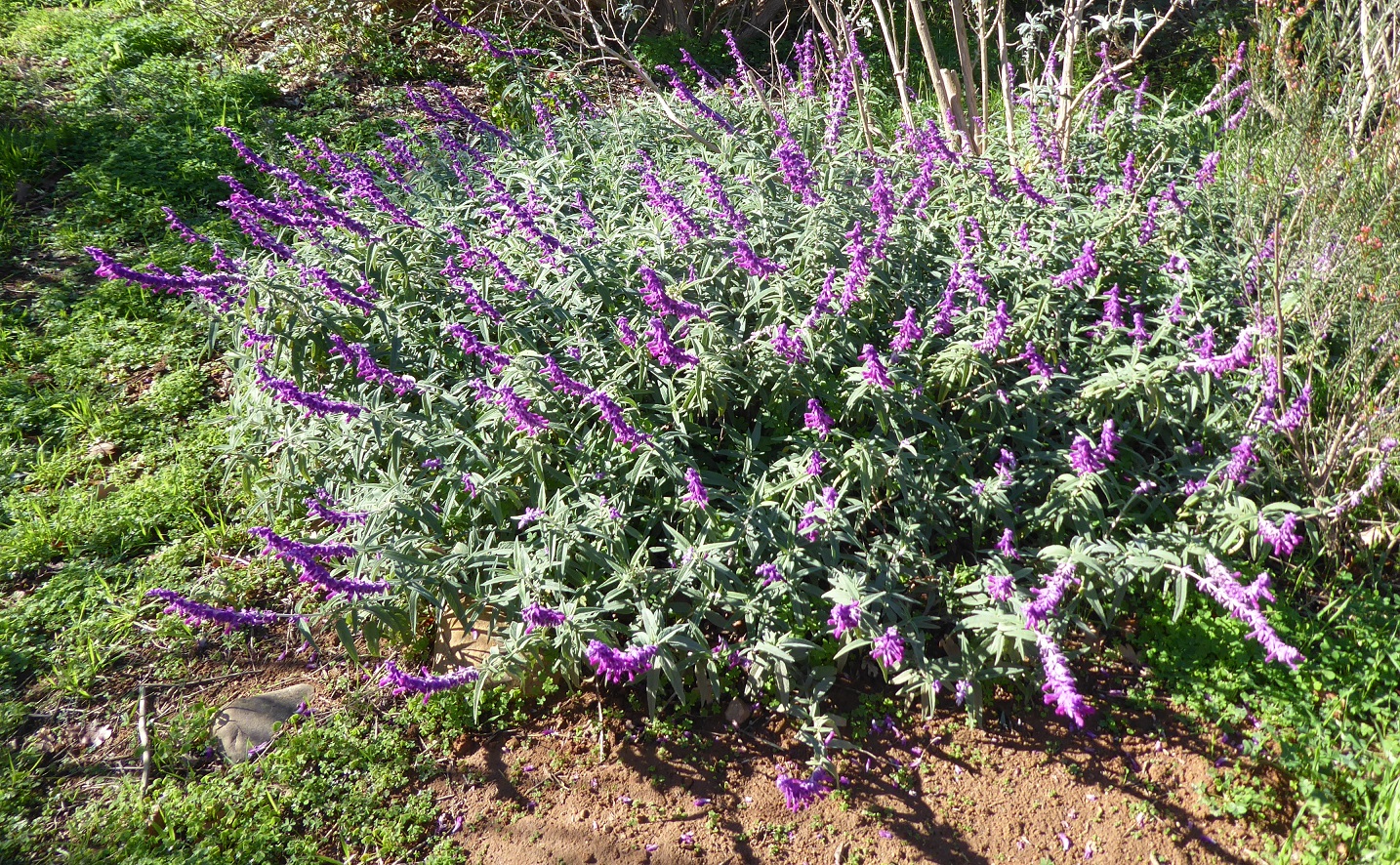
The other stars of April are ribbon bushes (Hypoestes aristata) and Mexican sage bushes (Salvia leucantha). Both of these do well here at KSU and will flower for a few months. The ribbon bushes seed themselves all over. Most are a lovely lilac pink form, but I have one bush with white flowers.
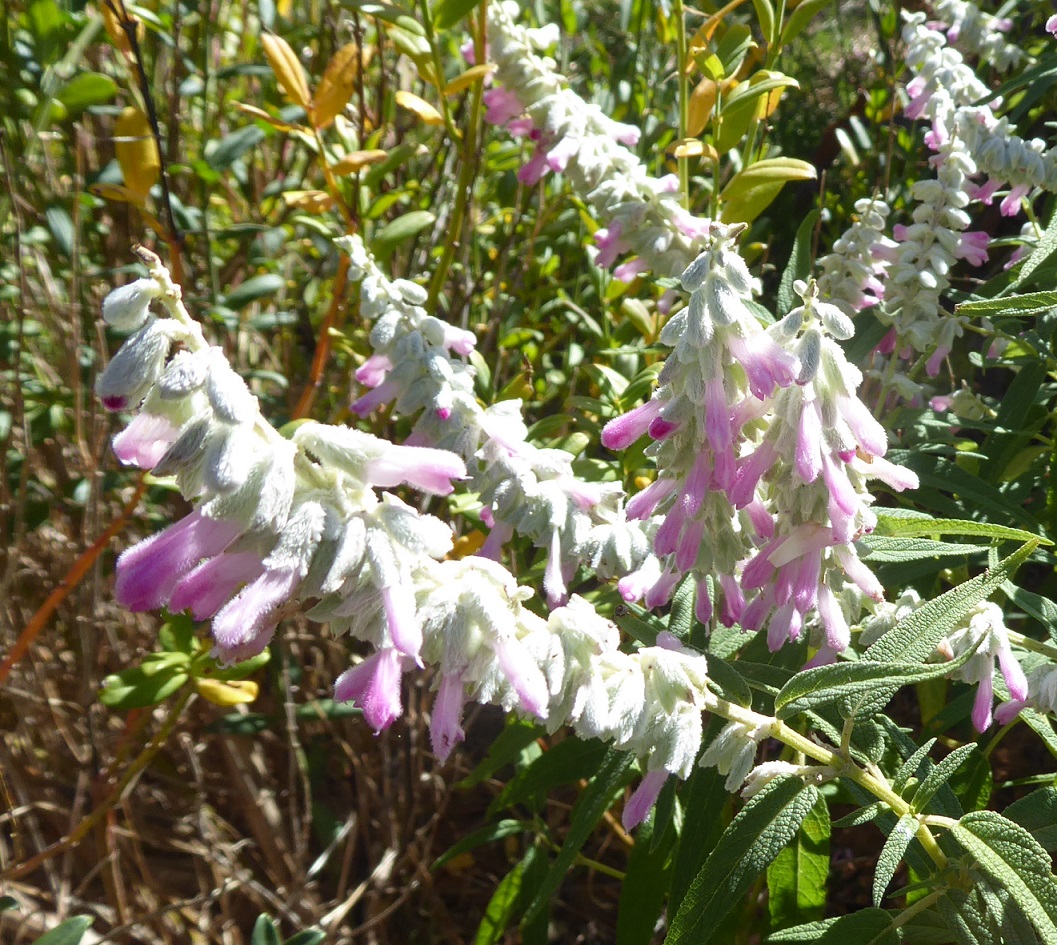
The Mexican sage bush forms creeping beds of half metre white stems with grey lance shaped leaves which are silver beneath. Even when it is not in flower it is an attractive plant. I have two forms; one with purple flowers and another from Jenny Ferreira’s garden which has pink bracts or sepals and white flowers.

I plan to get more of the common blue barleria, Barleria obtusa for the garden. They are stunning , tough plants at their best this month. Talking of blue flowered plants, the plumbago hedges are still going strong and so is the yellow tecomaria which responds to the rain.

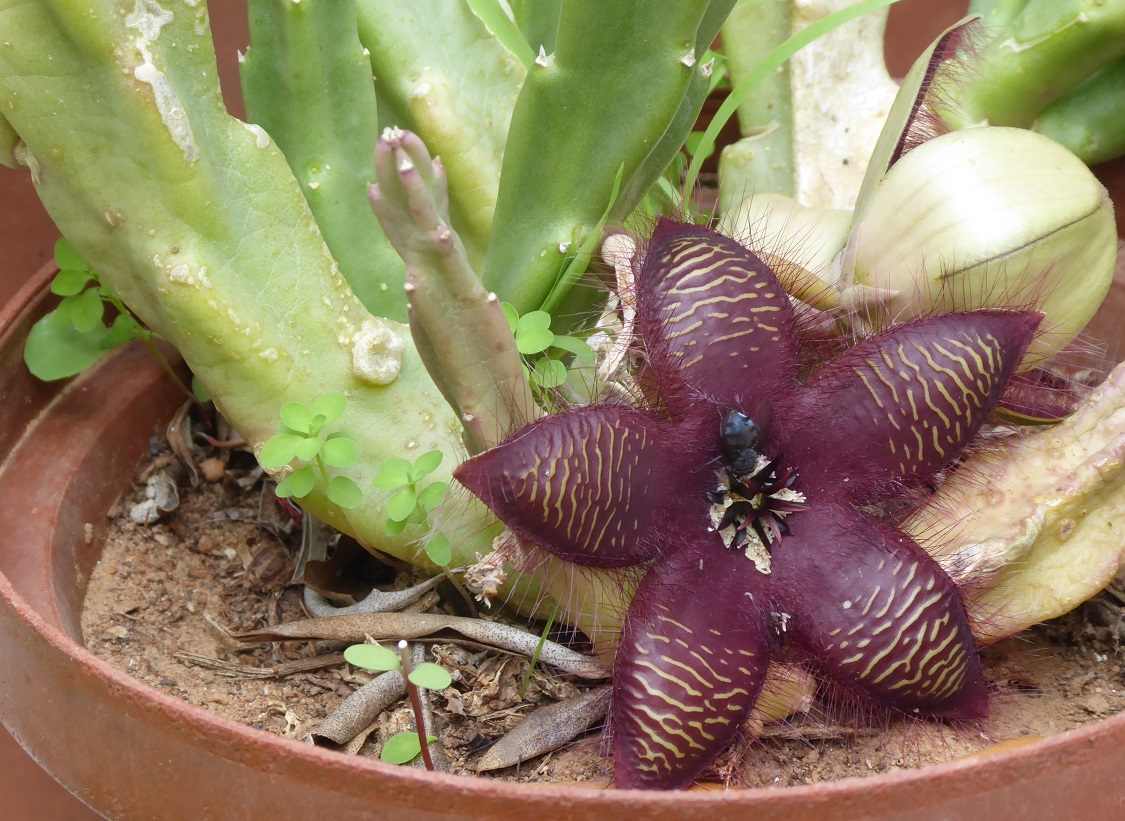
Among the succulent pots, one of the stapeliads has been flowering again. We have had a plague of flies as the neighbouring farmers have been spreading manure on their crops. (Paradise does have its pests). This stapeliad has a carrion smell that attracts them.

Owls to end

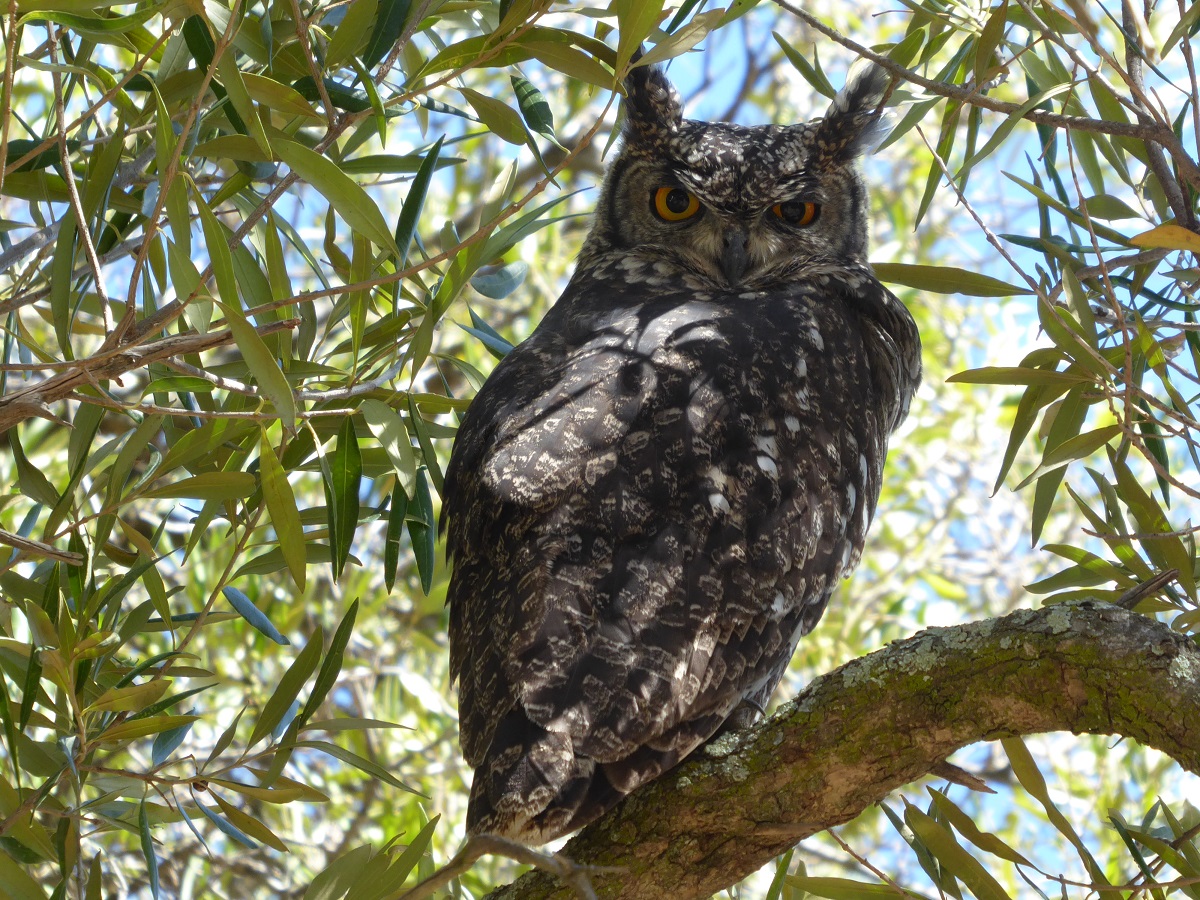
We are blessed with many birds at KSU. I am woken most mornings by the francolins making a racket on the front lawn and we sometimes hear the owls hooting in the wild olives around the house at night. In early April one came at sat in a low branch during the day so we could photograph it. Along with the owls, we have had some lovely sunsets this month especially when there are some clouds. Who can resist photographing sunsets?

April 2019 Gallery

March 2019
Summer  has ended and we have been tipped into a strange season which does not have the usual attractions of autumn. On the last day of February and again on the 11th March we had some rain which promised  the greening of autumn, but after that the winds blew and no further rain fell and everything just seems to be hanging in there. The days are definitely shorter though with the sun rising at 7:40am and setting at about 6:10pm at the equinox. The sun is moving northwards quickly now and it set directly behind the highest point of the western mountains  at the equinox.

Fruits of autumn

The Hanepoot grapes were disappointing this year. They are usually at their best in February but were a bit late this year. The rains caused many of them to rot. These grapes, the remnants of the old vineyard which covered the whole farm, are sweet and delicious. They are a very old variety, Muscat d’Alexandrie, planted worldwide and one of the earliest grapes to be grown at the Cape. Here they are highly esteemed as a table grape and used to make fortified Hanepoot desert wine. Sadly very few new plantings are being made here I am told.

The quinces  ripen in March. One of the real delights of KSU is an old quince boundary hedge which bears tasty if misshapen and sometimes stung fruit every year. This old hedge receives no water or feeding, but gives us enough fruit to share with friends and to enjoy in a variety of ways. Quinces are tasty cooked with lamb or pork. In this part of the country many housewives bottle them to serve as a side dish with meat. I make quince jelly and cotignac or quince paste which is delicious. It is tricky to make as the thick sugary paste spits as it boils and one needs to cover the pot with a mesh and to wear gloves and use a long wooden spoon to stir the paste. It is prone to catching/ burning at the bottom of the pot, so one has to keep stirring until it is ready to set. Once dried in the sun, cotignac will keep for a long time and can be enjoyed as an after dinner treat or served with the cheeseboard.

Persimmons also ripen in March. Gorgeous golden red balls of sweetness, there is nothing to do with them but to eat them fresh and as fast as possible or the mousebirds will beat you to it. While they are still firm they can be peeled and added to salads.

The first time I ever saw a persimmon tree was in November in Venice. The tree had no leaves, just beautiful orange fruits glowing against an old building and a blue sky. I was entranced and determined to find and grow a persimmon. Here at the Cape the trees still have leaves when the fruit ripens so they are not as visually spectacular, but the glossy green leaves do turn yellow and red before falling making for a very attractive garden tree.

Other unusual fruits that ripen now in March are cherry guavas and citrons. I have 2 small red cherry guava bushes. The fruits are about the size and colour of a cherry and taste a bit like a guava – one can see where the common name comes from. There is another variety which has greeny yellow slightly larger fruit, but I don’t have it. At KSU the bushes remain less than a metre in height and it may be due to our colder winters. I have seen much bigger bushes in Cape Town.

Citrons are another of those heritage fruits which can be found on some old Cape farms. Members of the citrus family the fruits have hardly any flesh. The large round fruits were made into a preserves or used for candied peel. I have 2 kinds;  one with large spherical fruits with flatten bottoms and 1 with a strangely misshapen fruit where the segments separate. It is known as a Buddha’s hand citron and is of Asian origin.  Both have a long lasting citrus aroma and can perfume a room. Citrons were the earliest citrus trees to be cultivated in the Middle East and are part of the Jewish festival of Suchot.

Autumn bulbs

March lilies (Amaryllis belladonna) are one of the joys of late summer. Indigenous to the Cape, these bulbs send up their flower spikes from the bare ground any time from late January, but here at KSU they only appeared in March and it was a very poor showing this year with only two flower heads. I am worried that the moles might have eat lots of the bulbs although they are very poisonous.  They have a lovely scent and despite the common  name are not lilies but part of the large Amaryllidaceae family.  Once the winter rains come the leaves should appear and I can see how many bulbs I have left.

Nerine sarniensis is another gorgeous native autumn bulb. We grow ours in a pot and every year we have the great pleasure of their scarlet flowers which appear to be covered in gold glitter in the sunlight. This is another bulb which flowers while the leaves are dormant. This is also a member of the Amaryllidaceae and has the strange common name of Guernsey or Jersey lily.  Sarnia was the Roman name for Guernsey and when this bulb was named it was thought to come from there. There are several other nerines that flower in autumn which I would love to grow, but none can compare to this.

Brugsvigia bosmaniae is another beautiful amaryllid with candlebras of pink flowers.   Usually one has  to travel  to Niewoudtville to see the spectacular  display these bulbs make in the veld after autumn rains, but this year I was stunned to find a hillside of them flowering nearby  in the Karoo Desert National Botanical Garden in Worcester.   What a sight!

Cape honeysuckles

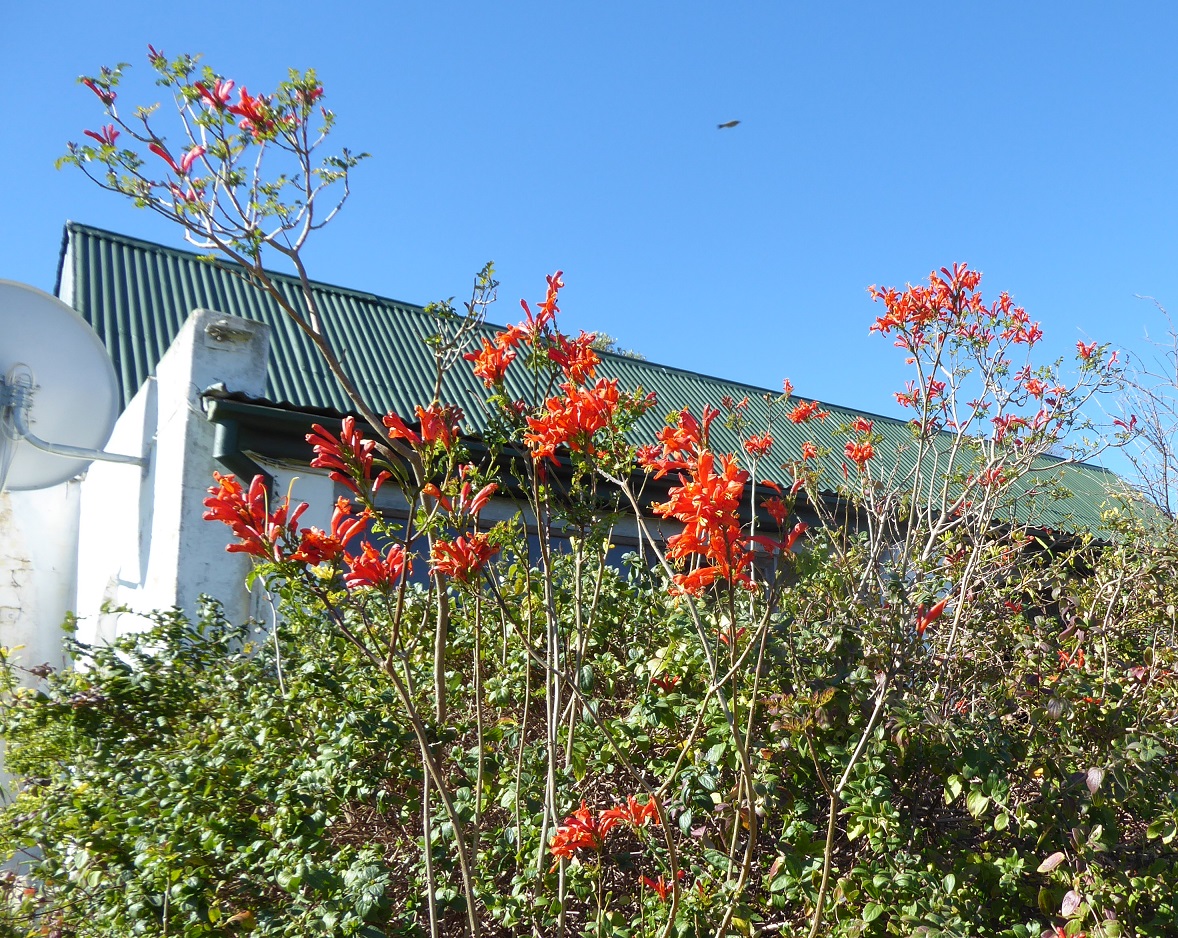
Oranges, reds, yellows and pinks, what a kaleidoscope of bright autumn colours this shrub offers. Often taken for granted here at the Cape as it is so easy to grow, these plants signal autumn at KSU. Tecomaria capensis is not a member of the honeysuckle family, but is a great favourite with sunbirds. They can flower all summer long if they are well watered, but here we have the main flourish in March after the first autumn rains. I have collected 7 different colour forms; a dark red, very robust shrub whose leaves are a dark green; a bright clear orange which is the most common form of Cape honeysuckle and which I remember from hedges of my childhood in the Eastern Cape; a cross between these two which is orange red with markings inside the petals; a clear lemon yellow; a warmer golden butter yellow; a pink form and lastly a pale biscuit tan which is probably closely related to the pink form as they both have a tendency to walk /spread. The common combination of orange tecomaria with blue and white plumbago reminds me of the colours of the old South African flag.

Other stars of March

I wish I had shade to grow more Plectranthus.   Anyone  visiting Kirstenbosch in March will admire them grown en masse. They are great native plants for autumn. Here at KSU I have a few species grown as nursery stock in the hopes I can grow more one day. They are very easy to propagate from slips and I dream of a shady border of blue, pink and white P. ecklonii. Meanwhile I enjoy my few plants of the blue form.

Flowering in March this year is Aloe greenii. Is it a forerunner of winter aloes, or should it have flowered earlier? This aloe has a tall spike of subtle pink flowers which shoots up almost overnight from a rosette of speckled leaves. It is an easy aloe to grow and at KSU  it grows next to an Australian wattle with grey leaves which provide a foil for the pink  flowers and a little afternoon shade which it likes.  Sunbirds also love this aloe and the flash of turquoise against the pink is lovely. A big bed of them would be a fine thing, but I only have 1 plant.

Lastly a favourite that has been flowering most of the summer and is an anathema to most people, Morning glory. How can anyone not admire these glorious blue flowers, thuggish though they may be?

March 2019 Gallery

February 2019

Although February is traditionally regarded as the hottest month  at the Cape, it doesn’t seem to be the case here at KSU. I think it may have to do with the shape of the mountain ranges to the east and west of us. The mountains to the east are much closer and can delay sunrise by an hour or more, but they taper away to the south, so the midsummer sun in Nov/ Dec rises comparatively early at about 5:30 am. However the range rises steeply to peaks which delay sunrise as we move towards the equinox. The sun in February is now rising well after 7am.

The same occurs on the west. The gap in the mountains formed by Bainskloof is directly opposite the house and this is where the sun sets in midsummer after 8pm.  The range rises gently to the north and now sunset is around  7pm. Thus the  mountain profiles  shorten the hours the sun beats down in February compared to December.

The days and nights  nevertheless are still hot and we have had no rain this month except for 3ml on the 2nd Feb. Plants are starting to look stressed and long for autumn rain. The south-easter has also blown almost all month. Although this cools and makes the heat bearable, it also desiccates. The air is often hazy with dust and smoke, but this is a month of plenty harvest-wise.

Figs & Grapes

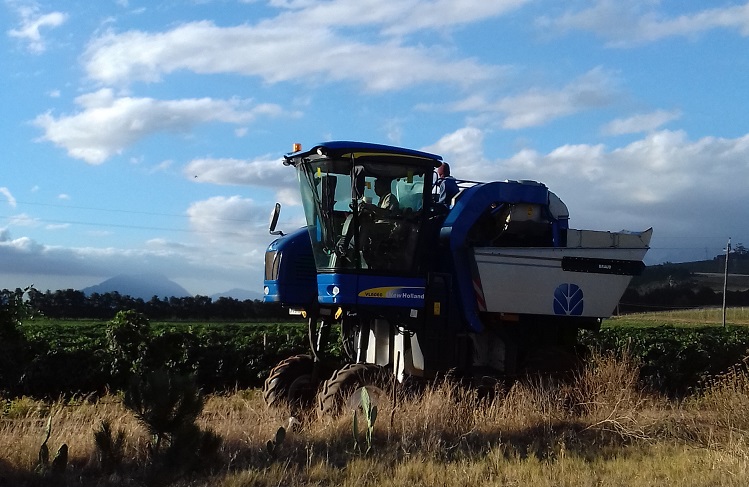
Farmers around me grow wine grapes and the harvest has started. When I first came to KSU the grapes were harvested by hand, but within the last 5 years all farmers have acquired tall harvesting machines which straddle the rows – great behemoths with big headlights in the sky, scary to meet on the road before daylight. Roads are busy with tractors dragging trailers full of grapes to the co-ops. The trailers tilt to tip out the grapes once the load has been weighed then back race the tractors for another load.

Grapes

My garden has been developed on an old Hanepoot vineyard. Some of the old vines are still in the garden and the grapes ripen towards the end of the month. First to ripen are the tiny black seedy Jacques grapes. Pronounced Yak-kay locally, Jacques was an old rootstock, no longer used. The grapes I look forward to are the Catawba grapes. This is an American grape which has a particular musky flavour, not admired by everyone, but addictive to those who like it. The skins are firm and the flavour only develops when the grapes are completely ripe. When I lived in Cape Town I had a vine which grew amazingly well, but the 3 vines I grew from cuttings and planted on a pergola here struggle a bit. They bear well though and grapes make delicious jelly which is especially nice mixed into plain Greek yoghurt.

Figs

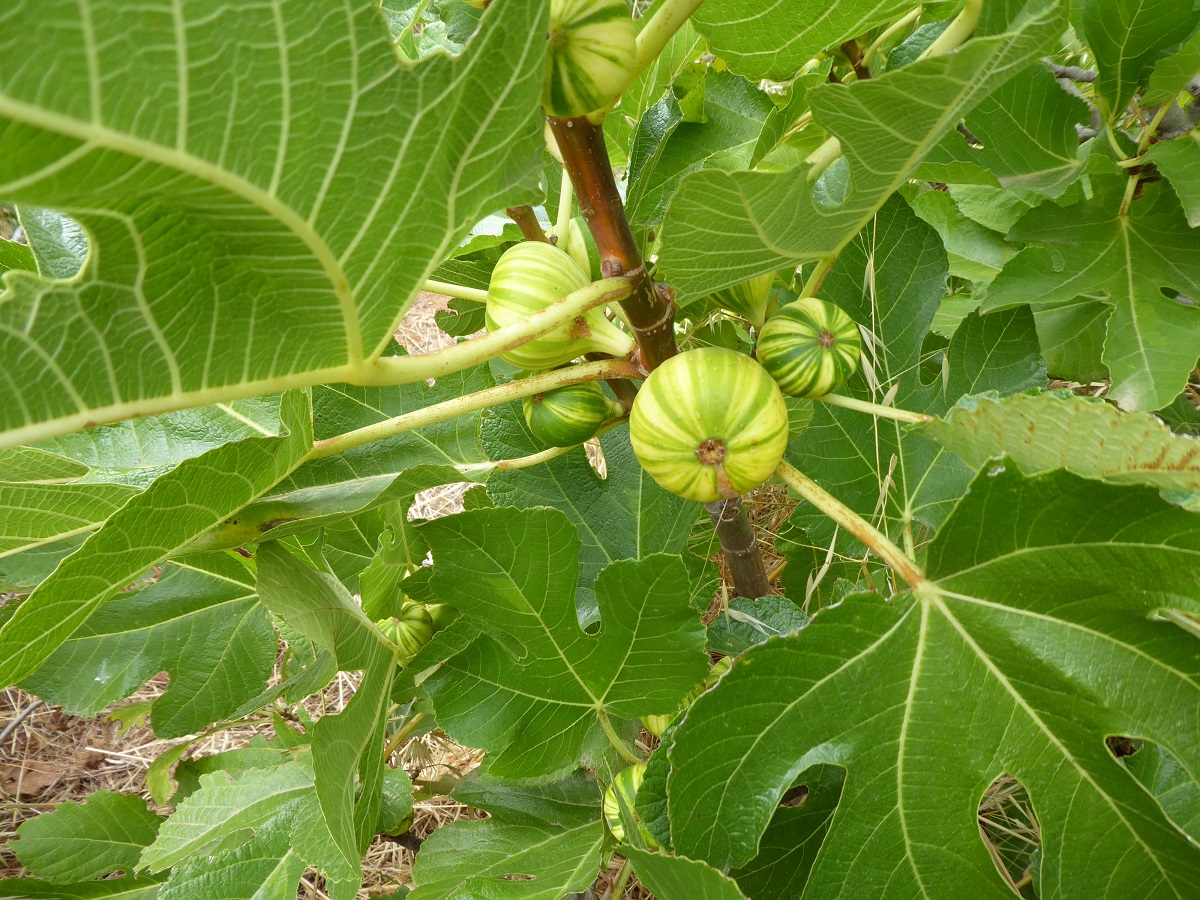
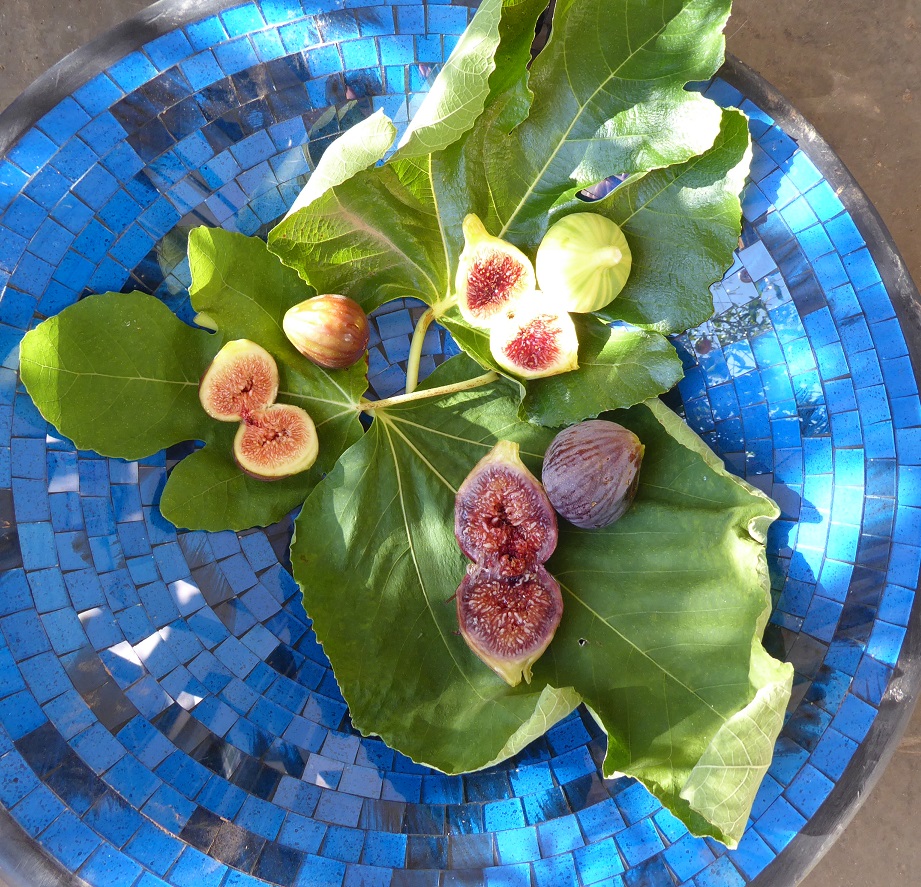
February is fig time. They ripen faster than we can pick them and the mouse birds are having a great time. First to ripen is the little Cape brown fig, a firm little fig which makes a tasty bite. This year the big purple Adam fig starting ripening at almost the same time. These are luscious figs with a deep red centres. Lastly come the tiger figs, with green and yellow stripes these figs are also red inside and are very sweet making them my mom’s favourite fig. The strong winds blew down and broke a big branch this year just as the fruit was ripening.

Figs don’t keep and are best eaten straight off the tree. One of the rewards for watering the garden is making frequent forays to the figs trees for sustaining snacks! I have friends who enjoy fresh figs too so lots get given away. Some get cut up and covered with brown sugar or honey and port and popped in the oven to bake and then enjoyed either warm or cold with Greek yoghurt- a very easy and delicious dessert. Some get made into jam. I find plain fig jam is not always a success and this year I have mixed them with Kei apples to add a bit of acid and pectin and I think the results are yummy. Best of all is sandkorrel konfyt. Mrs Olive Niewoudt of the Cedarberg shared her recipe with me many years ago. This jam is a mixture of fig, hanepoot grapes and watermelon rind. It is tricky to make, but absolutely delicious when you get it right. The famous green fig preserve is made in spring from young green figs, not now in late summer.

Pomegranates and prickly pears

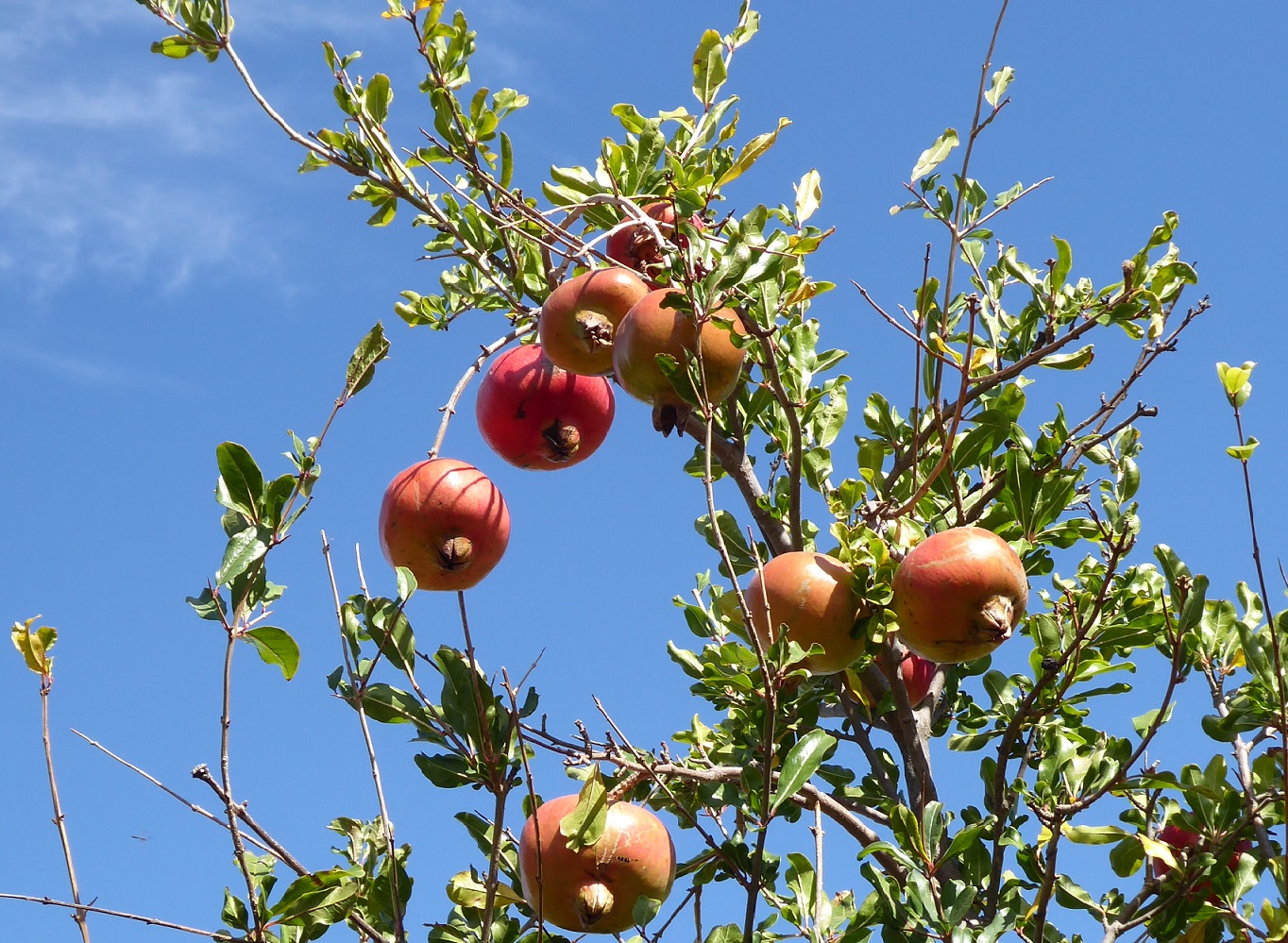
Pomegranates are also ripening now. It is great to see that this ancient fruit is back in fashion. It is one of my favourite trees as you can see from the banner of this site,  and I have one growing just off the stoep. In spring the new leaves are a lovely bronze, then come the bright orange flowers and the bright green leaves. It is lovely to watch the beautifully shaped little fruits swell and ripen and then split to reveal the jewel-like red pips. When the chilly nights come the leaves turn yellow before falling and let the sun through to warm us on winter afternoons. I have also planted some pomegranate hedges. We eat the fruits and some years I try making pomegranate molasses, but it takes lots of pips to get a little bottle.

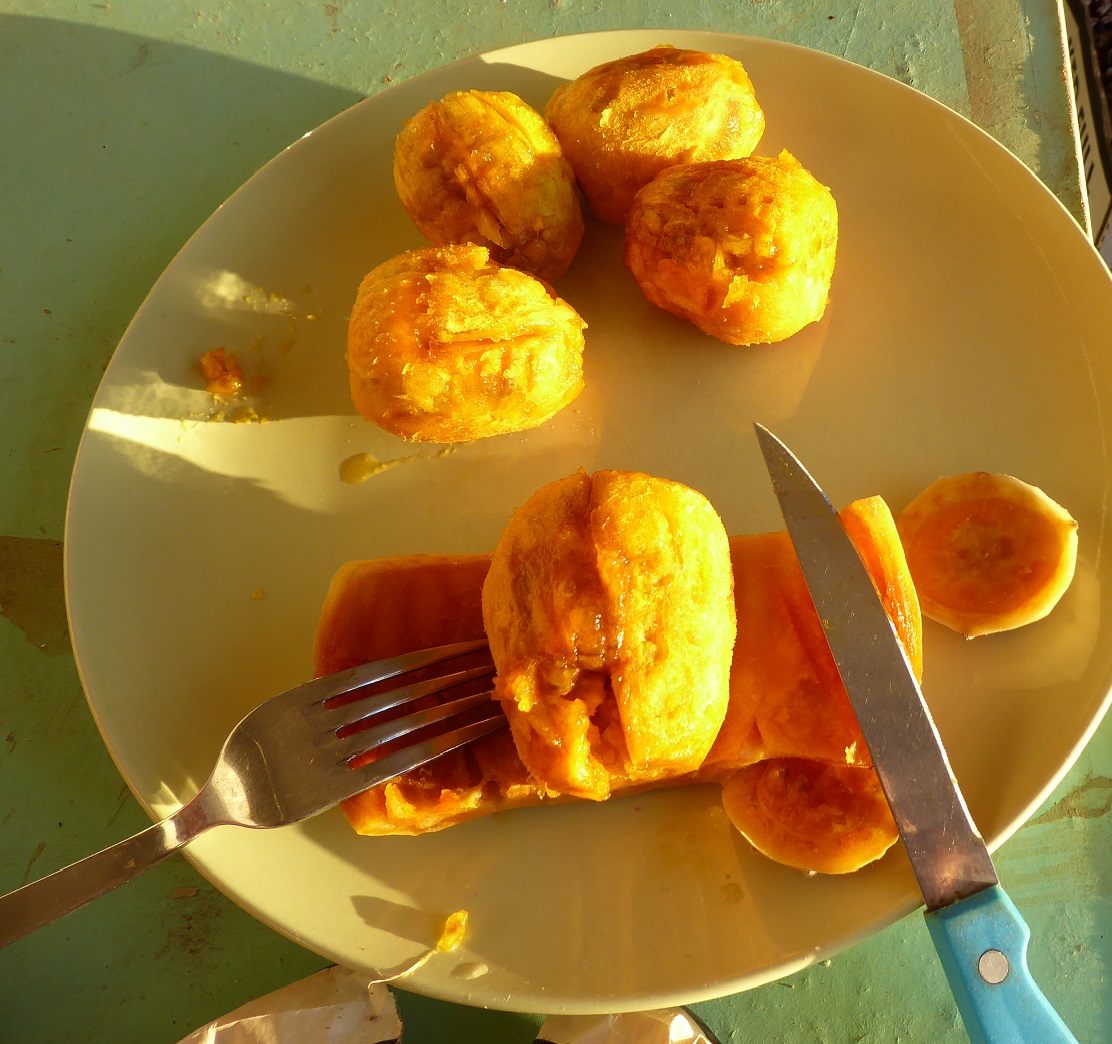
Prickly pears (Opuntia sp.) take me back to my childhood growing up in the Eastern Cape. My father would peel lots and chill them in the fridge for breakfast. It is still the way we enjoy them. When I bought KSU there were several old plants on the boundaries. Some are massive. The tastiest form has yellow flowers, lots of prickles and orange flesh. The one with less prickles has paler fruit which is less tasty. Safely picking and peeling prickly pears is an art to cultivate as the tiny prickly hairs are fiendish.

Pretty barrier plants

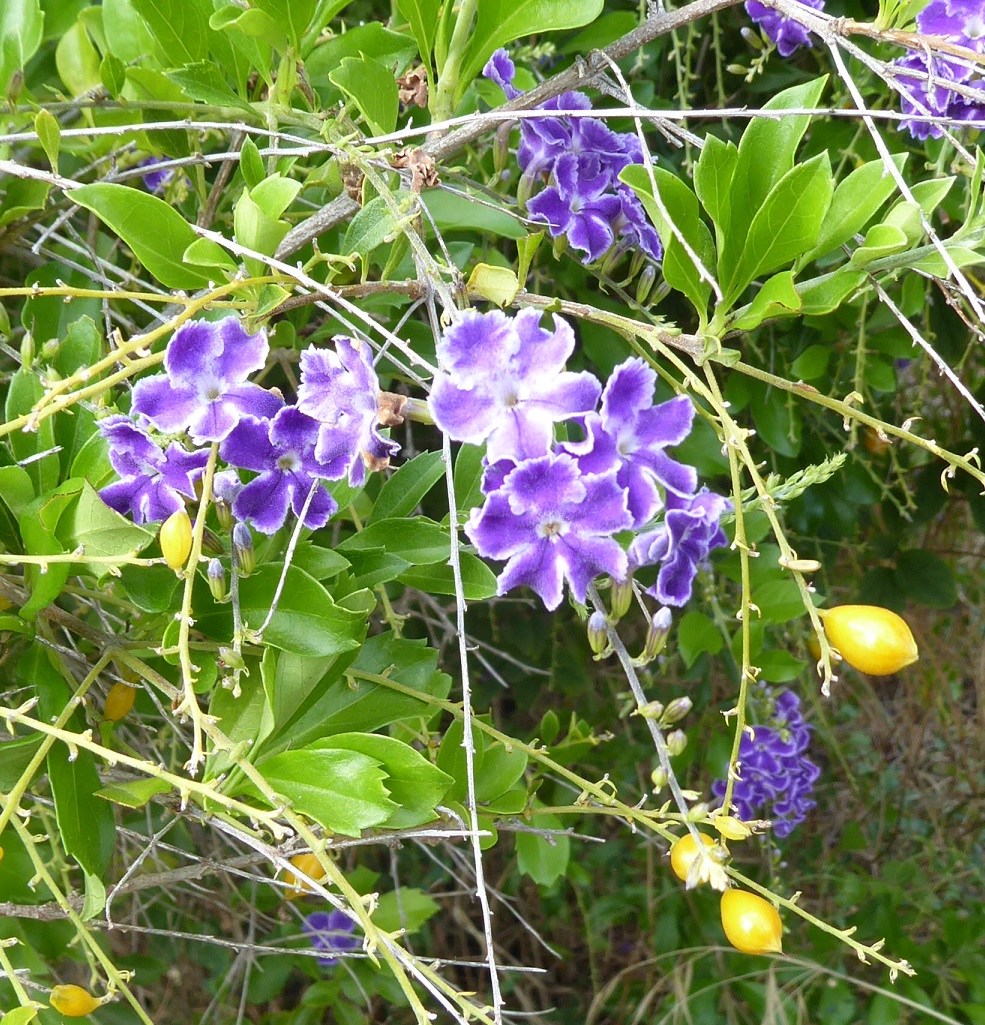
Aside from Kei apples (Dovyalis caffra)which I wrote about last month and prickly pears, two other  prickly tough plants which can be grown as barrier shrubs are carissas and durantas. Both are long flowering and are still looking good in February.

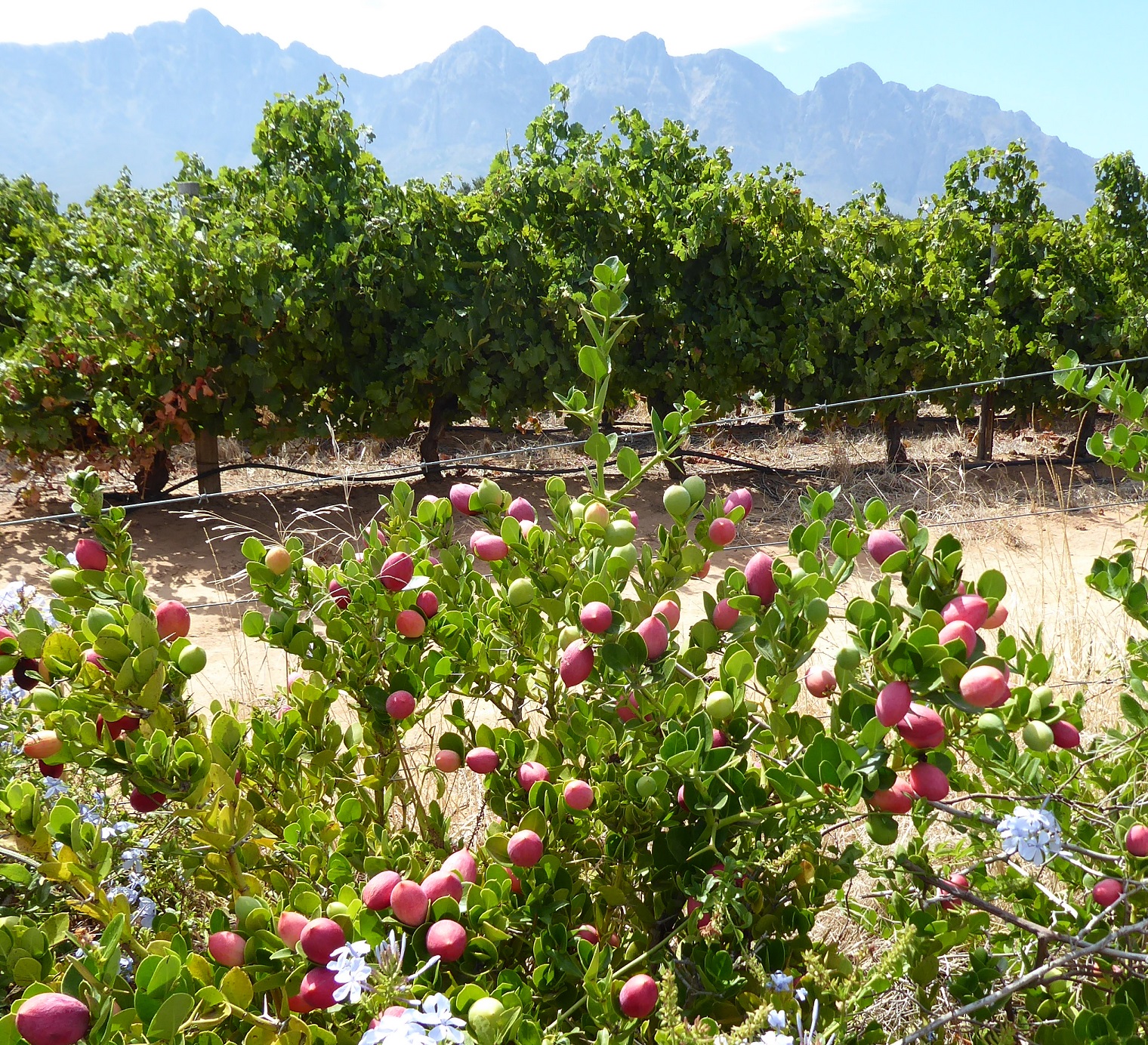
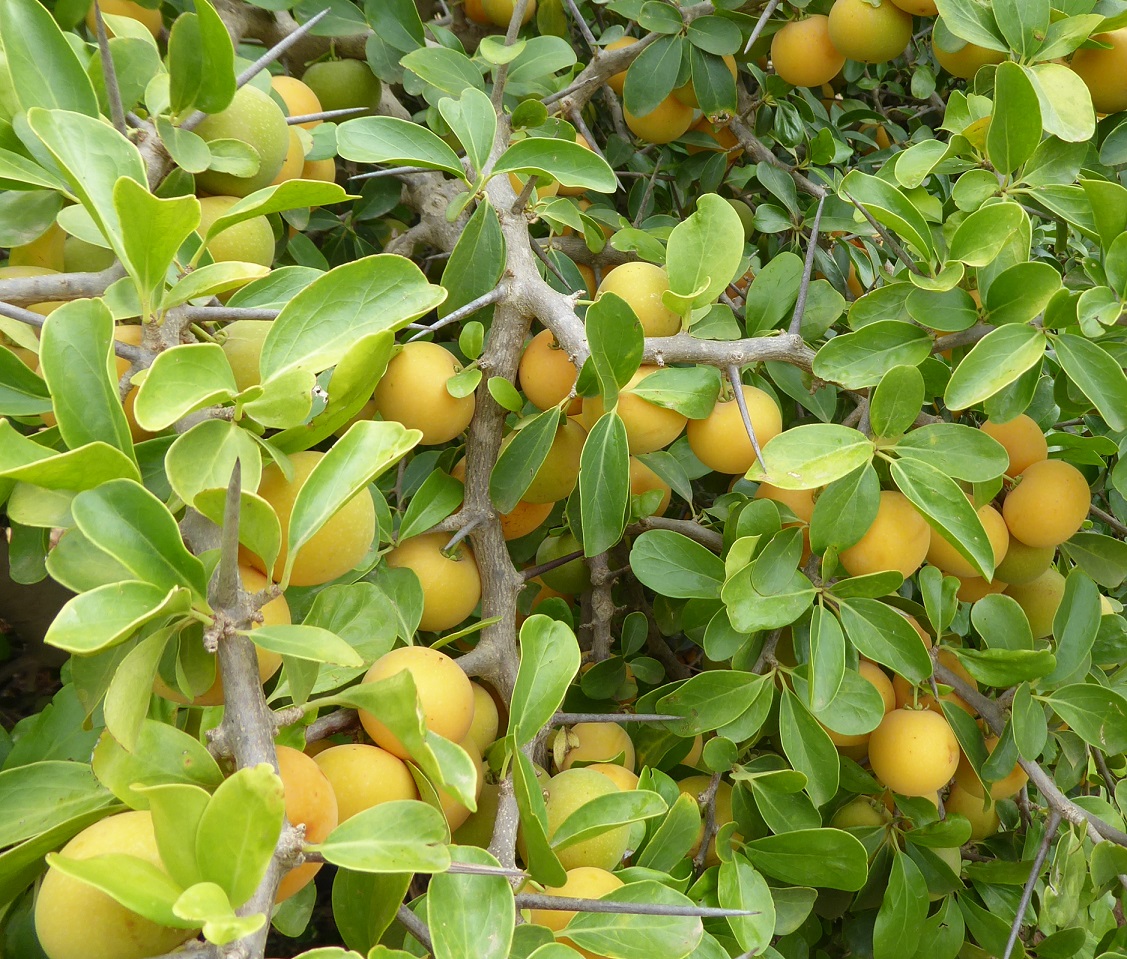
Amatungula, num-num or Natal plum (Carissa macrocarpa) is full of fruit now and still has a few flowers. The fruits are quite tasty and I believe make a good jelly, but I have not tried yet. It is native to the eastern coastal parts of the country and I have been surprised that it grows quite well here but is not as tall as in coastal areas. The large scented single white flowers are followed by bright red, oval fruits about the size of a prune.

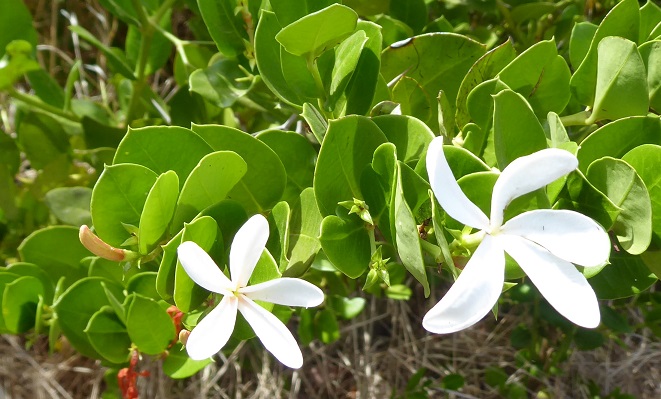
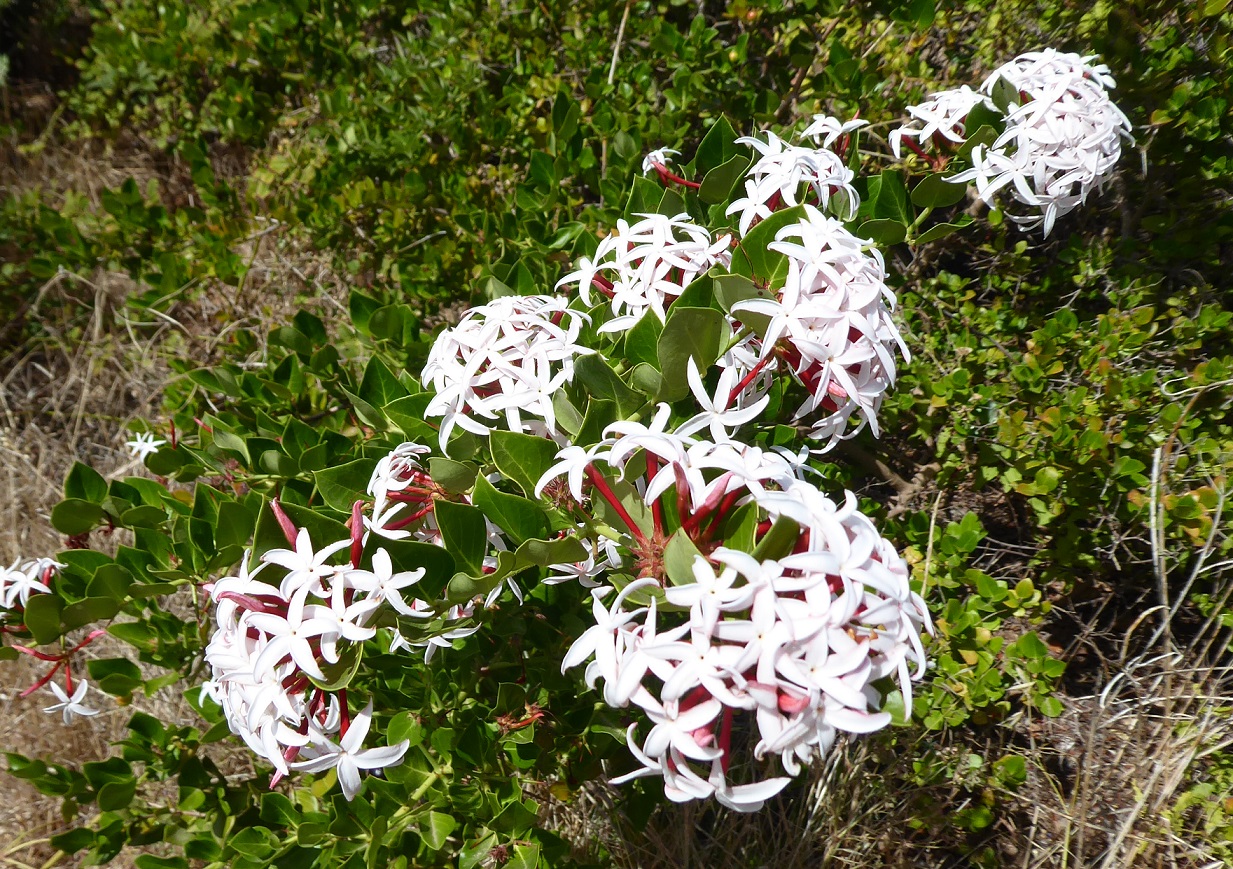
Carissa edulis has much smaller black round fruits, and smaller tubular flower which come in clusters like spring jasmine. The shrub has been flowering on and off all summer. The scent is heavenly, the buds and flower tubes are red pink which contrasts beautifully with the starry white flowers. The long spines are vicious. It comes from the bushveld and further north in Africa and does well here.

I have two duranta bushes, but may acquire more as they are tough shrubs requiring very little water when established, real stalwarts for summer. They come from Mexico and  South America and are sometimes called golden dewdrops. One of mine has variegated leaves with a silvery gold edging and pale blue flowers. The other is the real beauty with darker violet blue flowers which are edged with white. I think it is the cultivar called Sapphire showers. The flowers are faintly sweetly scented and cover the large shrub all summer. Both shrubs also have golden berries now.

Stars of February

With elegant, pale pink lily like, scented flowers, Crinum moorei has been a treat all month.  The flowers remind me of ballerinas in Giselle. Sometimes called the Natal lily, this member of the Amaryllis family has big bulbs and prefers shade. Mine are growing in a big pot under a tree and have survived considerable neglect. Their scent is stronger at night making them a good choice for a shady courtyard.

Another pale pink beauty flowering for weeks from mid to late summer is Barleria greenii. This likes some sun and also comes from KZN and I read that it is also scented at night. It is critically endangered in the wild. A bushy perennial with big  (for a barleria) delicate flowers, it has prickly leaves. My single plant has survived in the garden for many years, but I must try to propagate more as it is out of its comfort zone here. I do prune it back a bit each winter and wait anxiously to see if it will shoot in spring. I also water it weekly in summer.

Much tougher and brighter is Crassula perfoliata var. falcata which is also a February star at KSU. This is a succulent  from the Eastern Cape with attractive grey stems of grey sickle shaped leaves which complement the big heads of tiny  bright red flowers. Easy to propagate from cuttings, I have a few plants in the rockery and have noticed that those which get afternoon shade do best.  There seems to be some confusion about the name of this plant.

Even bigger and brighter is the firewheel tree, Stenocarpus sinuatus, from tropical rain forests of Australia. I have been amazed that it has grown and flowered here, but it is a member of the protea family and I think must like the acid soil. The flowers are like bright red, spidery catherine wheels and the seedpods an elegant pale green.  It has very handsome glossy dark green leaves too which make it attractive all year round.

And lastly let us not forget the humble petunia, a pot of them have been flowering beside the front steps all summer long, a daily star.

February 2019 Gallery

January 2019

Although January is the beginning of the calendar year, it isn’t the beginning of the gardening year here at the Cape. It is midsummer with long dry days when survival is the name of the game. This is one of the “brown months” at KSU when the background to the garden is short dry grass. It is time to aestivate – a lovely word, which my dictionary defines as spending the summer in a state of torpor. Both days and nights are hot with daily temperatures in the 30’s even over 40°C. Most plants stop growing and just hang in there waiting for the cooler days making this a good time to examine the bones of the garden, to plan and prune back.

This year we have been very lucky in having a slightly cooler January and even a few showers, but the downside is that the fruit is not as sweet.  The water is also still running in the big pipe which takes away the excess water in winter and is my main source of garden water, so there is still plenty to put on the garden. As this is high summer I have to spend hours watering each week. The garden does not look as scorched as some years, but this is definitely the time to enjoy shade trees.

Trees

Near my old cottage are several massive wild Africa olive trees Olea europea subsp. africana. They must be at least 100 years old and shelter the house from the worst of the south east winds and provide welcome shade. Birds love their fruits which are sweeter than the cultivated olive, they drop seeds all over the farm and little wild olives pop up everywhere as the most persistent weeds. This is a tough tree and I enjoy snacking on the fruits too- possible new gourmet food? I have planted some along the boundary fence as a screening hedge. Once established they are almost indestructible, so don’t let them get a hold where you don’t want them.

Among the first trees I planted were some oaks, Quercus robur, which have adorned Cape towns and farmsteads for centuries, but which are now out of fashion. They have thrived here and now make respectable little trees and I can enjoy their dense shade while watering.

January is also the month to collect the cones from the umbrella or stone pines, Pinus pinea another tree which I think of as iconic of the Cape of yesteryear. People collected the dennepitte (pine nuts) to make tameletjies, brittle sweets. There is a recipe in Hilda Gerber’s book on Malay cookery. I love their dense glossy green healthy foliage and the silhouettes of mature trees at sunset, so I planted some when I came to KSU 14 years ago. They have grown well and have started bearing cones at last. They are a real hassle to shell though as one first has to dislodge the nuts from the resinous cones and then remove the sooty shells from the nuts. It is no wonder pine nuts cost so much to buy, but after a few hours of shelling I have enough for pesto. I must now remove the bottom branches from the trees to encourage their umbrella like shape, and also to prevent fire taking hold. Fires are what we all dread now in summer and all the farmers are on high alert.

Much easier to shell than pine cones and also ripening now in January are the almond trees. This year we have a meagre harvest unlike last year. I have 6 Nonpareil trees which is a papershell variety and 2 other varieties to pollinate them.

Although it started flowering at Xmas, January is the time the sweet thorn (Acacia karroo or Vachellia karroo as it is now called) flowers are at their best. The scent wafts across the garden and brings delight while I water and the bright yellow pompom flowers are alive with bees. Although not native to this part of the country they do surprisingly well here.  The scented creamy white pompoms of the paperbark thorn Acacia sieberiana var. woodii /Vachellia sieberiana var. woodii also flowered here in January this year. The tree I planted as a weedy, almost dead sapling 14 years has grown into a large flat topped specimen and the scent is heavenly. I wish I could distill the fragrance as a perfume.

Another indigenous tree which is at its best in January at KSU is the huilboom or African wattle (Peltophorum africanum). It comes from the summer rainfall zone and I don’t really have enough water to do it justice. Each year I wait quite anxiously to see if it will leaf out again. It gets its light green wattle like leaves late in spring, but for most of January it is covered in spikes of yellow flowers which the bees  and big black bumble bees love.

The other trees which are the stars of January are the Pride of India or Crepe myrtle trees, Lagerstroemia speciosa. Their flowers come in a range of pinks, lilacs and whites. I have lined one of the main walkways with these trees, but once again they have not grown as well as I had hoped through lack of water. Nevertheless they are still special trees, with their lovely satiny bark and their flowers are very gay against the blue sky and tall cypress trees. The town of Ceres grows these as street trees and we like to visit each year to admire them. Now there are new varieties with plum coloured leaves. I have just treated myself to one of these with crimson red flowers which are an electric contrast to the leaves. I just hope it will thrive.

Fruit and Veg

January is the middle of the fruit harvest and the time to enjoy peaches, plums and pears. My Santa Rosa plum ripened at Xmas and we have enjoyed a few peaches from young trees, but the star of the month has been the van der Merwe prune plum. Sweet and luscious these are a real delight and I plan to dry some in the hot sun to enjoy in winter. The Cape mulberry also fruits now in January. This tree has firmer leaves than the common mulberry which fruits in spring and the fruits are bigger and better. My tree does not get enough water and is a dwarf with small fruits, but each is an explosion of flavour, the perfect balance of sweet and sour. It  is another fruit which is out of fashion. Once nurseries sold several varieties, but I doubt you could buy a single one now. Along the boundary fence some of the Kei apples, Dovyalis caffra are bearing their round yellow apricot sized fruits which make a lovely acid jelly. This tough, tall plant with long spines makes an excellent barrier. It needs no water after the first summer.

In the veggie and cutting garden, everything is struggling to stay alive in the heat and plants are being eaten by little red ladybird like insects which lurk under the leaves in pairs. Not sure what they are and what to do about them as I garden organically and don’t spray. We are enjoying courgettes, gem squash, tomatoes, aubergines and peppers and watching the butternuts grow. This is the month for dahlias too, but this year they have struggled for some reason and I have lost several from the collection I was building up. They are old fashioned flowers and great to pick for the vase.

Other highlights

The waterlilies in the pond are also still flowering well. The slightly cooler summer suits them.  Nearby is a small plant of Bauhinia galpinii  whose orange red flowers are at their best now.  I also have a small collection of cannas growing in pots.  People either love or hate cannas. Some of the road verges here sport magnificent colourful rows of them. I have opted for the more subtle colours,  and some have lovely striped leaves. I still need to find a spot in the garden to  suit them though – on the “to do” list.

So January has many stars, but I haven’t mentioned the very best yet – plumbago. Without a doubt plumbago is the mainstay of the summer garden here at KSU. I have planted lots of it as hedges and along the boundary. I like all three colour forms; the common pale blue, the white and the bright blue form, Royal Cape. All of them are tough, versatile plants and the colours refreshing in the midday heat as well as magical in the long evening gloaming.

The best time to enjoy the garden here in January is early in the morning and late in the evening and  to spend most of the day aestivating!

January 2019 Gallery