Istanbul : Prague : Vienna : Trieste & Milan : Stresa : Switzerland : Art
In April 2023, after much planning, I set off on another whirlwind 3 week visit to Europe. It was mainly to see my family in Switzerland, but as they lead busy lives and only have weekends free, I decided to cram in as much as possible in the weeks between.
I have long wanted to visit Istanbul and this seemed the perfect time to spend a few days there before the first weekend in Geneva. Fortunately the Turkish airline flight from Cape Town was a bit delayed and instead of arriving at around 4.30am, we arrived around 6 which was a far easier time to find transport into the city. The new Istanbul airport is over 50kms from the city itself and the rail links are not working yet. The cheapest way to get into Istanbul itself is to take one of the shuttle busses and it is worth doing some research beforehand to find out which one to catch. I was staying in Sultanahmet, the old part of the city near the Aya Sofya . The shuttle stopped a few kilometres away and I needed to catch a tram the rest of the way. Fortunately the people of Istanbul are very friendly and I was helped to acquire the necessary Istanbul transport card from the machine at the closest tram stop and load it with lire. This card works on all forms of transport in the city and one pays a flat rate for a ride, irrespective of the number of stops.
I was very happy with my room at the family run Hotel Anadolou and after shedding my backpack and having a quick shower, set out to explore. This is prime tourist territory with Aya Sofya and Blue (Sultanahmet) mosque and Topkapi palace all close by. There are also many budget hotels in the area.
Around Sultanahmet
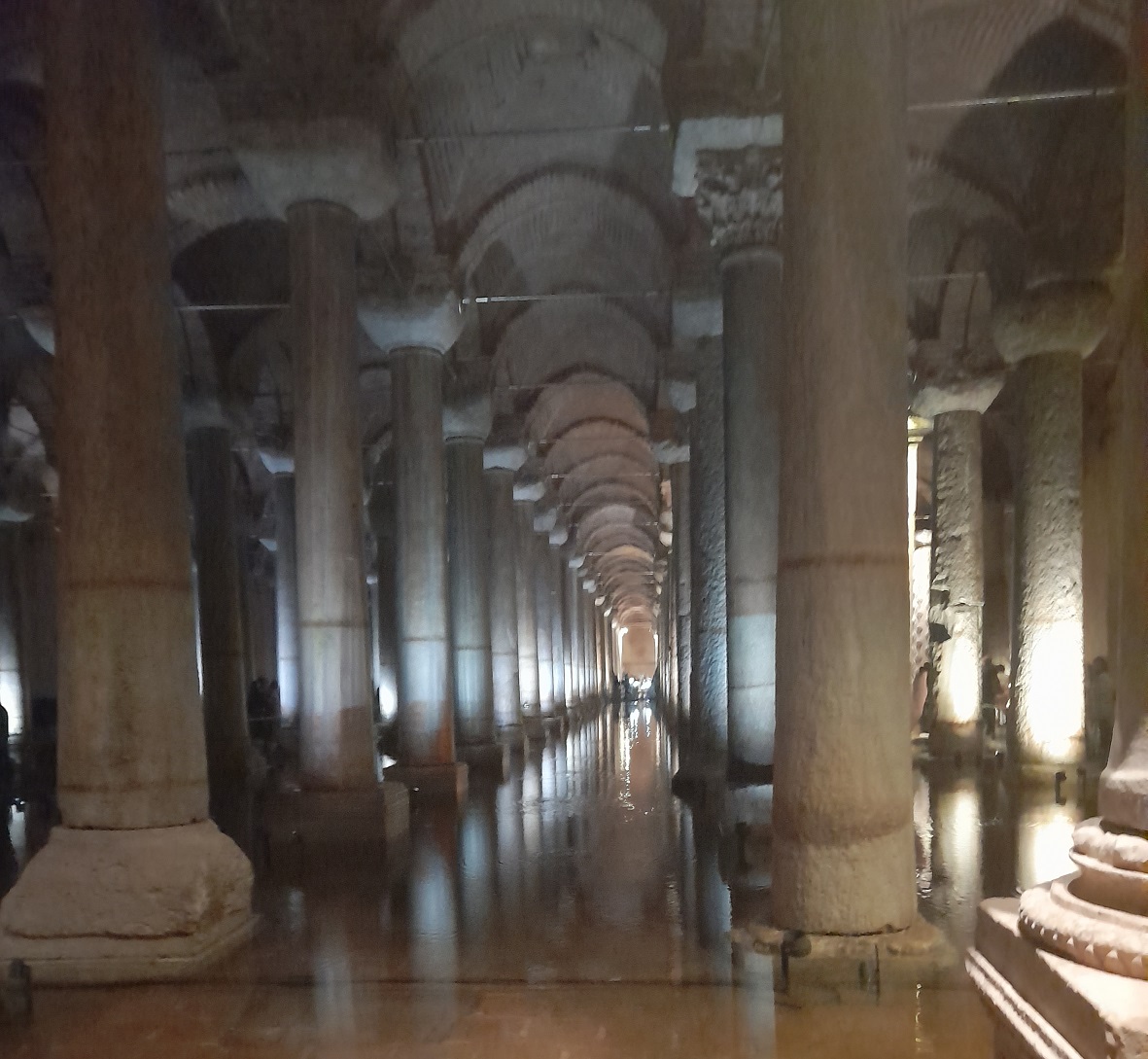
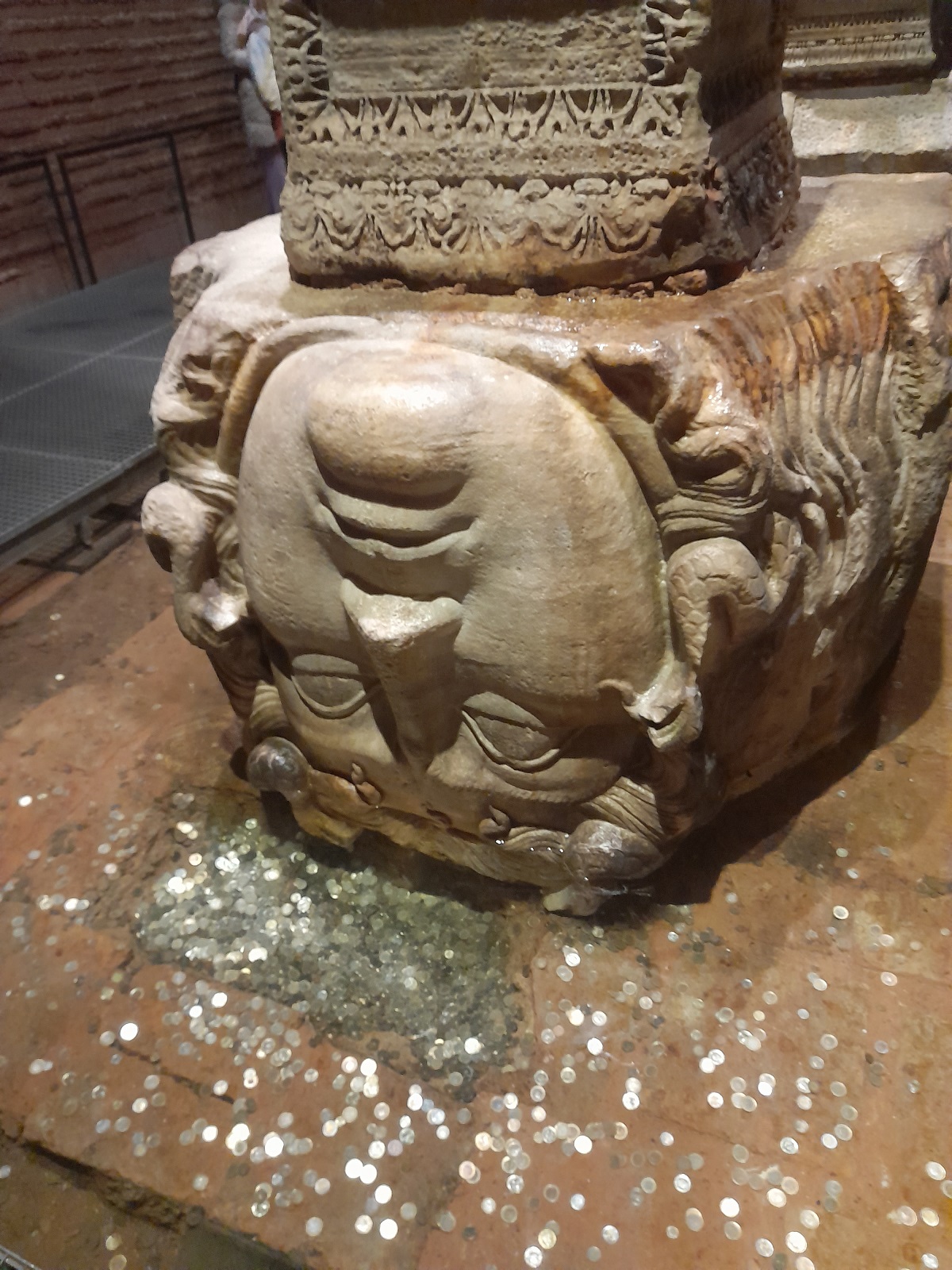
My first stop was the big cistern built at the time of Justinian, the Yerebatan Saray. This is a most impressive underground space almost like a cathedral supported by 336 columns. Aside from the ancient sculptures, it contains some modern pieces too. About 30cm of water has been left in the bottom of the cistern to enhance the effect. Later in the day, after a struggle to find it, I visited another nearby cistern, the Binbirderik Sarnici. This appears smaller, has not been fully restored and not worth the admission charge.
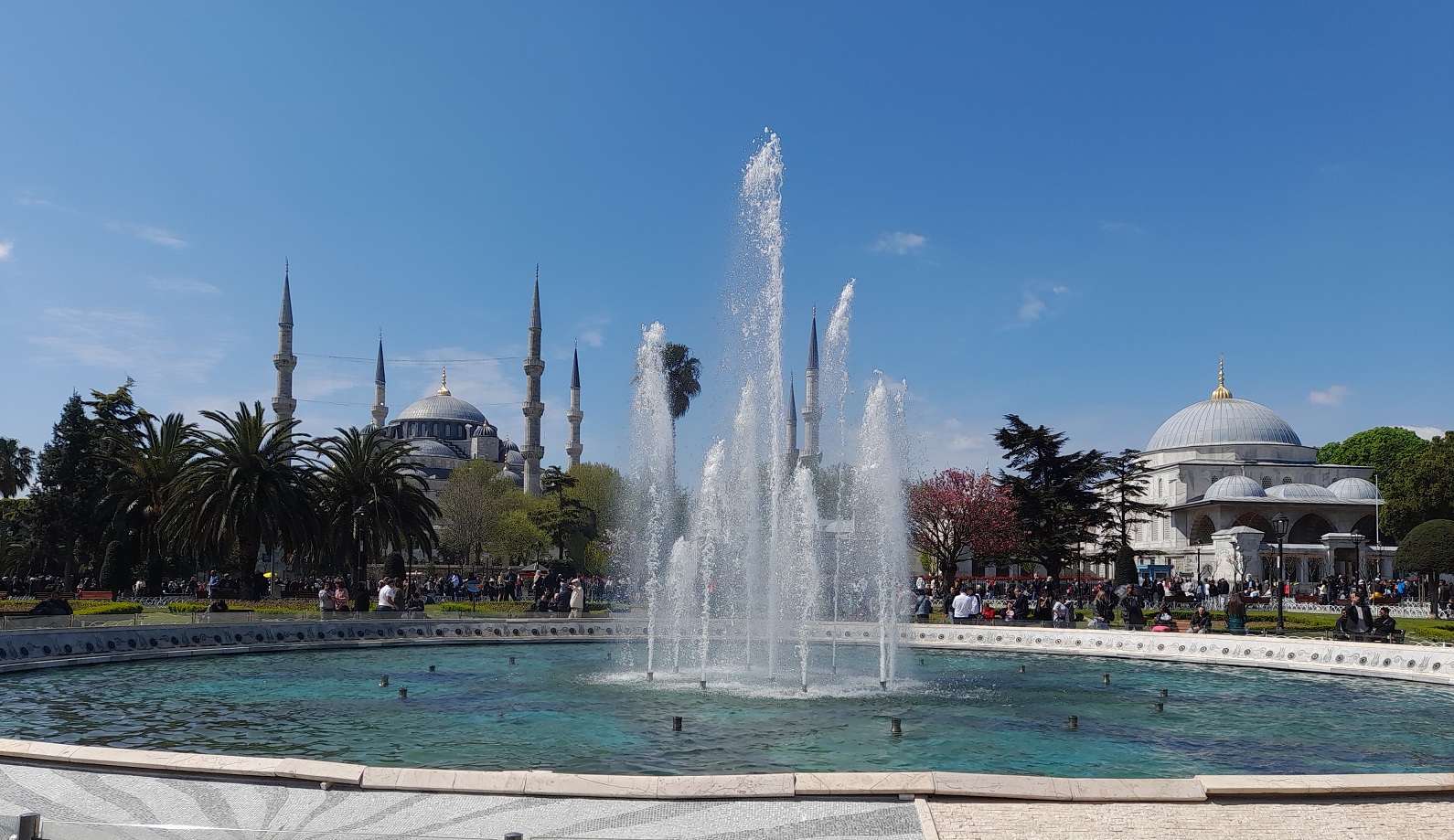
After visiting the Yerebatan Saray I wandered about enjoying the public spaces, I had my first simit, a bagel like bread filled with cream cheese. These are sold all round the area from stands and one has a choice of cream cheese, Nutella and other fillings. Other vendors were selling roasted green mielies (corn) and roasted chestnuts. The day was sunny and people were out enjoying the fountains and spring blossom. Little did I know it, but this was to be some of the best weather of the whole trip!
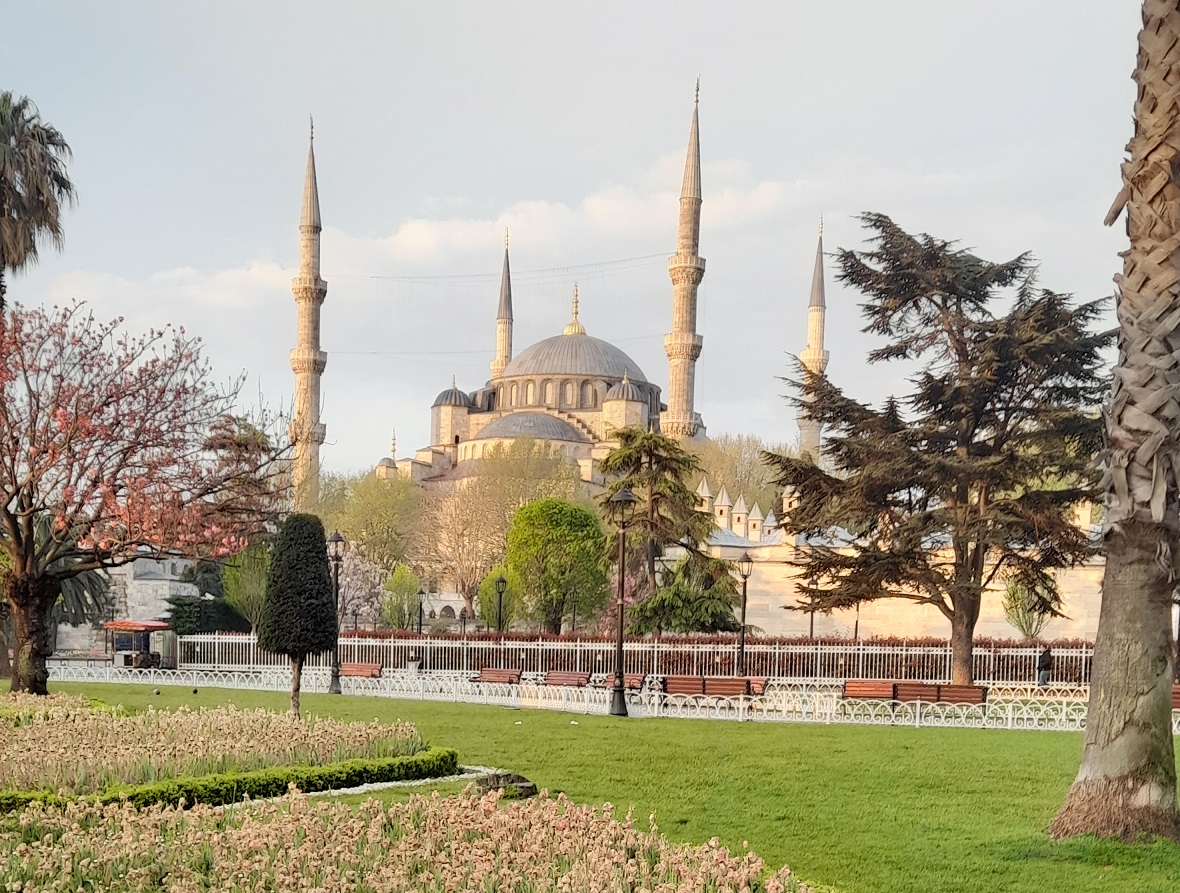
After trying to take pictures of the blue mosque (Sultanahmet camii) to include all the minarets, I went inside to admire the pretty interior. (To visit mosques one must cover one’s head and take off one’s shoes, so pack a scarf.) Built in 1617 by Sultan Ahmet, the interior is very attractively tiled, but I felt it lacked the gravitas and feelings of awe generated by the 1000 year older Aya Sofya nearby.
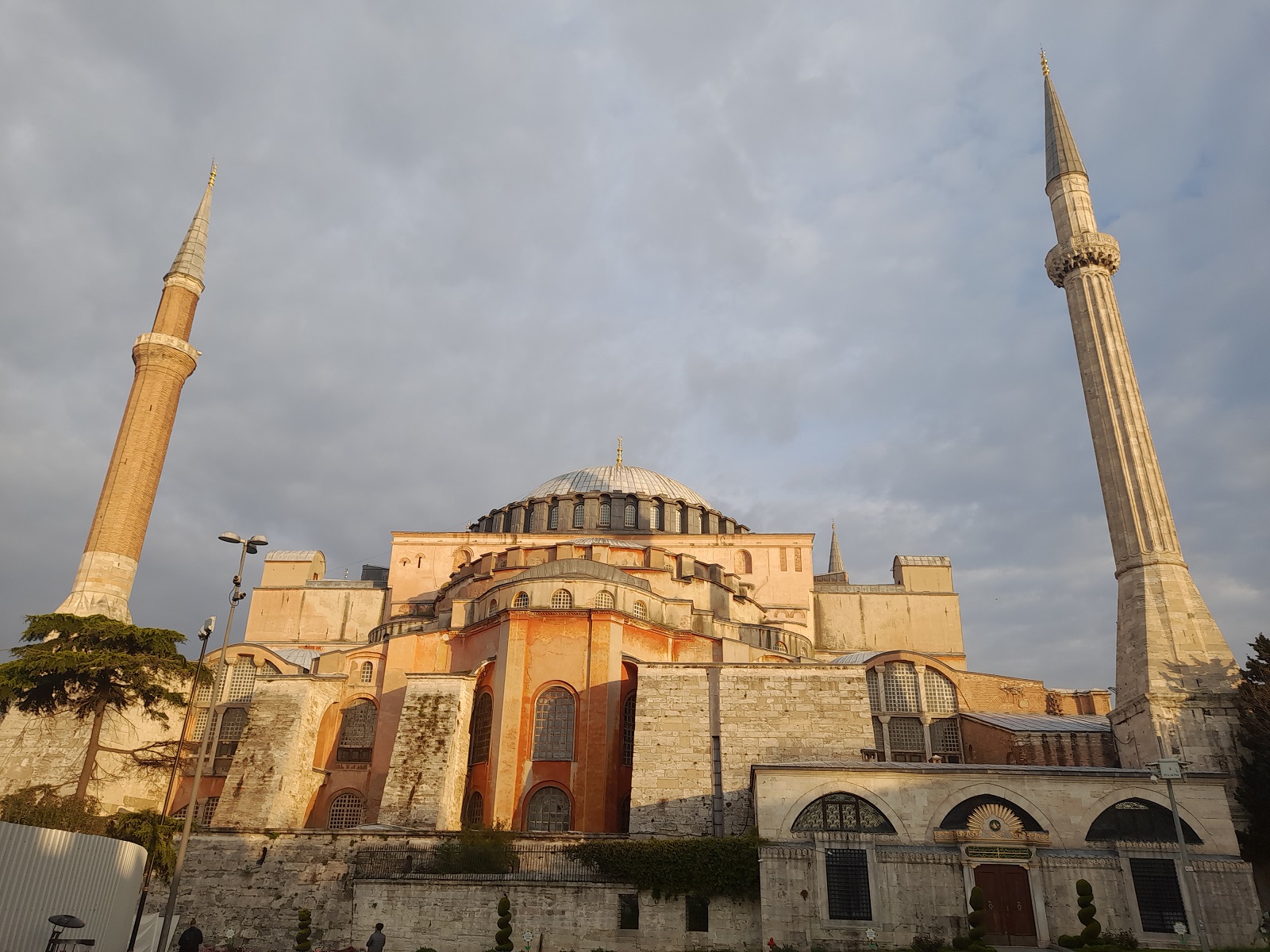
The Aya Sofya is one of the oldest buildings in Istanbul having been built as a church in 532 at the time of Justinian, when Istanbul as known as Byzantium. It and the nearby cistern must be of a similar age. It is a dark space with an enormous dome which soars above one. For over 1000 years it was a Christian church, but after the fall of Constantinople in 1453 , it became a mosque and remained so until the early 20th century when it became a museum at the time of Ataturk. However, under President Erdogan it recently became a mosque again and I visited at a time of prayer. The voice of the iman calling out was magnified by the amazing acoustics and it was a very moving experience. So much so that I neglected to look around to see all its renowned mosaics and when I tried to go back on Friday morning it was closed for viewing.
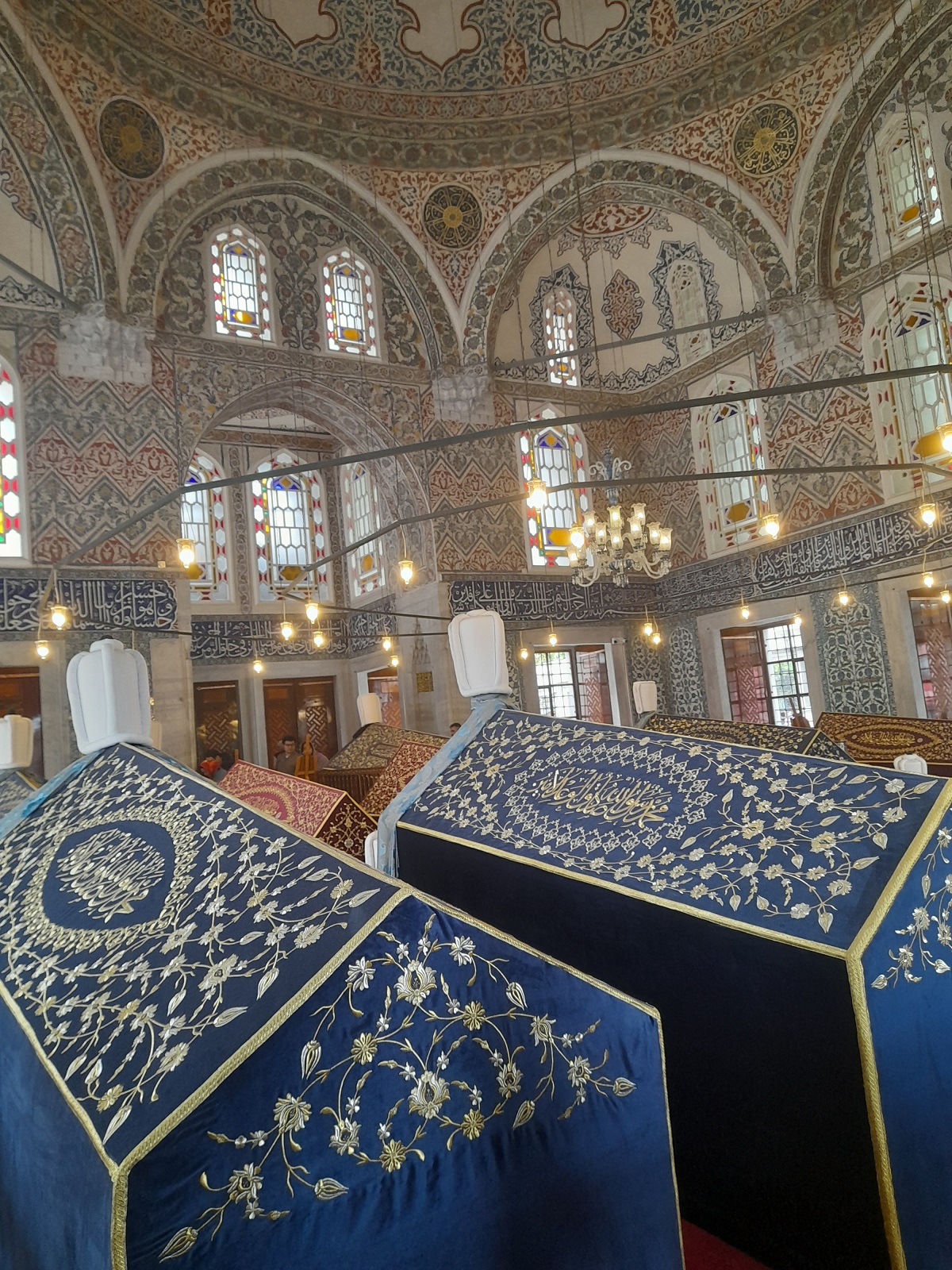
I was hoping to visit the carpet museum, but it has closed. After checking the space of the ancient hippodrome and admiring the remaining monuments there, I entered the attractive domed building which is the tomb of Sultan Ahmet and his family. Once again the tiles and wood work were magnificent and the interior tombs were all covered by beautifully embroidered cloths. This was the first of several tombs adjacent to mosques that I visited and they are all beautiful spaces.
Bosphorus
As it was only mid afternoon and the weather forecast for the next days was not auspicious, I decided to take a tour of the Bosphorus. I followed the tramline line down from Sultanahmet to Eminӧnü, overwhelmed by all the sweet and pastry shops I passed en route. Do the people of Istanbul have such a sweet tooth? Visually they are a feast for the eye and very tempting.
Many ferries leave from Eminӧnü on the shores of the Golden horn. The trip I chose lasted 90 minutes and was one of the highlights of my stay in Istanbul. There was no commentary, but refreshments in the form of fruit salads and drinks and snacks were constantly being touted.
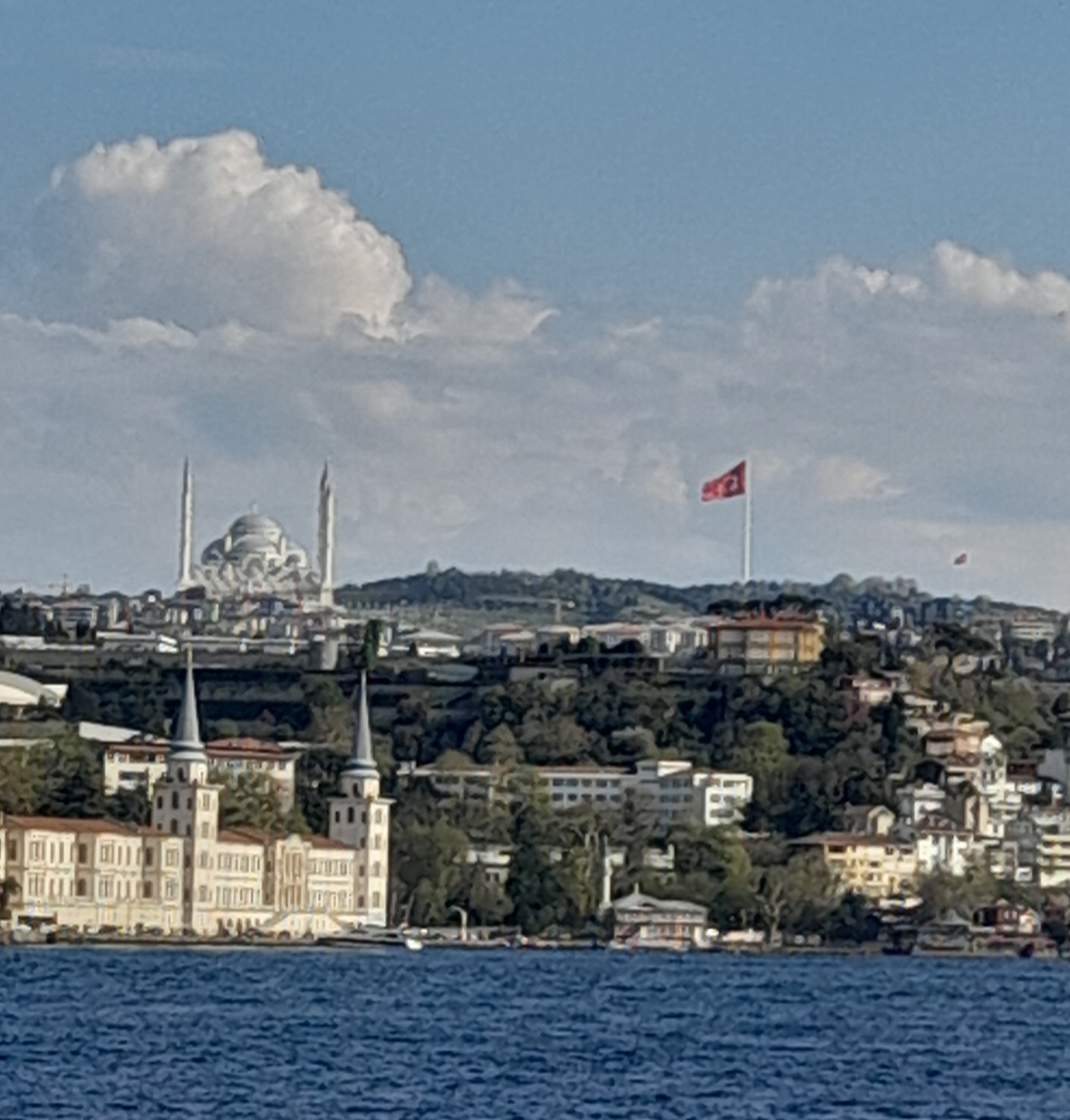
As we pulled away from the shore one could admire the skyline of the old city punctuated by the many mosques. As the boat made its way up the European side of the Bosphorus there were more mosques, palaces and grand hotels to admire. At the 2nd bridge over the Bosphorus the boat turned and made its way back along the Asian side. Here were more palaces, but also the villas of the wealthy set in extensive gardens that had been preserved. High on the hill on the Asian side is an enormous new mosque: maybe President Erdogan challenge to Sultan Ahmet? Flying nearby is one of the enormous Turkish flags on very high flagpoles. I saw several of these flying over Istanbul. The whole trip was very invigorating and judging from the many Turkish families on board, not just something set up for tourists, but enjoyed by locals too. Unfortunately my camera jammed on the boat and I had to use the inferior phone camera for the rest of the trip. Apologies for the quality of the pictures.
A long walk before breakfast.
I was awake very early on day 2 and dashed out before breakfast to try to capture the mosques at sunrise. Thereafter I wandered to the shore through Gϋlhane park to admire the tulips. Down on the shore were several fishermen, but I never saw anyone land anything. I was drawn to walk along the shoreline following the joggers. On my left the Bosphorus and to the right the walls of the Topkapi palace grounds, with a busy freeway in between. I walked and walked as I gradually realized just how big those grounds are, enclosing the whole of the eastern tip of European Istanbul, south of the Golden Horn. Eventually the walls ended and I was able to climb up back to the hotel for breakfast.
Like all breakfasts on my trip, there was a buffet combination of sweet and savory items; various rolls and breads, biscuits and cakes, boiled eggs, cheeses and cold meat, fresh fruit and salads, including a platter of tiny sweet sliced cucumber. There was also yoghurt and fruit juice and what I think was white powdered dry yoghurt to sprinkle over the salad. And most important to me, plenty of coffee.
A Day of Mosques
Refuelled, I set off on a marathon day of sightseeing. Istanbul, as most people know straddles 2 continents, with the Bosphorus strait separating the western (European) city from the eastern Asian bit. The European city is larger and older and is turn divided by an estuary known as the Golden Horn. To the south of the Golden Horn lies the oldest part of Istanbul and this is where I spent most of my time. I much admire the architecture of mosques (camii) and I set off to visit several, especially those built by the great Sinan at the time of Sultan Sϋleymaniye (1520-1566).
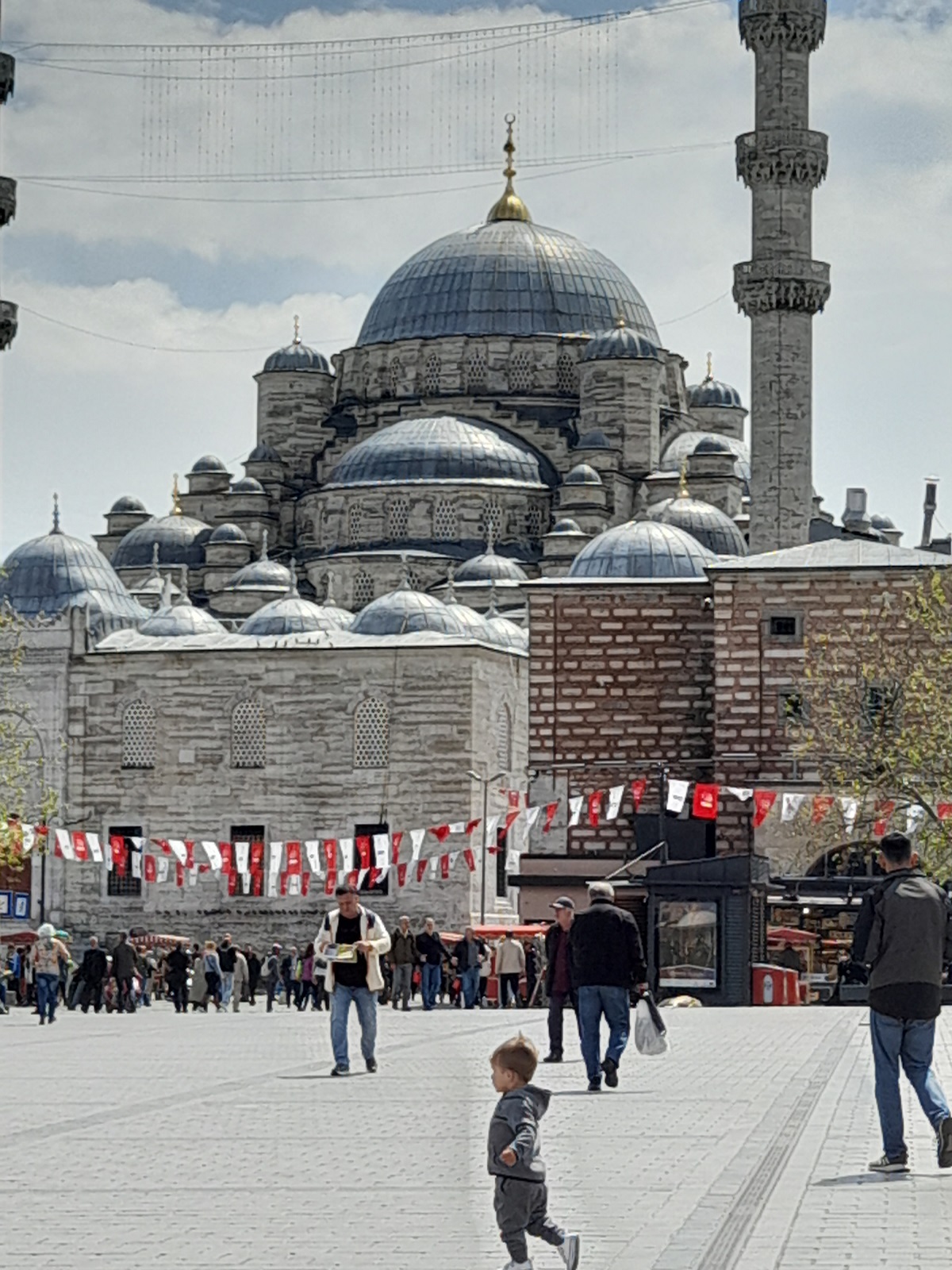
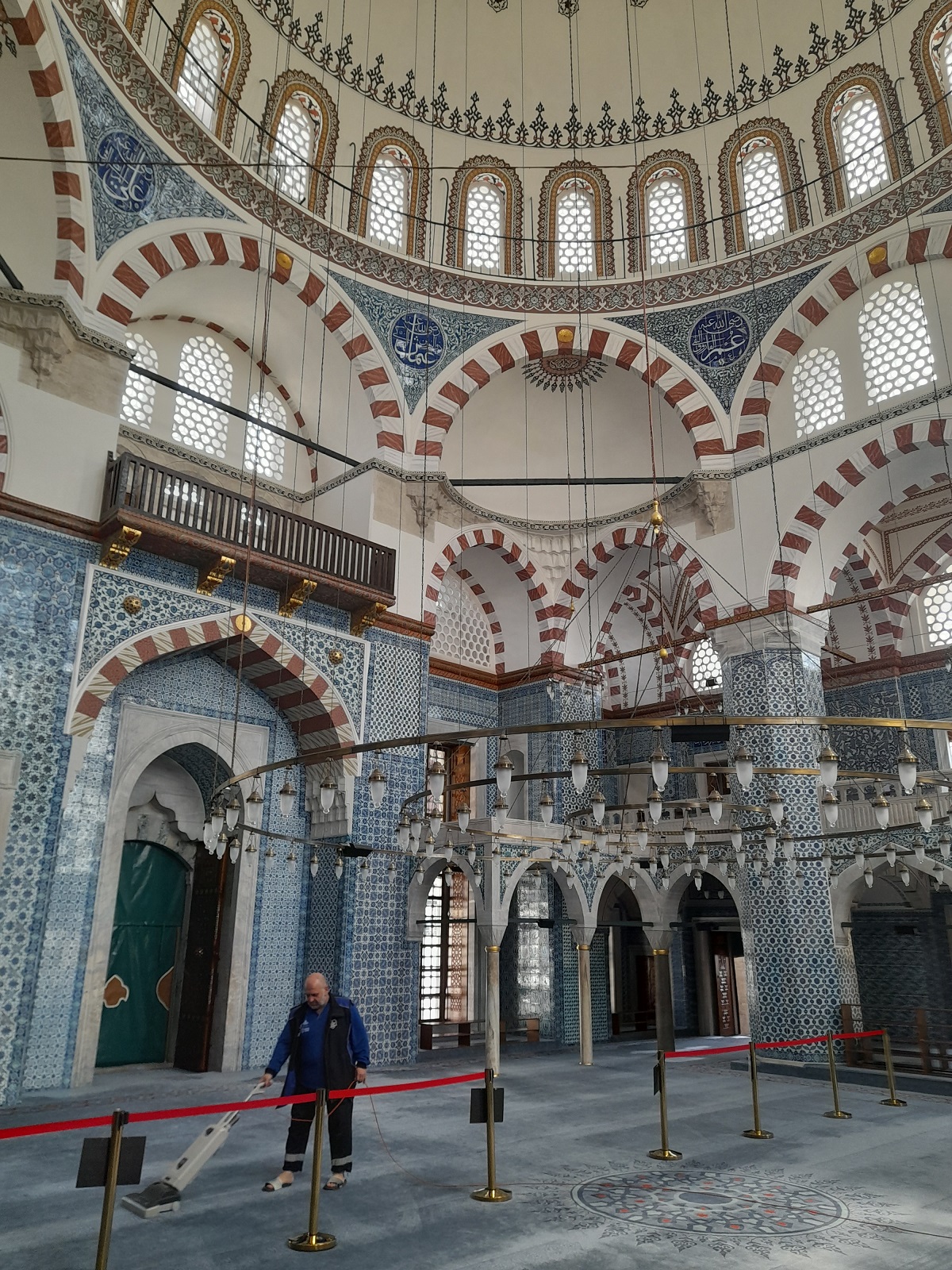
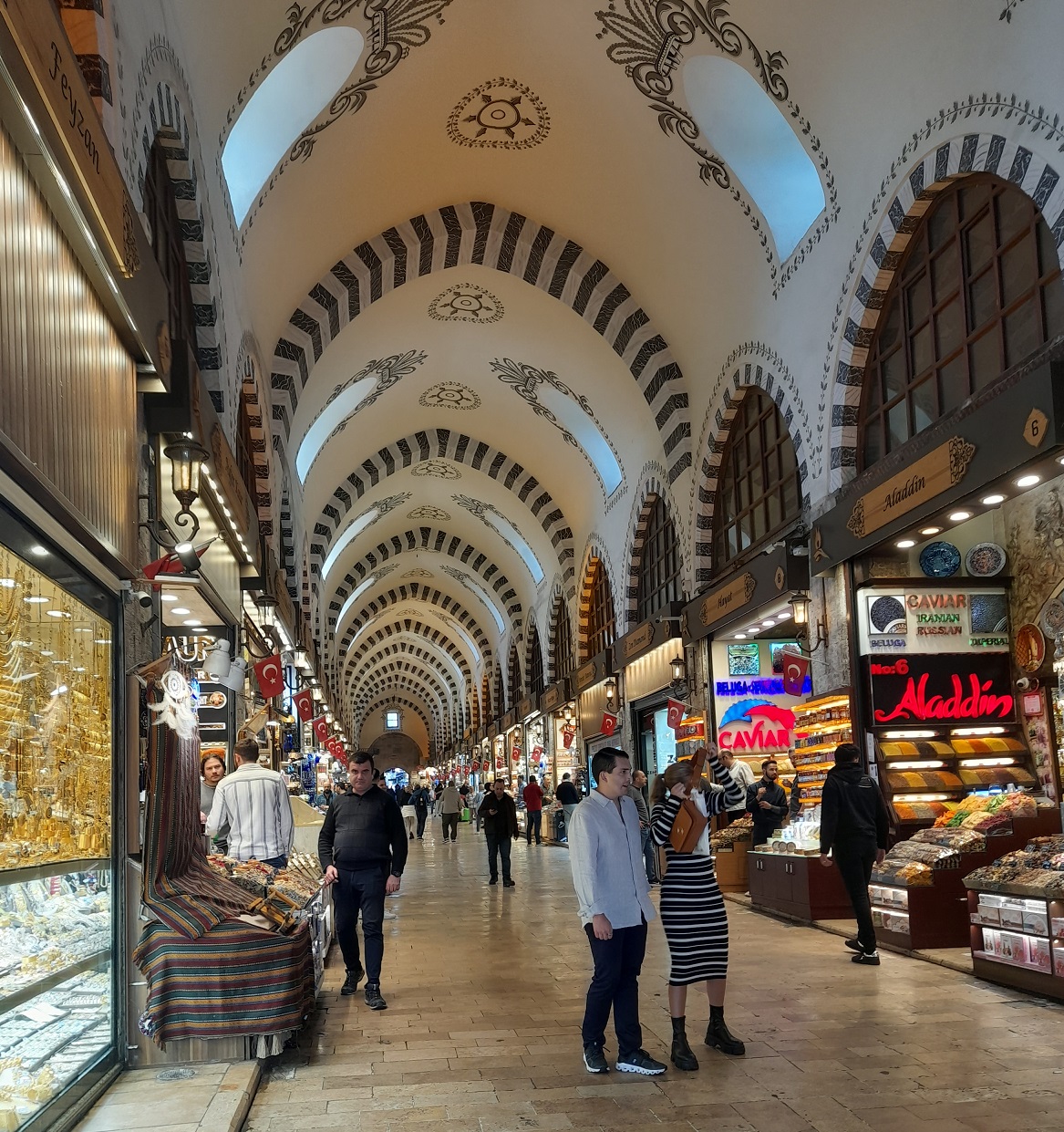
I headed down to Eminӧnü where the large Yeni Camii graces the shore and after visiting this, set out to find the Rϋstem Paşa camii which is famed for its beautiful Iznik tiles. I stumbled upon it after finding myself in the Spice bazaar. The Spice bazaar is a most enticing spot and I sampled a dried persimmon (rather like a big date), telling myself it was far healthier than all the sweets around.
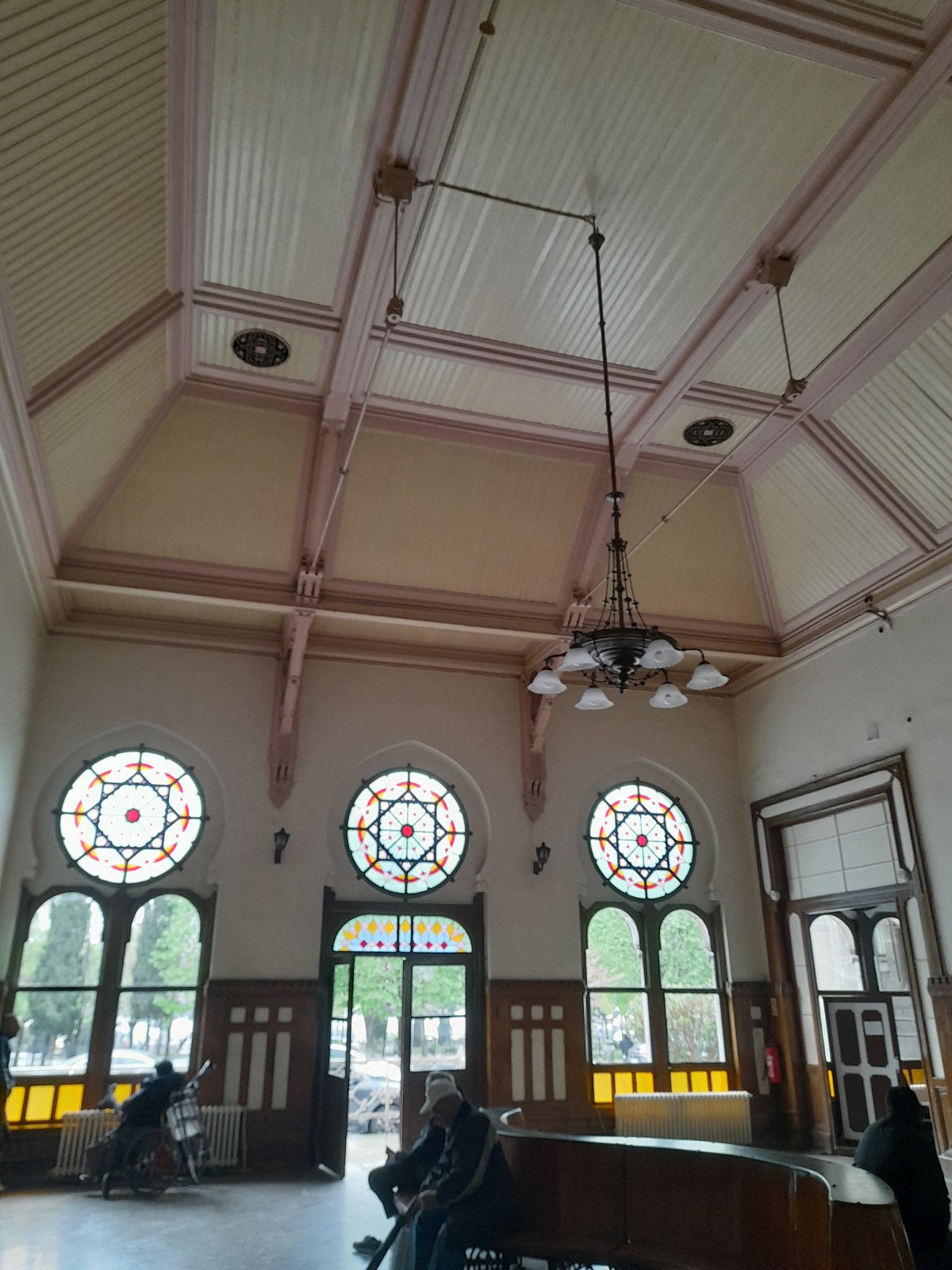
While exploring the back streets of Eminӧnϋ I came across the most fabulous derelict art nouveau building which looked as if it belonged in Paris. I do hope it is rescued before it falls down. It must have been built around the same time as the nearby Sirkeci railway station, which was once the terminus of Orient Express.
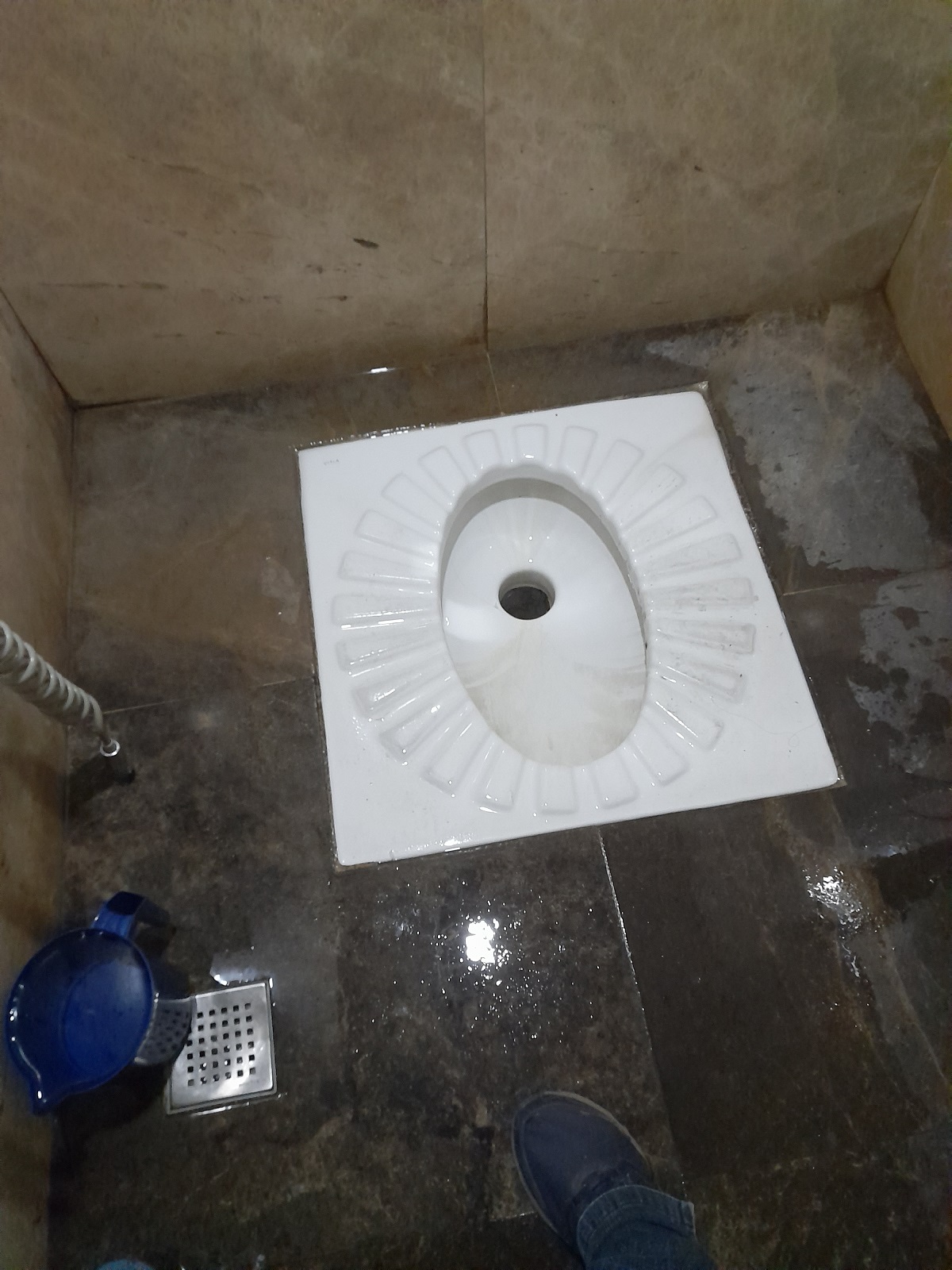
Almost topping my list of places I wanted to visit in Istanbul was the Chora monastery (Kariye camii) famed for its Byzantine mosaics. I was devastated to hear that it was closed for reconversion into a mosque after being a museum for many years. . It is situated right on the outskirts of the old city near the walls. I decided to head out that way to visit the nearby Mihrimah Sultan camii. After snacking on roasted chestnuts for lunch while wandering around the pretty Eminӧnϋ square and encountering my first traditional loo, I set off by bus armed with a map and directions from the tourist office in Eminӧnϋ.
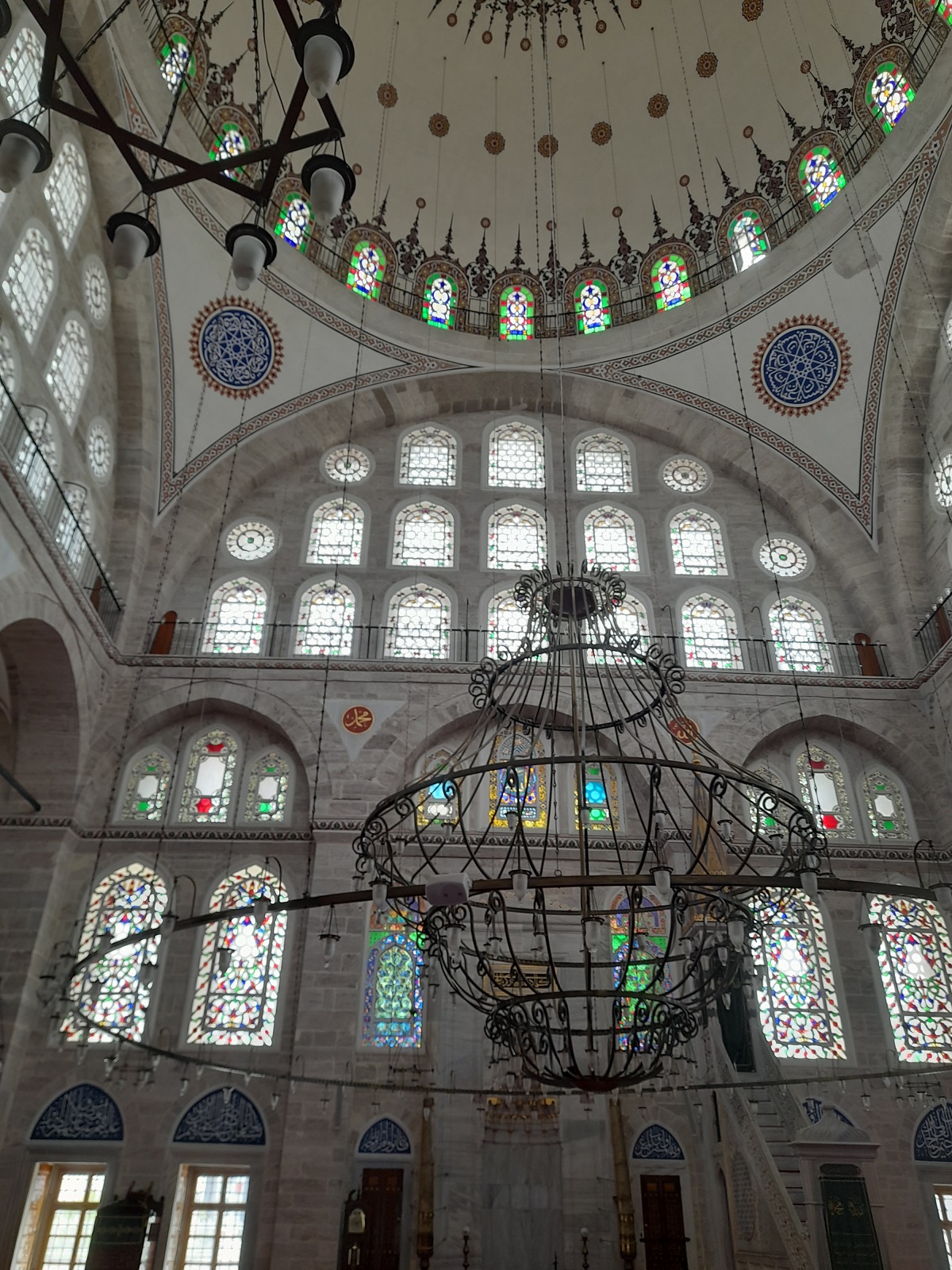
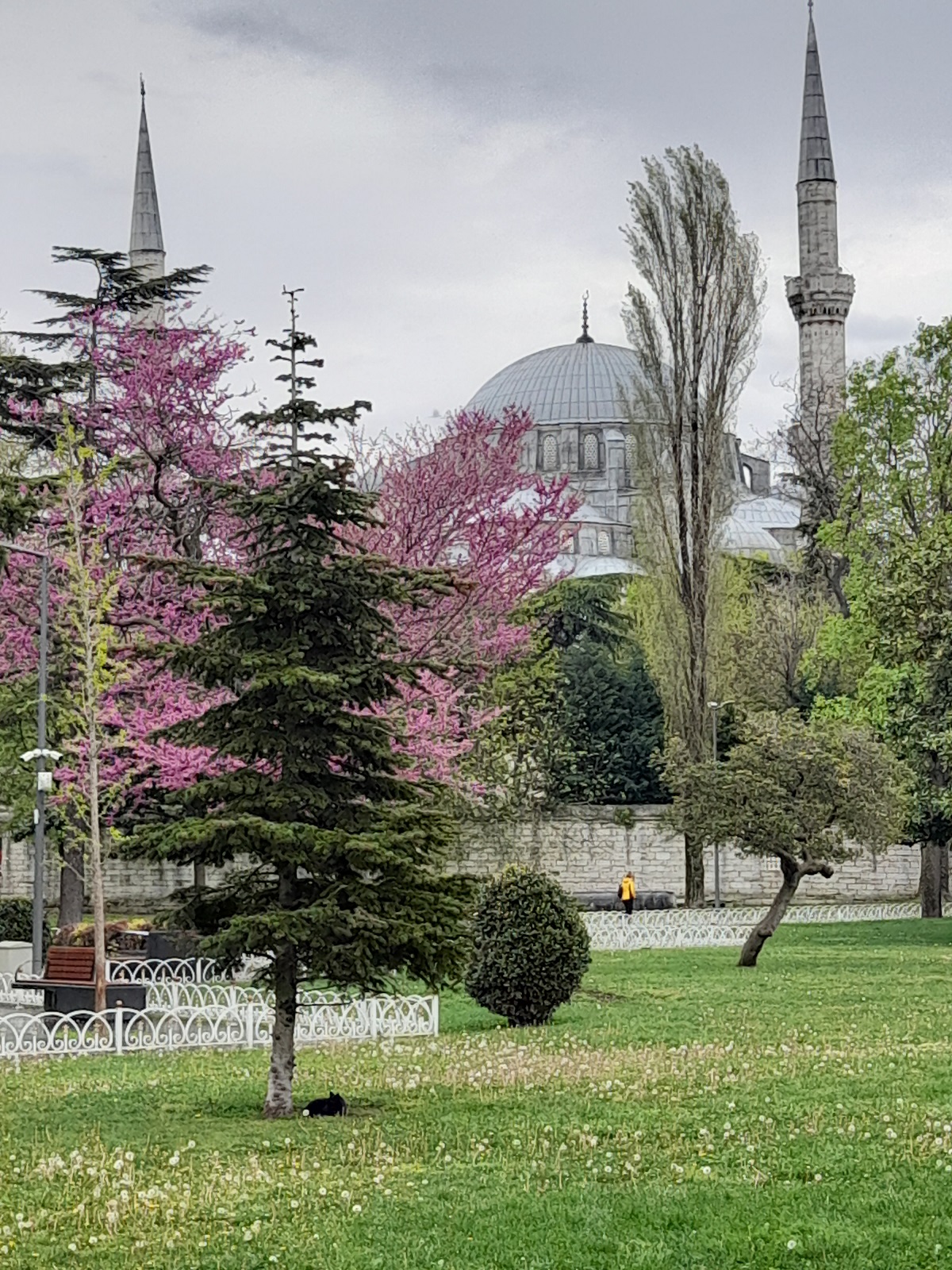
The Mihrimah Sultan mosque, was delightful, airy and graceful with attractive stained glass windows. It was built by the daughter of Sultan Süleyman 1 (the magnificent) and is very close to the old Byzantine land walls of the city which run for miles. I now regret that I didn’t look for the Kariye camii nearby. Instead I started the long walk back to the Sϋleymaniye Camii stopping to sample some delicious pastries en route and detouring down into Fatih where I hoped to find a tram. Along the way I passed an area where every shop seemed to be a bridal boutique or a jeweller. It was quite dazzling. Do all the brides of Tϋrkiye come here? How does one choose from so wide a selection?
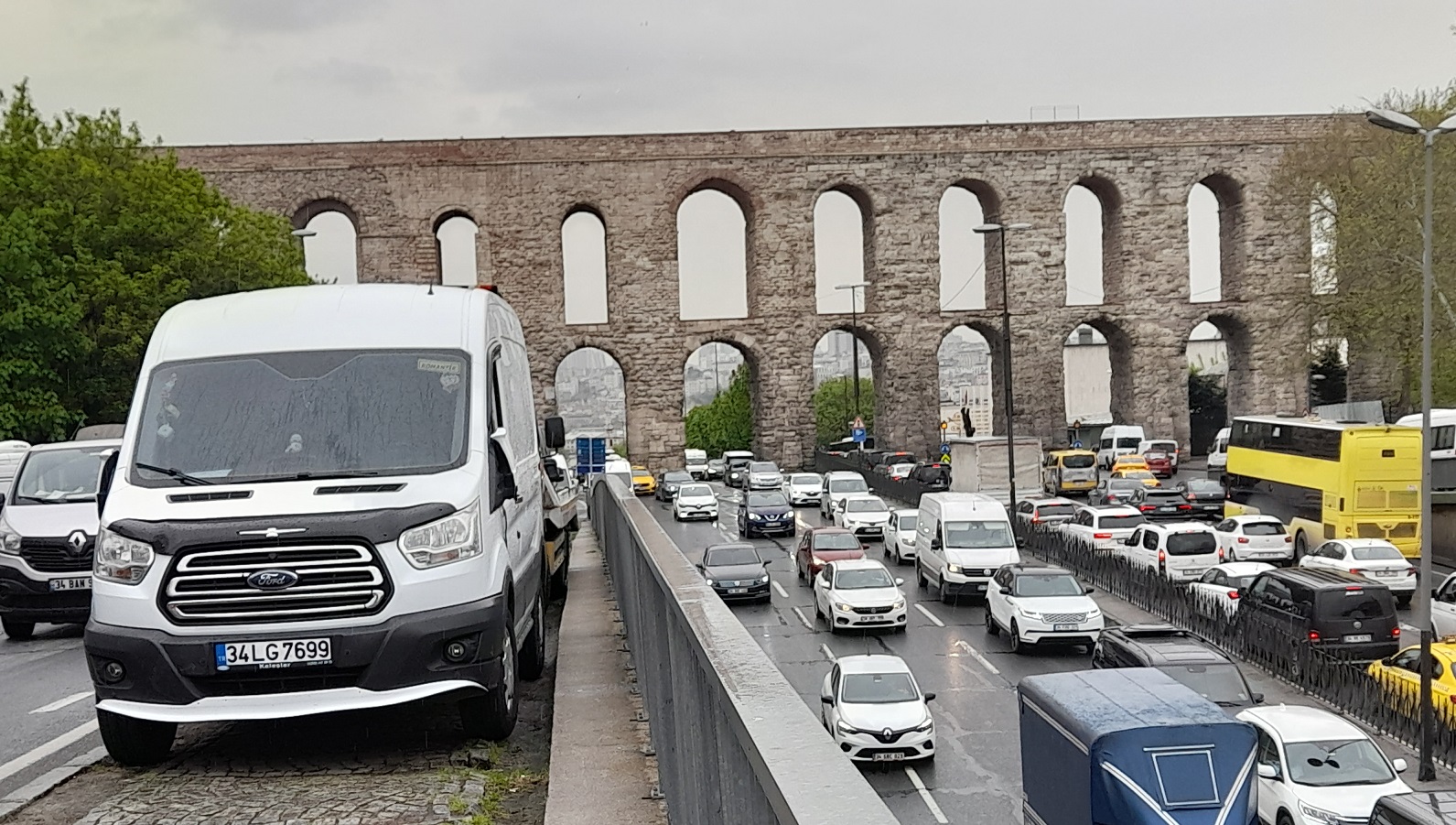
Eventually I reached the aqueduct of Valens which runs for about 900 m. through a park and over a busy highway. With its double arches, it provided this part of the city with water for many years and was rebuilt several times.
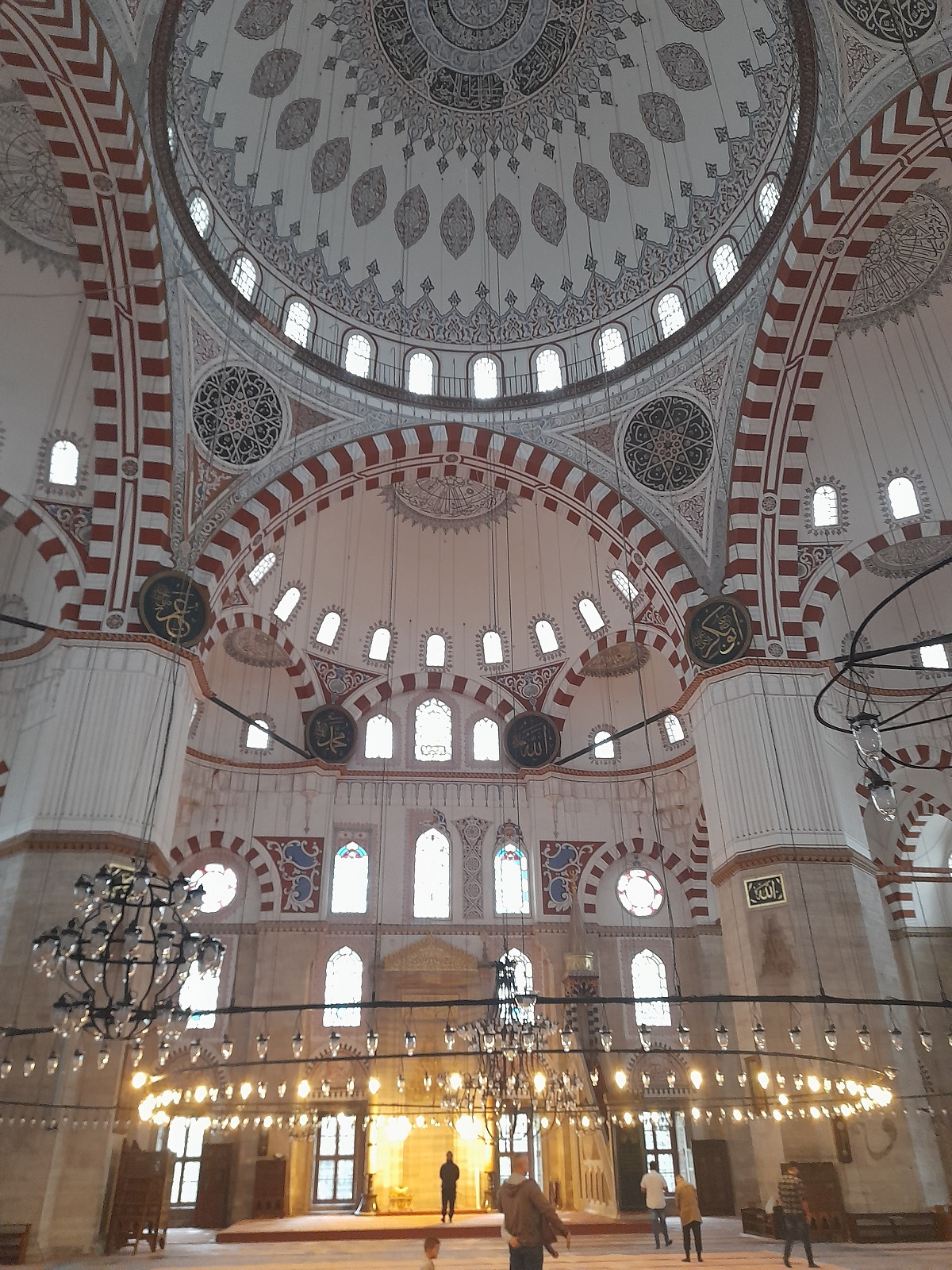
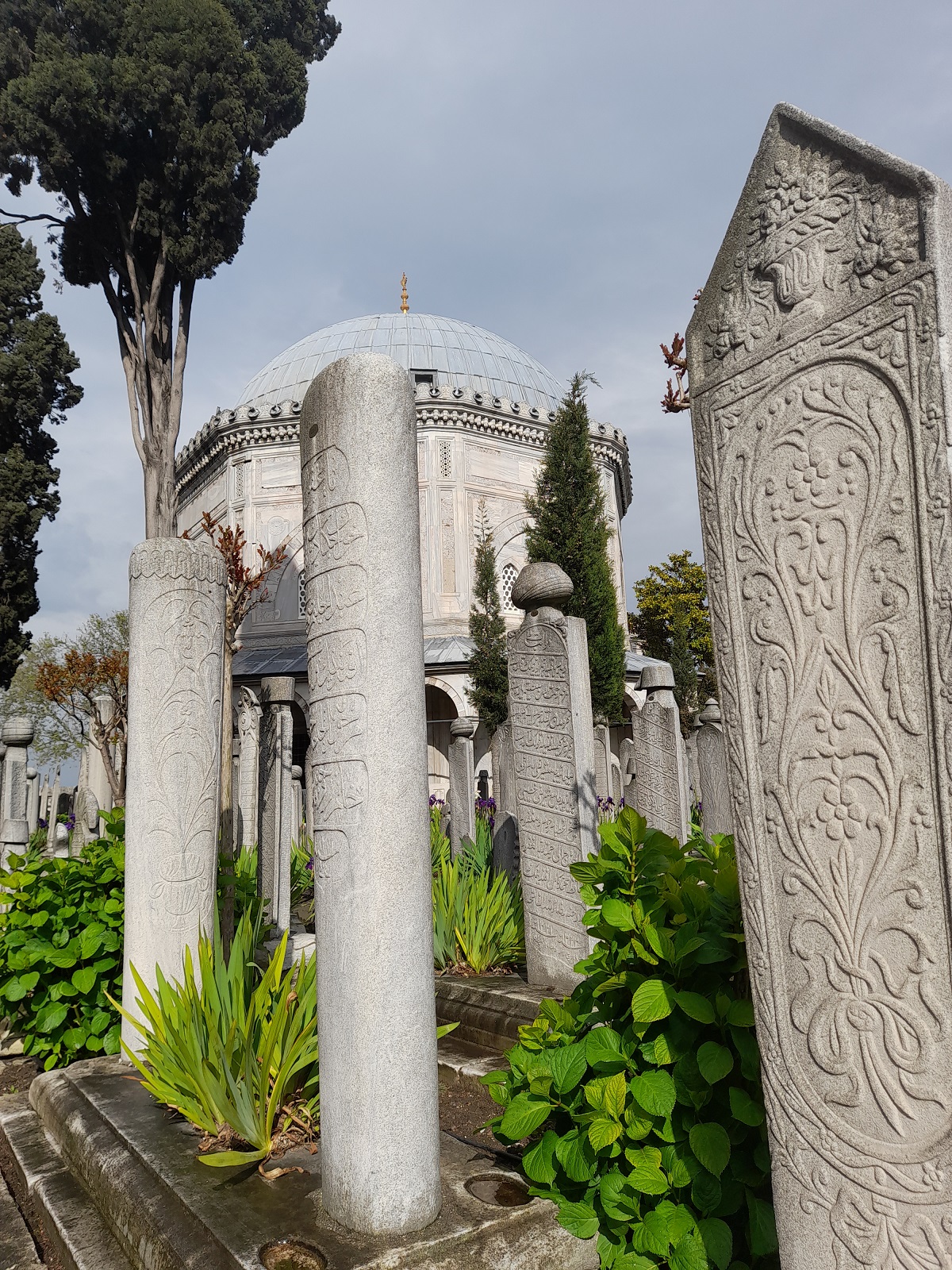
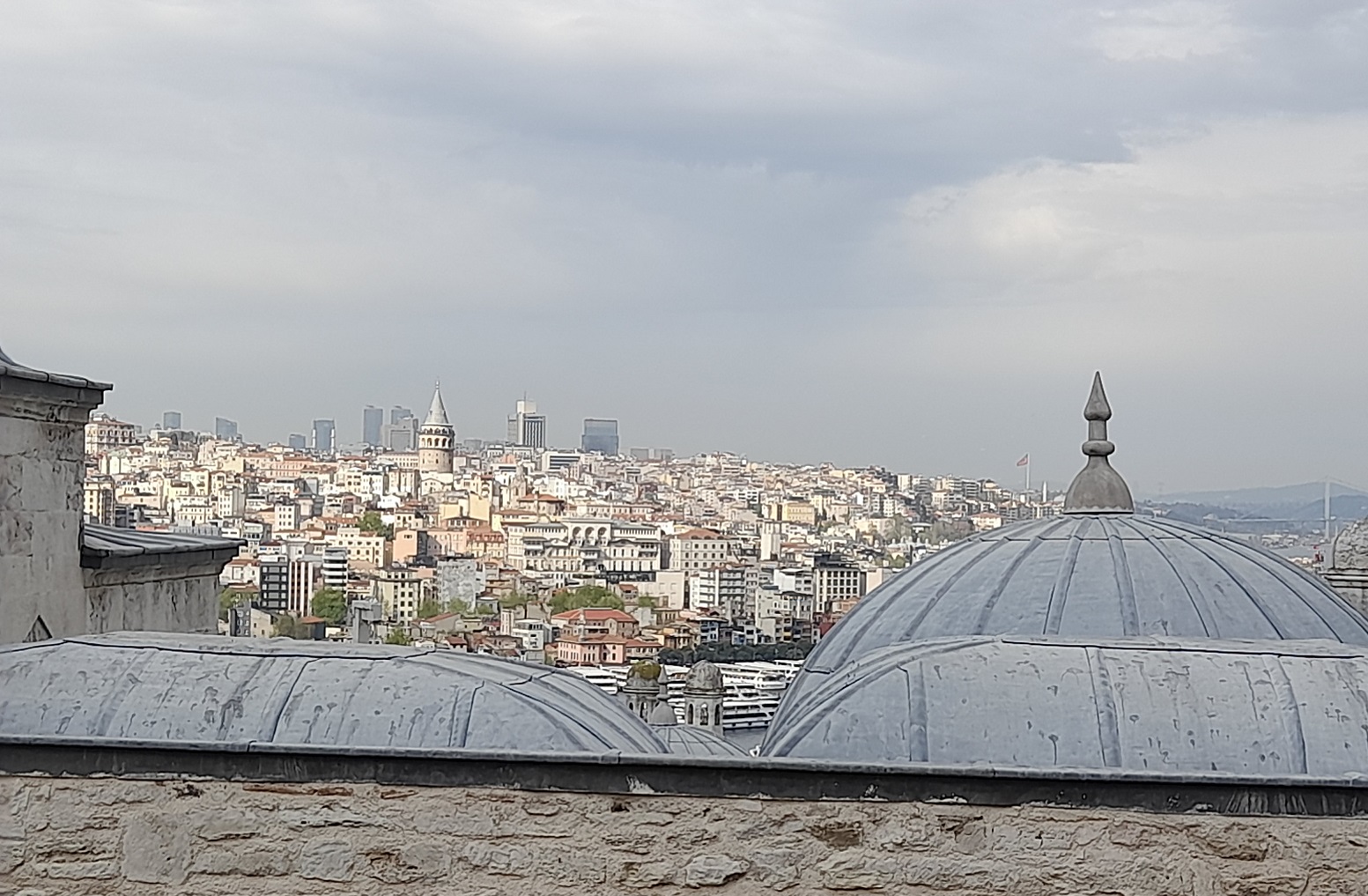
Across the highway was another beautiful mosque, The Sehzade mosque, also designed by Sinan. I rather liked its plain interior with bold red bands of colour. Outside was a pavilion with a delicate brick minaret. Initially I mistook this complex for the Sϋleymaniye mosque, but that was further on and nearer the shore. The Süleymaniye mosque complex is enormous and dominates the skyline. The tombs of the sultan and his wife are beautifully tiled and surrounded by other graves. On the other side of the mosque is a large lawn with an amazing view over the Golden Horn to Galatea and modern Istanbul. Of the interior of the mosque itself I recall very little.
I was starting to flag, but pressed on to the Grand Bazaar. This was starting to close for the day but I was still dazzled by all the gold jewellery in the stalls around me. Next time I am in Istanbul I would like to explore it a bit more and see if I can see any craftsmen at work.
It was time for supper and I was pleased to find the restaurant I had spotted in Eminӧnϋ earlier in the day. I enjoyed a plate of crisp deep fried anchovies and a dish of smoky aubergine with tahini and toddled back to the hotel ready to collapse for the night.
Topkapi Palace and museums
It was pouring with rain the next day as I joined the queues to explore the nearby Topkapi palace. First inside the walls was the old Byzantine church, the Hagia or Aya Irene. Never converted to mosque, the austere interior of this old building retains a powerful presence and not distracted by decorative mosaics, one can admire the architecture.
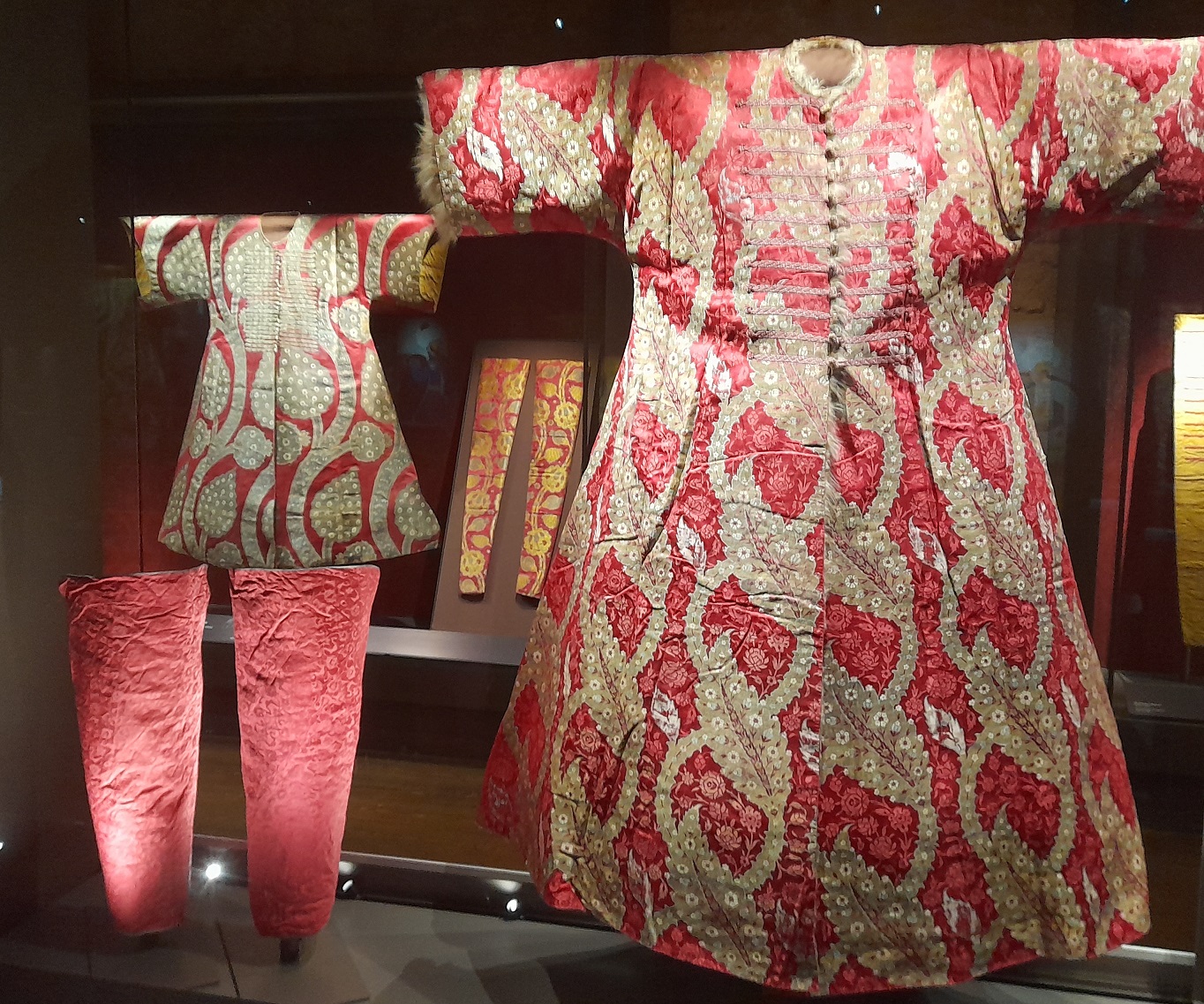
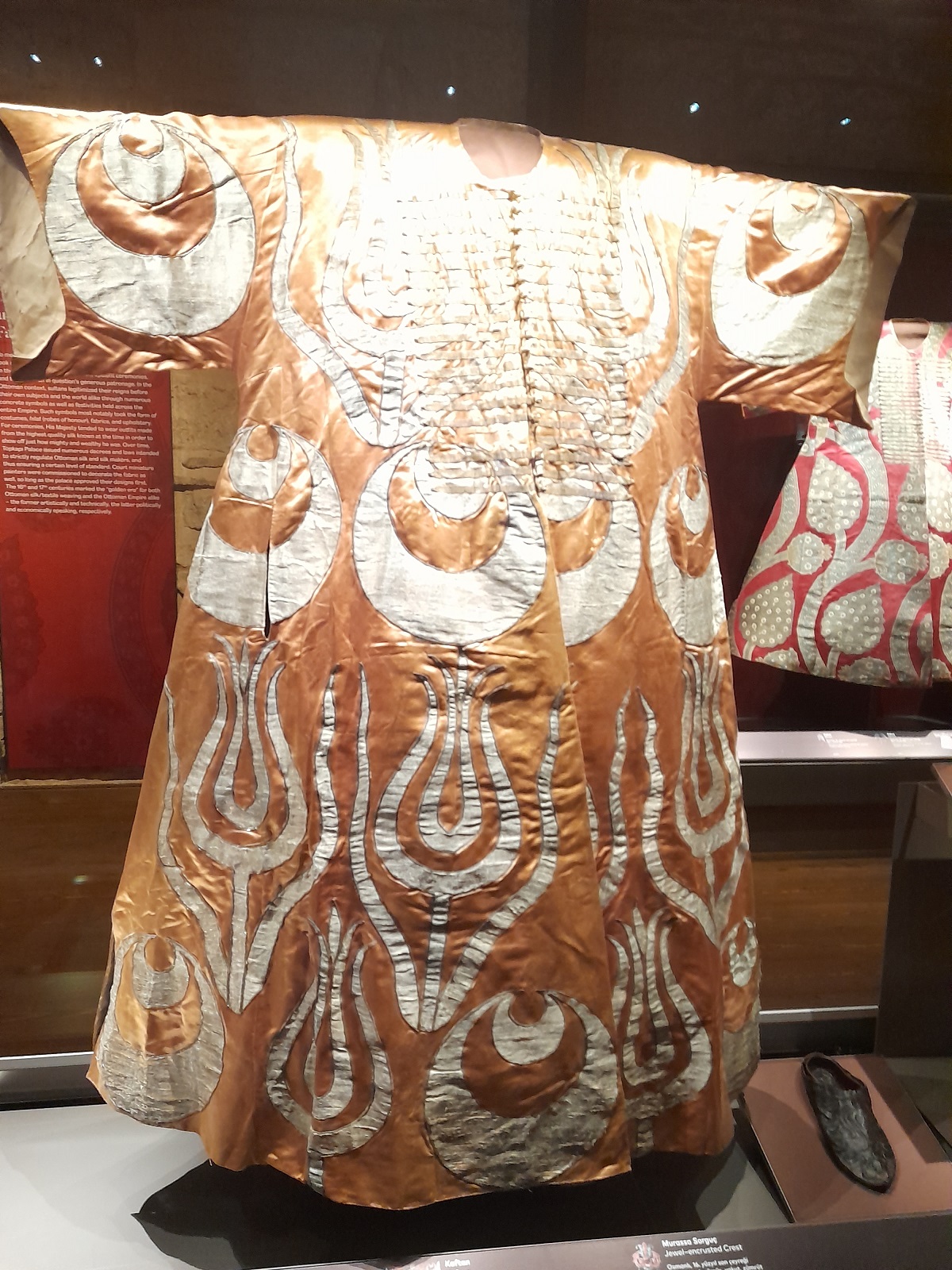
Next came a series of museums across the large wet courtyard. I was particularly taken by the exquisite robes worn by emperors and their sons. The treasury also contained some magnificent items. Towards the end of the palace were lovely pavilions with gorgeous views out over Gϋlhane park and the Bosphorus (Our enjoyment somewhat spoilt by the rain). Near the harem was a mosque with exquisite tiles. The visit to the harem itself was interesting, but not as extensive as I expected. Perhaps large areas have been blocked off. All in all, I was a tad disappointed by the Topkapi, but maybe the weather and damp shoes were to blame.
After visiting the palace itself, I joined the queue to visit the Archeological museum down the hill. It is the only 1 of the 3 museums associated with the Topkapi currently open. It contained some interesting objects and I was particularly taken with a delicate gold diadem from Rhodes. I do wish I had photographed it, or taken down the details. I think it dated from around 500 BC.
It was time for lunch and I visited a nearby restaurant where an elderly lady was rolling out flat breads with cheese or other fillings and cooking them quickly on a griddle. They were delicious and despite being thin, most filling.
Modern Istanbul
After lunch, mindful that I had not ventured over the Golden Horn to modern Istanbul, I caught the local tram over the famous Galatea bridge to the end of the line; then an underground funicular to Taksim Square. After a quick look around the square which seemed full of western fast food outlets, I set off to find one of the many modern art museums/galleries this part of Istanbul is noted for. This part of Istanbul is more hilly and after the relative prosperity of the square I soon plunged down side streets which were far more gritty and poor. I arrived at the sparkling modern museum and enjoyed the exhibits and then made my way back up to the square and home. Unfair to judge after so brief a visit on a rainy afternoon, but I preferred Sultanahmet.
For supper I popped in to a tiny restaurant near to my hotel where I enjoyed a kebab in a smoky aubergine yoghurt sauce and a cup of apple tea. I wish I had discovered the delights of this apple tea earlier.
A quick visit to Asia
By the next day the weather had cleared a bit and I decided to go across to Üsküdar which is on the Asian side of the Bosphorus as it has some lovely mosques. I caught a train at Sirkeci, leaving from a dull modern station beside the glorious edifice which once welcomed the Orient Express. The train used the underground Marmaray tunnel to whip across the strait in a few minutes. This is the deepest immersed tube tunnel in the world and is about 13 km long. It opened in 2013.
Once in Üsküdar, I discovered the mosques were not open. (Maybe because it was Friday and they would only open later for prayers.) Near the shore I found a lovely little cluster of food shops including greengrocers, a shop with a fabulous displays of olives, a butcher (which appeared to be selling pigs trotters and heads, along with tripe – pork in Istanbul?), a fishmonger and shops selling locum and other sweets. As this was my last morning in Istanbul, I decided to go shopping for gifts and emerged laden.
I was hoping to visit the Aya Sofya again, but it too was closed except to worshippers, so I just wandered about enjoying the fountains and public spaces of Sultanahmet until it was time to head to the airport for my plane to Geneva. I was spending the weekend with family there before visiting Prague.
Will I visit again?
Before my visit I was a little concerned about how I would be viewed as a woman alone in Istanbul, but I need not have worried. I felt perfectly safe and at ease in this cosmopolitan city. People were kind and helpful and most spoke very good English. The food was great; lots of fresh fish and fruit and vegetables; Mediterranean meets Eastern. The city is clean and free from litter and although one reads that economic times are tough, there were no beggars on the streets, just lots of stray cats and dopey large dogs. Even they all seem to be fed.
I feel I have only scratched the surface of this interesting place and would like to return one day. Like Rome it is a great city with layers of history and its situation straddling Europe and Asia makes it unique. The old city as seen from the Bosphorus is stunning and must be one of the most beautiful in the world, unmarred by inappropriate skyscrapers.
2023 Trip: Istanbul Gallery