Istanbul : Prague : Vienna : Trieste & Milan : Stresa : Switzerland : Art
I was very excited to be travelling to Vienna as I was meeting up with friends I had not seen for 4 years. The train trip from Prague took just under 5 hours as we sped through flat agricultural country, with some woodlands. This was the first of 4 long train trips I was making this time and I had bought all the tickets early using Trainline and scoring good discounts. I love travelling by train, not least because you can arrive minutes before the train leaves and step aboard without having to endure all the time consuming queues and security checks of air travel. Also train stations are usually in the centre of town and easy to get to, compared to airports. Rushing through the countryside at 160km per hour, I was able to spend my last Czech krone on lovely hazelnut wafers from the trolley which came by from the buffet car.
The flat we had booked was in Leopoldstadt which is E of the old centre of Vienna, and although it did not look like much when we arrived outside, it was fully refurbished inside and we were very comfortable for the 4 nights we spent in the city. It also had a Gourmet Spar close by which made shopping for provisions easy.
Innere Stadt
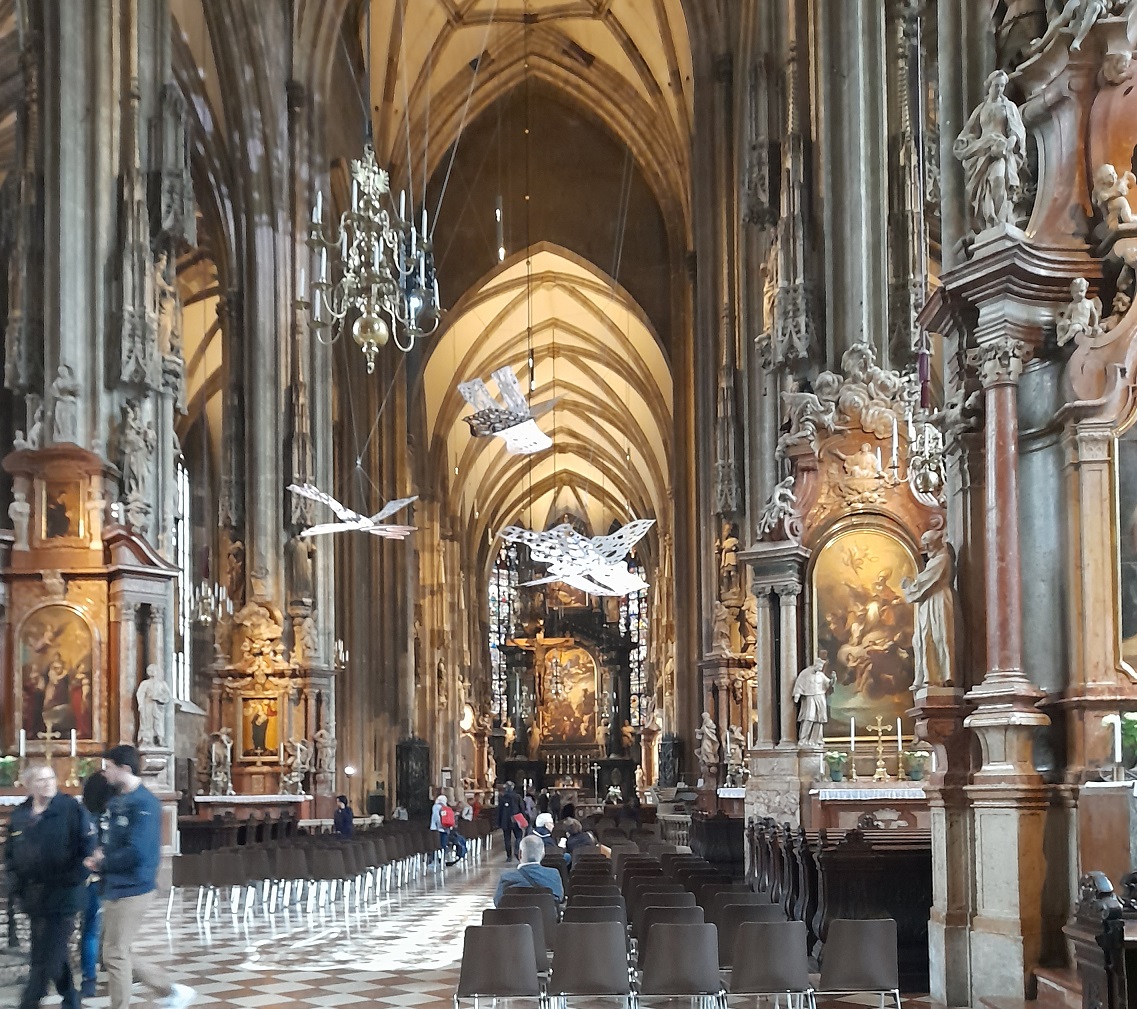
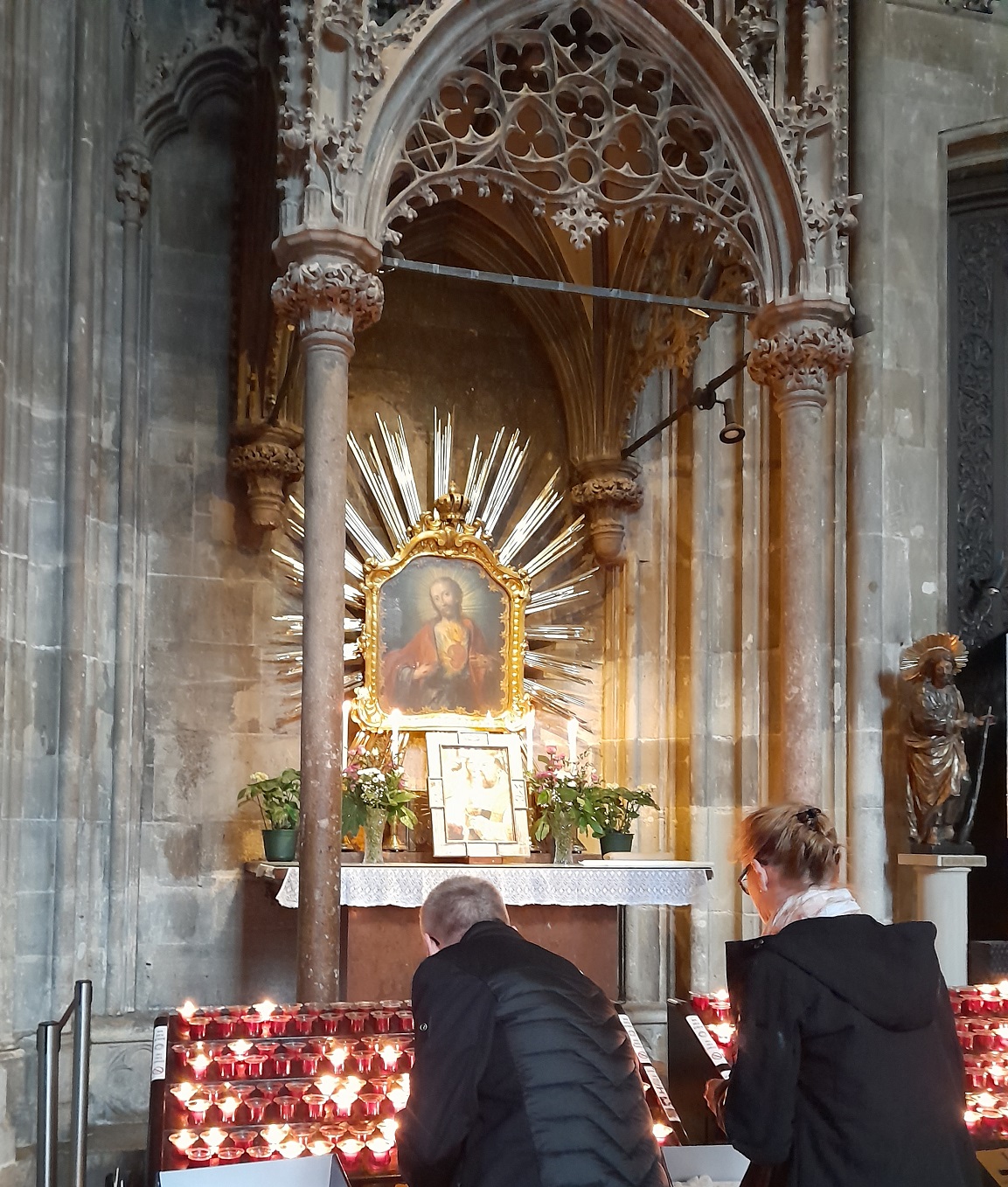
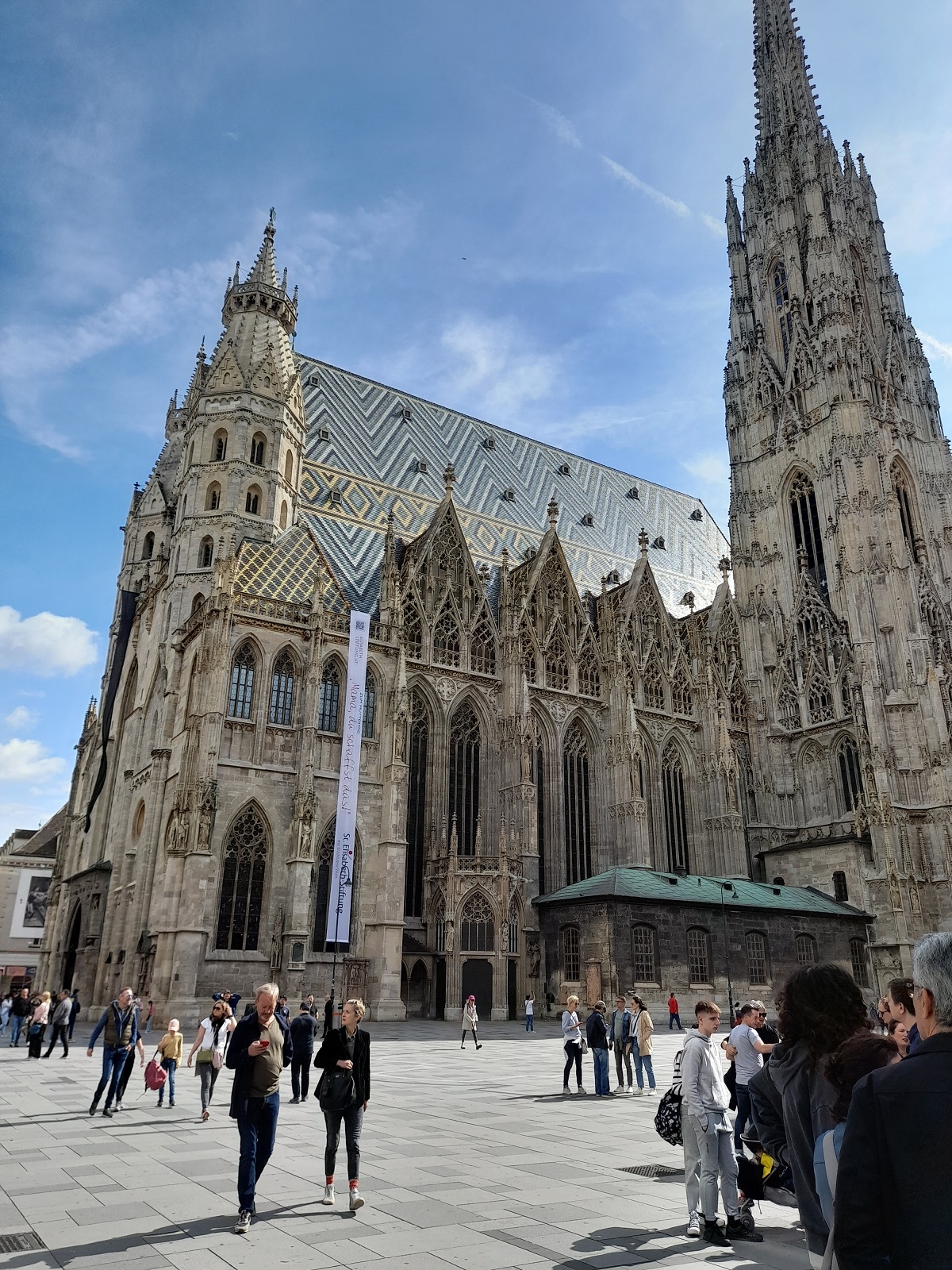
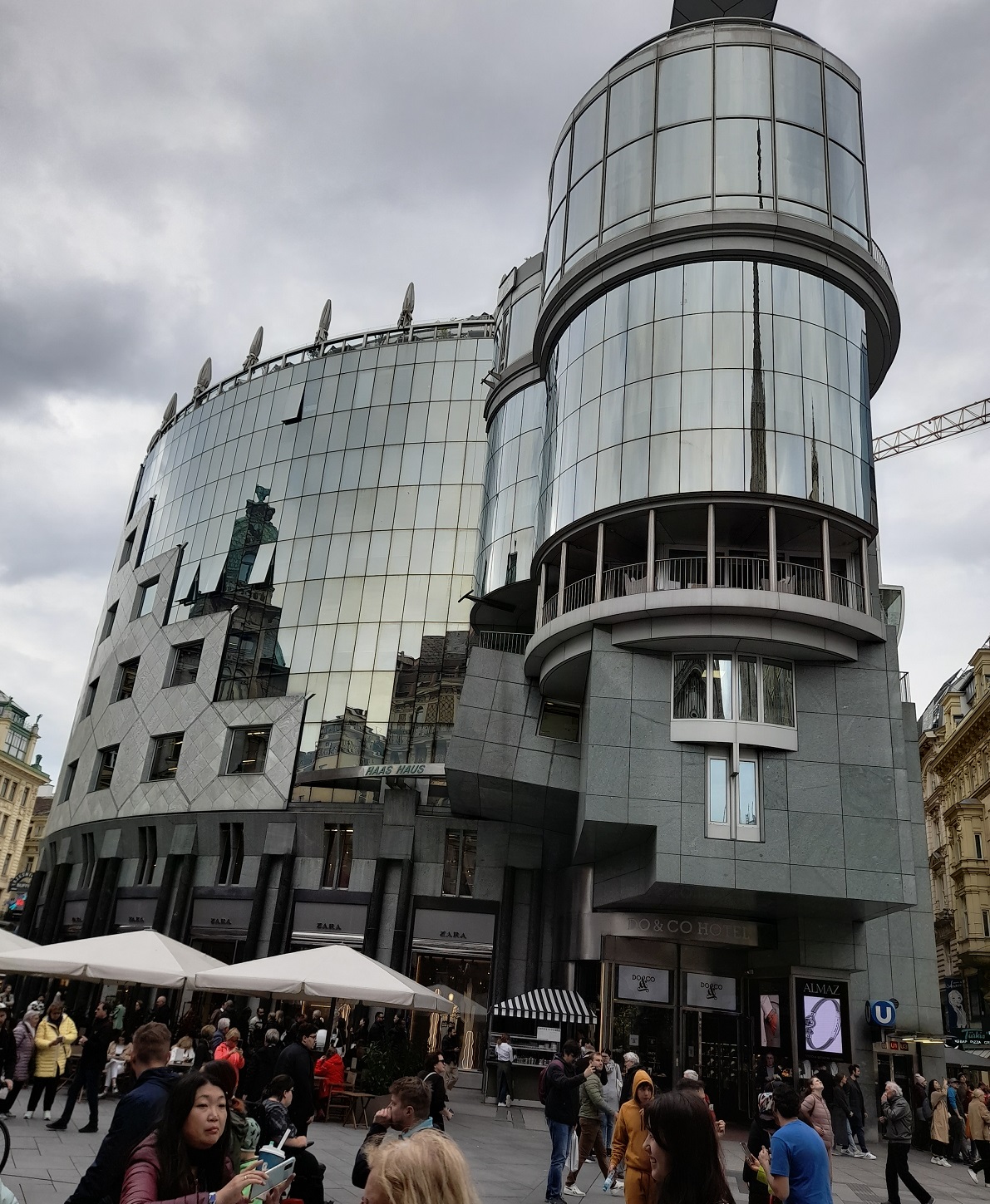
After dropping our bags we set out to explore the inner city (Innere Stadt) of Vienna. First stop was a coffee shop to sample the traditional delights of apple strudel and chocolate cream cake. Fortified, we headed to the cathedral, Stephansdom, which looms up from a square in the centre of town. It was lovely inside with many candles lit by worshippers. I was particularly taken by the white angels flying in the nave. Somehow we lacked the energy to climb the tower to admire the view and roof, but a good view of the patterned roof can be had from the square below. Also in the square below I admired the post modernist Haas Haus, designed by Hans Hollein and built in 1990. Despite being very different to buildings around it, it seems to blend in and definitely adds interest to the square.
After the cathedral we sought out the Clock (Uhren) museum. The interesting array of clocks here is arranged over 3 floors, starting from the earliest below. I was particularly taken with a huge wooden astronomical clock which was the life’s work of a monk, the Cajetano clock. One nifty early clock was designed so one could read the time while lying in bed as well as standing beside it. There were also picture clocks where the clock face was part of a painting and many others. For clock lovers this museum is a must. I wished that more of the clocks on display were working.
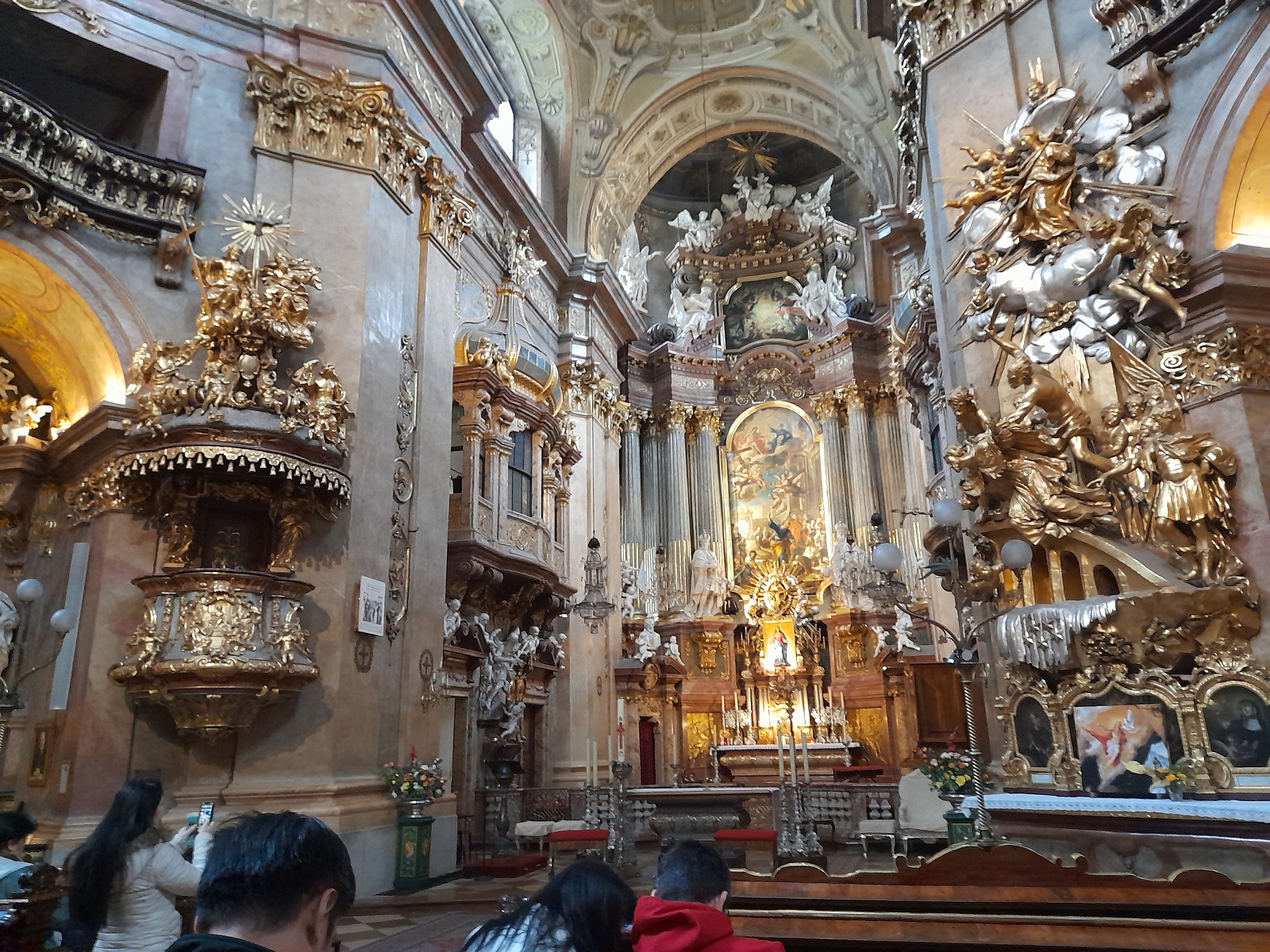
Next stop was a beautiful baroque church, Peterskirche. This has an immense oval dome, frescoed within and containing a central mini dome with windows. The lavish paintings and gilt add to the magnificence and one is rather dazzled. I forgot to look out for the carved pew ends and bejewelled skeletons the guidebook had mentioned. This church is the Vienna base of the Opus dei movement.
Opera house and Pretty Yende
Wandering on we came to the impressive entrance to the Hofburg. This cluster of large buildings, on the SW outskirts on the Inner Stadt contains the imperial apartments and houses many museums and the Spanish riding school. Further along was the Vienna State Opera house. This was the first building built on the Ringstrasse, which encircles the old Innere Stadt, and it is large and handsome with a distinctive green roof and dates from the 1860s.
I was planning to attend a recital given by the soprano, Pretty Yende that evening at the opera. We found a restaurant in one of the nearby streets and enjoyed an early supper. Thereafter, my friends who had been up before 4 am to catch their flight to Vienna, headed back to the flat for an early night while I joined the queue to buy a standing room ticket for the recital.
I felt a little under dressed in my jeans in such grand surroundings and was not sure I would be able to stand for the 2 hour long recital. However, I found it quite easy as there was a rail to lean on and although several of the fellow standers were young people in jeans, I had two knowledgeable businessmen in suits on either side of me who had also bought last minute standing tickets. Pretty Yende was amazing and looked like the angel on top of a Xmas tree in a beautiful white dress. Her voice soars effortlessly and transports one. She received a standing ovation and the audience demanded 2 encores. Reluctantly we let her go and I made my way home to the flat using the conveniently place underground. There were still plenty of people about around 10.30 pm.
Hofburg
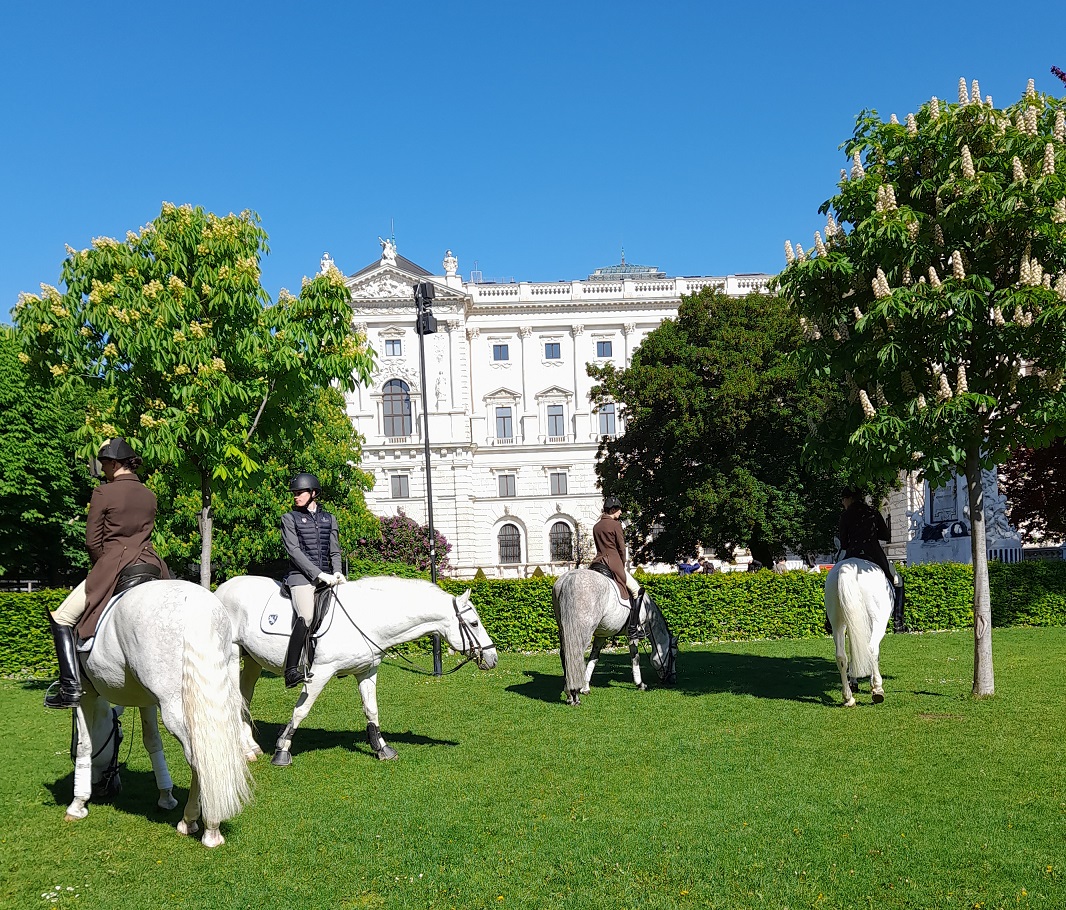
First stop the next morning was a training session at the famous Spanish riding school. This hour long session took place in the 55m long Reitsaal built in 1735. Unfortunately we were not allowed to take photos, but it was fun watching the beautiful Lipizzaner horses being put through their paces. One was being encouraged to jump, by having its back legs tickled with a whip. We were told that it takes about 10 years of training before they are ready to perform and that the horses grow paler as they age. Before the training session we had been lucky to find some of them grazing in a nearby park.
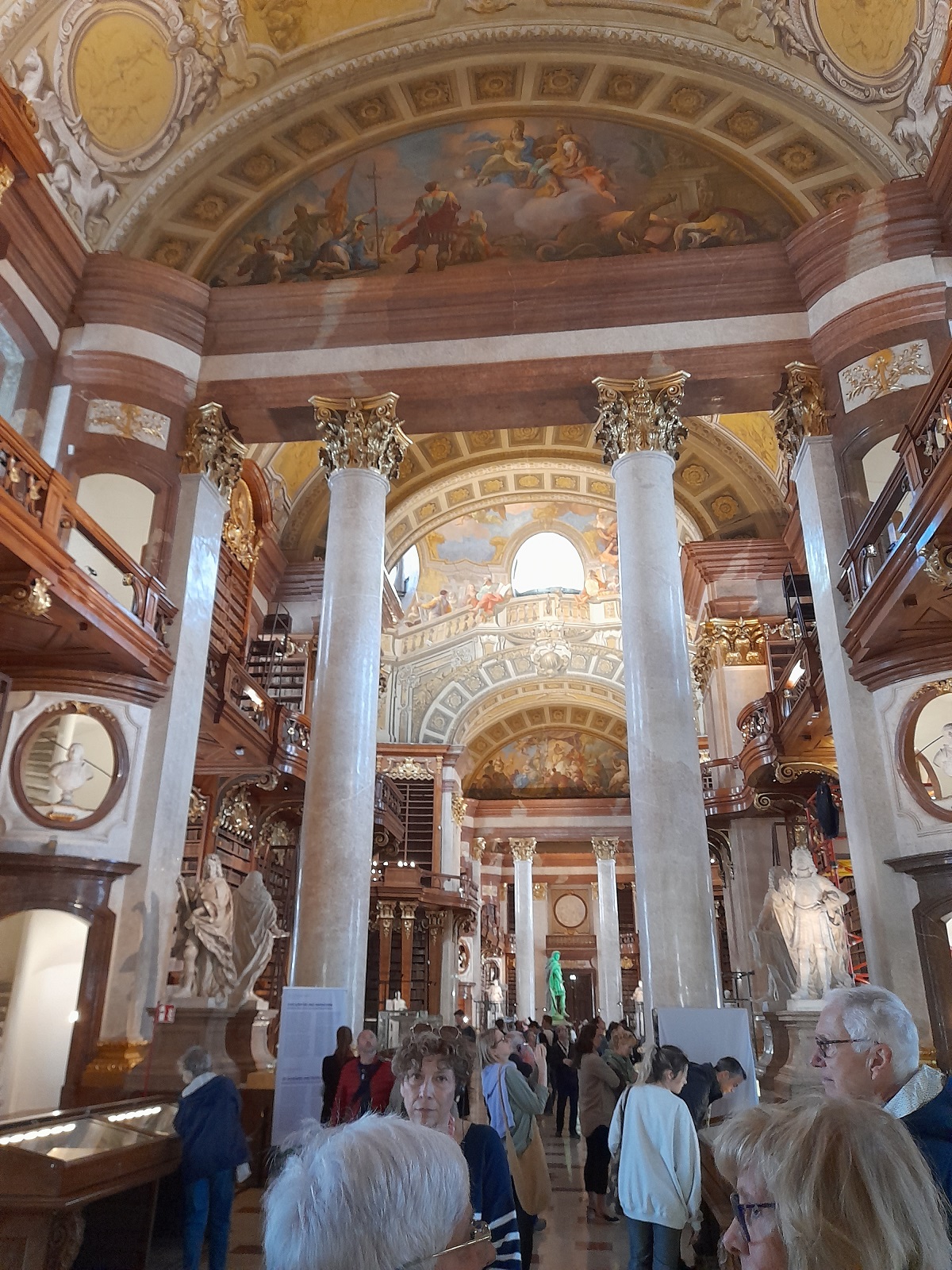
After watching the training session we set off to explore more of the Hofburg. First stop was the Prunksaal of the National library. This is an amazing building; 80m long with tall walls covered with wooden bookcases reached by spiral stairs. It is beautifully decorated with marble columns and statues and has a frescoed central dome. According to my guide book, it is by far the largest baroque library in Europe. Interesting old volumes and maps were on view in display cases as were some ancient globes. Renovation/restorations was in progress and we watched the careful packing away of priceless books from upper shelves.
In search of more magnificence we headed to the nearby Schatzkammer, the Imperial Treasury of the Hapsburgs. Having recently seen the treasures of the Ottoman Empire at the Topkapi Palace in Istanbul, it was interesting to compare the Hapsburg horde. Both contained beautiful robes and jewels. The Schatzkammer also has objects associated with the church some beautiful, some bizarre. Islam creates beautiful spaces for worship, but does not fill them with objects. Ironically one of the loveliest things to be found in the Schatzkammer is a 4th century giant agate bowl (76cm wide), stolen from Constantinople in 1204 because it was thought to be the Holy Grail.
After the Schatzkamer we popped into the nearby Augustinerkirche to view the enormous memorial carved by Canova for Maria Christina, favourite daughter of Empress Marie Theresa. This comprises life sized figures about to disappear into a black tomb like void while watched by a large sleepy lion and winged spirit. It is weird, but exquisitely carved and I rather fell for the lion. I rather liked the church too, with its restrained decoration and tasteful chandeliers.
Naschmarkt and environs
Lunch was calling, so we set off to find the Naschmarkt, a street market packed with food stalls and places to eat. This is a very good pit stop for anyone doing Vienna on a budget. Naschmarkt means nibbles market and it certainly has long aisles of stalls selling cheeses, olives, fresh fruit and veg, fish breads and cakes etc. The choice is overwhelming as are the number of small restaurants, often with outdoor seating. After enjoying lunch (I had bratwurst, my friends falafels) and beer we set off again.
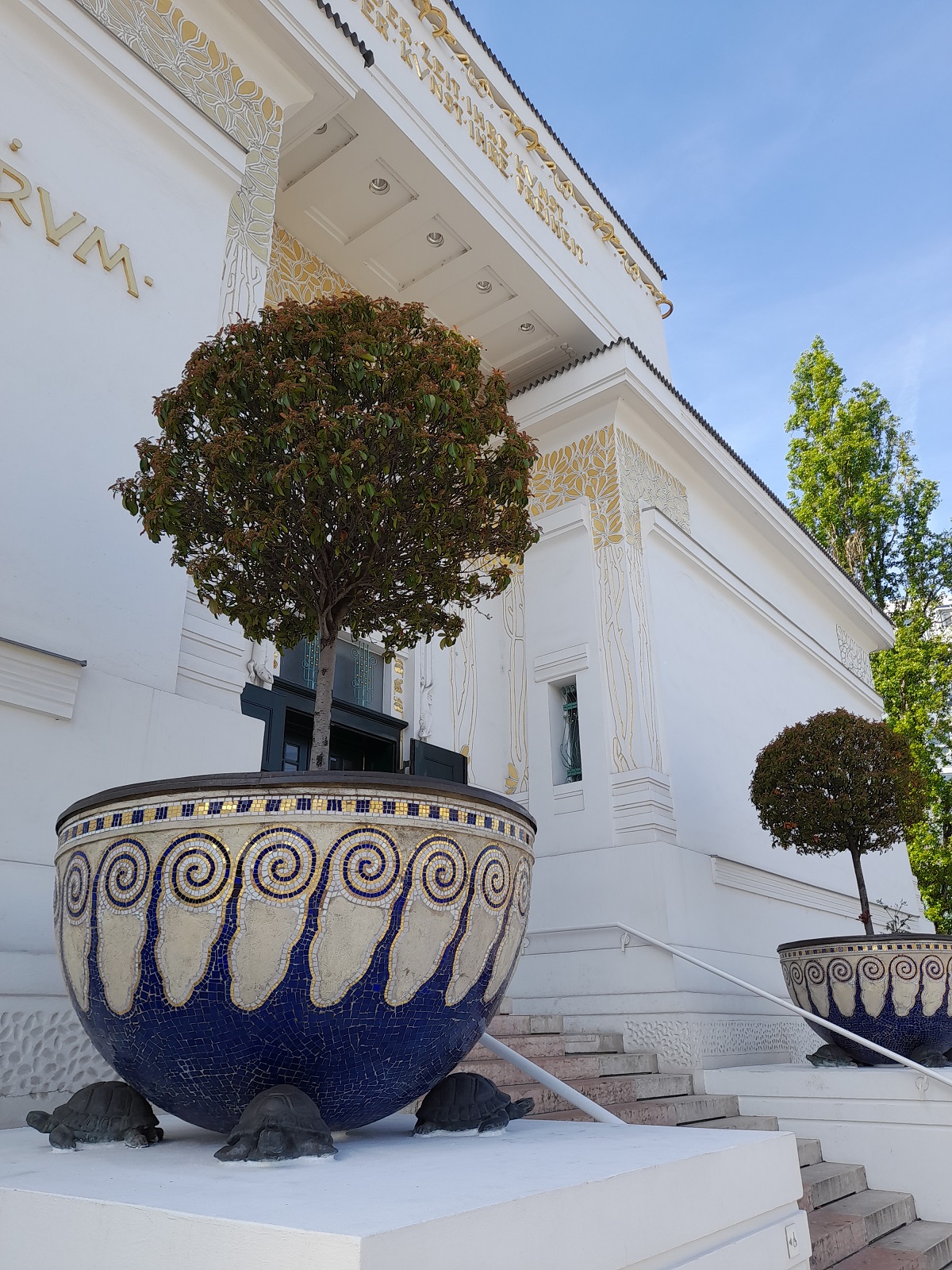
Nearby was the Secession building, a Viennese landmark with a beautiful dome wrought of gold leaves. It is rudely named the golden cabbage. Designed by Joseph Olbrich, it epitomizes the art movement known as Jugendstil and was completed in 1898. Gustav Klimt was one of the founder members of the movement. It has a serene white façade, with delightful mosaic urns near the front door surrounded by turtles.
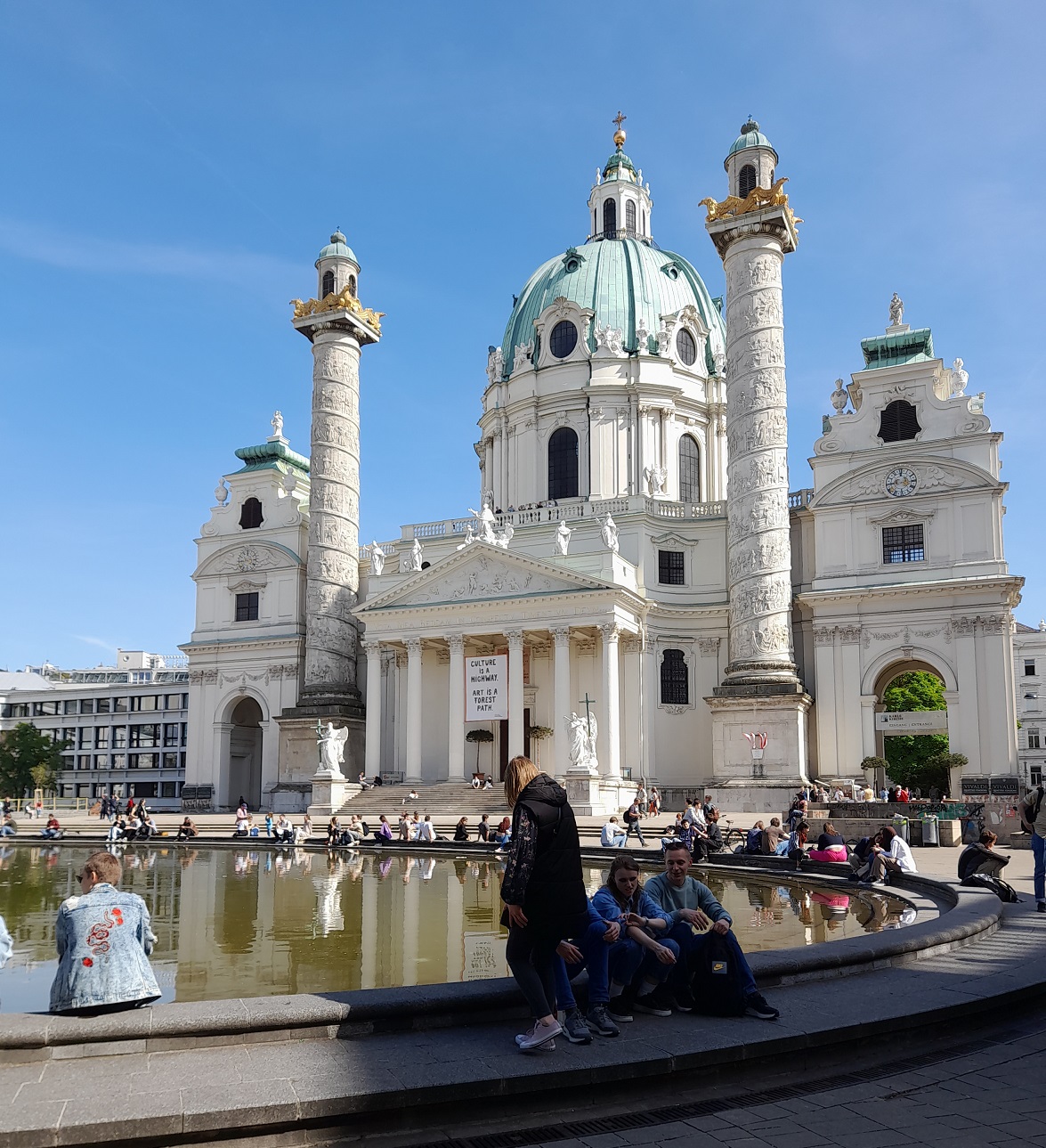
While my friends went inside, I set off to explore the nearby Karlsplatz and Resselpark. At the other end of the park I found the very impressive large baroque Karlskirche. It has strange columns either side, a little reminiscent of minarets. I balked at the entrance charge, so cannot say anything about the interior.
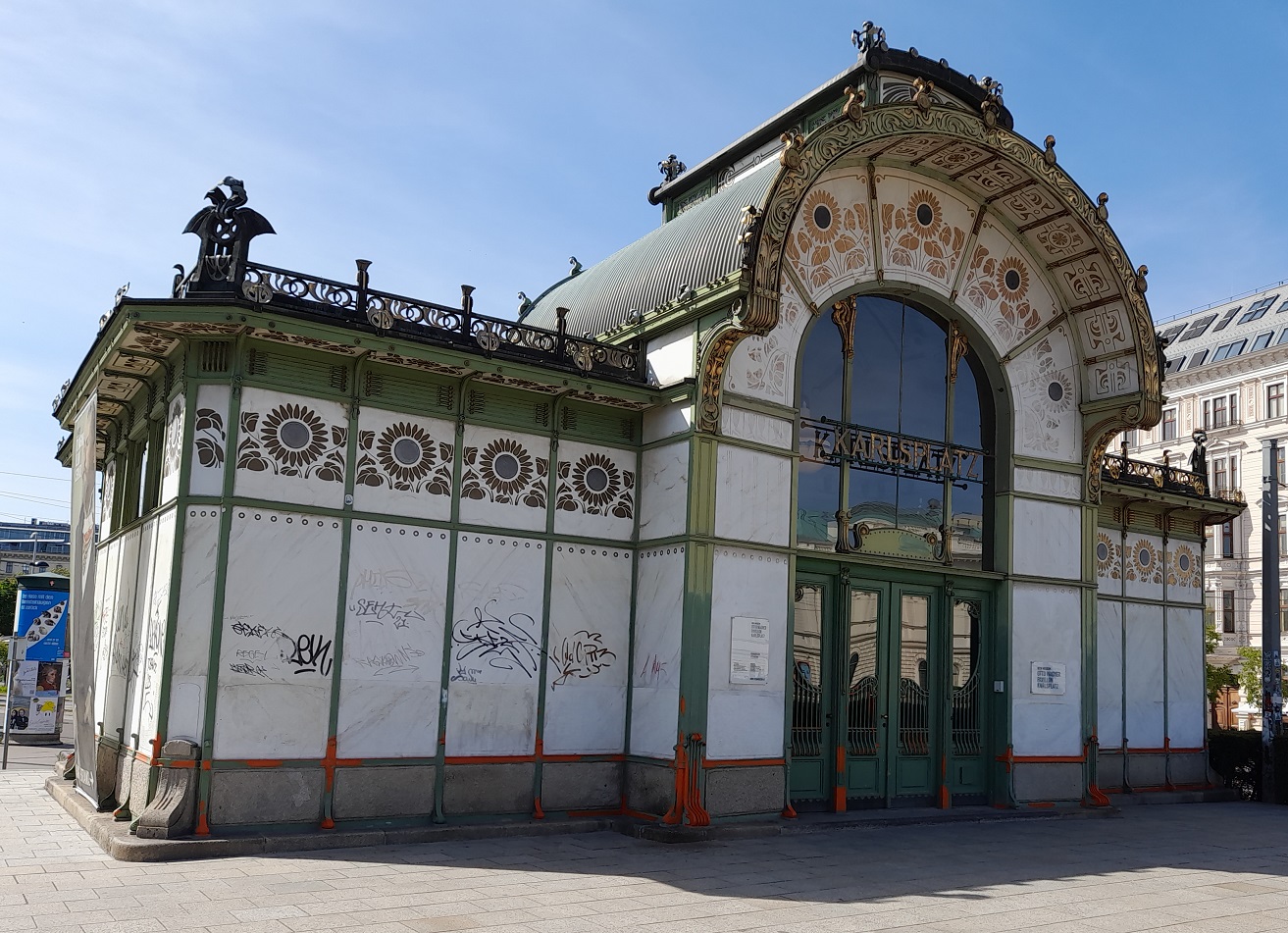
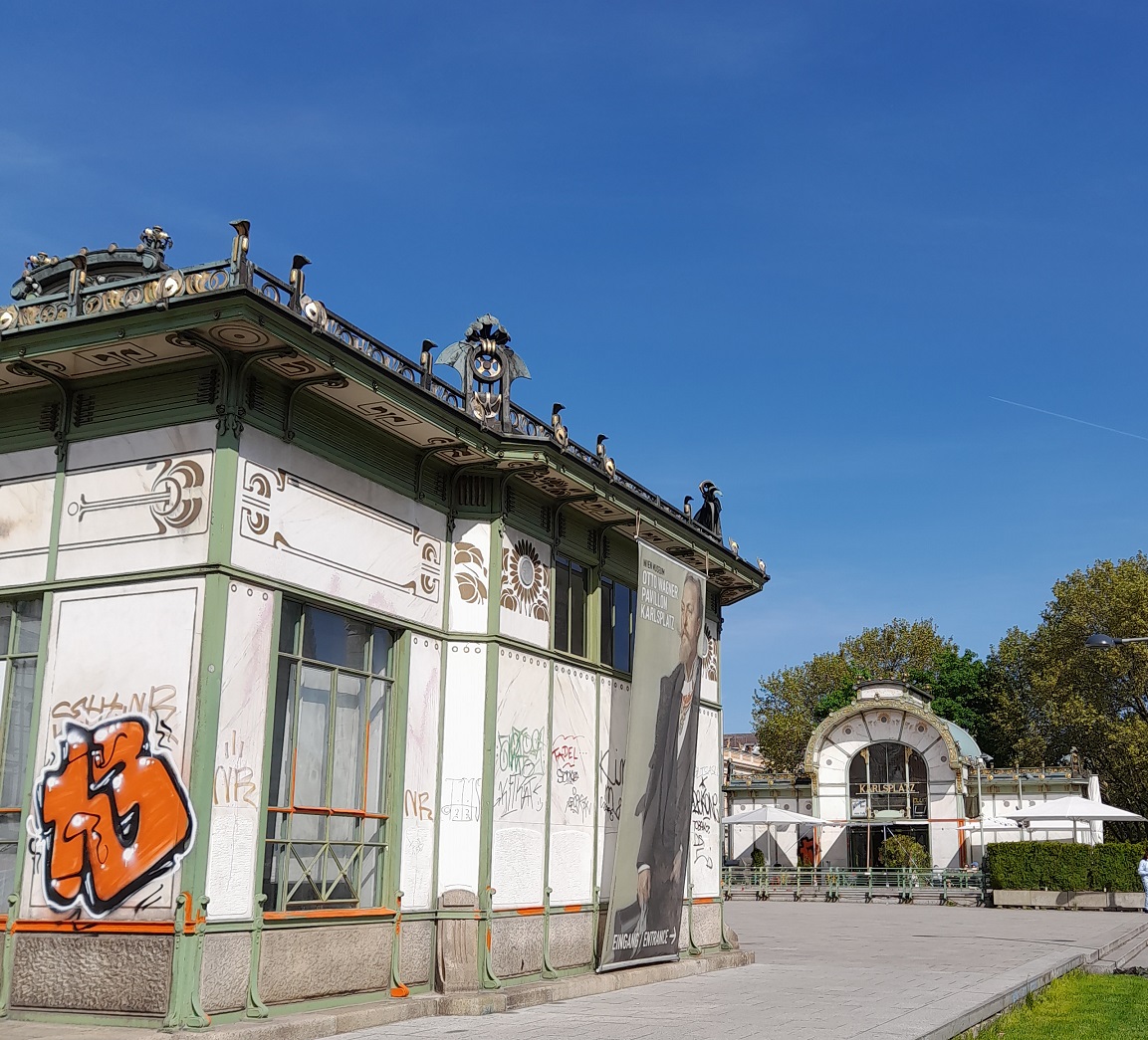
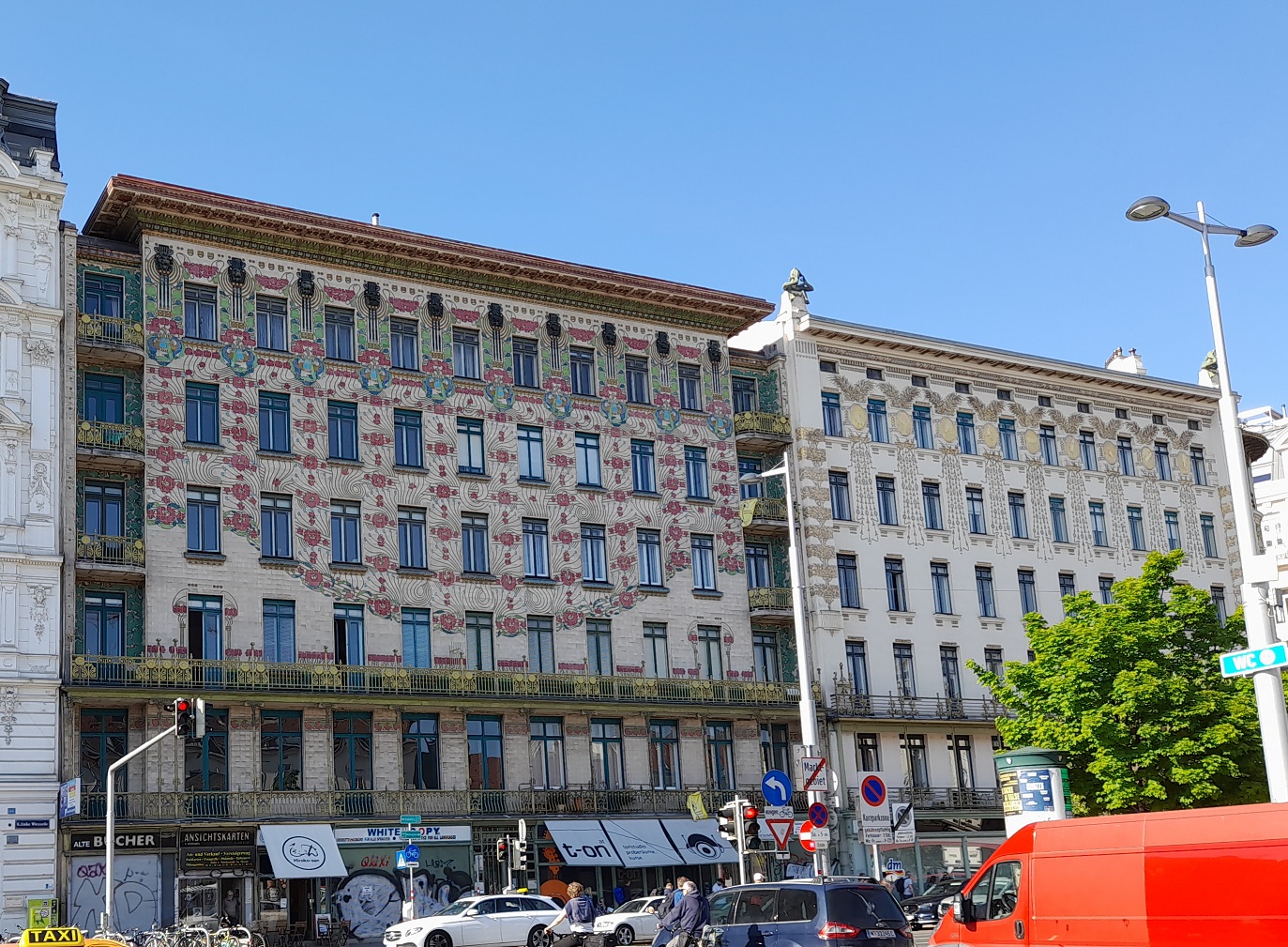
Nearby I found 2 green pavilions both in Jugendstil style designed by Otto Wagner, but looking sadly neglected and covered in graffiti. I could not but help feel that they would be better cared for in Prague. The Underground station at the Naschmarkt also retained elements of the Jugendstil and nearby are two apartment blocks designed by Otto Wagner with interesting decorative façades.
Kunsthistorische Museum
A friend had said that if I did nothing else in Vienna, I must go to the Kunsthistorisches Museum; that it was one of the great art museums of the world. So after enjoying an ice cream en route, this was our final stop of the day. The museum is housed in a very grand building with an impressive staircase. We only had time to see some of the paintings and none of the Roman, Greek and Egyptian antiquities. The museum is particularly known for its collection of Bruegel’s paintings, but also has an amazing collection of Italian, Dutch, Flemish and Spanish paintings with many works by Cranach, Durer, Titian, van Dyck, Rubens, Rembrandt. I very much regret we did not have more time to do it justice. See the 2023 Trip Art page for a bit more about the paintings there.
Belvedere
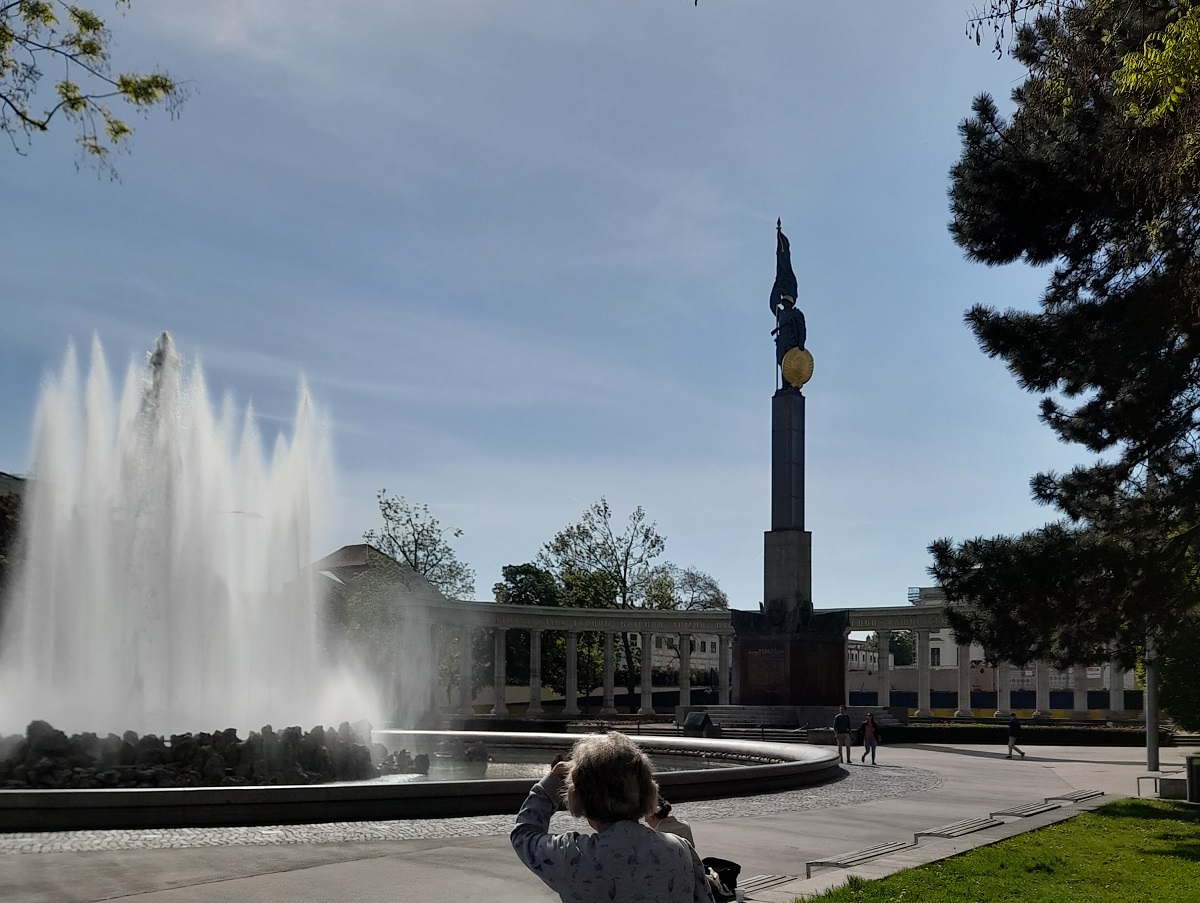
There is so much to see in Vienna that we had to cram two highlights, the Belvedere and Schӧnbrunn palace, into one day. Friday was a bright sunny morning and we set off to the Belvedere first. On the way we passed an impressive fountain, the Hochstrahlbrunnen, which is situated in front of a large memorial to the Red Army.
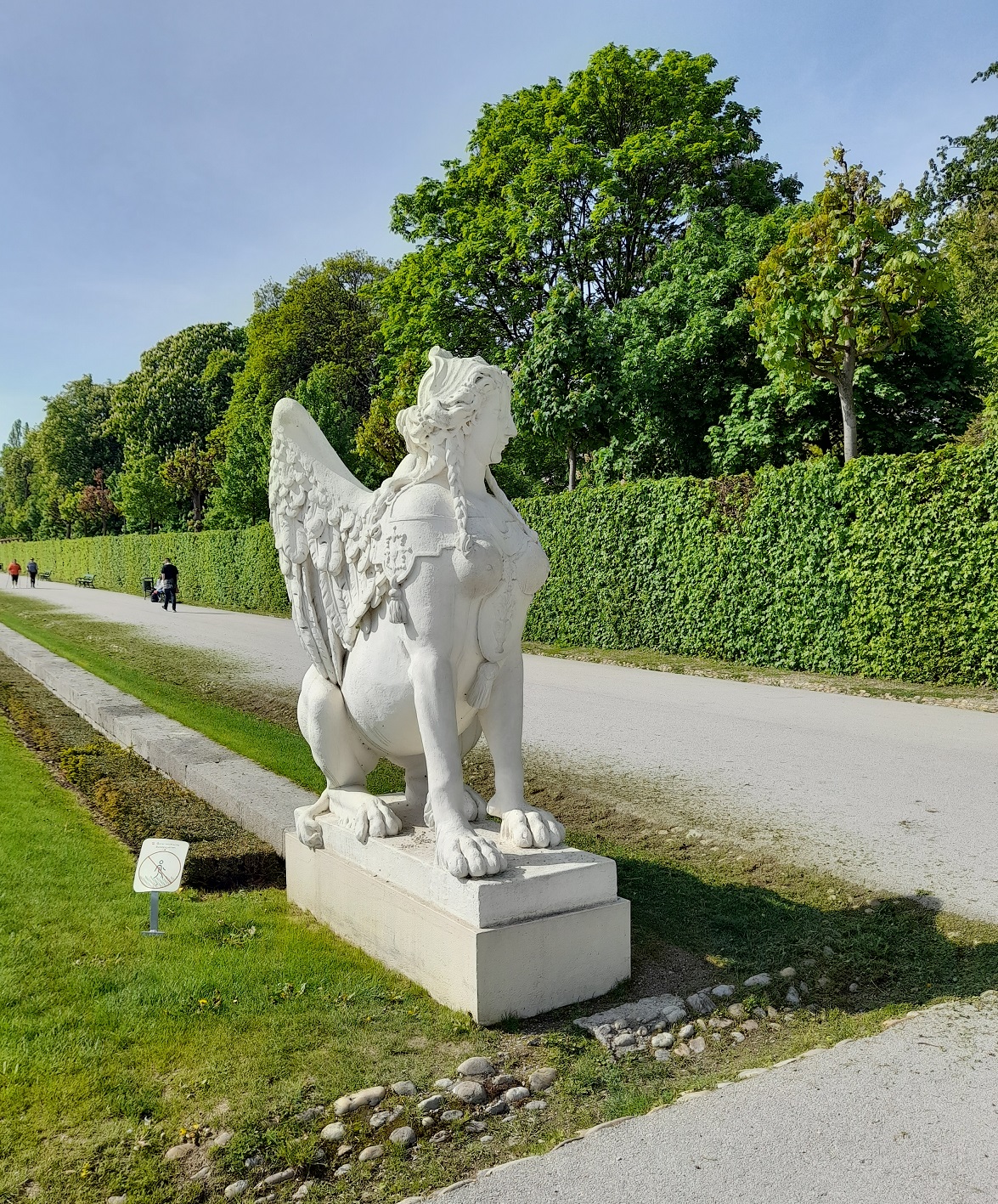
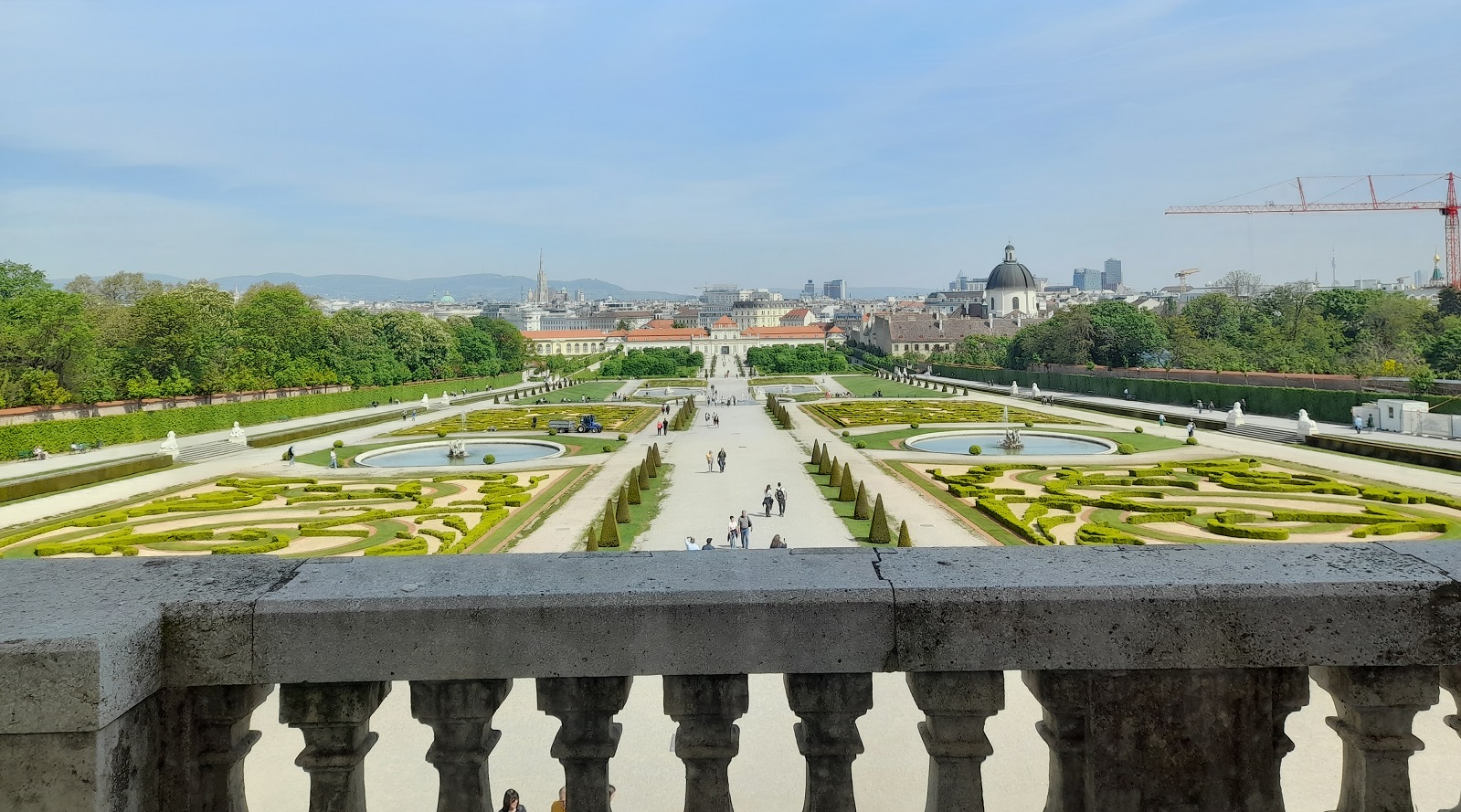
We planned to enjoy the gardens of the Belvedere before our 9:30 booking for the Upper (Oberes)Belvedere. We entered below near the Lower Belvedere and made our way up the formal gardens. Sadly the fountains were not working, and although I liked the sphinxes, the statues seemed to be whitewashed concrete; not marble or stone. Perhaps they are stone, under the whitewash/paint? The planting was not very impressive and beds needed weeding. There was no shortage of gardeners and I was later to observe one spreading a thick layer of compost/manure over a grassed bed before seeding it. No weeding or digging first. When seen from a window of the Upper Belvedere, the garden layout is most impressive and one can see the centre of Vienna in the distance, but they are not gardens to sit in and enjoy as there is little shade and few benches.
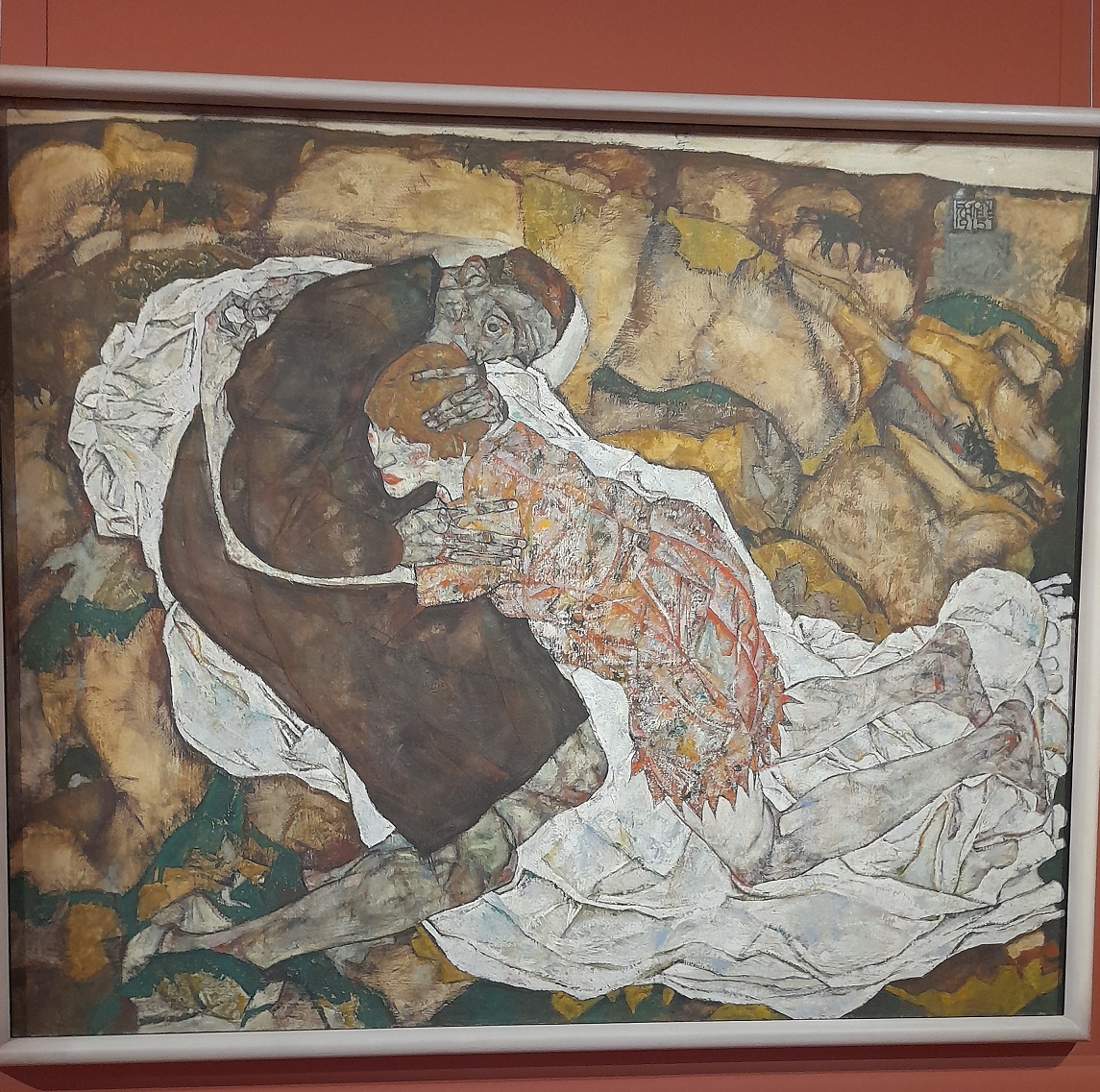
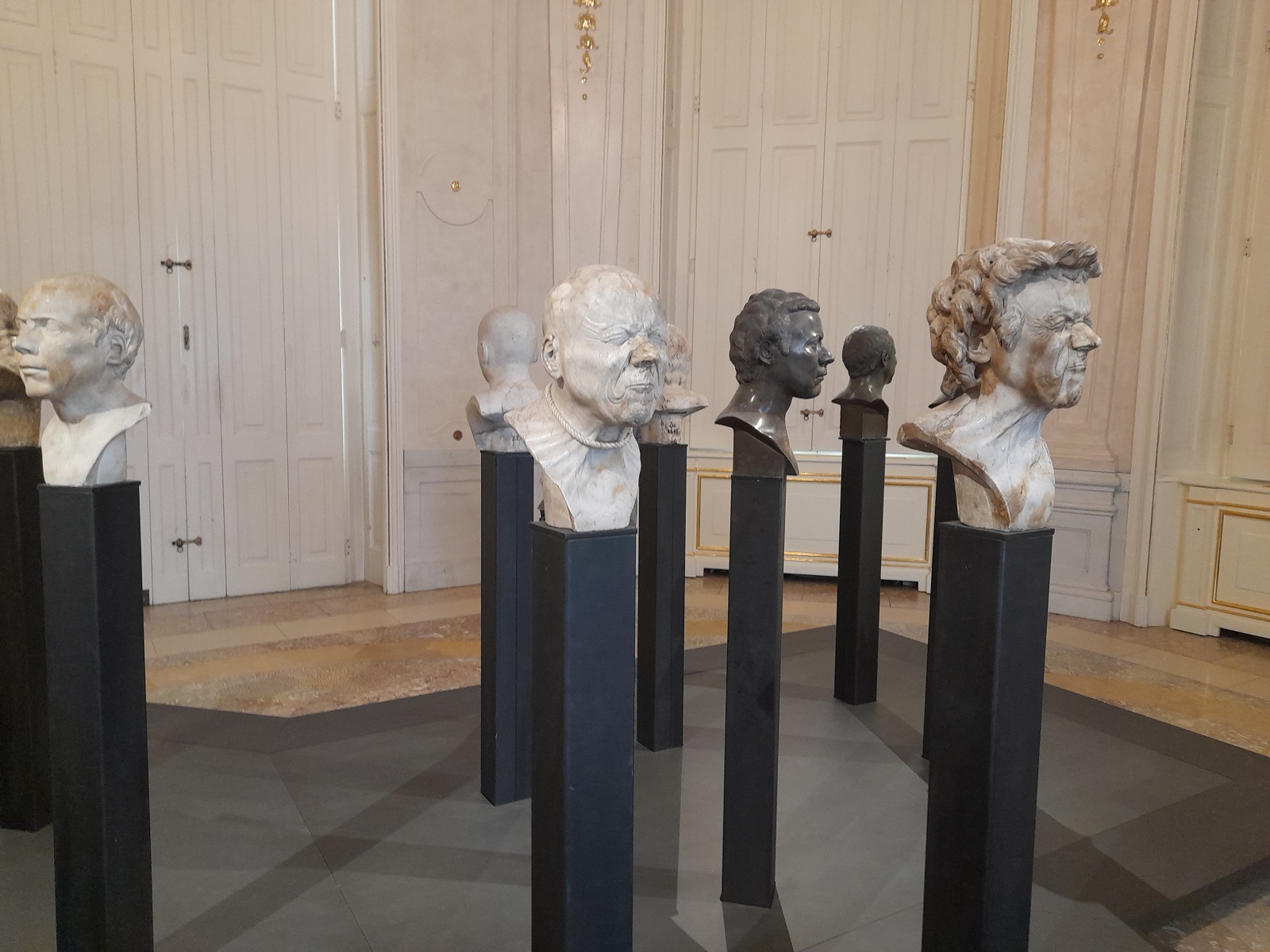
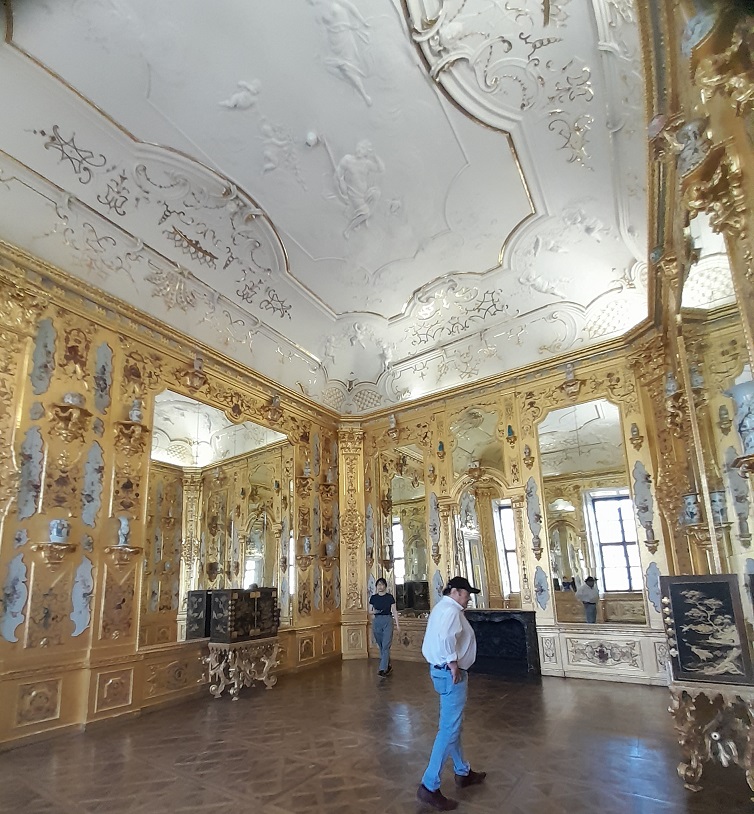
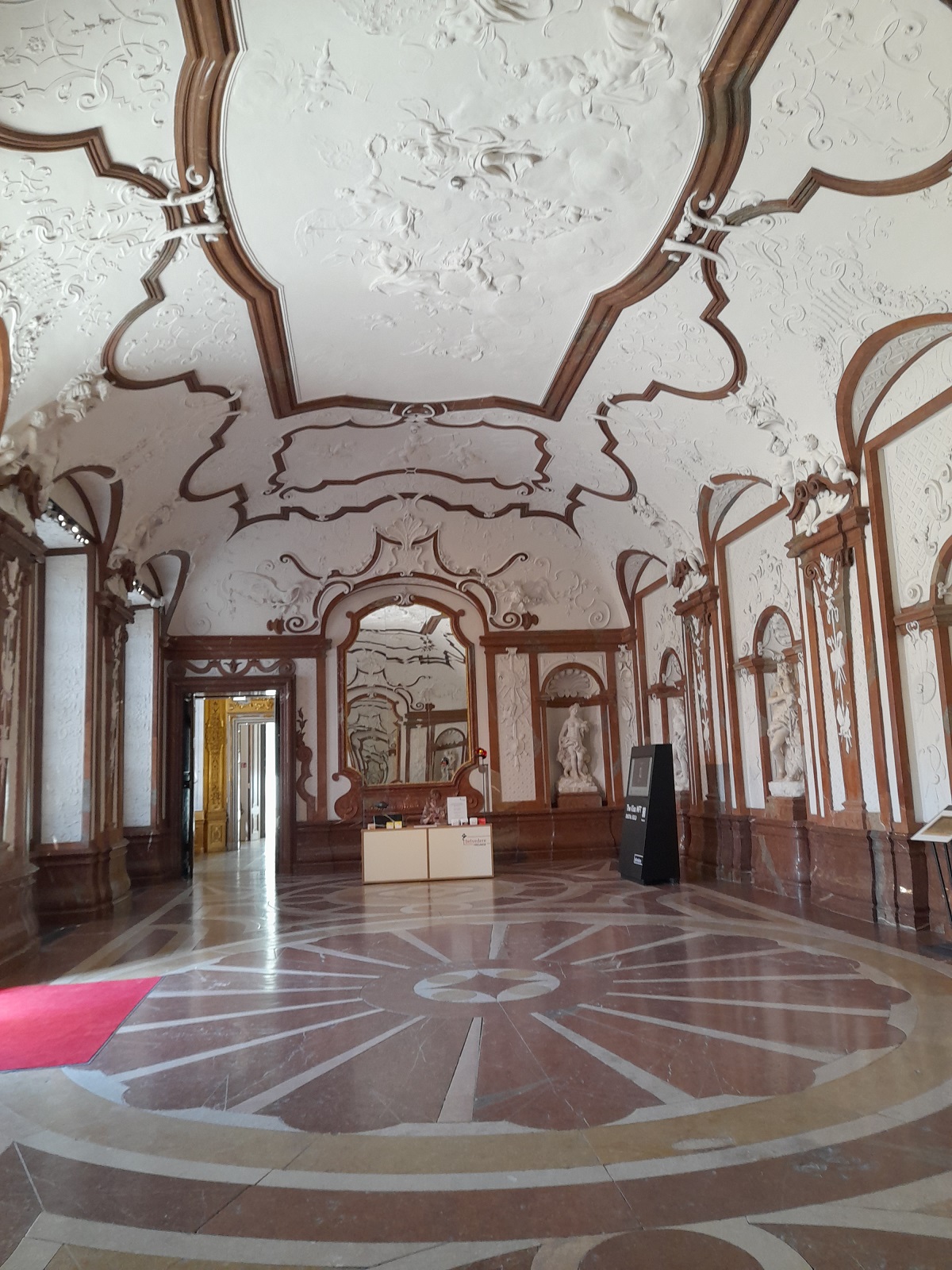
The Upper Belvedere is a lovely museum, just the right size, with some grandly decorated rooms and a mixed, mainly modern collection. The most famous painting being “The Kiss“ by Gustav Klimt. Crowds had gathered about it, but there were other Klimts to see as well as works by Egon Schiele. I had never seen his work before and despite expectations, I admired them and hoped to see more. There was also a room of bizarre character heads by Franz Xaver Messerschmidt, an 18th century sculptor. After viewing the paintings we made for the tearoom where I had perhaps the most delicious cake of the whole trip, a Mozart torte. This modern Viennese speciality looked amazing with its green marzipan coating and contained dark chocolate cake, whipped cream and pistachio cream – yum.
We then headed down to the Lower (Unteres) Belvedere which had a special Klimt exhibition. This was very well done as it included many paintings from the artists of period which probably influenced his work. We peeped into and admired some of the other grand rooms of the Lower Belvedere before heading off to Schӧnbrunn.
Schӧnbrunn
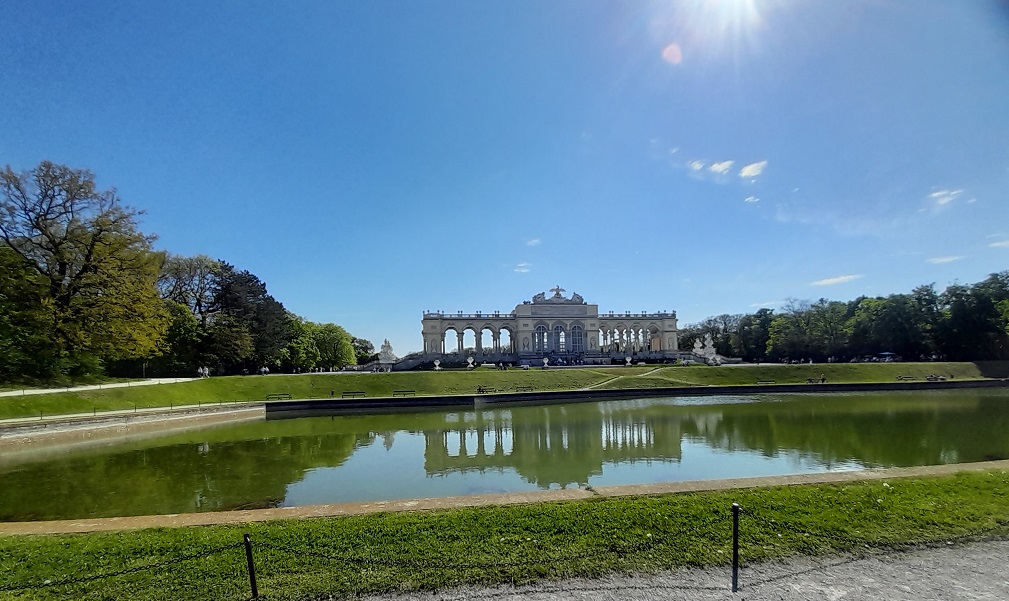
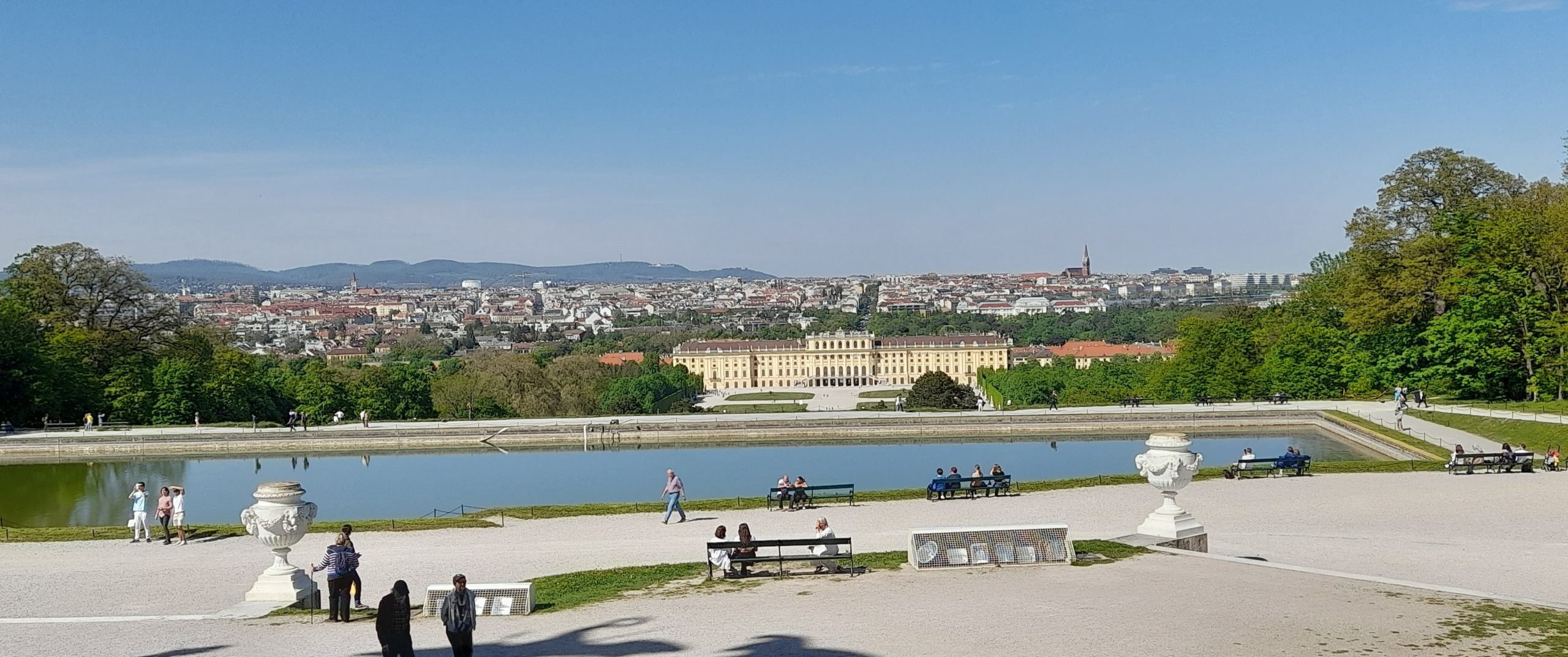
Schӧnbrunn, the summer palace of the Hapsburgs, is accessible on the Underground but it is still quite a walk to the entrance. We felt we did not have time to visit the palace itself, but would rather explore its very extensive grounds (Schlosspark). It was a hot afternoon and we were grateful for the shady walks in the lower part of the garden, but once we started climbing the zigzag path to the Gloriette which crowns the hill opposite the palace, we were in the sun. There is a magnificent view of the palace from up there with the outskirts of Vienna spread behind it. I did feel though that the grassy hill could be improved by the odd tulip or poppy flower. There was little to celebrate spring other than a lovely pergola of blooming wisteria nearer the palace and a bed of roses in bud. In fairness, there was part of the garden which was not free to visit which had spring flowers. After enjoying an ice cream we were ready to head back to our flat.
Pramerl & the Wolf
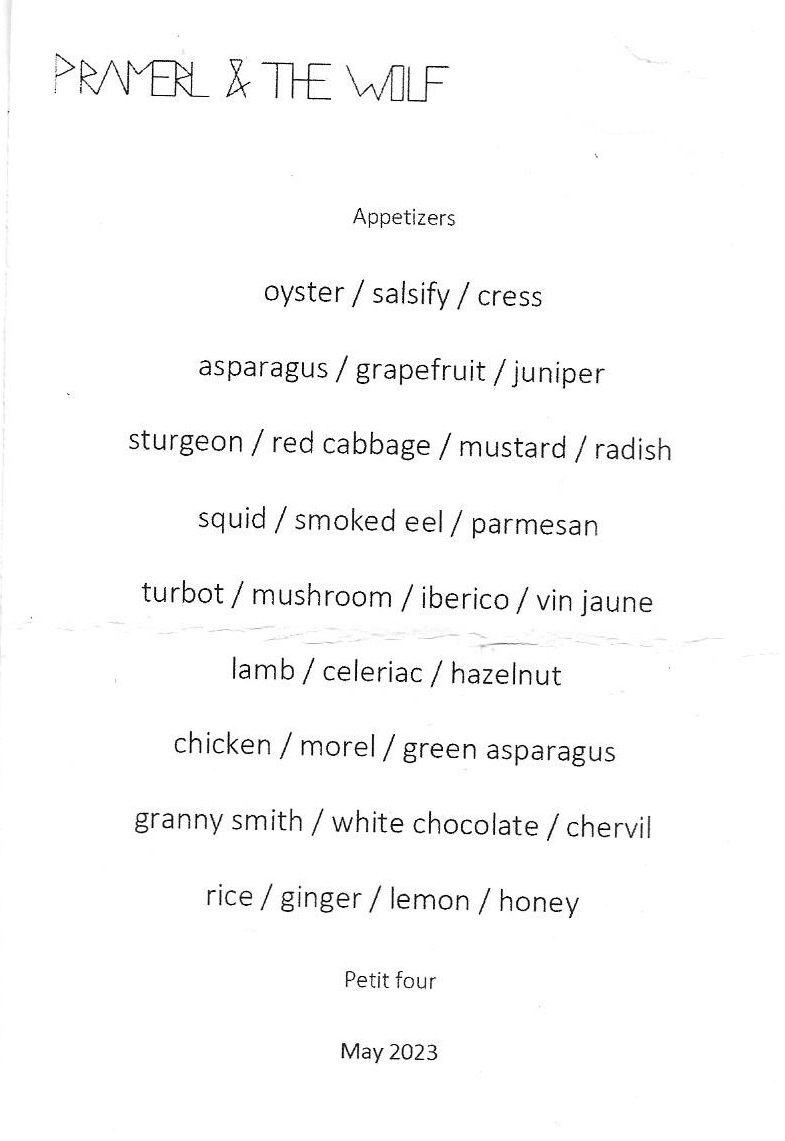
My family had come to spend Saturday with us in Vienna and on Friday night S treated us to a delicious meal at Pramerl & the Wolf, a Michelin starred restaurant. I have never had such an inspired pairing of food and wine, and what made it so nice was that the venue and presentation was not pretentious. One was excited by the creativity of the cooks and their experimentation with different flavor combinations. It was a lovely evening and late by the time we staggered home.
Innere Stadt again
Saturday was our last day in Vienna and we wanted to spend as much time with family as possible as well as ticking off a few more sights in the Innere Stadt. First stop was the Minoritenkirche to see the mosaic copy of The Last Supper commissioned by Napoleon who wished to steal the original in Milan and remove it to Paris. Fortunately he fell from power before he could do this and this copy with its tiny mosaic pieces landed up in Vienna. You have to stare hard to see it is not a painting.
We then went hunting for Rachel Whiteread’s Holocaust memorial in Judenplatz unveiled in 2000. We found it difficult to find this bunker like concrete memorial,made to look like many books facing outwards with the spines hidden. Judenplatz was the site of the medieval Jewish ghetto from which the Jews were also expelled in the 15th century. Although they have contributed enormously to the culture of the City, Vienna has not treated them well. Leopoldstadt, where we were staying, is also a traditional Jewish area.
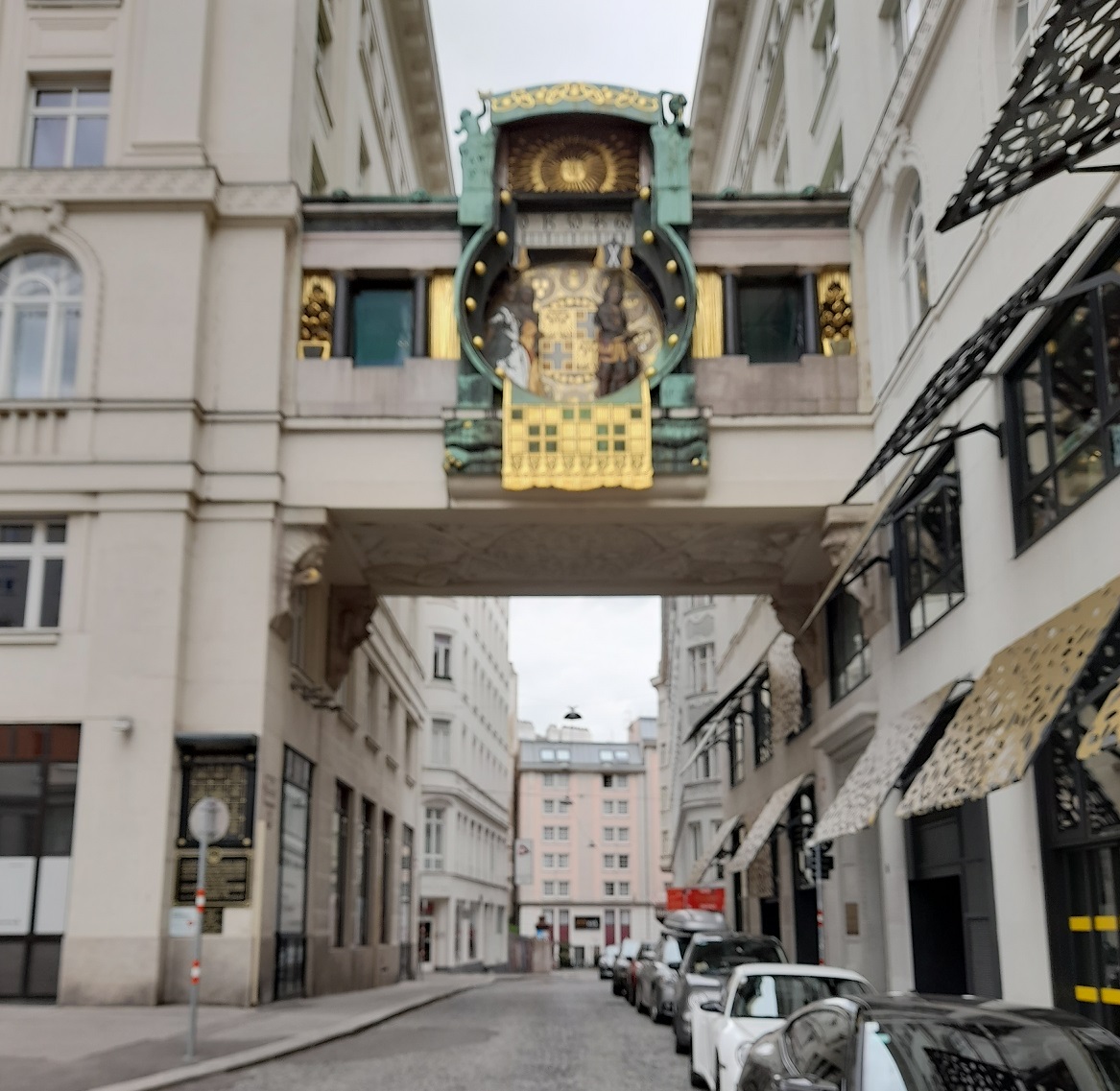
As it was nearing noon we made our way to the famous Ankeruhr clock. For 10 minutes at noon 12 life sized figures from Vienna’s history process past the clock face. This gilded Jugendstil clock which spans 2 streets was made in 1914. Ten minutes is a long time to be watching figures shuffle past!
Albertina and lunch
We decided to visit one more museum before lunch and headed to the Albertina. I thought that this museum contained only graphic art/prints, but it has a fabulous collection of mainly Impressionist paintings in the Batliner collection and it also had 2 special exhibitions; one of Picasso works and the other of the works of Alex Katz. I will write about it more on the 2023 Trip Art page. The Albertina also has a some fun street art- a painting displayed on the risers of the staircase you climb to the entrance. Members of my family who visited its contemporary collection after lunch were also impressed.
It was time for a late lunch and we headed back to the Naschmarkt for traditional schnitzels and beer. Then sadly it was time to say good bye to family as they had to fly off on business. It was so great that they had made the time to join us, albeit for such a short stay in Vienna.
Hundertwasser house
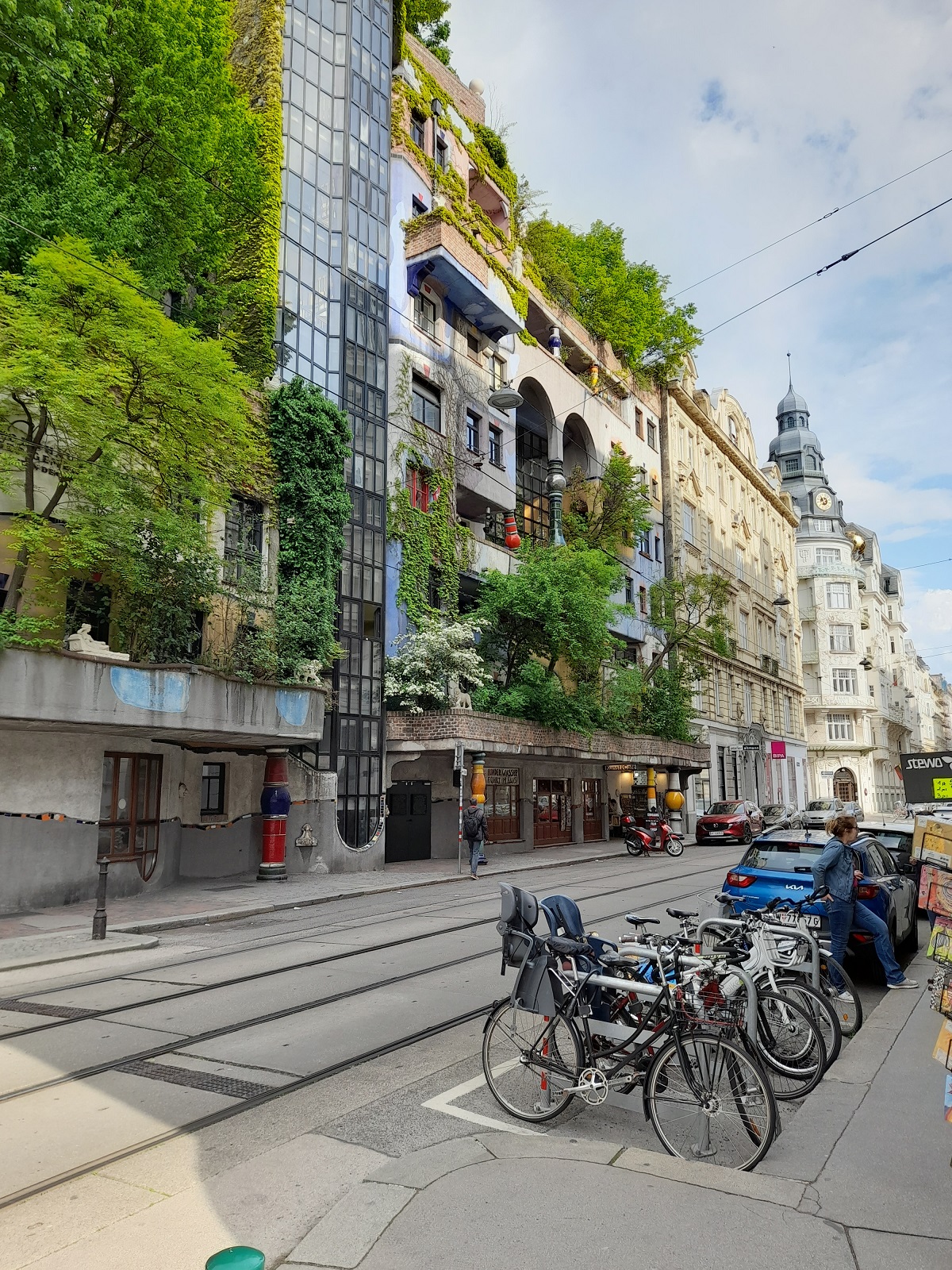
My friends and I decided we would try to track down one more landmark, the Hundertwasser house. We emerged from the underground and then struggled to find it without a map or Google. Fortunately someone pointed us in the right direction and we tagged along after a family using google maps. This colourful, quirky apartment house was transformed from a dull block in the 1980’s by the hippy artist Hundertwasser into a riot of architectural foibles. Across the road he built a shopping arcade, Kalke Village, for all the visitors who cannot access the apartments. Here you can view his interiors and stock up on trivia. It was a fun finale to Wien.
Auf Weidersehen Wien
Our last evening was spent quietly at home enjoying a last supper together and packing for our early departure the next day. I was heading down to Trieste in Italy and my friends were planning to spend a few more days in Austria.
I enjoyed my stay in Vienna, but perhaps it did not quite live up to my expectations. It has some grand buildings and fabulous museums, but I didn’t find the layout as impressive as I had expected. I missed parks with spring flowers and public spaces with open air restaurants and people enjoying themselves. It lacks the beauty of a river or lake and doesn’t make the most of the canal which runs along the east of the inner city. Perhaps my expectations were too high and Prague and Istanbul are hard acts to follow!
2023 Trip- Vienna Gallery